Bitcoin ecology news|Using FOMO to fight "Sophon", Runestone protocol update

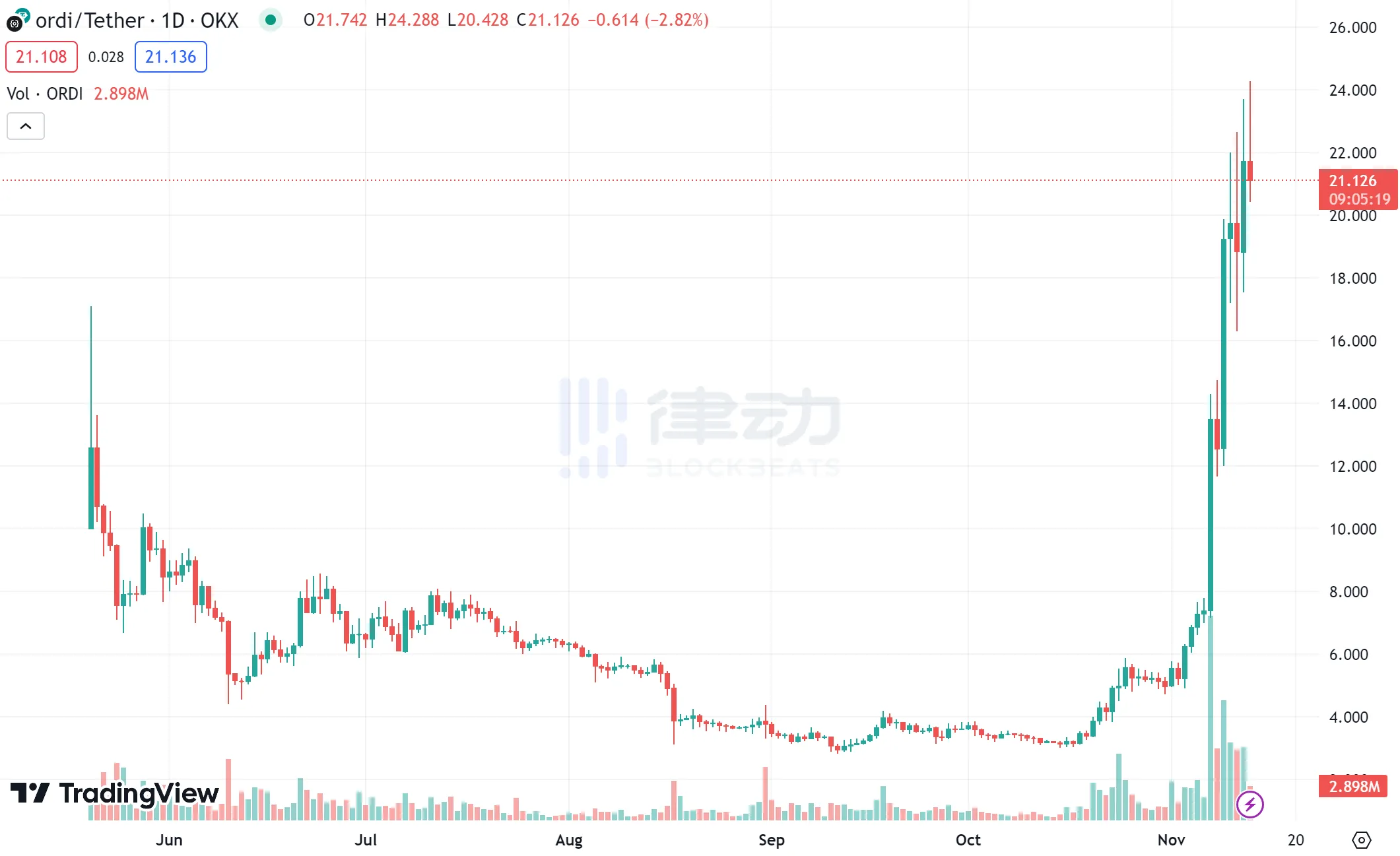
Over the past week, the Bitcoin ecosystem has continued to be hot. Binance has finally launched the BRC-20 leading token $ORDI. As a result, $ORDI's increase this month has exceeded 300%, and it is very close to breaking through its historical high.
Outside of $ORDI, players are still searching for the next "wealth code" with great enthusiasm, and the RGB protocol is receiving increasing attention.
Binance has launched $ORDI, token introduction sparks controversy
On November 7th, Binance announced the listing of the BRC-20 leading token $ORDI, which caused an instant price surge. Since its listing on Binance, $ORDI has experienced a maximum increase of over 200%, with a cumulative increase of over 300% this month.
After Binance listed $ORDI, there was controversy surrounding the information provided about $ORDI. In Binance's introduction to $ORDI, the official website link directed to the Ordinals protocol's official browser, the white paper link directed to the Ordinals protocol's official white paper, and the token's full name was labeled as "Ordinals," which caused controversy. On November 8th, Casey Rodarmor, the founder of the Ordinals protocol, tweeted that $ORDI is not affiliated with the Ordinals protocol, The Open Ordinals Institute, or The Ordicord, and that $ORDI's full name is "ORDI," not "Ordinals." He hopes that Binance can correct the issue as soon as possible.
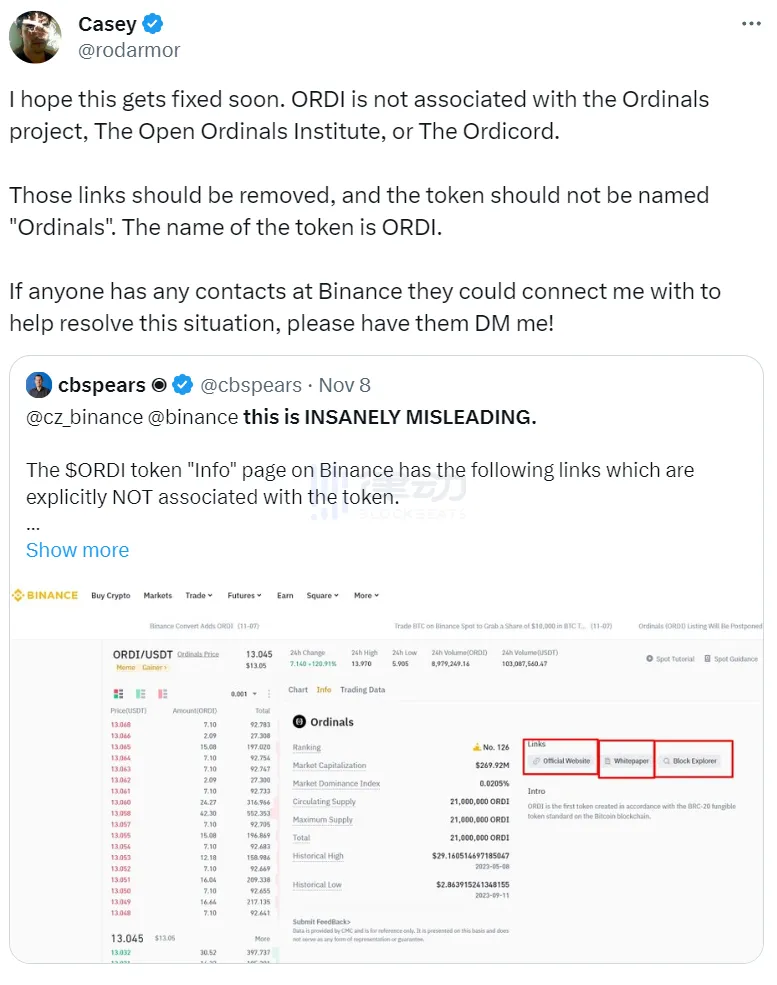
Of course, The Ordicord is a problem for CoinMarketCap. This may be because CoinMarketCap is owned by Binance, and Casey directly called out Binance.
Some players have such a big reaction to Casey that they can't understand it. In fact, Casey himself has been somewhat dissatisfied with the BRC-20 FT protocol parasitic on the Ordinals protocol, and he has even proposed and is developing a new FT protocol, Runestone. (Related reading: "New Bitcoin FT Protocol Appears, Ordinals Founder Can't Stand BRC Anymore"). From his perspective, it is necessary to clarify the relationship between the Ordinals protocol and the BRC-20 protocol, whether for personal emotional reasons or for preventive avoidance of possible problems.
Binance quickly corrected the introduction information of $ORDI afterwards.
BRC-20 Index Specification "Freeze" Proposal Has Taken Effect
A Bitcoin block with a height of 816000 was produced on November 9th, indicating the official implementation of the BRC-20 index specification "freeze" proposal.
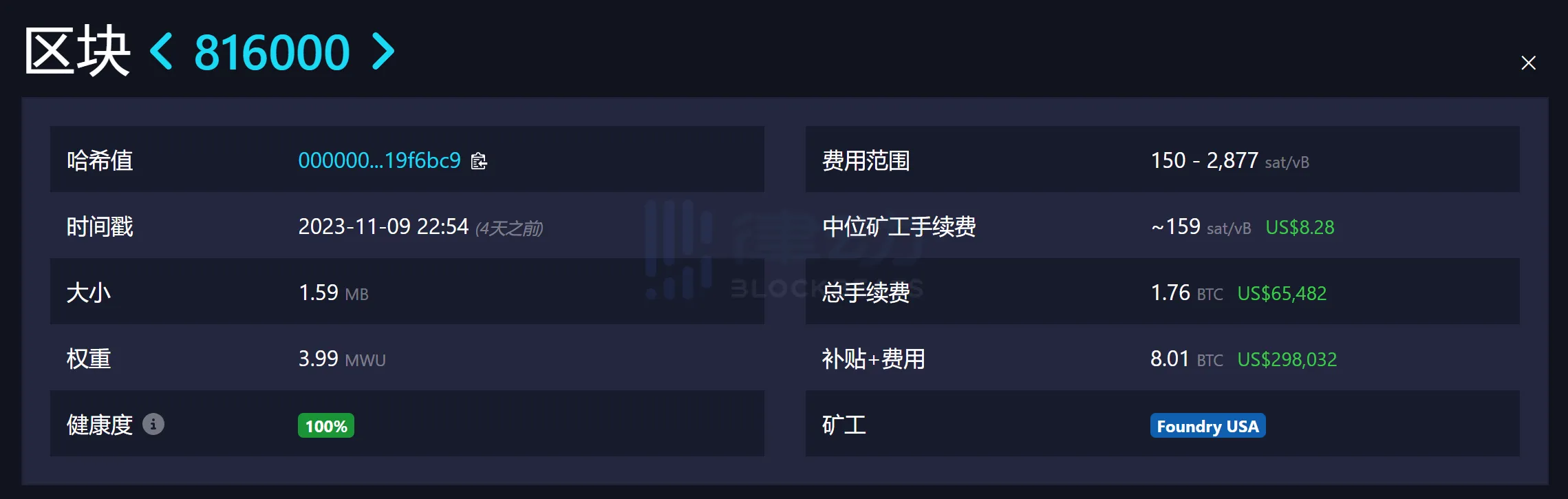
The "Freeze" proposal for the BRC-20 index specification was proposed by domo, the founder of the BRC-20 protocol, on October 26th and announced on November 2nd that the proposal will officially take effect in the Bitcoin block with a height of 816,000. Domo named the proposal "Freeze" because the content of the proposal is that the BRC-20 protocol has decided to standardize (maintain) the index of BRC-20 at v 0.9.0 to maintain the stability of the index.
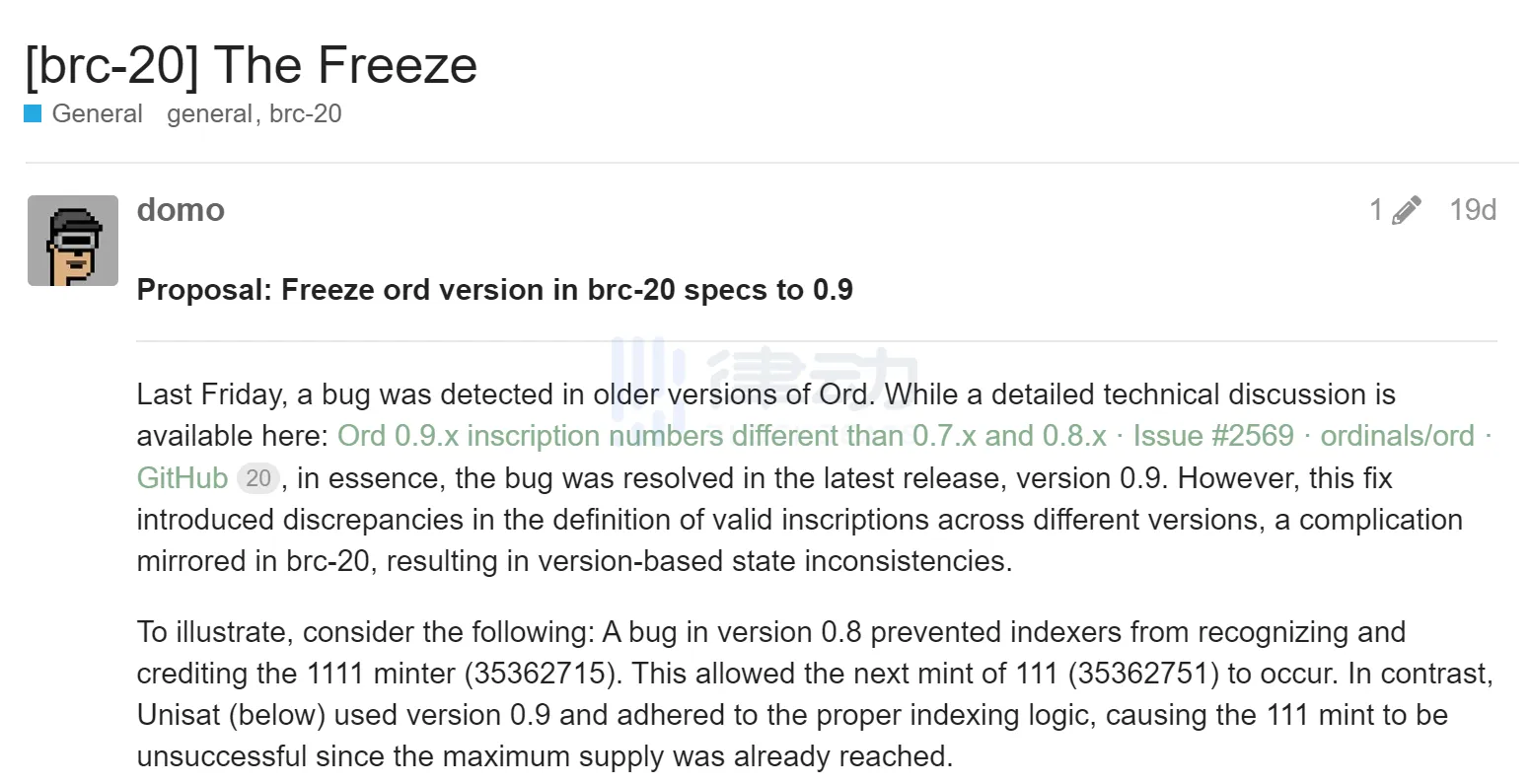
About 4 weeks ago, someone discovered that #35321413 and #35329860 can be indexed by v 0.9.0 but not by v 0.7.0 and v 0.8.0. Due to different markets adopting different versions of the Ordinals protocol, some inscriptions cannot be correctly indexed in some markets, resulting in a factual offset of inscription numbers.
For BRC-20, the problem is even bigger. The bug in v 0.8.0 will make double spending between the difference in maximum supply and different market Ordinals protocol versions a huge risk.
Interestingly, at first everyone thought that the error in version 0.9.0 caused the glyph numbering to shift again, but it was soon discovered that the numbering obtained from version 0.9.0 remained consistent with the indexing situation of version 0.5.0 and earlier. In the end, it was agreed that this was an error in versions 0.6.0 to 0.8.0.
This is why trading of BRC-20 was suspended by Magic Eden before - Magic Eden did nothing wrong, but the version it adopted happened to have a serious issue. Suspending the trading in a timely manner was a responsible action for the users.
Some players understand this proposal as BRC-20 being separated from the Ordinals protocol, but this understanding is inaccurate. Firstly, the BRC-20 protocol is entirely built on top of the Ordinals protocol and cannot operate independently of it. Secondly, if the Ordinals protocol iterates to a more stable new version in the future, the Ordinals protocol version defined by the BRC-20 index should also change accordingly.
BRC-20 Pure Digital Series is on fire, confronting the "Intelligence" of "Behavioral Art"?
On November 10th, someone proposed a game, but it is unclear who was the first to suggest it...
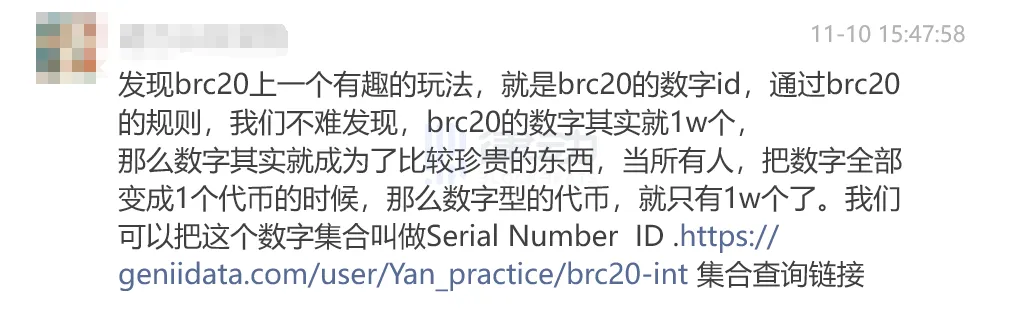
Actually, this "lucky number" gameplay has already existed in the Ordinals protocol, which directly inscribes pure digital text as an identity symbol. Pure digital text inscriptions ranging from 1 to 5 digits will be included in the Bitcoin Digits NFT collection.
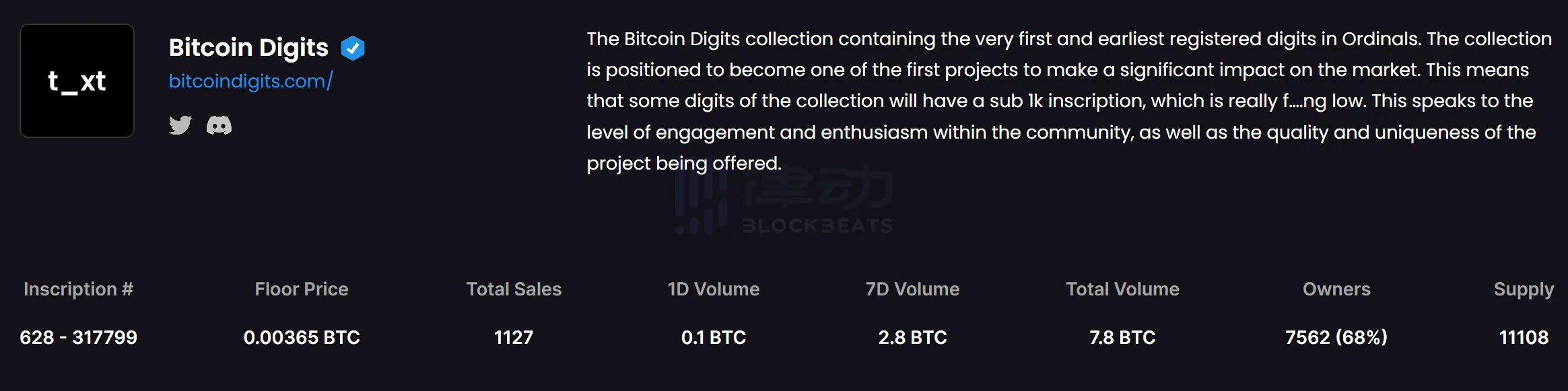
If we expand "identity symbol" to "domain name", there are more related projects. For example, .sats domain name, UniSat's .unisat domain name, BTCDOMAIN's .btc domain name (there was also a Layer2 .btc domain name on Stacks before, not the same company), and the community's .x domain name for the Water Margin 108. In the case of Bitcoin Digits and many other "identity symbol" projects already existing, the FOMO caused by the BRC-20 pure digital series can also indicate that many new players have entered the Bitcoin ecosystem this time.
Interestingly, this spontaneous wave of players participating in IPOs was eventually given a layer of "performance art" narrative...
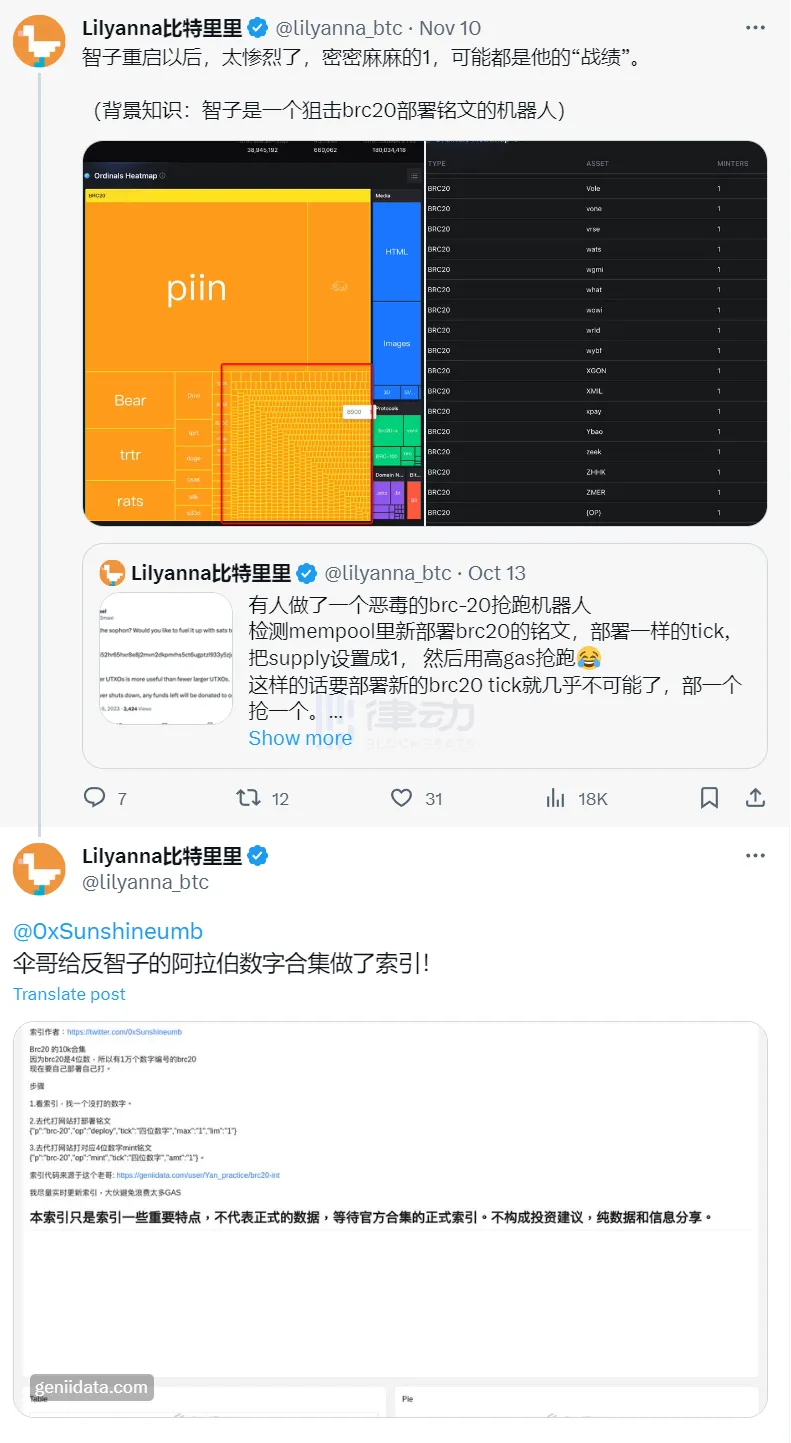
The so-called "Zhizi" is actually a robot named "Sophon" developed by @rot13maxi to "eliminate" BRC-20. "Zhizi" started running on October 3. After running, the number of new text-type inscriptions dropped sharply by 72% compared to the previous day. On October 23, the day after "Zhizi" ran out of funds, the number of new text-type inscriptions increased by 540% compared to the previous day.
Players who participate in the BRC-20 protocol and seek to profit from it generally prefer to "buy new, not old". Based on this characteristic, "Zhi Zi" continuously detects new deployments of BRC-20 tokens and pays higher transaction fees to miners to disrupt the deployment of new BRC-20 tokens. "Zhi Zi's" "race to deploy" will set the total supply of new tokens to 1. Since BRC-20 does not support token renaming, "Zhi Zi" has effectively permanently destroyed these potential new BRC-20 tokens.
During the first run of "Zhi Zi", it spent 0.013 bitcoins (about $500) to destroy the birth of 275 new BRC-20 tokens. The success rate of "Zhi Zi" was 75%. @rot13maxi claimed that the purpose of creating "Zhi Zi" was to demonstrate the design flaws of BRC-20 - anyone can see the deployment transaction from the mempool and maliciously "front-run" it, putting BRC-20 in a "blocked" state.
Chinese people's enthusiasm for the BRC-20 pure digital series has left foreigners confused... @mononautical observed that someone had restarted "Zhi Zi" (not @rot13maxi himself) and also observed that thousands of new pure digital BRC-20 tokens had been deployed with a total supply set to 1. He once thought this was a counterattack to deplete the operating funds of "Zhi Zi", until he finally realized that it was Chinese people FOMOing...
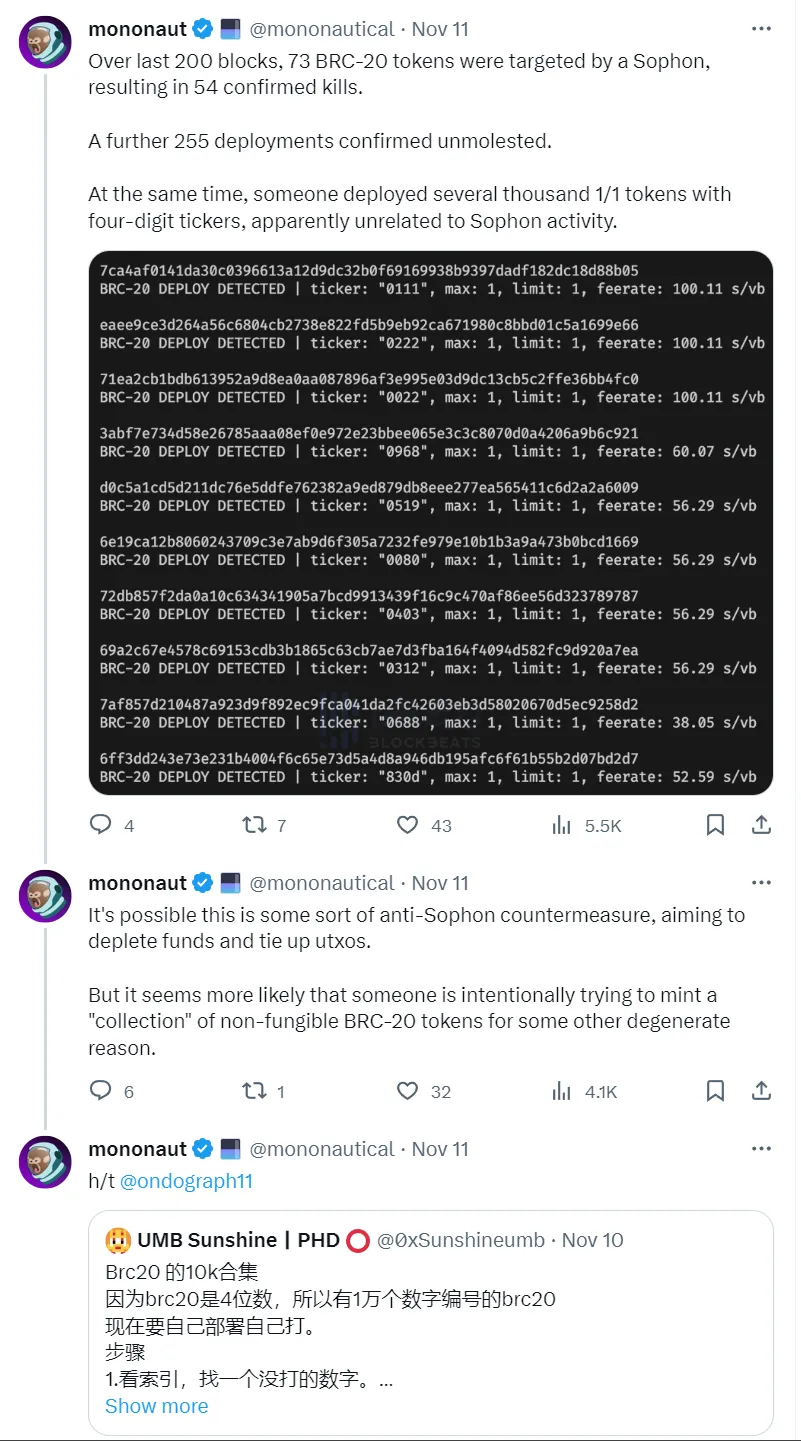
Actually, Chinese people didn't react at first...

Welcome to join the official BlockBeats community:
Telegram Subscription Group: https://t.me/theblockbeats
Telegram Discussion Group: https://t.me/BlockBeats_App
Official Twitter Account: https://twitter.com/BlockBeatsAsia

 Related Articles