Analysis of multi-address deposit function for top CEXs Binance, OKX, and Bitget, a must-have for scientists to prevent airdrop fraud.
Original author: Luo Jia Microscopic
Celestia (TIA) airdrop was officially distributed on October 31st. Many on-chain users received TIA token airdrops, and some users received airdrops in multiple wallet addresses. How can you consolidate TIA tokens from multiple addresses without being flagged as a witch account? Can multiple address deposits effectively avoid the project's anti-witch judgment? Which trading platform has a better multi-address deposit function? This article will provide a detailed explanation of the advantages and usage of multi-address deposits, teaching you how to correctly claim airdrops.
1. Current inconveniences of airdrops
The so-called witch account refers to a person controlling multiple on-chain addresses and disguising themselves as different users to interact. For the project party, the witch's behavior actually undermines the process of project decentralization. Therefore, during the airdrop distribution process, the project party may actively screen witches or cancel their airdrop qualifications based on community reports.
And in order to obtain more airdrop qualifications, a user usually frequently sends/collects assets to multiple addresses using one address, and such on-chain behavior can easily be judged as a witch account, resulting in the loss of the eligibility for receiving airdrops.
2. Advantages of Multi-Address Recharge
And to guard against the project party's witch judgment, the most important thing is to do a good job of address isolation. Simply put, do not distribute/collect funds on the chain, but generate multiple different addresses through the trading platform for collection to avoid this problem.
Therefore, multi-address recharge has emerged. Its biggest advantage is that it can generate different addresses to distribute/collect funds, avoiding being judged as a witch account by the project party. In addition, multi-address recharge also has higher security and privacy. Each account (including sub-accounts) can add multiple independent recharge addresses. Multiple addresses are provided for users to choose from each time they recharge, making it difficult to trace user transactions and thus improving privacy protection.
3. Comparison of multi-address deposit function among various trading platforms
Currently, multiple mainstream centralized trading platforms have launched multi-address deposit functions, including Binance, Bitget, and OKX. The following is a comparison of the multi-address deposit functions of each trading platform.
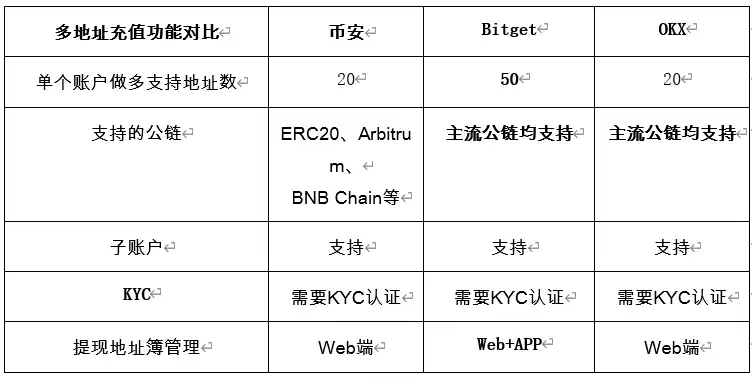
The multi-address recharge function of these three trading platforms is similar. Comparatively, Bitget supports more addresses per account, with a single account being able to generate 50 separate addresses, making it more convenient to use without the need to switch between multiple sub-accounts. In terms of the number of supported public chains, Bitget and OKX also support more, providing users with a wider range of options. Therefore, if you have higher requirements for the number of addresses and supported public chains, it is recommended to choose Bitget and OKX.
In addition, it is important to be anti-witch in the cryptocurrency industry by avoiding selecting the same amount for transfers and withdrawals. Instead, random amounts and times should be used. It is also important to avoid multiple accounts performing the same path of on-chain interactions at the same time, such as multiple accounts interacting with the same few DeFi protocols in the same order within a day. By following these guidelines, one can effectively avoid being labeled as a witch and greatly increase the chances of receiving airdrops.
This article is from a submission and does not represent the views of BlockBeats.
Welcome to join the official BlockBeats community:
Telegram Subscription Group: https://t.me/theblockbeats
Telegram Discussion Group: https://t.me/BlockBeats_App
Official Twitter Account: https://twitter.com/BlockBeatsAsia

 Related Articles