In-depth explanation of Cosmos LSM: Redefining ATOM staking and liquidity strategies.
Original Title: "Analyzing Cosmos LSM: Redefining ATOM Staking and Liquidity Strategies"
Source: PANews
Recently, Cosmos Hub completed the "Gais v12" upgrade, introducing the "Liquidity Staking Module" (LSM). Similar to other PoS-based blockchains, there are already multiple projects in the Cosmos ecosystem that offer liquidity staking services, including Stride, pSTAKE, Quicksilver, Stafi, etc. What is LSM, why was it specifically introduced, what are its functions and limitations, and what impact does it have on the Cosmos ecosystem? This article from PANews will answer all of your questions.
LSM is what? Why do we need LSM? How to implement it?
LSM is an ATOM staking alternative in the Cosmos Hub. It allows users to convert staked ATOM into liquid staking derivatives (LSD) to promote the adoption of ATOM liquid staking in a more secure and efficient manner. In other words, it not only promotes the development of ATOM liquid staking, but also serves as a regulatory form, establishing a secure framework and controlling the adoption of liquid staking through governance.
Cosmos Hub needs to embrace liquidity staking, and Cosmos DeFi needs more high-quality funds. LSD, which can generate income, is a good source of funds. However, more funds participating in liquidity staking also bring risks. For example, if the amount of staking accumulated by liquidity staking service providers exceeds 1/3 of the total staking amount, it will bring governance risks to PoS chains. In order to prevent malicious behavior by validators, the interests of validators and stakers need to be aligned. To prevent a chain reaction of liquidation caused by a large amount of LST used as collateral, the adoption of LSD needs to be limited.
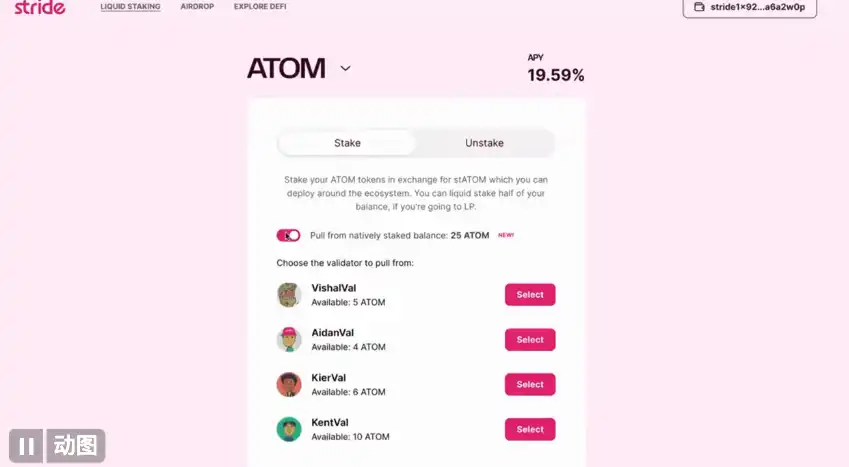
From the actual situation, it is very simple to convert the ATOM pledged on the Cosmos Hub to LSM. Currently, Stride has compiled a tutorial on how to convert already pledged ATOM to stATOM in 3 steps:
1. Select "Extract from Native Staking Balance" on the Stride staking page to use staked ATOM from your native staking balance.
2. Choose a validator and the amount of ATOM you want to stake for liquidity.
3. Sign and confirm the steps pledged by liquidity.
What are the functions and limitations of LSM?
1. Convert the pledged ATOM to LSD.
We know that after being directly bound (pledged) in Cosmos Hub, ATOM needs to wait for a 21-day unbonding period before it can be redeemed. According to CoinGecko data, as of September 15th, the market value of ATOM is 2 billion US dollars, ranking 30th; Stakingreward data shows that the staking rate of ATOM is 68.12%, and the staking yield is 20.42%. This indicates that many people and a large amount of funds are participating in the staking of ATOM, and the 21-day unbonding period is longer than most PoS public chains, which brings inconvenience to users.
LSM's main function is to convert ATOM that has already been staked in Cosmos Hub into various LSDs, such as Stride's stATOM. For users who want to exit in a timely manner, they can directly sell these LSDs in the DEX to avoid the 21-day unbonding period.
The Cosmos Hub has introduced this feature to promote the development of ATOM liquidity staking. LSD is one of the important sources of funds in DeFi. When PANews conducted a survey of various liquidity staking schemes in Cosmos in April this year, it was found that ATOM staked through liquidity staking accounted for only 1.15% of the total ATOM staked, which is less than 1% of the total ATOM staked. The adoption of promoting ATOM liquidity staking can provide more liquidity for Cosmos DeFi.
Related reading: "Cosmos Liquidity Staking Ecosystem Analysis: ATOM Liquidity Staking Accounts for Only 1.15% of Total Staking, Stride Currently Leading the Cosmos LSD Track."
2. Validators need to bind ATOM themselves in order to accept staking delegations.
LSM has introduced an additional security feature that requires validators to self-stake a certain amount of ATOM before accepting delegated staking of ATOM from liquidity staking service providers.
Here involves a parameter - ValidatorBondFactor, which means that a validator needs to stake 1 ATOM in order to be eligible to receive delegated ATOM for liquidity staking services from providers. Currently, this parameter is set to 250.
Through this parameter, validators can establish a certain degree of "interest-related" relationship with the Cosmos ecosystem, and the commission earned from liquidity staking service providers can cover the cost of the validator's own staking, so as not to cause excessive burden.
3. The ratio of liquidity pledged is limited to 25%.
According to current data, the proportion of ETH staked through liquidity in PoS public chains is about 23%. Due to Lido's market share in ETH staking exceeding 30%, there have been discussions about the centralization issue of Lido.
LSM limits the proportion of ATOM pledged through liquidity providers to 25% of the total amount of ATOM. When the LSM proposal was introduced in April, there were 223 million ATOM pledged, so the amount of ATOM pledged through liquidity will be limited to 55.69 million. There is still a significant gap between this number and the actual situation where the proportion of liquidity pledged is less than 1% of the total amount of ATOM we had calculated at that time, which means it will be difficult to reach the upper limit of 25% in the short term.
This restriction is in place to prevent liquidity providers from collectively controlling 1/3 of the ATOM staked, and to prevent collusion among nodes.
Possible adoption of liquidity collateral may have a greater impact on top projects
Due to the current insufficient liquidity-to-stake ratio of ATOM, which is far from the 25% limit, the update of LSM is more of a positive development for the Cosmos ecosystem.
LSM helps to increase the liquidity ratio of ATOM staking and the funds participating in DeFi in Cosmos. Since ATOM already staked in Cosmos Hub can also be converted to LSD, it may promote the adoption of LSD. In addition, with the introduction of LSM, it can be considered that these liquidity staking service providers are supervised to some extent by Cosmos Hub, which may make stakers more recognized of liquidity staking providers.
The benefits to the top providers of head liquidity collateralization services may be greater. This is true for both Ethereum and Cosmos, where the market share of the largest liquidity collateralization service providers far exceeds that of the second place. They have better network effects and their issued LSD has more application scenarios and liquidity, making them the optimal choice when the yield is similar. In the context of the Cosmos ecosystem, the largest project in the liquidity collateralization field is currently Stride, and the price of its native token STRD has also been affected and risen.
Original article link
Welcome to join the official BlockBeats community:
Telegram Subscription Group: https://t.me/theblockbeats
Telegram Discussion Group: https://t.me/BlockBeats_App
Official Twitter Account: https://twitter.com/BlockBeatsAsia

 Related Articles