Six noteworthy AI topics and why Bitcoin is the best currency for AI.
Original Title: "Six AI Themes to Consider"
Original Author: Lyn Alden
Original Translation: Luccy, BlockBeats
In the future, artificial intelligence (AI) and robotics technology will mainly be used to eliminate the tedious and boring work that most people are currently engaged in, allowing more and more people to pursue their passions in a similar way. Ideally, this will lead to the next great artistic and cultural renaissance, as millions of humans are free to do what they love and create happiness through art.
Before such a brilliant future arrives, we also need to constantly think and explore the intersection of AI and the financial world, identify the problems, even if we may not know all the answers. Macro investor Lyn Alden published an article "Six AI Themes to Consider" on her personal social media platform, which detailed the interactive development of AI technology and human society, and why Bitcoin will become the preferred currency of artificial intelligence. The following is a translation and summary of the original article by BlockBeats:
One major trend in the market in 2023 is artificial intelligence, or AI for short. As a practitioner in the encryption industry, I usually avoid getting involved in hot topics, so I haven't written much about AI in public. I prefer to spend time absorbing and thinking about new trends rather than immediately expressing popular opinions. I introduced this topic in the May and July advanced reports, and although I haven't written extensively, it's a topic I've been closely following. This article will reference these previous reports and recent materials to discuss some AI topics that I think are worth paying attention to but haven't been widely reported.
The range of opinions on AI is vast. Some people think "it's all hype, there's no substance," while others even believe that "within five years it will kill us all and rule the world." My view falls somewhere between these two extremes. I believe that AI has made significant breakthroughs, but any emerging technology is susceptible to hype cycles and can sometimes be overhyped. People who have used some of these emerging technologies can see their value, which did not exist a few years ago. As technology matures and becomes more widespread, it will naturally have a significant impact on the economy. However, it is difficult for us to describe any technology that brings exponential growth over a long timeline, and we can only identify the problems, even if we do not necessarily know all the answers to those problems. But there is nothing worse than not knowing what questions to ask or not knowing the potential boundaries or bottlenecks in complex topics. In other words, we must strive to draw a basic roadmap, even if there are many unknown areas. I am not good at programming (the last time I wrote code was probably around 2014), so my views on AI come more from the perspective of engineering hardware or economics, rather than discussing any specific software. I mainly want to identify some real problems to think about and start drawing some roadmaps to see where the potential bottlenecks or turning points may be.
Topic 1: Gradual Technological Transformation
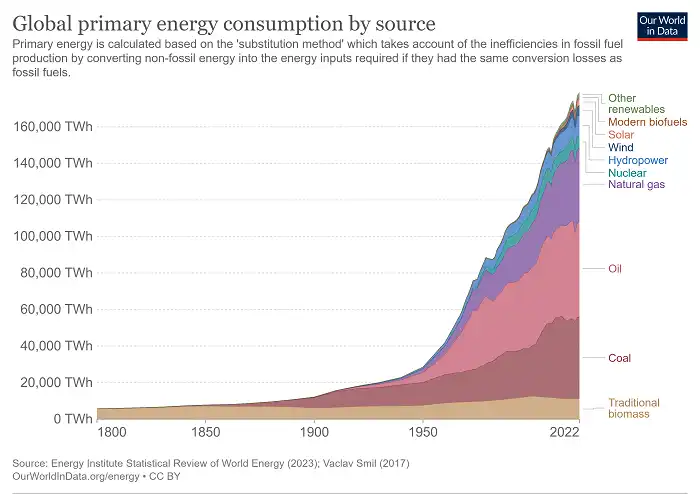
When it comes to technological development, we usually imagine a smooth exponential growth curve. In reality, technological development is mainly composed of a series of overlapping leapfrog changes. The emergence of a breakthrough in a certain technology triggers decades of technological prosperity, and then it reaches a ceiling and stagnates until the next breakthrough appears. This is why science fiction stories are usually set on a specific date, and when we actually reach that date, our world is not as advanced as the author expected (for example, the book "Do Androids Dream of Electric Sheep?" set in 1992 was written in 1968, and the movie "Blade Runner" set in 2019 was adapted from a book written in 1982). Therefore, without new breakthroughs, the technology within an industry often cannot meet our expectations (assuming technological development is a continuous growth model), but when there is a new breakthrough, the technology within an industry can easily exceed our expectations and change things faster. Generally, the discovery and application of more powerful energy can be considered a major leapfrog change. The invention of the steam engine and coal mining led the industrial revolution, followed by the invention of the internal combustion engine and oil production, which provided humans with enough dense energy to achieve high-speed travel, widely available tap water, and agricultural mechanization. All of these have freed most people from self-sufficient farming and allowed them to engage in other work, resulting in improved living conditions, industrial productivity, and human life expectancy. In other words, we have treated energy resources as part of technology. The following chart covers most of the energy sources:
In the early 20th century, the medical industry made a series of significant breakthroughs, such as the discovery of bacteria and the emergence of antibiotics, the invention of anesthesia, and the innovation of various surgical techniques, as well as the development of vaccines for diseases such as polio, which greatly increased the possibility of human longevity. However, over time, our ability to extend maximum lifespan seems to have stagnated, but we have indeed increased the proportion of people living to 70 or even longer. Perhaps one day, gene editing and various anti-aging technologies will bring about a huge change in extending human lifespan. For thousands of years, humans have longed to fly, but progress has been slow. In the 18th century, inventors invented hot air balloons, followed by hydrogen/helium airships, and then progress stalled. However, with the rise of oil and aluminum production (both of which began commercial-scale production in the 19th century), humans finally created the airplane, a true flying machine, in the early 20th century. In the subsequent technological boom, just a few decades later, we had safe commercial intercontinental flights and manned space exploration. However, technological development subsequently encountered bottlenecks, and development slowed down. Humans were unable to sustain the burden of supersonic commercial flights (such as the discontinuation of the Concorde) or maintain the pace of previous manned space exploration.
Between 1968 and 1972, humans briefly surpassed low Earth orbit, but for over fifty years since 1972, no one has surpassed low Earth orbit again. Think about it, in the 1980s, civilians had the opportunity to ride supersonic planes, but today in the 2020s, people can no longer enjoy this privilege. The discovery and application of electricity, as well as the development of communication systems, have become another important driving force for innovation, making our living environment more automated and connecting the world closely together. This has had a huge impact on currency: telegraphy enabled transactions to spread at the speed of light worldwide, ultimately changing the type of currency we use globally. The invention of semiconductors further pushed this trend, allowing us to use supercomputers in our pockets to achieve remote end-to-end communication. These portable supercomputers have almost the entire surface as a controllable glass panel, bringing us into a globally connected digital realm. Imagine describing this technology to your great-grandparents, they would be amazed.

Since the mid-20th century, artificial intelligence has been with us. For more than 20 years, chess programs have been able to beat the best human players. Initially, a large supercomputer was needed to defeat top human masters, but with technological advances, ordinary desktop computers can now do this, and even smartphones can achieve it. The field of machine learning has been developing, and although it has achieved some commercial success, breakthrough progress has only recently emerged. Today, artificial intelligence seems to have spread to business-related fields, and conceptually, it can be compared to engineers combining hydrocarbons and aluminum to open up various new possibilities for flight. Specifically, computers and software have reached a critical point where we can apply artificial intelligence to various software tasks, enabling it to learn and adjust quickly, greatly affecting our way of working. This is a phase change, not a year-by-year development.
Topic 2: 10x Usability
Investors' instinctive reaction to artificial intelligence is to invest in what is needed to build AI, such as AI software and the chips they use. However, this field is already quite crowded, and another topic worth considering is: "Which products will increase usability by 10 times with the help of AI?" Taking Adobe (ADBE) as an example, Photoshop is a semi-advanced program. Although it is not as difficult to use as studying rockets, it still takes a considerable amount of time to become proficient. In a video I saw before, Adobe Photoshop demonstrated how to integrate generative AI so that users can easily make significant changes in a few seconds with basic text commands. The production of art, movies, software code, engineering design, and various complex things has become more efficient through AI programs that complete a large number of tedious and complex underlying details for creators. In addition to improving the productivity and capabilities of each Photoshop user (i.e., allowing them to complete more work in a unit of time), it also lowers the threshold for using Photoshop. Just as computers were difficult to operate in the past but became easier over time, various historically moderately difficult creator applications will also become easier.
Pessimistically speaking, this type of AI-assisted tool for creators could lead to a large number of creators losing their jobs, as each creator can now complete work that previously required multiple creators. However, this assumption is based on the fact that the amount of work to be completed has not changed significantly. Optimistically speaking, by expanding the popularity of AI-assisted tools, the overall use and demand for creator applications will greatly increase. In other words, more creators can complete more creative work, rather than the same amount of work being completed by fewer creators. Similar to the past few decades, where we have used 1000 or even 1 million times more storage space to make the cost of storing each megabyte of data exponentially decrease. Imagine being able to use any creator application (such as art, video, music, programming, 3D printing, engineering software, etc.) and intuitively create what you want through verbal or written commands, while abstracting most of the tedious details. This greatly reduces the entry barrier, allowing companies that create these creator applications to sell more products to users. Although more experienced users may not subscribe to such products, the number of people who can effectively use advanced creator software may increase significantly overall. I initially mentioned this point in my advanced report on May 28th, when Adobe's stock price had not yet skyrocketed, while Nvidia's (NVDA) stock price had already soared. Therefore, I believe that from a risk/reward perspective, Adobe is a more desirable investment in the trend of artificial intelligence. As of now, Adobe's stock price has also skyrocketed, far exceeding the Nasdaq 100 index, so I don't think it's a good entry point anymore, but I think the theme of greatly expanding creator usability is worth paying attention to, and I intend to join in when Adobe adjusts.

I believe that a long-term trend worth taking seriously is how artificial intelligence can help pharmaceutical and biotech companies. One of the most significant applications of AI is molecular simulation. In many ways, developing new drugs is a process of rapid guessing and iteration, and AI can complete this task faster and cheaper than humans in the laboratory. Therefore, in the coming years, AI will significantly reduce the cost of new drug development and make drugs enter the market faster. Whether through new drugs or gene manipulation, if there is a technology that can accelerate our ability to cure most cancers, it is artificial intelligence. Giving creators power, especially bioengineers, AI may also significantly reduce the cost of manufacturing deadly new viruses. So, I am not worried about AI dominating and taking over the world, but rather what will happen when the cost of making bioweapons by bad actors is reduced to 1/1000 of the current cost.
Topic 3: Inverted Problem
Aside from asking "what will benefit from artificial intelligence?", we also need to ask "what will be destroyed by artificial intelligence?". Through the process of elimination, we can identify a series of investments that, while they may not benefit greatly from artificial intelligence, will at least not be severely damaged by it. When purchased at a low valuation, they will continue to provide good risk returns during price adjustments. Artificial intelligence can destroy various outdated businesses and repetitive tasks, greatly simplifying administrative expenses within organizations, and their profit margins are the opportunity for artificial intelligence. However, in terms of affecting the material world, it may be slower than affecting the digital world before artificial intelligence helps us solve some basic physical problems and provides us with a world full of fusion reactors and nanomachines. Energy and material production and distribution are still a key constraint. For example, in the next decade, artificial intelligence has various abilities to change the way we interact with the digital world, but it is unlikely to have a significant impact on the energy and material markets unless it moderately improves efficiency at the edge (for example, software applications that find untapped resources, better and faster device design, and reducing administrative costs for energy/material companies).
In other words, the field of robotics is not easy, especially outside of highly controlled manufacturing facilities. Robots are complex, energy-consuming, material-consuming, and require intensive maintenance. For example, decades ago, people invented robotic vacuum cleaners, but due to various limitations, they still have not become popular. Other types of robots are 5 to 10 times more complex than this, so they have greater constraints in completely replacing humans. Specifically, we still have a long way to go before robots can reliably drive to my house to repair the heating and air conditioning system. Throughout history, people have overestimated the speed of hardware development (supersonic aircraft, flying cars, robot assistants) and underestimated the speed of software development. I suspect this trend will continue in the next decade. In the coming years, software and electronic products will continue to amaze us, but the physical world will remain remarkably similar to the present, with only subtle changes. Unless there are major physical breakthroughs that suggest otherwise, I will not change this expectation.
Topic 4: A world where nobody knows what happened
When humans write software programs, the relevant personnel can understand these programs, but this is not always the case in machine learning and iteration. The software may become so complex that no one really knows what is happening. Artificial intelligence can now write code, including creating new artificial intelligence. In other words, a benign feedback loop can be formed without human involvement. It is not difficult to imagine that this may become very strange in many years or decades. Now, there are always a large number of hackers trying to break into various software systems we rely on, and a small part of them have succeeded, causing many data leaks and other problems. Now, imagine a hacker team or government agency creating an artificial intelligence optimized for hacking. In other words, some artificial intelligence programs are optimized to beat humans in chess, while others can be better at cracking systems than humans. Early chess artificial intelligence learned from matches between human masters and could beat these masters every time. The latest chess artificial intelligence learns through self-play and then beats other artificial intelligence in chess. Now, suppose similar methods are used for hacking attacks. In fact, I would be surprised if many teams are not already researching this area. First, artificial intelligence learns how to hack from existing technology, and then iteratively updates at a speed beyond human, rewriting code to become better and better, and ultimately having an advantage over any human-designed system in hacking attacks. This may be open source and widely used. So what are the defense measures for this? For systems that are connected to the Internet and have a high level of complexity (so they cannot truly become "unbreakable" like offline or basic systems), the answer is more artificial intelligence. Similar to other chess programs, we may reach a point where we use artificial intelligence security software to defend against artificial intelligence hacking software in hacking attacks.
Imagine that superhuman hackers are constantly trying to break into everything, while superhuman defenders are constantly trying to prevent these attacks from happening. Attackers and defenders are constantly iterating and updating themselves because they learn from each other, but humans cannot truly understand what is happening because the code is much more complex than they can understand, and updates much faster than they can. In this situation, digital deities will constantly battle in cyberspace in ways we cannot understand, and the systems we rely on are the stakes of this battle.
Topic 5: Inflation and Deflation
For decades, people have combined outsourcing and automation in manufacturing to reduce the cost of goods. Prices for shoes, textiles, electronics, plastic products, and other goods have significantly decreased compared to most other commodities. Price inflation is mainly limited to services that cannot be easily automated and energy-intensive assets. For example, even with a significant increase in the money supply, today's television prices are cheaper than those of 20 years ago for the same size and resolution, and the rate of decline in television prices is even faster than the rate of currency depreciation. Similarly, according to Moore's Law, the number of transistors per square inch on a processor doubles every two years, and the cost of transistors will decrease over time unless the money supply grows at an annual rate of nearly 50%. In the next few years or even decades, artificial intelligence may bring significant price deflation in services, ultimately allowing one accountant to do the work of several accountants, one administrative assistant to do the work of several administrative assistants, one graphic designer to do the work of several graphic designers, one programmer to do the work of several programmers, and so on. It is difficult to predict the speed and scope of this impact, but it is clearly the trend. We should have more abundant resources and advantages in the future to efficiently produce and operate businesses. However, the problem is that the money supply may still be growing significantly, and the ratio of debt to gross domestic product (GDP) and debt to the money supply is still very high. Under the current global debt-based financial system structure, it is difficult to maintain the current levels of government, corporate, and household debt without more broad and basic currency. From 2000 to the end of 2022, we can see a significant divergence in asset and consumer goods prices. The price of gold has grown by an average of 8.3% per year, the broad money supply has grown by an average of 6.8% per year, hospital service prices have grown by an average of 5.3% per year, oil prices have grown by an average of 4.7% per year, median home prices have grown by an average of 4.7% per year, childcare prices have grown by an average of 4.2% per year, non-supervisory production workers' average hourly wage income has increased by an average of 3.2% per year, official consumer price inflation has averaged 2.6% per year, the average annual interest rate on bank accounts is less than 2%, clothing prices have not changed, and the prices of electronic products, plastic toys, and various software have all decreased. The following chart shows the official price growth of these goods since 2000:
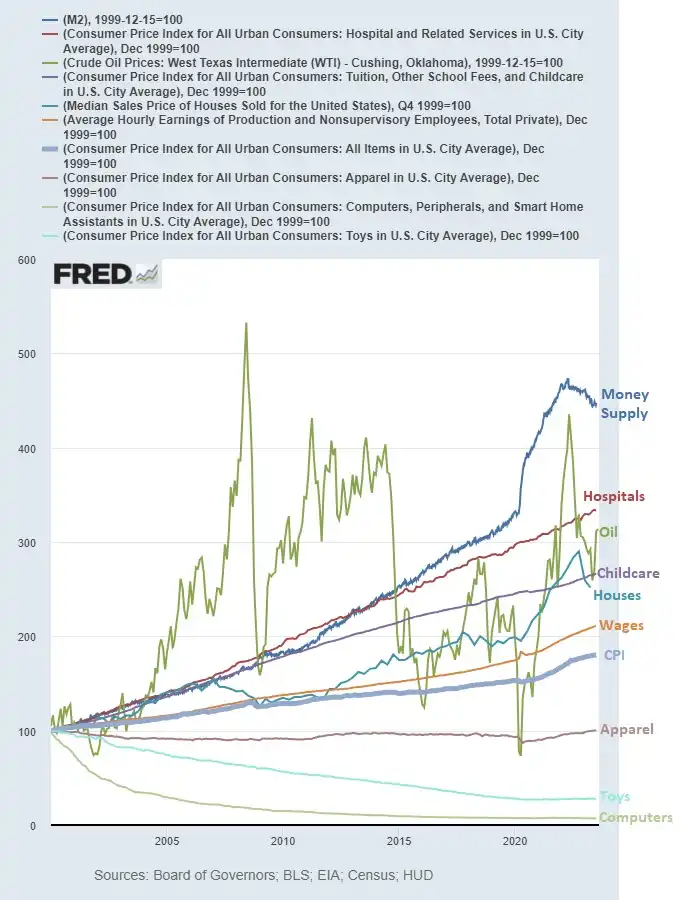
Scarcity items, such as exquisite artworks, gold, and beachfront properties (not shown in the chart), appreciate at a pace consistent with the growth of broad money supply and significantly outpace official consumer price inflation. Semi-scarcity items, such as hospital services, childcare services, oil, grass-fed beef, and ordinary housing, appreciate at a slightly lower rate than the pace of broad money creation but still higher than the average consumer price inflation rate. Official consumer price inflation data is dragged down by deflationary items aided by exponential technological help and near-zero production costs. Additionally, the consumer price index is essentially a recursive function. If the price of ribeye steak rises and consumers switch to cheaper ground beef, then the basket of goods used to calculate the consumer price index will be adjusted according to the new benchmark; if the price of ground beef is too high and consumers switch to cheaper poultry, then the basket will be adjusted again; if the price of poultry is too high and consumers switch to more rice and beans, then the basket will be adjusted again; if the price of butter from grass-fed cows is too high and people switch to industrial soybean oil, then the basket will be adjusted accordingly. Therefore, high-priced goods and services are often screened out of the basket, while low-priced goods and services are emphasized. Artificial intelligence may exacerbate this trend. AI can give us access to cheaper and more abundant services, but it does not substantially change the scarcity of certain goods and services, and we need to continue to view inflation as a spectrum that spans multiple categories. If someone wants to buy limited items, such as gold-standard real estate, exquisite artworks, Bitcoin, or leading technology monopoly stocks, then their income and net worth are best kept up with the growth of broad money supply. If someone wants to have an ordinary house, quality medical insurance, and sufficient retirement savings, while consuming nutritious food and abundant energy, then their income and net worth are best kept above official CPI, even if slightly lower than the growth of broad money supply. If someone only wants to get by, living in multi-family housing or with relatives, spending most of their time in the virtual world, consuming cheap mass-produced food and consumer goods, then the growth of their required income and net worth can be consistent with or lower than official CPI.
Topic 6: The Intersection of Artificial Intelligence and Bitcoin
I think it is necessary to spend more time on this topic, although it may not be the most important among the six major themes. However, due to my previous work and research in the Bitcoin ecosystem and its adjacent ecosystems, I have already invested a lot of time in studying this topic.
What is the best currency for AI?
What is the best currency for AI? Based on my current understanding, I believe Bitcoin is a top answer. In a future world filled with human-to-machine, machine-to-human, and machine-to-machine payments, open-source digital native currency has a natural adaptability. After discussing this topic with Elizabeth Stark, CEO of Lightning Labs, I elaborated on this viewpoint in my article on the Lightning Network in August 2022.
"In addition, the network is capable of conducting micro-payments smaller than Visa and Mastercard. Through the Lightning Network, payments as low as less than one cent can be completed. This provides possibilities for new use cases that credit cards cannot achieve, such as machine-to-machine payments, micro-payment flows, or using micro-payments as anti-spam technology." - Lyn Alden, "Exploring the Lightning Network", August 2022. In my advanced report on May 28th, I emphasized this example:
A AI agent can create a Bitcoin/cryptocurrency wallet, earn and use funds. The AI agent has obtained Bitcoin balance on the Lightning Network, and they can use these balances to obtain services required to complete specified tasks:
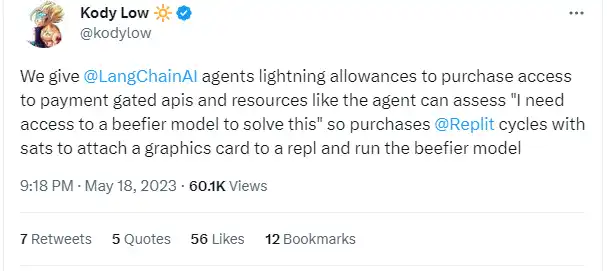
In this case, the creator intentionally provides some funds to the AI agent for use when needed, and an advanced AI agent can easily reproduce this process from scratch. In other words, an AI can start from scratch, be given a task or just "decide" to complete a task, and when evaluating the best way to complete the task, it finds that certain paid services are helpful or essential to it. So it generates a Bitcoin/Lightning wallet (unlike a bank account, it doesn't need permission to do so because it's open source) and convinces its creator to provide funds or earn funds online in other ways (perhaps it has posted a lot of useful content on Nostr and received tips). With money, it can pay for what it needs. Imagine an AI agent having money during the process of completing the task assigned to it, and even the creator doesn't know how it got the money. Efficient open-source native digital currencies can trade faster, without permission, and with smaller amounts (microtransactions) than existing fiat currencies, providing more possibilities for machine-to-machine payments, machine-to-human payments, and human-to-machine payments. This is a natural type of currency used by AI agents." - Advanced Report, May 28, 2023.
This trend eventually showed strong development momentum. At the end of June, Bitcoin companies Fedi and Stak teamed up to organize an AI hackathon, which lasted until July: "Fedi and Stak invite all developers, builders, and pioneers who believe that technology can empower people and communities: Join us and use Bitcoin, Lightning Network, and Fedimint to democratize artificial intelligence. With the support of Bitcoin and AI companies, the Ai4ALL hackathon will be held remotely on the BOLT.FUN and Replit platforms from July 1st to July 31st, 2023. Participants can compete for prizes, collaborate with peers, and improve their skills while enhancing humanity through a series of seminars, live coding courses, interactive tutorials, and coaching courses guided by key figures in both ecosystems. We are at a critical moment in the development of generative AI, which will determine whether it is controlled by central authorities, censors, and traditional institutions, or by free and empowered people and communities." - Fedi, June 30th. In early July, Lightning Labs (a major Lightning Network infrastructure provider) announced the launch of a new set of developer tools to support this emerging intersection of Bitcoin and AI.
LangChainBitcoin: A set of tools that enables Langchain agents to directly interact with Bitcoin and Lightning Network, including two main functions:
LLM Agent BitcoinTools: A series of tools that utilize newly released OpenAI GPT function calls, allowing developers to create agents that can hold Bitcoin balances (on-chain and Lightning Network), send/receive Bitcoin on the Lightning Network, and directly drive LND nodes.
L402 HTTP API Traversal: A Python wrapper for LangChain LLM chain (APIChain) that allows proxies to transparently access the L402 paid metering API. Aperture: The latest version of Aperture is an embedded reverse proxy server that implements the L402 protocol and can convert any API into a resource paid for through L402 functionality and sats on the Lightning Network.
Now supports lightning node connection: Aperture supports any lightning node running litd, which is a binary file that packages lightning laboratory services and is used with LND (such as Voltage, Umbrel, Start9, Raspiblitz, BTCPayServer). The lightning node connection protocol is an end-to-end encrypted mechanism for connecting lightning nodes to web browsers. Rich dynamic API endpoint pricing: Aperture now optionally provides the complete HTTP request context to the proxied backend to achieve dynamic pricing for each call. Compared to existing static pricing configurations, dynamic pricing allows backends to implement custom endpoint pricing logic. L402 bLIP: A Bitcoin Lightning Improvement Proposal (bLIP) specification for the L402 protocol standard, aimed at sharing the original models for building these components with the community. L402 is a protocol standard designed specifically for metered API payments, closely integrated with the existing HTTP 402 payment required status response code proposed by the web's creators to enable native payments. By combining Bitcoin and the Lightning Network, L402 enables fast, scalable micro-payment APIs worldwide. - Lightning Labs, July 6th.
Simply put, the tools of Lightning Labs have two functions:
1) Make building AI agents easier, which can hold and spend Bitcoin during the task completion process;
2) Using the Lightning Network and the long-existing "HTTP 402 Payment Required" status code makes it easier to pay for resource-intensive computing on a per-use basis. Olaoluwa Osuntokun, the Chief Technical Officer of Lightning Labs, mentioned in a video that a user (Kody Low, the developer and product support manager of Fedi) had GPT-4 write code for him and paid for it through the Lightning Network (about $0.01 per question). He asked the AI to write code that would allow him to use the Lightning Payment API to call his service. Specifically, Kody asked the AI, "How do I create a reverse proxy that blocks my API calls with Lightning payments? Use the LND backend and write the reverse proxy for me in Golang." Then he paid the Lightning invoice. The AI understood the request, received the payment, and replied with organized and annotated code. Next, Kody asked for the code to be rewritten in Rust instead of Golang and paid again. The AI rewrote the code, this time with detailed explanations of certain parts of the code and clarifications on the need for more error handling and other minor details in the fully implemented version, but this was the basic outline of the program. Kody thanked it and said that AI and Lightning worked well together, and paid again. The AI replied that it was no problem and agreed that AI and Lightning were powerful technologies that could create cutting-edge solutions. I have tested such a program and, when using ChatGPT on a mobile phone, there is no need to subscribe. You can simply press a button to pay one or two cents through Lightning to ask a question, and the price of each question will fluctuate dynamically based on some supply and demand algorithm running in the background.
For fun, I asked ChatGPT about some examples of AI agents that may need to pay humans during their task completion process in the cryptocurrency industry. Here is its response:
Great question! AI agents may need to pay fees to humans during the process of completing various tasks. Here are some possible scenarios:
1. Gig economy and microtasks: AI may be assigned to find certain individuals, such as labeling images or transcribing audio, which often occurs on gig platforms. After the task is completed, AI can pay the agreed-upon fee to the worker.
2. E-commerce transactions: If AI is managing an e-commerce platform or online marketplace, it may need to pay fees to sellers or service providers, which could be for product sales, refunds, or service fees.
3. Content creators and network operators: AI agents may manage platforms or channels where humans publish content or influence others. They can pay fees or rewards to these creators based on metrics such as views, likes, shares, or other indicators.
4. Crowdsourcing and creativity generation: Companies can use AI to manage innovation or creativity generation activities and encourage people to submit ideas. Once an idea is selected, AI can send payment or rewards to the person.
5. Customer Refunds: If AI is responsible for handling customer service for a company, it may need to pay refunds for returned products, canceled services, or any inconvenience caused by the company.
6. Participation in Surveys: AI may be responsible for conducting market research or other data collection surveys. Participants may receive compensation for their time and input.
7. Charitable donations: AI can be used to manage the payment from charitable organizations to beneficiaries.
8. Freelancer Payment: AI may be employed to manage freelancers or contract workers and pay fees upon completion of work.
9. Prize and Reward: If AI manages a competition or game, it may need to pay bonuses or rewards to the winners.
These are just a few examples of the many potential applications, with the commonality being that any service that requires payment or task that provides value could be managed by AI. For instance, an AI agent may need to pay another AI agent during the task completion process.
There are indeed many potential scenarios where AI agents may need to trade with another AI agent, which may occur in situations where the system is designed to autonomously interact and exchange resources or services, for example:
1. Autonomous driving cars: In the future of autonomous driving cars, the AI agent controlling a single car may need to pay tolls or parking fees to other AI-controlled cars for passage rights.
2. AI Market: In the AI market, one AI may need to pay a specific fee to another AI for services such as data analysis, machine learning model training, or optimizing complex tasks.
3. Content or data acquisition: An AI may need to pay for exclusive data or content from another AI, such as proprietary research, market analysis, or digital assets.
4. Cloud computing resources: An AI that manages servers or cloud resources may need to pay fees to another AI for using its surplus computing power or storage space.
5. Digital advertising: AI that manages advertising campaigns may need to pay another AI for the cost of placing its ads in the best location or time on digital platforms.
6. AI-mediated auctions: In a real-time bidding system for online advertising targeting specific audiences, an AI agent may need to pay for an advertising space to another.
7. Game: In an online gaming scenario, one AI may need to pay another AI for virtual goods, services, or game advancement fees.
8. Internet of Things (IoT): In smart homes or cities, an AI-managed IoT device may need to pay a fee to another device to prioritize its tasks. For example, a smart refrigerator can pay a fee to a smart oven to start preheating after the refrigerator completes a high-energy cooling cycle.
These examples are speculative and depend on a complex infrastructure that can support AI-to-AI transactions. However, as technology continues to evolve, we may see more systems designed to allow for this kind of autonomous interaction.
Now, the question that readers who are reading this article should be asking is, "Why use the Lightning Network to purchase AI usage rights instead of directly paying in US dollars?" The answer is that Bitcoin/Lightning Network is very suitable for combining with AI for the following reasons:
- No refund risk - Unlike many software applications, AI has very high hardware requirements for each use. When you use AI, you are using GPU hardware that consumes a lot of electricity. The software itself has a very low cost after development, but there is a considerable cost of electricity/hardware resources for each use of the software, which is different from most types of software. If an API allows payment in traditional ways (such as credit cards), merchants will face fraud risks. Users can overload GPUs with thousands of uses and then request refunds for their payments. In this case, the merchant bears the cost of electricity/hardware but loses the benefit. On the other hand, the Lightning Network is the ultimate solution for accepting assets.
- Microtransactions - Most payment methods have limits on the amount of a single transaction. For example, you cannot pay 0.03 US dollars with a Visa card, and PayPal's minimum fixed fee for each transaction on the merchant side is 0.49 US dollars. The best way is to prepay an account and pay small amounts according to the number of uses in their ledger. Globally, cross-border and currency issues are even more complex. If someone in Malaysia wants to pay some AI usage fees to someone in California, what payment method should they use? Even in the subscription payment backend on my website, my operations manager and I sometimes encounter issues with accepting foreign credit cards, and in many countries, they use mobile payment services instead of credit cards. The Lightning Network can handle microtransactions globally. Users can pay usage fees of a few cents from anywhere, without subscribing or prepaying. This is important for machine-to-machine payments, where subscriptions may not be the ideal choice, and they only need real-time interaction.
- No permission required and programmable - AI agents can perform various tasks. For an entity without legal status, using open-source programmable currency is easier than using a bank account or bank payment product. AI agents may not be able to obtain bank accounts, but they can run Lightning nodes or operate Lightning wallets. The programmability of the Lightning Network, as well as its instant nature, allows for dynamic pricing. In other words, the price of each API call can be programmed to be different per second based on the number of API requests received at the same time.
Proof of Work to Prevent Spam Emails
Nowadays, artificial intelligence makes it almost costless to create images, videos, texts, programs, and other things. It becomes increasingly difficult for us to distinguish what content is real and what is high-quality fake videos or fake characters. When we see an image or video that may have important implications for a company, society, politics, or geopolitics, how do we know it is a real scene and not a digitally generated forgery? Now imagine how this situation will be in five or ten years with the advancement of technology. Perhaps even more worrying is the persuasiveness of robots. Whenever I use Twitter (now called "X"), my posts are always flooded with bots. Fortunately, they are poorly programmed and of low quality. However, there are also imitators who manually create a high-quality fake account of mine and try to deceive others through fraud. What if the AI robots on social media become very convincing? What if they can be created at an uncountable speed, just like when they are recognized and blocked? In addition to using robots as a means of fraud and harassing people, a complex robot strategy may construct a completely false community to promote a certain viewpoint, making it look very popular. A large number of different artificial roles may operate online and persuade many people. If someone writes a program that creates an army of robots, each of which is unique and more advanced than the current ChatGPT by several years, and they work together to promote a political candidate, a social viewpoint, or just to increase the audience awareness of an influencer, and this program is open source, anyone who wants to use it can do so, then the Pandora's box will be opened. Imagine when interacting online, 1) most seemingly human online entities are not human, and 2) it is difficult to determine which entities are truly human. This will be a very strange state.
One way to solve this problem is for social media platforms to perform identity verification during user registration, where new users need to provide sufficient evidence to prove that they are real people. Elon Musk's Twitter/X seems to be moving in this direction, as are some other platforms. While this can indeed solve certain platform problems, the obvious drawback of this method is that anonymity is an important component of security and authenticity in many cases. In many countries, certain types of speech are illegal, leaders cannot be openly criticized, certain topics are illegal, and so on. In fact, several founding fathers in the United States initially used pseudonyms to protect themselves when criticizing the British monarchy. Some leaders like to force social media identity verification, and the severity of the robot problem will provide them with a good excuse to implement these verifications, and they can easily force various platforms to provide them with data. Another approach is for social media to remain open and anonymous, but to use some form of persistent proof or payment check to prevent a large number of robots from flooding in. In the 1990s, cryptographer Adam Back invented a proof-of-work method called Hashcash to resist various types of spam or denial-of-service attacks, which was eventually used by Satoshi Nakamoto as a core part of the Bitcoin protocol, but has not been widely adopted in other parts of social media and the Internet. The Bitcoin ledger history is almost impossible to forge, and energy is required for each block on each blockchain to update the ledger, so the entire history of the ledger contains a lot of energy, making it difficult to forge. In addition to being a currency asset, the Bitcoin blockchain has now become a globally open immutable time capsule that can insert any data (including documents, images, books, songs, or other system timestamps) and prove that the inserted content has not been changed since that date, and there is no closed, opaque, or centralized server that can achieve this function. Can Bitcoin's proof of work be used to protect other types of systems from spam, just as Adam Back originally created Hashcash for this purpose? There has been some exploration in this area, and it may be getting closer to this goal in the coming years. Payment: Bitcoin is currently used by Stacker News as a way to incentivize publishing and control spam. Users must pay a small amount of Bitcoin to post information and can reward each other with small amounts of Bitcoin. The problem with traditional payment methods (such as Visa) is that they identify the user's identity, while Bitcoin as a payment proof does not need to know the identity, which is very suitable for preventing spam and can be adjusted in various ways. If Twitter (now renamed X) implements similar functionality, perhaps I can set it up to only allow micro-cost people related to their identity to comment on my posts to prevent spam. Identity with cost: People can create a public/private key pair (such as on Nostr), then further embed the public key into the Bitcoin blockchain, and generate actual resource costs through transaction fees to prove to people in various ways that this key does belong to them, and then use the private key that matches the public key to sign any digital content they create or authorize. This is also true for large news organizations with known integrity standards, where platforms can check which key pairs have been embedded or not, allowing people to distinguish between forgeries and real content (at least to the extent that it is created by individuals or organizations and has not been changed since it was published, rather than being objectively true), and making it impossible for a million impersonators to use similar key pairs embedded in the Bitcoin blockchain. Although we have not yet reached this stage, in a world with advanced artificial intelligence and almost no cost for impersonation or forgery, we may need to provide continuity proof (encrypted public/private key pairs) and proof of work (proof that actual resources have been spent to increase the weight of a given public/private key pair or online identity) before taking certain types of digital content seriously.
In the future world I described earlier, 1) most of the seemingly human entities in online operations are not actually human, and 2) it is difficult to determine which entities are actually human. We need to use various methods to distinguish different entities from the tangibility or cost-related aspects of the real world, in order to find effective information from the almost infinite ocean of noise. Identity verification and the cost of using real-world resources are the two main directions that platforms deal with this issue.
Original Link
Welcome to join the official BlockBeats community:
Telegram Subscription Group: https://t.me/theblockbeats
Telegram Discussion Group: https://t.me/BlockBeats_App
Official Twitter Account: https://twitter.com/BlockBeatsAsia

 Related Articles