Analysis of the decentralized computing power protocol Gensyn, which accelerates AI model training.

Source: TokenMore Coin Cute
Project Description
Gensyn is a blockchain-based decentralized deep learning computing protocol aimed at establishing an artificial intelligence (AGI) computing power market. It decomposes complex machine learning tasks into multiple sub-tasks and achieves highly parallel computing with the help of participants' computing resources. Through smart contract automation of task allocation, verification, and rewards, Gensyn eliminates centralized management and provides an efficient and autonomous solution for machine learning computing.
Official website: https://www.gensyn.ai/
Twitter: https://twitter.com/gensynai
Technical Background
With the rapid development of artificial intelligence technology, deep learning models are becoming increasingly complex and the demand for computing resources is also increasing sharply. However, the available computing resources are relatively scarce, posing a series of challenges in this context.
Firstly, in order to ensure the accuracy of the calculation, it is necessary to verify the effectiveness of deep learning computation. However, each layer in the deep learning model depends on the output of the previous layer, which makes verification complex. It is necessary to find a method to ensure that each step is executed correctly, especially as the model becomes more and more complex.
Secondly, there are some issues in building a computing market. How to balance supply and demand, match computing resources reasonably, and how to incentivize participants to contribute computing time are all difficult problems that need to be solved. The traditional market model may no longer be applicable in the computing field, and new ways need to be explored.
Privacy protection is also an important issue. With the strengthening of global privacy regulations, protecting the privacy of user data has become particularly important. When building and training models, balancing data privacy and model performance is a complex challenge.
In addition, highly parallel computing has become an inevitable trend to meet the computational demands. Modern deep learning models require parallel training on large-scale hardware clusters to cope with the expanding computational needs. The advancement of parallelization technology provides some hope for us to solve the problem of insufficient computing resources.
In summary, the field of deep learning computation faces various challenges, involving validation, market, privacy, and efficiency. Solving these challenges will help promote the continuous development of artificial intelligence technology.
Product Design
The Gensyn protocol is like an intelligent computing network designed specifically for handling deep learning tasks. It allows people who are willing to participate in tasks with their own computers to receive rewards, just like helping others complete tasks. This protocol does not require intermediaries or legal enforcement, but rather automatically assigns tasks and pays rewards through specific programs. However, ensuring that tasks in this network are actually completed is a complex problem. Since each task depends on the results of the previous task, verifying the completion of tasks is not simple. By combining three key concepts into a more efficient solution, this problem is solved, making task verification more reliable.
• Probabilistic learning proof: By using the metadata of the gradient optimization process, a certificate of completed work is constructed, which can be quickly verified by re-running certain stages.
• Graph-based positioning protocol: using a multi-granularity, graph-based positioning protocol and cross-validation consistency execution, so that the verification work can be re-run and compared to ensure consistency, and ultimately confirmed by the blockchain itself.
• Truebit-style incentive game: Construct an incentive game through pledging and reduction mechanisms to ensure that every economically rational participant honestly performs tasks.
Participants
In the Gensyn system, there are four main roles involved: submitter, resolver, validator, and reporter.
• Submitter: The ultimate user of the system who provides tasks to be computed and pays for completed work.
• Solver: The main worker of the system, responsible for executing model training and generating proofs that need to be verified by the verifier.
• Validator: They are crucial in connecting the uncertain training process with deterministic linear calculations. They replicate part of the solver's proof and compare it with the expected threshold.
• Reporter: As the final security safeguard, the reporter will review the work of the validator and raise questions when problems are found in order to receive a reward.
Application Method
Process: Submit task -> Analyze -> Train -> Proof generation -> Verify proof -> Graph-based precise positioning -> Cont -> Contract arbitration -> Settlement.
Cost and Performance

With Ethereum transitioning from Proof of Work to Proof of Stake, many miners will lose their mining income. This presents a huge opportunity for the Gensyn protocol, allowing these miners with machine learning capable hardware to earn returns on useful processor cycles, rather than just computing hashes in a Proof of Work system. By attracting these mining resources and other potential computing resources, the Gensyn protocol has cost advantages, such as 80% cheaper computing costs equivalent to NVIDIA V100 compared to AWS on-demand computing.
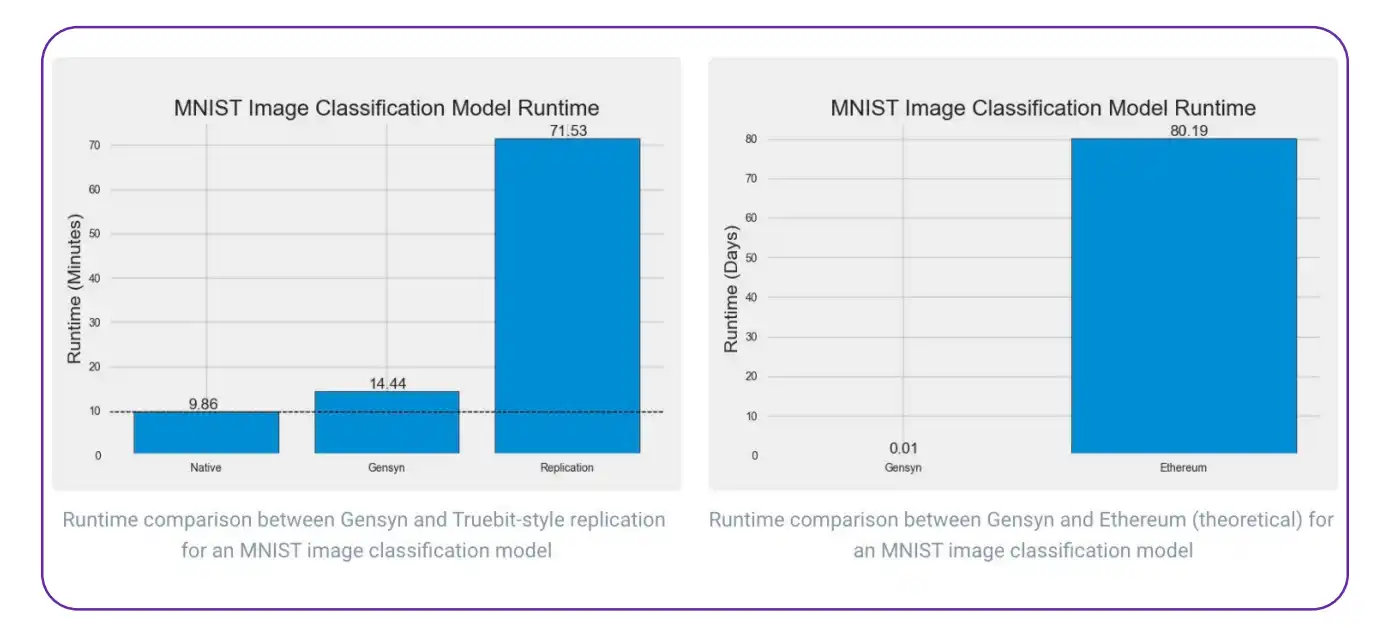
Through Python simulation, the performance of the Gensyn protocol was evaluated. A small MNIST image classification model was used as an example and tested on a 6-core Intel Core i7 processor. The protocol was compared with three other methods: running the model locally (without using any protocol), using a replication method similar to Truebit (with 7 validators), and running the model on Ethereum. Despite the lack of production-level optimization in the code, the results showed that the Gensyn protocol increased the time overhead of model training by about 46%, but compared to Truebit-style replication, the performance improved by 1,350%, and compared to running the model on Ethereum, the performance improved by as much as 2,522,477%. This indicates that the Gensyn protocol has significant advantages in model training.
Team/Partners/Funding
6 members on LinkedIn:
https://www.linkedin.com/search/results/people/?currentCompany=%5B%2254109371%22%5D&origin=COMPANY_PAGE_CANNED_SEARCH&sid=dD *
Partners
Funding
• In January 2021, a Pre-Seed round of financing was conducted, attracting investors such as 7percent Ventures, Entrepreneur First, Counterview Capital, and Id4 Ventures. The financing amount was $1.1 million.
• In March 2022, a seed round of financing was conducted, led by Eden Block, with participation from 11 investors including Galaxy Digital, Maven 11, Coinfund, Jsquare, Hypersphere, and Zee Prime. The financing amount reached $6.5 million.
• On June 12, 2023, the A round financing was conducted, led by a16z, with investors such as CoinFund, Canonical Crypto, Protocol Labs, and Eden Block also participating in the investment. The financing amount reached 43 million US dollars. These funds will be used to accelerate the launch of the protocol, expand the team, and recruit more machine learning engineers.
Gensyn has received over 50 million US dollars in investment at different stages of financing.
Project Summary
Overall, Gensyn is a blockchain-based decentralized computing power protocol that aims to accelerate the training of AI models and reduce costs by distributing and rewarding machine learning tasks through smart contracts. However, the prospect of decentralized training of large models still faces challenges such as communication and privacy, which need to be re-evaluated for feasibility.
In the development of the AI field, although utilizing idle computing power to train large models has potential, small AI models are more convenient and efficient in terms of deployment and management. In many application scenarios, small AI models are still the more practical choice and their value should not be overlooked in the pursuit of the big model trend. Therefore, the development path of AI should consider diverse model scales and demands to achieve more widespread and flexible applications.
This article is from a submission and does not represent the views of BlockBeats.
Welcome to join the official BlockBeats community:
Telegram Subscription Group: https://t.me/theblockbeats
Telegram Discussion Group: https://t.me/BlockBeats_App
Official Twitter Account: https://twitter.com/BlockBeatsAsia