This week in review | Curve founder sells over 140 million CRV tokens to repay loans; Binance Launchpool simultaneously launches SEI and CYBER.
BlockBeats will compile industry news highlights for the week of 7.31-8.6 in this article, and recommend in-depth articles to help readers better understand the market and industry trends.
Binance launches new projects Sei (SEI) and CyberConnect (CYBER) on Launchpool simultaneously
On August 1st, according to an official announcement, Binance announced the launch of new projects Sei (SEI) and CyberConnect (CYBER) on Launchpool. Users can deposit BNB, TUSD, and FDUSD into the mining pool to receive SEI and CYBER rewards starting from 08:00 on August 2, 2023 (Beijing time). The mining period lasts for 30 days. Binance will open spot trading for Sei and CYBER on August 15, 2023 at 20:00 (GMT+8).
Sei releases token economic model, 48% to be allocated to ecological reserve fund
On August 1st, Sei officially released its token economic model. The total supply of SEI tokens is 10 billion, of which 48% will be allocated to the ecological reserve fund, 20% will be allocated to private investors, 20% will be allocated to the team, 9% will be allocated to the foundation, and 3% will be used as Binance Launchpool rewards.
CyberConnect has opened an airdrop query webpage
On August 4th, Web3 social graph protocol CyberConnect announced on social media that it has opened an airdrop query webpage, where users can check their eligibility and the amount of airdrop rewards through the official website. CyberConnect will distribute a total of 2.4 million CYBER tokens as airdrop rewards to community users in Season 1, accounting for 2.4% of the total token supply.
Curve suffers attack due to Vyper recursive lock failure, CRV price drops, founder faces liquidation risk with large mortgage
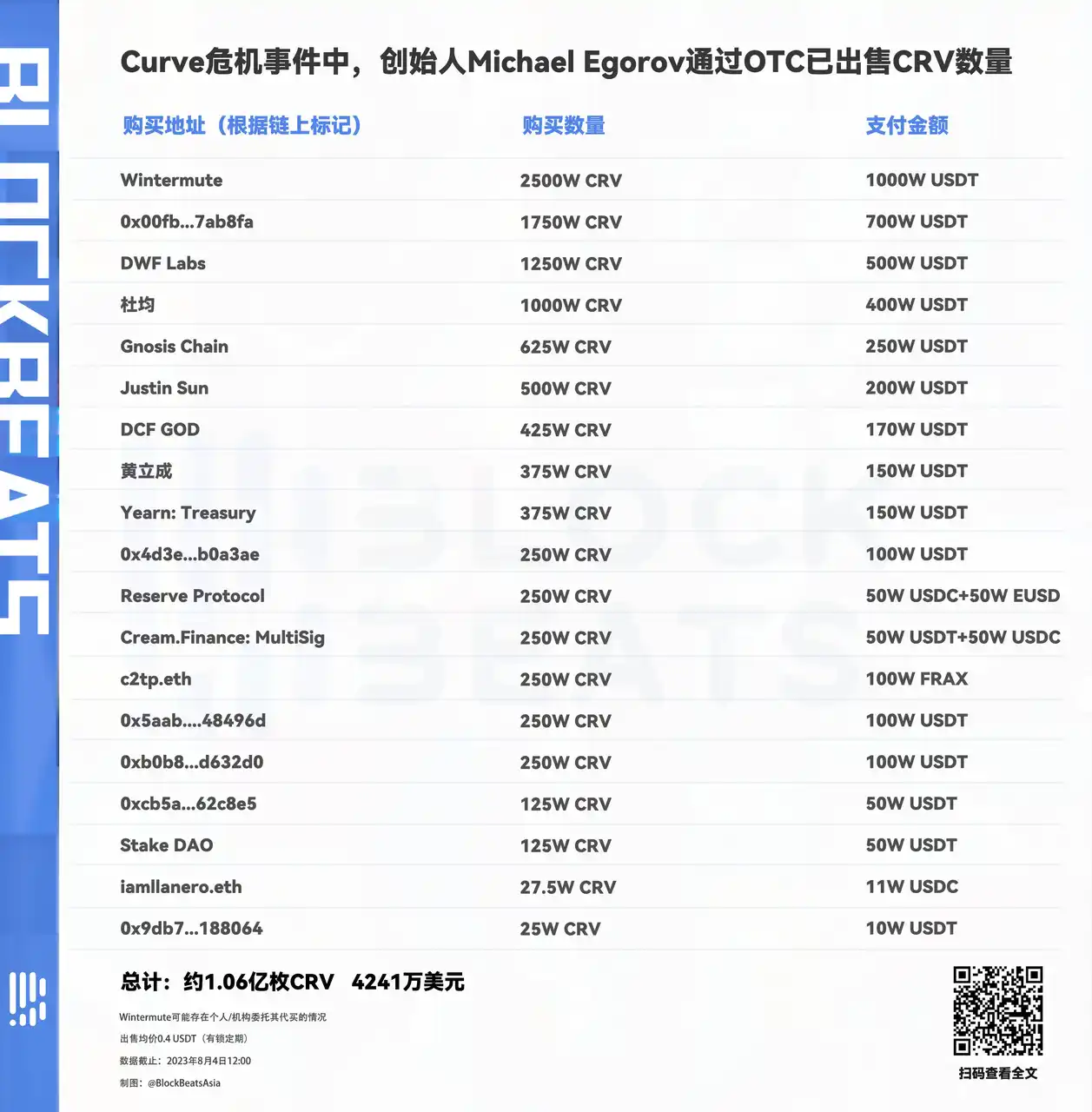
On the early morning of July 31st, Curve Finance suffered an attack on some stablecoin pools due to Vyper recursive lock failure. As a result of the attack, the price of CRV began to fall, leading to a decrease in the health rate of Michael Egorov's on-chain CRV mortgage loan. As the founder of Curve holds a large amount of CRV in on-chain mortgage loans, further price drops may lead to liquidation and a chain reaction. In the face of the crisis, Michael Egorov, the founder of Curve, sold CRV through OTC to repay the loan. Since August 1st, the Curve founder has sold a total of 114.025 million CRV to 24 investors/institutions through OTC, in exchange for $45.61 million in funds.
Related reading: "Timeline | Vyper compiler malfunction, Curve and other protocols attacked", "The vulnerability exploited by Curve may open up new ideas for hackers", "E-weekly observation | Curve issue is a symptom of DeFi's "yield disease"", "Approaching the liquidation line, the current status of Curve founder's $170 million position".
HashKey Exchange: Obtains Official Upgrade Approval for License No. 1 and No. 7, Becoming the First Licensed Trading Platform for Retail Users in Hong Kong
On August 3rd, HashKey Group announced on its official website that HashKey Exchange has obtained official approval for the upgrade of License No. 1 and No. 7, becoming the first licensed trading platform for retail users in Hong Kong. This license upgrade will further expand the business scope of HashKey Exchange from serving only professional investors to retail users, meeting market demand and providing more secure and convenient buying and storing services for retail users.
CZ: Binance internal address encountered "zero transfer phishing attack", discovered in time and no actual loss
On August 3rd, Binance founder CZ posted on social media that Binance's internal address was hit by a "zero transfer phishing attack" yesterday. The operator discovered the error immediately after completing the transaction (transferring 20 million USDT) and promptly requested the freezing of USDT. Now some procedures need to be followed, including submitting a police report, to recover the funds. Fortunately, there was no actual loss of funds. CZ hopes that sharing this incident can serve as a warning to users.
Web3 Mahjong game Mahjong Meta completes $12 million financing, jointly led by Dragonfly and Folius
On August 3rd, according to official sources, Web3 Mahjong game Mahjong Meta based on the Ethereum network announced the completion of a $12 million financing round, jointly led by Dragonfly Capital and Folius Ventures, with participation from Meteorite Labs, Find Satoshi Labs, Parallel Ventures, and Emoote. The funds from this round of financing will be used to promote the product development of Mahjong Meta and expand the Web3 gaming ecosystem, further enhancing the player's gaming experience and expanding its global influence.
Coinbase announced that it will publicly launch its Layer 2 blockchain Base on August 9th
On August 3rd, Coinbase, a US cryptocurrency trading platform, announced that its Layer 2 blockchain "Base", built on Optimism's OP Stack, will be open to the public on August 9th. Base was opened to developers in July for testing applications on the new network.
Lifeform has completed the snapshot and will distribute airdrops to early adopters
On July 31st, visual DID infrastructure provider Lifeform announced the completion of a snapshot at block heights 30342850 (BSC) and 17787821 (ETH). The LFT token airdrop will be distributed as a reward to early adopters of Lifeform.
Trading platform ZT Global suspected of running away
On July 31st, the trading platform ZT Global announced that it has completed maintenance and resumed deposit, withdrawal, and trading functions. However, its official website shows that there is no liquidity in the market and prices are fluctuating sharply. According to the official website, the trading platform has been unable to trade since announcing its fifth anniversary celebration on the 28th, and August 1st was the original announcement for the event.
Binance, Coinbase and 5 other cryptocurrency companies selected in CNBC's Global Fintech 200 list
On August 4th, CNBC released its Global Fintech 200 list, which includes the largest companies in the global financial industry, such as Ant Group, Tencent, Paypal, Stripe, Klarna, and Revolut. Five cryptocurrency companies were also included, namely Binance, BitMart, Coinbase, Dapper Labs, and OpenSea.
This Week's Popular Articles
Interview with 1inch: How to Innovate in the DEX Field Under the Shadow of Uniswap's Monopoly?During the ETHCC conference in Paris, BlockBeats conducted an exclusive interview with Anton Bukov, co-founder of 1inch, delving into the development history of 1inch, their views and thoughts on DeFi innovation, how to respond to Uniswap's attack, and the origin of the name 1inch.
Multiple DeFi protocols have been attacked. What is the "culprit" Vyper language?
On July 31st, Curve was affected by a re-entry lock failure in certain versions of Vyper, which led to a hacker attack on its stable pools such as alETH/msETH/pETH, causing a series of secondary disasters and shocks in the DeFi and crypto world. However, compared to the Solidity language that is often seen in the crypto world, Vyper is not so well-known. So what exactly is Vyper, what role does it play in the DeFi world, and why does its bug attract high attention in the industry?
Curve founder sold 72 million CRV through OTC to which institutions or individuals?
On the early morning of July 31st, Curve Finance suffered an attack on some of its stablecoin pools due to a Vyper recursive lock failure. As a result of the attack, the price of CRV began to decline, leading to a decrease in the health ratio of Michael Egorov's on-chain CRV collateralized borrowing and lending. Since the founder of Curve holds a large amount of CRV for on-chain collateralized borrowing and lending, further price drops may result in a forced liquidation. In the midst of the crisis, Curve founder Michael Egorov sold CRV through OTC to repay the debt. According to current sales records, the OTC price is 0.4 USDT/CRV, and according to KOL 0xSifu, the sold CRV all have lock-up requirements.
Curve's vulnerability exploitation may have opened up new ideas for hackers
With the occurrence of a vulnerability exploitation event, the DeFi industry has fallen into chaos. Curve Finance, a giant in the DeFi industry, has become a serious target of "attacks", and multiple stablecoin pools such as alETH/msETH/pETH are at risk. According to incomplete statistics, this vulnerability exploitation event has caused a cumulative loss of $52 million for Alchemix, JPEG'd, MetronomeDAO, deBridge, Ellipsis, and CRV/ETH pools, severely shaking the confidence of the entire market.
On July 31st, $BALD, the "meme dragon head" on Coinbase's Layer2 network Base, which rose and fell in a short period of time, seems to be a senior "player" who is well-versed in the play of Chinese crypto enthusiasts. This inevitably raises the question of who is behind $BALD. Cryptocurrency KOL @WSBChairman revealed on social media that SBF may be the mastermind behind BALD.
BALD 一夜千倍,Base 生态除了 Meme 还有什么值得关注? Translation:
On July 13th, Base, a Layer 2 network launched by Coinbase, opened its mainnet to developers. Some tools for developers are now available on the Base mainnet. Currently, although the mainnet has started running, it has not been officially released to users. Currently, there are basic ecological projects and assets appearing on Base.
Polygon's zero-knowledge proof team, Polygon Zero, publicly criticized zkSync, accusing them of copying Polygon's open-source code without permission and making misleading statements. This drama between the two top Layer 2 developers in the ZK field has attracted widespread attention in the industry. Polygon Zero accuses Matter Labs, the development team behind zkSync, of using a significant amount of code from the Plonky2 proof system, which was developed by Polygon Labs, in their recent Boojum library release.
实测|在 Base 上发行一个 meme,需要花多少钱? translates to:
Tested | How much does it cost to issue a meme on Base?
The Layer2 network Base launched by Coinbase has ignited the market with a meme myth of a thousand-fold increase, attracting countless attention. Mint Token spent $0.42 and set up a funding pool on LeetSwap for $11.35. The cost of creating a "Tu Gou" is only $14.03, plus a little effort to click the mouse with your finger.
As a DeFi OG, MakerDAO returned to the center of the crypto stage this year with the narrative of RWA. MakerDAO's core investor, Silicon Valley legendary venture capital firm a16z, continued to sell MKR, while MakerDAO founder Rune Christensen continued to buy MKR, leading to a long and short battle between the project founder and investors. Recently, a16z finally sold its last remaining balance in MakerDAO, and a16z, Paradigm, and Dragonfly finally sold off their tokens, unburdening MKR from VC.
Queen of Cryptography Katie Haun: How to Survive the Darkest Moments of Cryptocurrency?
Cryptocurrencies may experience cyclical fluctuations, but this trough is much steeper than investors expected, and the collapse of many leading projects in the cryptocurrency industry has exacerbated this volatility. For Haun, the Waterloo of cryptocurrencies has dealt a severe blow to her rapidly rising career and carefully cultivated reputation, from her position as a Supreme Court clerk to important positions in the Department of Justice and the top of the VC world.
The only opportunity for the cryptocurrency industry to participate in superconductor speculation
Is room-temperature superconductivity really true? If you have a unique perspective on this matter, you can try predicting the market on Polymarket. In this market, your scope will be infinitely expanded. You can learn the latest knowledge and understand the hottest events every day. And who knows, you might even make a small profit based on your cognition.
Overview | What technology stack did Lens use to build decentralized social networking?
Lens Protocol is a Web3 social graph protocol built on Polygon. As one of the important Web2 social media platforms, it adopts an open and decentralized underlying architecture, which has created a thriving ecosystem in a short period of time. In addition to the applications developed by the project team itself, there are also many third-party applications and several compatible decentralized social technology stacks. What other decentralized technology stacks are available? This article lists a series of technology stacks that can be used to build Web3 social applications.
Welcome to join the official community of BlockBeats by LUDONG
Telegram subscription group: https://t.me/theblockbeats
Telegram communication group: https://t.me/theblockbeatsApp
Twitter official account: https://twitter.com/BlockBeatsAsia
Welcome to join the official BlockBeats community:
Telegram Subscription Group: https://t.me/theblockbeats
Telegram Discussion Group: https://t.me/BlockBeats_App
Official Twitter Account: https://twitter.com/BlockBeatsAsia