EIP-7377: The Pioneer for Migrating from EOA to Smart Contract Wallet.
Source: TechFlow "Shenchao"
In the past few months, discussions about account abstraction and smart contract wallets have been very hot in the encryption industry.
With the rapid development of the Ethereum ecosystem, achieving a unified and seamless user experience has become increasingly important. In the Ethereum 2.0 roadmap, account abstraction and merging, as well as sharding, are placed in equally important positions.
Vitalik Buterin has also tweeted that smart contract wallets offer a better user experience compared to EOA wallets.
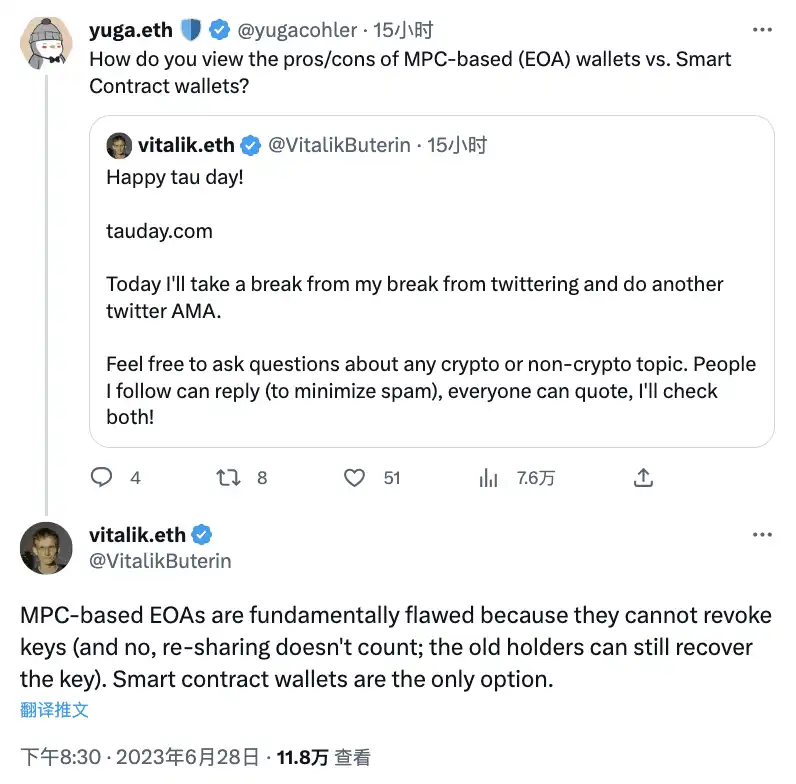
For experienced players in the encryption industry, using an EOA wallet is already proficient enough. However, from the perspective of attracting more new users, there are still certain problems with the user interface and understanding cost of EOA wallets: confusing signatures, where to get gas fees, and the hardcore logic of "action = transaction" that can be difficult to understand.
Therefore, the community gradually formed a consensus that a smooth transition from EOA accounts to smart contract wallets is needed, which has also become a kind of political correctness.
However, the information popular in the crypto industry usually only focuses on narrative rather than implementation:
Assuming we all know that smart contract wallets are better than EOA, the path forward is very clear. The question is, how do we get there? Where is the bridge?
The more difficult problem to solve is the real-world issue of path dependence: I already have various assets in my EOA account, and now you want me to migrate to a smart contract account. Is it troublesome or not?
How can we effectively achieve this transformation? And how can we simplify the operation of user asset migration?
This world originally had no roads, unless someone paved the way in advance.
Recently, the EIP-7377 proposal has provided a possible solution for this. The proposal was put forward by Matt Garnett, a Go Ethereum developer, and its purpose is to add a new transaction type that allows EOA accounts to permanently migrate to smart contract wallets through a one-time transaction. This provides a feasible path for advancing Ethereum account abstraction.
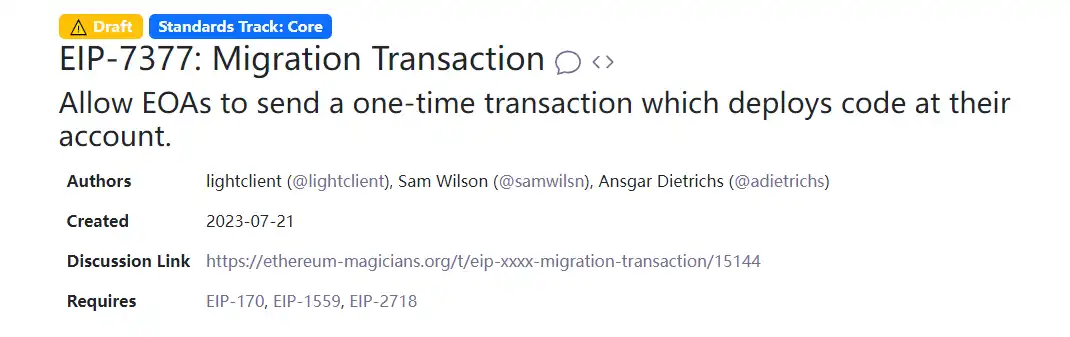
EIP-7377 Proposal Motivation
Since 2015, smart contract wallets have been considered an important way to solve the user experience problems of Ethereum. Compared to EOA accounts, smart contract wallets have stronger programmability and can achieve complex mechanism design, improving security and user-friendliness.
However, due to historical reasons, currently only a small number of users on Ethereum use smart contract wallets, and a large amount of assets are still stored in EOA accounts. This has become an obstacle to the development of Ethereum.
With the accumulation of assets, it is difficult for users to manually migrate all assets in EOA accounts to new smart contract addresses, both in terms of cost and operational processes.
Therefore, the motivation behind EIP-7377 is to provide a mechanism for migrating from EOA to smart contract wallets at the protocol level, in order to address this real-world need and achieve a smooth transition. This may greatly increase the willingness of existing users to migrate, as well as provide a more pragmatic EOA transition solution for new users entering the market before account abstraction becomes widely adopted.
EIP-7377 Technical Implementation Explained in Layman's Terms
So, how exactly is this proposal implemented for EOA to transfer to a smart contract wallet?
In the original post on the technical forum, the author provided a brief explanation:

The rough meaning of this summary is that EIP-7377 proposes a new transaction type 0x04, specifically for "migration transactions".
In the language of the original post:
It sets the code field of the account in the state tree to the pointer of the specified code in the code storage. Additionally, the migration transaction can directly set the storage value of the sending account. The storage field in the transaction will be written as key-value pairs in the sending account's storage tree. Furthermore, the code storage uses pointers instead of inline code. The advantage of this approach is the ability to reuse shared code, reduce redundancy, and optimize the size of the state tree.
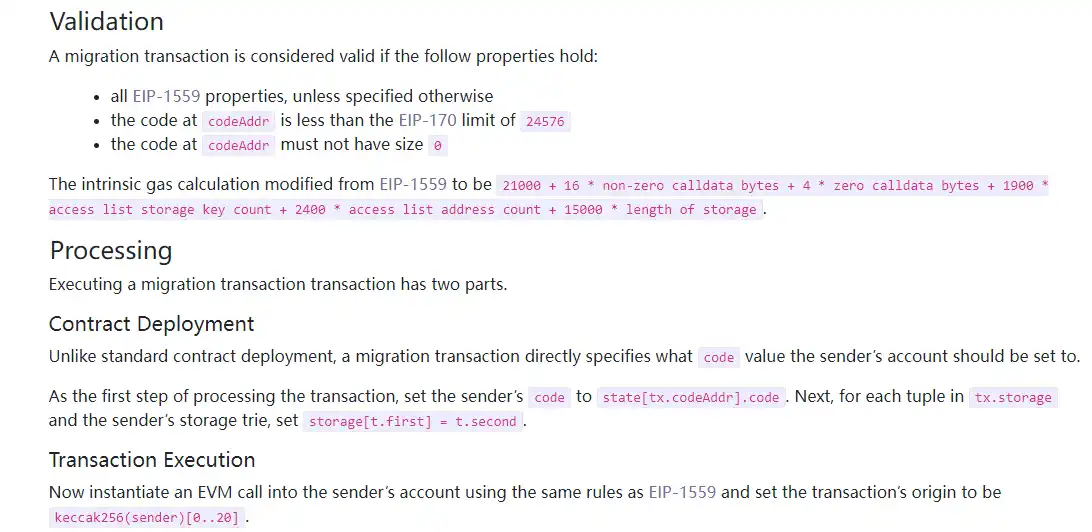
The original description above appears to be very obscure and difficult to understand, especially for those without a technical background. After consulting with some technical friends and public resources, we have attempted to simplify all technical details and explain EIP-7377 through metaphors for a quicker understanding.
EIP-7377 proposed a special type of transaction, which can be understood as a "migration card".
Ordinary users only need to initiate this migration card transaction to migrate assets from their account to the smart contract wallet.
This is equivalent to your account on the original website, which contains information such as username, password, and avatar (your original EOA contains information such as coin name, quantity, chain, and gas limit). However, the functionality of this website is not very good, and you want to completely migrate to another new website.
In order to facilitate migration, the new website has launched a "migration card". You only need to submit this "migration card" on the new website, and your account information will be automatically copied over, which is equivalent to directly docking the data of the old and new accounts. This is much more convenient than manually moving data one by one.
At the same time, for safety reasons, the "migration card" can only be used once and cannot be repeatedly used to transfer data back and forth. In addition, the new website will inherit some of the old website's verification rules, so other users cannot tell whether you are a new or old user.
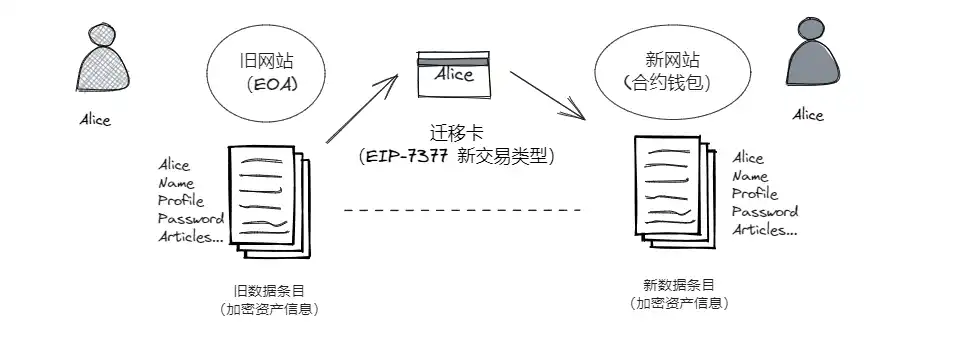
This is the effect that EIP-7377 aims to achieve technically. By using the special "migration transaction" card, the smooth migration from EOA to smart contract wallet can be completed in a secure and efficient way through direct manipulation of account code and storage.
Of course, the specific migration target is not the username, password, or avatar mentioned in the above analogies, but rather includes various information related to encrypted assets.
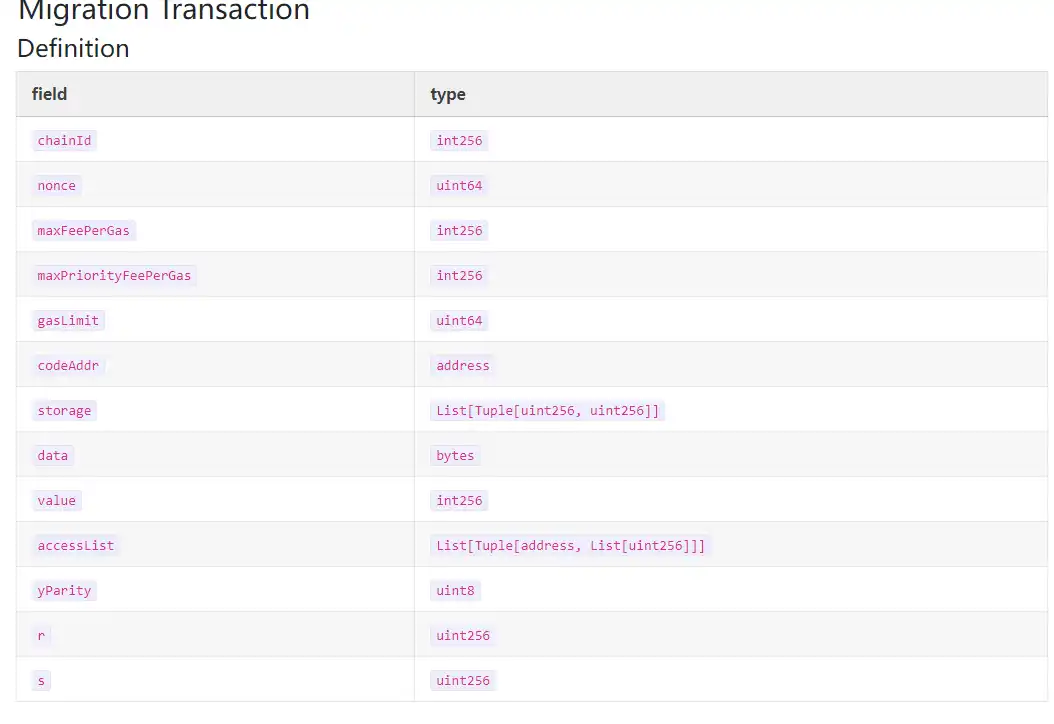
(Note: As a non-technical person, I am unable to fully understand all the content of this proposal. I also ask all technical experts to further correct and supplement it. Original post address: https://eips.ethereum.org/EIPS/eip-7377?ref=newsletter.ether.fm)
EIP-7377 proposes a migration plan for EOA to smart contract accounts, which is expected to have a positive impact on the Ethereum ecosystem in the long term. We believe it has the potential to become one of the key steps in promoting account abstraction implementation.
This smooth migration method supported at the protocol level can greatly reduce the difficulty and path dependence of users migrating to smart contract wallets. For crypto users, they are often not proficient in underlying technologies and are not actively engaged in technological innovation under the guidance of asset prioritization. If the underlying protocol already supports "one-click migration", coupled with appropriate incentive activities and user-friendly front-end interface adaptation, the willingness of users to migrate theoretically will greatly increase.
However, we should also be aware of the risk of this new feature being used for malicious attacks. Possible malicious methods include but are not limited to:
Phishing attack: creating a forged migration transaction, then deceiving users through phishing links to approve the transaction, in order to achieve the illegal transfer of assets.
Malware implantation: Hackers can gain control of accounts by implanting backdoors through code tampering during migration.
Repetitive migration theft: By exploiting the restriction that migration transactions can only be executed once, hackers can initiate repetitive migration transactions after a legitimate migration, falsely claiming failure and then prompting the user to approve, in order to steal assets.
In the world of encryption, the complete vision of a single protocol upgrade and innovation cannot be achieved overnight. In the environment of the dark forest, protocol upgrades also require corresponding measures such as audit upgrades, trusted source verification, and bounty programs to prevent these threats and ensure the security of migration transactions.
Finally, we also need to consider:
The transformation of infrastructure and protocols requires a powerful ecological driving force. Who will drive users to migrate on a large scale from EOA to smart contract accounts? Who will bear the technical risks and asset security during the migration process?
In the world of cryptography that values freedom and decentralization, how do such system upgrades form consensus and synergy?
The Ethereum ecosystem is vast, with many stakeholders. While this transition has positive implications, it may also face questioning and resistance from different groups. The planning and details of the transition need to be carefully designed to achieve community consensus and ensure that user interests are not harmed.
From ideal to reality, from conception to execution, the journey is still long.
"Original article link"
Welcome to join the official BlockBeats community:
Telegram Subscription Group: https://t.me/theblockbeats
Telegram Discussion Group: https://t.me/BlockBeats_App
Official Twitter Account: https://twitter.com/BlockBeatsAsia

 Related Articles