After the upgrade of Ethereum Shanghai, the amount of pledges has risen against the trend. Is LSDFi worthy of long-term attention?
Original title: "After the upgrade of Ethereum Shanghai, the amount of pledges has not decreased but increased, and the voice of LSDFi has risen."
Original source: vernacular blockchain
The completion of the Shanghai upgrade in April made the pledged ETH redeemable, thus making the LSD track complete. Ether The number of pending validators on the Fang Beacon Chain has reached 33,450, an all-time high, indicating a large number of users attempting to participate in staking. At the same time, ETH pledged deposits have exceeded withdrawals, the net pledge balance is about 435,000 ETH, and the pledge income has also hit a new high, reaching 8%.

In the past month after the upgrade in Shanghai, 70% of Ethereum pledged withdrawals came from Kraken, Coinbase, Binance and other CEXs, and among them Part of it flows into Lido, SSV and other LSD protocols.
Although, the Token price of LSD-related concepts has declined due to the weakening of benefits It has fallen back, but the LSD track is one of the main narratives of the 23-year or even next bull market. The pledge scale of Ethereum is 33.1 billion U.S. dollars, the total lock-up volume of the DeFi market is 90 billion U.S. dollars, and the pledge market size is 36.7% of the DeFi market. The LSD track deserves long-term attention.
LSDFi, as LSD With the gradual improvement of the LSD track and the expansion of the market scale, LSDFi will gradually enter everyone's field of vision.
Currently LSDFi is a very new concept, not like LSD After market testing, the projects are uneven. The projects mentioned in the article are just for the convenience of everyone to understand the possible development direction and application of the relevant tracks. Today, let's briefly understand the relevant knowledge of LSDFi. This article is only for relevant knowledge popularization, not for investment advice.
01 What is LSD?
To understand LSDFi, we must first understand the relevant knowledge of LSD.
Liquid Staking Derivatives, referred to as LSD, namely Liquid Staking Derivatives Products. Users pledge Token in exchange for certificates through joint pledge. LSD represents the pledged assets of the holder. Holding LSD can not only enjoy the benefits of pledged Token, but also participate in the exchange of derivatives.
Here we take ETH as an example for easy understanding , users own ETH assets, and ETH itself, due to its PoS mechanism, is issued at a rate of about 4% every year. Users can pledge their ETH assets to obtain this part of the additional issuance fee. After staking ETH, you will be given a new certificate (such as stETH obtained by staking ETH through Lido) at a ratio of 1:1. The value of this certificate (stETH) is equal to the ETH you pledged The value is not much different, and can be circulated at will.
LSD The introduction of not only enhances the security and stability of the Ethereum network, but also maintains the flexibility of assets.
A brief understanding of the current situation Project features of several mainstream LSD tracks:

Market share of each project on the LSD track: defillama
Lido: uses a decentralized validator network to ensure the security and decentralization of the network. Lido accounts for more than 70% of the ETH LSD market share, and its stETH is currently the most popular liquid pledge token, and stETH is also widely accepted as collateral;
Coinbase Staking: With Coinbase's influence in the encryption world, it also has a large share in the LSD track, which is beneficial to users The friendly interface and the seamless integration of its Coinbase products provide greater liquidity and flexibility than other pledge agreements;
Frax Ether:Frax Finance owns 20 million veCRVs, and controls Convex through bribery to adjust the Curve liquidity pool, making its pledge yield higher than other LSDs;
Ankr: provides a variety of blockchain services and products, such as node deployment, development Users can enjoy the convenience of blockchain technology in one stop;
SSV:As the underlying protocol, it saves node operation and maintenance costs for pledge service providers such as Lido through its own scale effect.
From the above we can see, the first generation of LSD project , the problem to be solved is mainly to lower the pledge threshold (ETH quantity requirements, user pledge convenience, no need to build nodes), release liquidity (LSD can participate in simple DEFI activities), Improve network security, decentralize operations, and improve node construction. The common goal of these solutions is to solve the pain points faced by Ethereum staking, and the profits obtained mainly come from the additional issuance of Ethereum (Some protocols also charge management fees from it).
02 What is LSDFi ? What projects are currently testing the water
LSDFi = LSD+ DeFi, that is, LSD-based DeFi products, the purpose of LSDFi is to improve the capital efficiency of LSD, and achieve higher returns through layers of nesting dolls (the composability of DeFi). Let's take a brief inventory of the current LSDFi projects on the market and possible future directions, so that we can understand related concepts.
The development direction of LSDFi (note that some of the following projects are still in the early stage, we only do learning, not as investment standards, some of the following track project businesses overlap It is easy for everyone to understand and classify them):
1. Trading direction, increasing LSD liquidity
LSD Aggregated transactions: At present, due to the different market share and liquidity of LSD Token, the usage scenarios are actually not high, such as the exchange between xxETH, and aggregated transactions like Curve, which increase the liquidity of LSD at the same time, Occupy the market share of LSD asset liquidity.
LSDx Finance: LSDx Finance aims to Become a DEX with high barriers like Curve in the LSD asset segment (such as stETH, FrxETH, and rETH), effectively occupying the market share of LSD asset liquidity.
Margin redemption: Use xxETH as a margin Participate in derivatives, options exchange.
Pendle Finance: Combine the interest of xxETH with The principal is split and tokenized, and these tokens are used for exchange. Investors can exchange the future income of LSD assets and increase market liquidity.
2. High APY attraction
Liquidity mining:Support xxETH to participate in liquidity block production, xxETH re-pledge
Yearn Finance: Issue yETH based on a basket of xxETH for DeFi activities to increase the rate of return while diversifying risks;
Eigen Layer: Provides a variety of pledge methods: LSD pledge, xxETH pledged to EigenLayer; LSD LP pledge, such as Curve's stETH-ETH LP Token pledged to EigenLayer again;
By bribery and other methods to increase pledge income: The project party has certain control over the top DeFi projects, Encourage participation in staking by adjusting pool rewards
Aura Finance:< /strong>Aura affects the rewards of LSD LP related pools by affecting the weight of BAL reward distribution, thereby increasing the pledge income;
Frax Finance: launched frxETH, which increases the fee income and re-pledge income obtained by the frxETH group LP by adjusting the capital pool emissions of the Curve platform.
Protocol dividend: Similar to liquidity mining The pledge dividend in .
unshETH: Improves through dynamic allocation of incentives The decentralization agreement of verifiers gives higher rewards to LSD with low market share, thereby promoting the overall decentralization of the Ethereum pledge track;
< br>
3. Improve capital utilization
Leverage: Support xxETH high leverage for exchange arbitrage.
Gearbox Protocol: Support xxETH leverage , In leveraged lending, xxETH and debt must be the same asset, Assets lent on Gearbox can only be used in the account, and can only interact with supported whitelist protocols to prevent users from raising Run away. Similar to CEX, after high-leverage lending, the assets can only be used within the platform and cannot be withdrawn; Cycle cycle, multiple mortgage lending, magnifies capital efficiency.
AAVE :Support stETH revolving loan, realize multi-leverage loan, improve capital utilization;
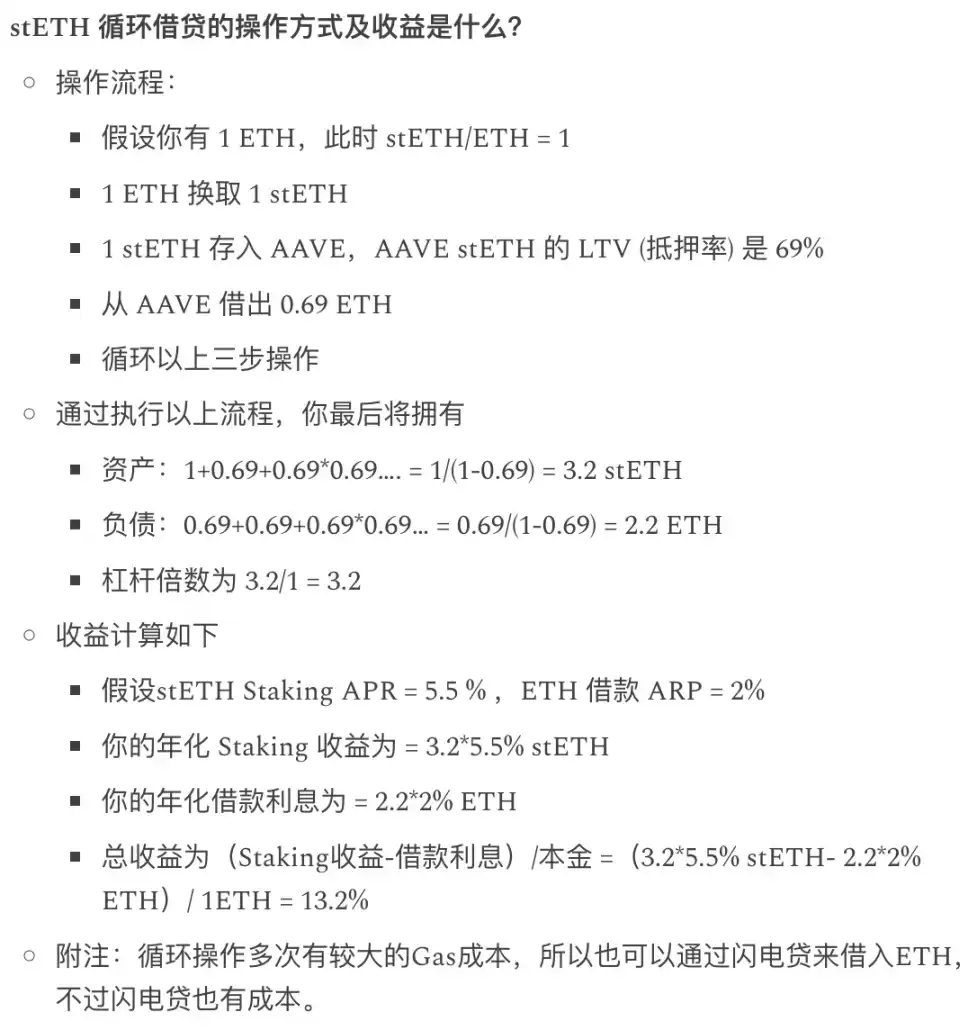
AAVE revolving loan process
4. Asset issuance
Issue new assets anchored in a basket of xxETH, carry out various DeFi activities to increase LSD liquidity
MakerDAO:
strong>Issuing ETHD based on a basket of xxETH, ETHD can be used as collateral to lend DAI, and DAI can be used for other DeFi activities;
Lybra Finance: Mortgage xxETH to mint interest-earning stablecoin eUSD (eUSD's security pledge rate is 160%, APY 7.2%), eUSD holders can pass DEFI activities Get more profit.
Through the above, we can see that all LSDFi products The goal is to promote the improvement of the efficiency of Ethereum’s pledge capital, mainly starting from improving the pledge income and increasing the liquidity of LSD.
Income of LSD Project , mainly from the additional issuance of Ethereum, and the extra income of LSDFi is mainly realized through DeFi matryoshka leverage, project side subsidies, bribery and other methods.
What are the current problems with LSDFi?
- Contract risk, generally the more complex the contract, the more prone to problems;
- When the market fluctuates sharply, All kinds of DEFI dolls are prone to liquidation;
- The track is in the early stage, and new projects are prone to failure.
03 Is the LSDFi track worthy of long-term attention?
Is LSDFi worth long-term attention? Let's take a look at the performance of pledge data after the upgrade in Shanghai:
Since the Shanghai upgrade on April 13, except for the severe net outflow in the first few days before the Shanghai upgrade, the number of pledges even exceeded the number of withdrawals in the next few days. At present, ETH pledge deposits have exceeded withdrawals, and the net pledge balance is about 435,000 ETH.

Since the Shanghai upgrade, the net withdrawal of Ethereum Number: token.unlocks
After Shanghai upgrade, centralized pledge (CEX such as Kraken, Coinbase, Binance, etc.) The lock-up volume of staking decreased, while the lock-up volume of the decentralized pledge agreement increased instead.

Ethereum staking changes (by category): dune
especially protocols like Lido, Rocket Pool and Frax LSD The amount of pledges has increased. On April 13, a total of about 7.73 million Ethereum was locked in the LSD protocol, and by May 11, it increased to 8.73 million ETH, worth $15.9 billion. Primarily because these LSDs allow users to participate in a range of DeFi transactions and lending applications with their Ethereum-based derivatives.

Lido and other protocol pledge market changes: Defillama
Currently, the total amount of Ethereum pledged is 18 million, worth 33.1 billion US dollars, and the pledge rate is 14.96%. Compared with other public chains, which are easily 50 to 60 percent, there is still a lot of room for improvement. Of course, it has a lot to do with the decentralization of Ethereum.

The pledge rate of the head project: Staking Reward
Ethereum pledge scale is 33.1 billion US dollars, according to defillama data, The total lock-up volume of the DeFi market is 900 100 million US dollars, the pledge market size is 36.7% of the DeFi market. It can be said that staking has proven to be a feasible way to earn passive income. With the advent of the bull market, Ethereum staking is a high-quality interest-earning asset, and its stable annualized rate will surely attract more prudent investors.
And the price of Ethereum will also increase. It is not an exaggeration to regard LSD as a market size of 100 billion. In the last wave of the bull market, DeFi is one of the important drivers, and in the future, the LSD track will also become one of the main narratives of the next bull market.
As the scale of the pledge market expands and the foundation soil is established, LSDFi It will become inevitable for some people to pursue higher returns.
04 Summary
On the whole, the most difficult market for cryptocurrencies has passed, and the development of the industry is easy, with such high-quality LSD Soil, I believe more LSDFi innovative projects will emerge.
Original source
Welcome to join the official BlockBeats community:
Telegram Subscription Group: https://t.me/theblockbeats
Telegram Discussion Group: https://t.me/BlockBeats_App
Official Twitter Account: https://twitter.com/BlockBeatsAsia
 Related Articles