



The re-hypothecation token (LRT) narrative is rekindled, taking stock of its high-potential project opportunities
Original Title: "The Narrative of Re-Pledging Tokens (LRT) Rekindled: Seeking High-Potential Project Opportunities in the Endless Liquidity Trap"
Original Author: David, Deep Tide TechFlow
On the eve of the results of the Bitcoin spot ETF, the cryptocurrency market experienced a flash crash this week.
After the panic, Ethereum ecosystem tokens such as LDO and ARB rebounded quickly, and some smaller Ethereum L2s such as Metis even reached higher levels, which in turn indicates the current market's optimism towards the Ethereum ecosystem.
But the L2s have already collectively risen, and most of the projects in liquidity mining only have Beta returns. What other narratives can be laid out around the Ethereum ecosystem?
Don't forget about another grand yet unrealized catalyst - re-collateralization and EigenLayer.
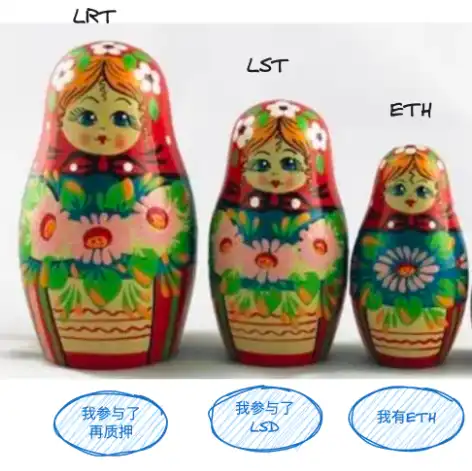
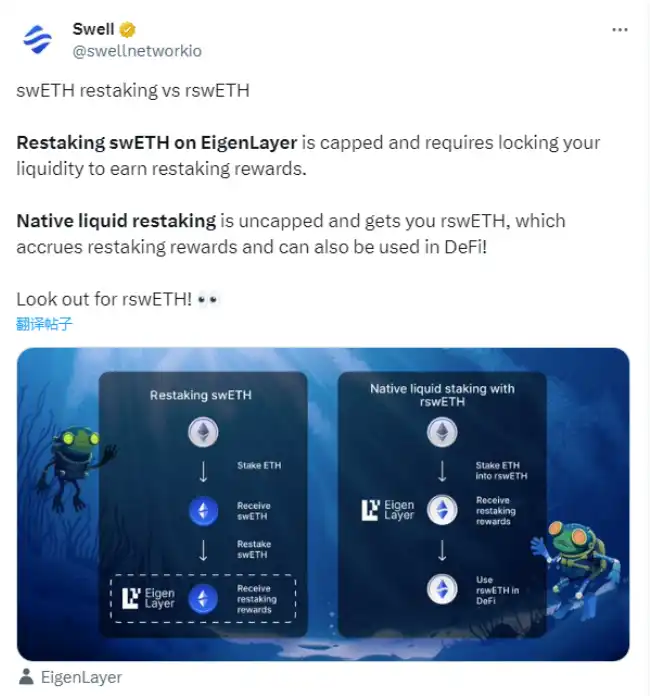
Based on the liquidity collateral, the re-staking has been derived. In the pursuit of efficiency and returns, which are always sought after by capital, the nested version of the liquidity collateral token (LST) has gradually evolved into the liquidity re-staking token (LRT).
Recently, some tokens related to the LRT concept have seen good gains, apart from CEX.
It sounds somewhat familiar, but the logic behind it is not completely understood?
In this issue, we will help everyone quickly understand the logic of re-staking and LRT, and delve into projects with low market value or those that have not yet released tokens.
Review of Repledge and Liquidity Stacking
Re-pledging is not a new concept.
As early as June last year, EigenLayer introduced the concept of "re-staking" on Ethereum. It allows users to re-stake Ethereum or Liquidity Staking Tokens (LST) that have already been staked, providing additional security for various decentralized services on Ethereum and earning additional rewards for themselves.

There is no need to repeat the technical principles of EigenLayer here, and it is assumed that readers have a certain understanding of it. (Related reading: Analysis of Restaking Leader: EigenLayer's business logic and valuation deduction)
On the contrary, if you are not concerned about the technical details within EigenLayer, it may be easier for you to understand the logic of liquidity staking and restaking.

说白了就是:" translates to "In plain terms, it means:
·For Ethereum, staking maintains security, and more staking maintains even greater security.
For investors, pledging assets for returns means seeking even higher returns through additional pledges.
So, from an investment perspective, how is this method of seeking returns currently being implemented? The following image provides a simplified understanding:
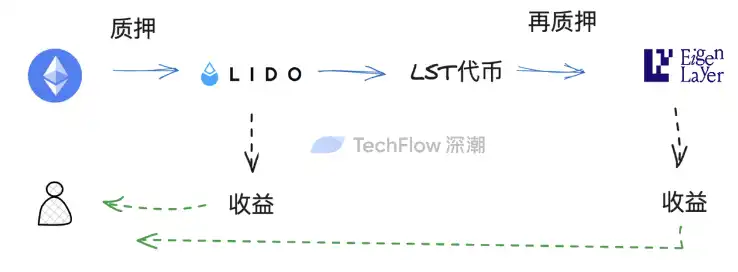
1. I have ETH and will pledge it to a service provider for LSD, such as Lido;
2. I received LST (liquidity staking tokens), such as stETH;
3. I will re-stake stETH in EigenLayer;
4. I can earn profits in steps 1 and 3.
Obviously, before the appearance of EigenLayer, I could only obtain one type of profit from my LST. With EigenLayer, I gained an additional layer of profit, theoretically without loss.
However, in the mature re-collateralization process, there is a key issue: liquidity is trapped.
Your LST has been re-staked in EigenLayer, which means you have lost the opportunity to generate income by staking your LST elsewhere.
EigenLayer, as a staking layer, will provide returns based on your staked investment, but it does not grant the same level of liquidity as holding the currency.
In the cryptocurrency market, where capital efficiency is emphasized, liquidity never sleeps. Speculation actually does not accept the liquidity of tokens being completely locked in one place and unable to expand.
Therefore, the current logic of earning profits through "pledging-repledging" is not perfect.
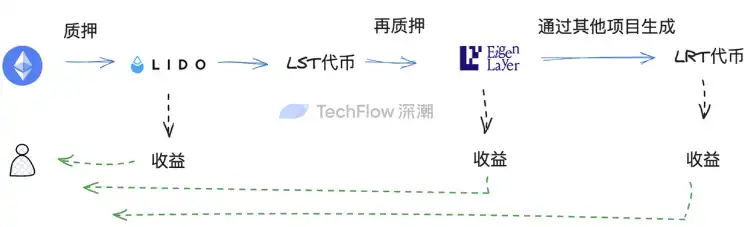
What related projects are worth paying attention to?


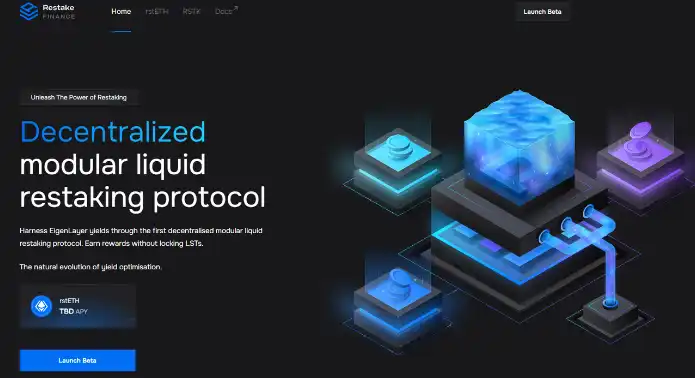

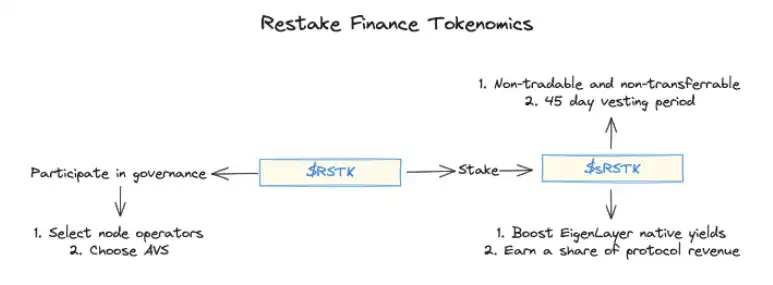


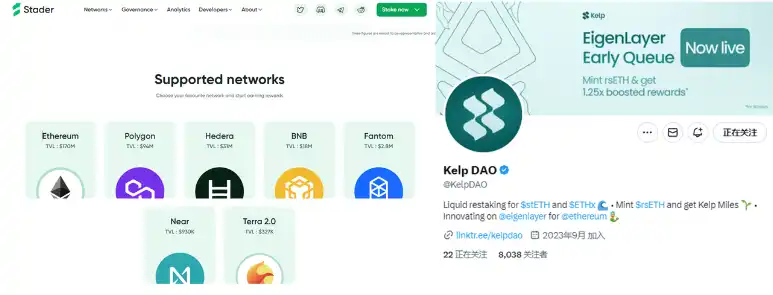
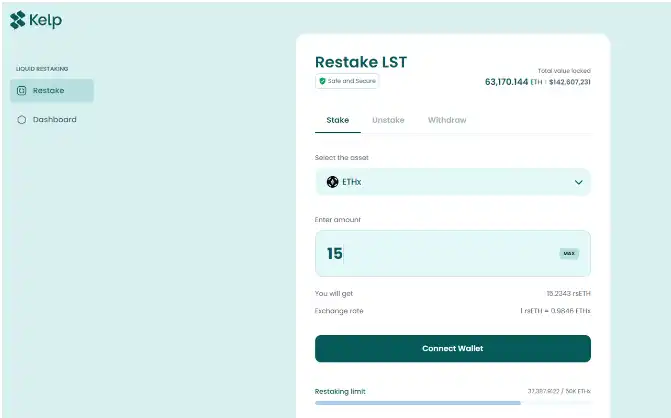
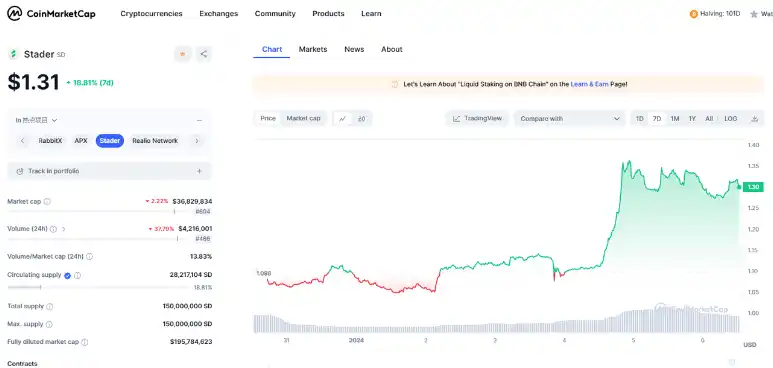
Regarding tokens, since Kelp DAO currently does not have its own token, the token SD from Stader Labs, which has a clear association, can be a point of focus.
SD has seen a growth of around 20% in the past week, with a market value similar to RSTK, both in the range of around 35 million.
But unlike RSTK, SD belongs to the old coin new speculation category, and after obtaining re-staking narrative, it has achieved new performance. At the same time, considering that Kelp DAO is only doing direct business without issuing coins, it may be possible to expect the synergy effect between SD token and Kelp issuance in the future, such as airdrops.
Prisma ($PRISMA): Not entirely related to LRT, another option for LSDFi
The above two tokenized projects are both articles that directly revolve around EigenLayer to liberate liquidity, but in fact, there are more ways to liberate token liquidity.
There is still another approach in the market, which is not directly linked to EigenLayer, but generates profits by releasing liquidity through its own resources. The representative project is Prisma.
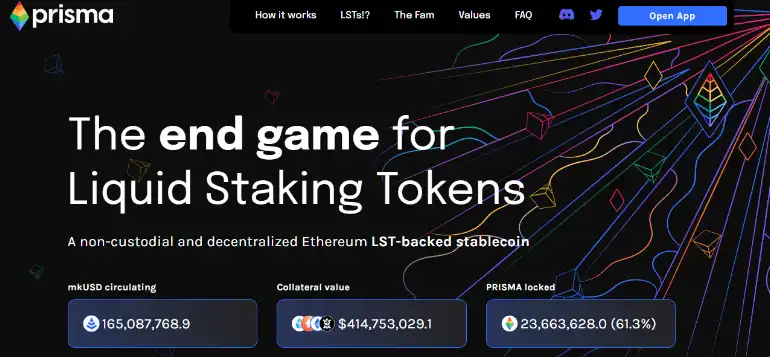
In strict sense, this project is not LRT, but more like LSDFi. (Related reading: Prisma Finance: Unlocking the Huge Potential of Liquidity Collateral Tokens)
Prisma entered the public eye six months ago, and at the time, the attention it garnered was due to its excessively luxurious investment and endorsement lineup:
The project has received joint endorsements from the founders of multiple projects such as Curve Finance, Convex Finance, Swell Network, and CoingeckoFinance, as well as leading project parties such as Frax Finance, Conic Finance, Tetranode, OK Venture, Llama Airforce, GBV, Agnostic Fund, Ankr Founders, MCEG, and Eric Chen.
Although the financing amount has not been disclosed, it can be said that it has basically covered the top DeFi projects.

Prisma releases LST liquidity through:
· Store LST in Prisma Protocol
·Mint's stablecoin named mkUSD
·Earn profits by staking, mining, borrowing, and other activities in different DeFi protocols using mkUSD, and unlock the liquidity of LST.

Regarding tokens, PRISMA has experienced ups and downs in the past month, with fluctuations of more than 100%. The price has been very unstable, but there has also been a decent increase in the past week.
The opposite of this is tokens with a market value of only around 17 million, which are extremely susceptible to news and can quickly rise or fall.

Considering the luxurious endorsement lineup, why is the current market value of the project so low? LSDFi's narrative has some appeal, but this does not necessarily mean that the project is undervalued. Instead, several points need to be considered:
·The circulating market value of PRISMA does not include locked tokens, and there are approximately 22 million PRISMA tokens in the project that have not been calculated.
·The locked tokens can be withdrawn and sold on the market at any time, which may also have an impact on the price;
According to Twitter user @lurkaroundfind, Sun owns 1/3 to 1/2 of the total PRISMA TVL and is also an unstable factor.

But unstable + small market value actually means there are certain opportunities for operation.
Overall, PRISMA has a small market value, but it has a luxurious endorsement and fits into the LSDFi narrative. There is no significant migration cost for future transfer to LRT, and there is a possibility of using the narrative to create some excitement.
The recommended approach would be to allocate a small position and aim to profit from the Pump & Dump cycles.
Picca Network ($PICA): Liquidity Recollateralization on Solana

If you feel that the projects revolving around Ethereum's liquidity and re-staking narrative are too crowded, a viable Plan B is to find similar narratives in the popular Solana ecosystem.
The current targets that meet this search criteria include Picasso Network.
The project itself aims to support multiple L1s, mainly promoting cross-ecosystem blockchain communication (IBC) between ecosystems such as Polkadot, Kusama, and Cosmos, and expanding to other networks such as Ethereum and Solana.
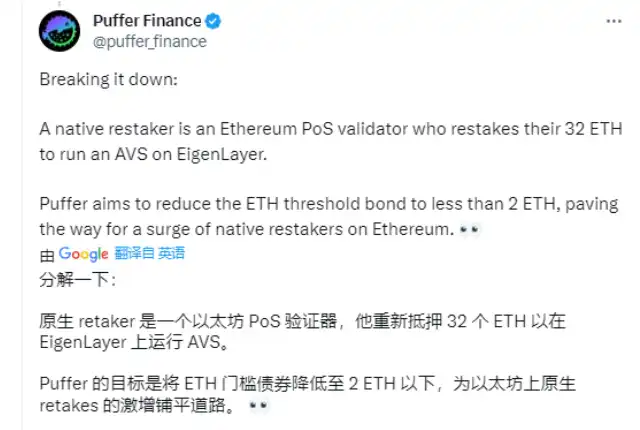
However, the project is currently targeting the blank space of liquidity re-staking track on the Solana ecosystem, attempting to enable re-staking on the Solana ecosystem through IBC capability.
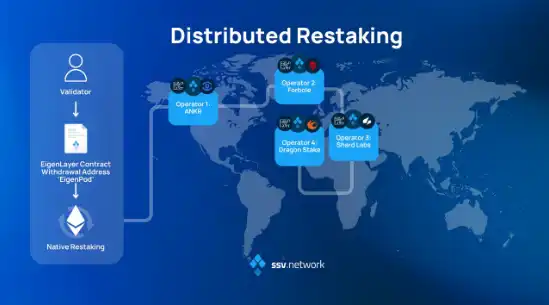
Specifically in terms of execution, Picasso is launching a Restaking Vault program. Excluding technical details, you can roughly understand Picasso as an EigenLayer on Solana. Its implementation is roughly as follows:

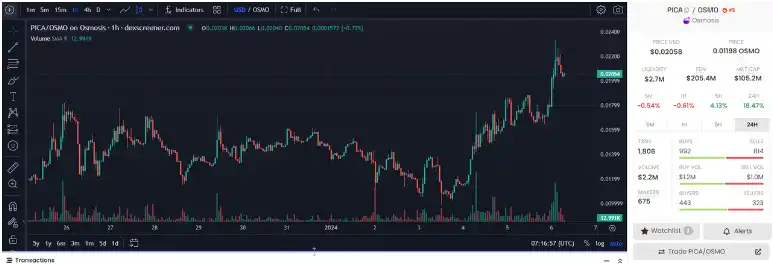
On the token side, Picasso has seen a nearly doubled increase in the past week, with a market value of around $100 million. Compared to other liquidity re-staking projects on Ethereum, its market value is relatively high. However, considering its IBC feature and its main business beyond liquidity re-staking, its market value cannot be fully compared to similar projects on Ethereum.
Welcome to join the official BlockBeats community:
Telegram Subscription Group: https://t.me/theblockbeats
Telegram Discussion Group: https://t.me/BlockBeats_App
Official Twitter Account: https://twitter.com/BlockBeatsAsia







