In-depth analysis of NFT MEV: New opportunities in the NFT trading market.
Original Title: "In-depth Analysis of NFT MEV: New Opportunities in NFT Trading"
Original Source: Alana Levin, Variant Fund (in collaboration with Frontier Research)
Translation: Cecilia, bfrenz DAO

When creating a new block, additional profits can be obtained by adjusting the order of transactions. Depending on the classification, it can be divided into different types such as Arbitrage, Liquidation, Sandwich Attack, etc. MEV (Maximum Extractable Value) refers to the maximum value that can be extracted from users by reordering, inserting, and reviewing transactions within the block, such as arbitrage and liquidation. The most fundamental understanding is that...
The development of MEV has been around for some time. After Ethereum merged into the PoS mechanism, MEV entered the vision of more people. NFT MEV is a new way, although there are some risks in making money, its greatest value is to provide more opportunities for searchers (that is, arbitrage robots that run algorithms on blockchain data to detect MEV with profit opportunities and automatically extract them to the network).
This article is a research paper from the early encryption fund Variant Fund, exploring new possibilities in the NFT trading field. Starting from the current situation of NFT and the characteristic of non-fungible tokens, the article discusses how to use MEV to obtain value flow. If you are not particularly familiar with MEV, you can read the introductory article first.
TL;DR
The market structure of the NFT market differs from that of the token market. The NFT market forms capital due to frequent minting events, has lower secondary trading volume, faces challenges in bid liquidity, and has a large amount of off-exchange order books.
Due to these differences, the form of the NFT MEV market is also different, with fewer arbitrage opportunities, but more MEV can be extracted when minting. In addition, there are some unique forms of MEV in the NFT market, such as clearing the bid wall and relisting (creating artificial trading volume leading to arbitrage space), Trait Sniping, and extracting from idle orders.
As a more mature market, the market provides some useful insights, such as the need for MEV-aware casting solutions, more open pricing data, dynamic on-chain order books, experimenting with new auction methods, and providing additional communication channels for traders.
Currently, the value flow of NFT mainly occurs during issuance and in the trading and lending processes on the secondary market. These flows may involve MEV (such as inefficient economic extraction from users during on-chain transactions), which can affect the business models and beneficiaries of market activities, including traders, markets, wallets, and developers.
However, compared to the DeFi market, MEV in the NFT field feels like a relatively unknown topic. The structure of the NFT market has significant differences, including more primary activities, smaller token supply, and less secondary liquidity, which also affects the way value flows.
This article will explore the emerging MEV opportunities in the NFT market, as well as how the market dynamics are constantly changing, affecting these opportunities and the infrastructure that can be established.
Current NFT Market Ecology
Understanding the current structure of the NFT market is an important prerequisite for identifying how MEV performs in the market.
We can look at it from the perspective of a cyclical process, which begins with users minting NFTs. I refer to this as the moment of capital formation, similar to airdrops or token releases in fungible token markets (where new assets are generated on-chain). However, there are at least three differences between fungible and non-fungible markets:
Capital formation events in irreplaceable markets occur more frequently than in replaceable markets.
The order of minting in the irreplaceable market may be important, as the order of minting can classify the minted items as rare features or identity symbols, giving them financial value.
Irreplaceable collectibles often have smaller supply; a collectible can mint 10,000 NFTs, while fungible tokens are typically released with a supply of 1 billion or more. This may affect the liquidity of the secondary market.
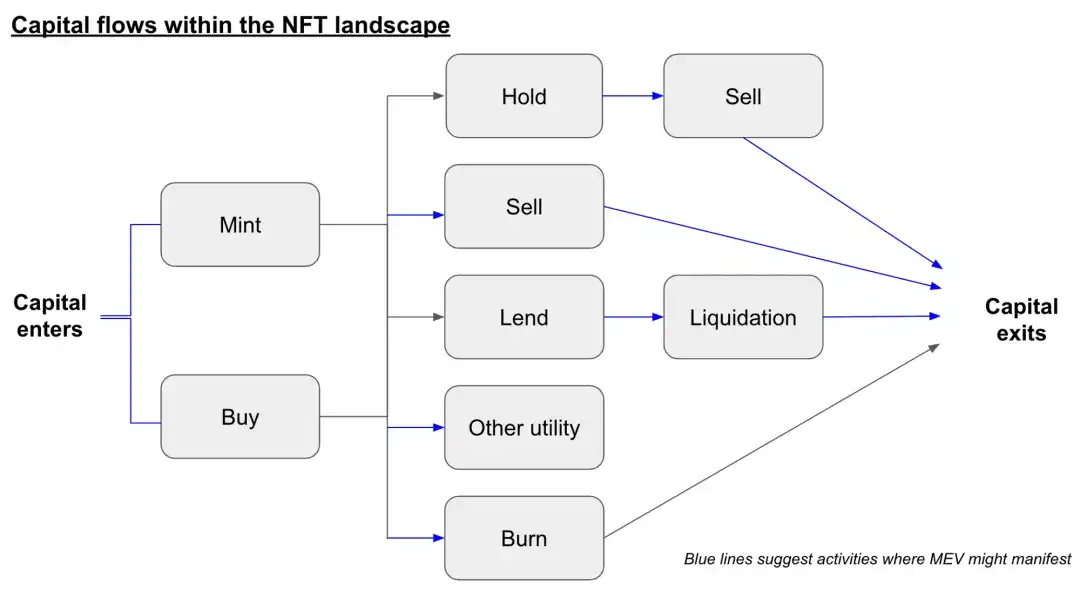
When a user decides to sell their NFT, they can list it for sale on the market, such as on OpenSea, Blur, Reservoir, and other markets. There are several touchpoints on-chain related to these off-chain order books: if the seller needs to change the order price, they need to sign, but do not need to pay additional gas fees. These orders are usually listed on off-chain order books and will remain until the order is executed or cancelled. In addition, there are also some on-chain order books, such as Zora and Sudoswap. The first time an order is listed, approval is required, and orders can be cancelled or executed.
Aside from the issuance and trading of NFTs in the market, it is worth noting that the utility of NFTs is also gradually emerging. Using NFTs on the blockchain may involve staking NFTs to earn rewards, delegating upcoming airdrop rights, destroying NFTs when used as game assets, and more. With the continuous emergence of these use cases, the utility of NFTs is gradually being recognized and developed.
Although the trading volume in the secondary market and issuance market is already very high, with a trading volume of nearly $2 billion in February, the trading volume in the NFT lending market is relatively small, with only hundreds of millions of dollars. Other practical areas outside of the lending market are still in their infancy. Therefore, this article will focus on the issuance and trading aspects of NFTs, but we also need to pay attention to the potential development and innovation of NFTs' practicality.
I define MEV as any inefficiency within the market that results in value leakage (to searchers, block builders, validators) downstream from the transaction initiator (user, wallet, application). This is a broad definition, but this breadth is helpful for considering different opportunities for value capture and/or redistribution. Common forms of MEV include arbitrage, sandwich attacks, liquidations, and front-running.
1 )套利 Arbitrage
Translation:
1 )Arbitrage
Arbitrage and sandwich attacks typically require high trading volume and liquidity depth, as the price difference is often very small and arbitrageurs hope to quickly enter and exit their positions. However, the NFT market often lacks these two conditions. In addition, there are liquidity challenges. Typically, there is no ready buyer on the other end of each listed item. This means that even if someone finds an arbitrage opportunity, there may be risks in relisting and selling.
Some native arbitrage forms of NFTs, and the corresponding risks for each form:
Raise the floor price and relist to get a higher price. In order to obtain a higher price, some traders will raise the floor price and relist the goods. They claim to be able to profit by taking advantage of buy orders located above the floor price. In this case, traders almost artificially create the high trading volume required for arbitrage. However, this arbitrage strategy carries the risk of high capital costs and inventory requirements.
Find demand that is not considered a "coincidence". For example, a person lists their CryptoPunk for 1 ETH, which has the red/blue glasses element, and another person has placed an order to buy any CryptoPunk with the red/blue glasses element for 2 ETH. At this point, a search bot can intervene, call Seaport's MATCH function to fulfill these two orders, and collect the price difference as a tip or reward. This example leads people to believe that this is a low-risk arbitrage opportunity, although it may not occur too frequently. The main risk is that the searcher may not be able to find enough matching orders to make a profit.
Trait Sniping is a form of arbitrage that arises solely due to the "non-fungible" nature of NFTs. When you see an NFT with a specific feature trading at price X, and you also know that other NFTs with the same feature are trading at price X+Y, you can buy that NFT and relist it at a higher price. If the searcher pays a lot of gas to ensure their bid is given priority, then MEV can be realized. In these cases, the searcher faces the risk of exiting: their listing may not have the waiting bids. Therefore, the searcher must bear the risk of holding inventory for an unknown period of time and accept the risk of long-term fluctuations in attribute prices.
2 ) Sandwiching Attack
In cryptocurrency trading, "sandwiching attack" usually refers to manipulating the entire market by making two trades before and after a low-cost transaction. Currently, there doesn't seem to be too many sandwiching attacks in the NFT market, partly because most NFTs are not dynamically repriced when the available supply changes. In the fungible market, large orders will push the market in a certain direction, but in the NFT market, buying an NFT at 10% of the floor price will not directly change the floor price of other NFTs. In addition, NFTs are often priced individually rather than collectively. It is worth noting that with the continuous development of dynamic pricing infrastructure, such as "Uniswap for NFTs" - Sudoswap, it can help solve the liquidity problem of NFTs and ensure that there are at least some merged NFTs bidding, so that there is at least some bidding. However, automated dynamic pricing may also expand the scope of its transactions.
3 ) Liquidation MEV
Another common form of MEV exists in the lending market, known as "liquidation MEV". Searchers profit by being the first to discover and obtain liquidation fees. As more and more are built on-chain (for example, liquidation engines running directly on protocols like Seaport) and equipped with gradually decreasing price auctions, liquidation is triggered as long as the price exceeds the reserved collateral price. Therefore, I believe there will be a group of searchers who specialize in manipulating the bottom price or price of certain NFT collateral in order to predict or control when NFT liquidation will occur. More lending books.
Other types of NFT MEV:
Blockage during casting: Blockage during minting is a common issue. For popular projects, users may even need to pay millions of dollars in gas fees when minting. Although this creates value for NFT projects, these fees are ultimately extracted by validators. In addition, there are also robot operations involved in the minting process. Searchers can find the first minting transaction in the memory pool, check the supply of tokens to be minted, and mint the remaining or all tokens ahead of time.
On the trading market, it is common to accidentally leave a placed order, also known as a "non-active order". As canceling an order incurs a fee, users may choose to simply transfer the NFT to a new wallet to end the order. However, technically speaking, this does not truly cancel the original order. If the person transfers the NFT back to the original wallet, the order will reappear. At this point, the base price may have risen above the original order, and a savvy third party may take advantage of the low-priced NFT. This phenomenon, known as MEV, arises because searchers may bribe validators with high gas fees to ensure priority processing of their bids on orders.
Arbitrage related to NFT leasing: Recently, there has been a trend of separating the rights or utilities of NFTs from the assets themselves, which is like an NFT version of Airbnb. Similar to Airbnb's housing rental model, holders can allow others to pay to use or enjoy the benefits of the asset while still retaining ownership of the asset. This fluid delegation is particularly useful for arbitrage related to airdrops. Buying the rights to a large number of NFTs, rather than trying to buy the NFTs themselves, can be expected to require less capital, limit the significant increase in the floor price, and provide an opportunity to obtain airdrop supply. If the eligibility requirements for airdrops increase (as has already happened in the fungible market), NFT holders may have asymmetric information about the scale of airdrops that can be claimed for their NFTs.
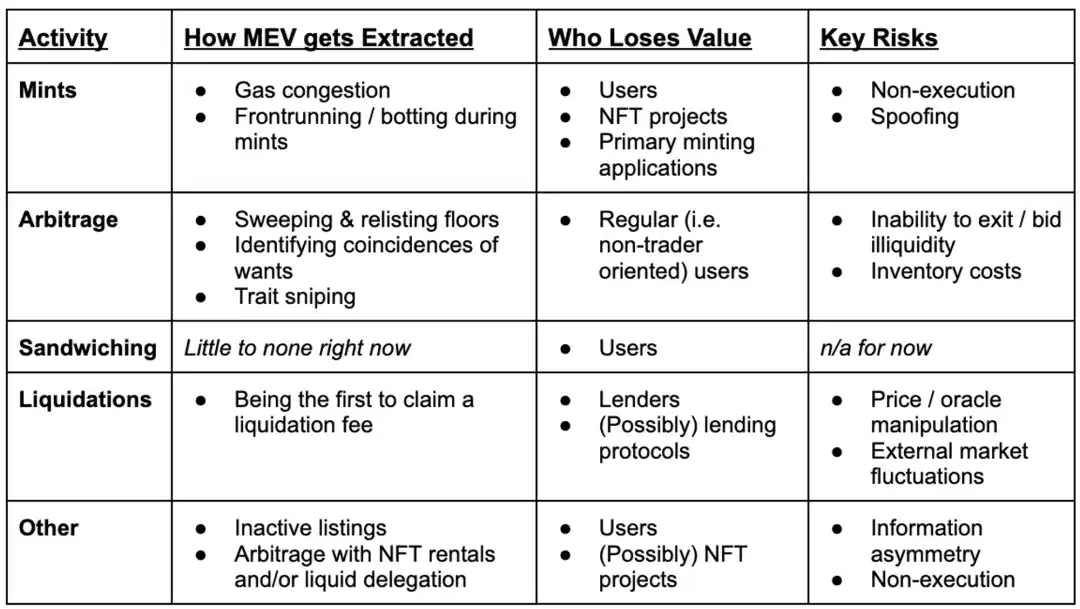
Finally, there may be more types of NFT MEV that have not been mentioned, such as spoofing, inefficiencies related to burning and exchanging functions, and front-running mint. The following list aims to summarize the characteristics and risks of different forms, hoping to bring some thinking and inspire NFT MEV related ideas and projects. (spoofing)
Opportunities at the infrastructure level
Based on the current market situation and MEV's expertise, here are some ideas for building NFT MEV native infrastructure:
1. In terms of timing, the project can distribute the minting process over several days or choose other times with less on-chain activity to further alleviate congestion issues. As for the MEV problem, a minting solution can be implemented through NFT auctions to capture more value created by the project. By allowing users to bid for access and sort during the minting process, a way to help price the project and reduce high gas fees can be provided. If the sorting itself occurs off-chain, while or before minting, it can also be helpful.
2. Strengthen the pricing infrastructure: There are several forms that can be adopted to enhance this infrastructure. For example, better data display can help searchers determine the purchase opportunity of a specific NFT, thereby improving the pricing method. In addition, dynamic pricing mechanisms, such as Sudoswap, can assist in collectively pricing NFTs instead of individual pricing. Finally, using sequential auctions and other methods can improve pricing discovery or enhance pricing infrastructure in other ways.
3. Establishing infrastructure to reduce exit (liquidity) risk: I believe that pricing NFTs is a difficult task, which is why fewer people are willing to bid. One possible helpful method is a bargaining mechanism. For example, if a user has listed an NFT for 2 ETH and a buyer only bids 1 ETH, there may be an intermediate clearing price that can be achieved through negotiation. This negotiation channel can increase overall liquidity while also promoting a better understanding of how to price NFTs. In fact, this category may overlap with the aforementioned pricing infrastructure.
4. Increasingly efficient performance agreements and tools: As NFT orders become more complex and more market participants enter the field, it becomes increasingly important to match and fill orders effectively. In order to improve the trading experience, increasingly efficient performance agreements and tools are emerging. For example, Seaport and Reservoir are complementary infrastructures that help share liquidity between markets, making it more efficient to discover and match orders with different preferences. As the surface area of coincidences identifying demand grows, opportunities to establish preference-aware matching solutions for partial filling in the order network also increase. In addition, we can also meet the needs of different types of traders by providing better choices. For example, professional traders may require near-instant transfers, while transactions aimed at retail consumers can be accepted for bidding at time X, but will only be actually fulfilled/transferred a few hours later at a lower gas fee.
Summary and Reflection
Long-term, we believe that as time goes on, there will be more applications centered around the "non-fungible" characteristic of tokens. Currently, most NFTs are heterogeneous, making them difficult to be used as substitutes. While sharing characteristics or underlying tokens may be more similar to substitutes, consumer preferences may still differ. In contrast, NFTs can serve as entry tickets for golf events, and they may have certain differentiating features (such as dates) that may affect consumer preferences, but overall, they can be considered as approximate substitutes because consumers can choose different tickets on different days (all tickets provide equal access to the event). As NFTs become tools representing everything from on-chain art to tickets, league links, intellectual property licenses, and property ownership, we believe we will see more MEV emerge. non-fungibility.
Overall, we believe that we are currently in the early stages of NFT. NFT has a lot of potential and is a good way to bring external capital into the crypto ecosystem, and the design space is open. However, inefficiencies always exist in the early stages of any market. We hope that by exploring the ways in which MEV exists in the entire market and the opportunities provided by such exploration to build a more enjoyable user experience, we can help achieve the goal of mass adoption.
Original article link
Welcome to join the official BlockBeats community:
Telegram Subscription Group: https://t.me/theblockbeats
Telegram Discussion Group: https://t.me/BlockBeats_App
Official Twitter Account: https://twitter.com/BlockBeatsAsia
 Related Articles