Hong Kong Web3 New paradigm: shop before factory, overseas growth
The original title: "Hong Kong Web3 new paradigm | front shop, back factory, growth abroad"
Source: FMResearch

What is the front shop and the back factory?
In 1978, Taiping Handbag Factory, the country's first "three to one" enterprise, settled in Dongguan.
"front shop, back factory" (English: "front shop, back factory") is a set of economic model developed jointly by Guangdong Province in mainland China and Hong Kong in the early stage of China's reform and opening up. Hong Kong as a transit point to mainland goods to Europe and the United States and other regions. But that model has been on the wane since China joined the World Trade Organization. Hong Kong is also moving into areas dominated by finance and high-tech industries.
In Web3, this model is gradually coming back, and we suspect it will become a mainstream operation model, combining Chinese capacity, resources in Hong Kong (including Singapore), and eventually offering products and services to the world. In eight words, it is called "front shop, back factory, overseas growth".
Mainland China, back factory advantage
We started to enter the high growth phase of Web3, and start-up teams mushroomed. In this fierce competition, the advantage of the rear plant will become very obvious. The afterplant model has three advantages.
1.1 Advantages of building scale teams at low cost
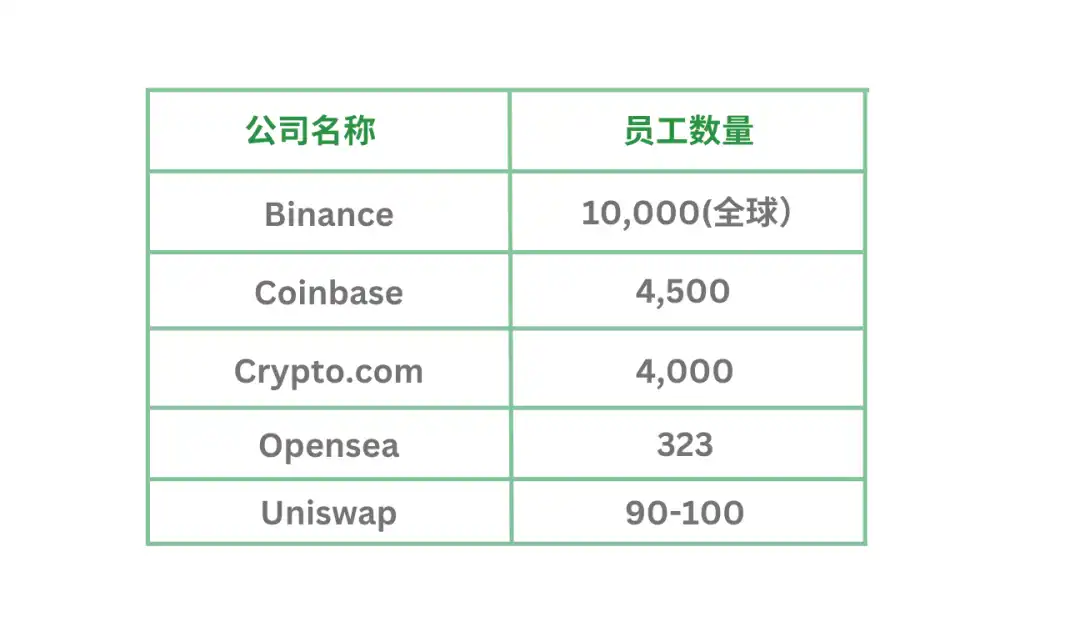
The above data does not fully show that,Head companies are getting bigger and bigger.While Web3 still has a lot of small startups, companies that make it past Series B need to build teams of 100 or more people, such as Uniswap. In places like Silicon Valley, it is extremely expensive to hire and operate, and complex policy restrictions and cultural differences make it difficult for teams to expand. siliconValley may be suitable for Angel Round companies, but in the subsequent competition, building part of the technical and operational back office in China has a competitive advantage.
1.2 Suitable for internal racehorse incubation
Many Web3 tracks are becoming more standardised and modular, and innovation often comes from in-house racing. For example, in the Defi sector, it is no longer the era of going it alone. We have seen some teams develop more than 20 protocols on the same public chain, and they have business cooperation and support each other, and even use the internal racing mechanism to make innovation.In such a highly capital - and labor-intensive field, it is advantageous to have a large team that can work together and compete internally, rather than a small, geeky team. In Solidity, where learning costs are becoming cheaper and information is becoming more fluid, the ability to imitate and follow is more important than originality, and quality fork is another entrepreneurial avenue. This is precisely where the "back factory" in China has the greatest advantage.
1.3 Hardware supply chain Advantages
We're looking at two new racetracks. One isCreator Economy, including Music NFT and entertainment economy. The other is DePIN(Decentralized network of hardware facilities). The conceptual innovation in these fields may be in Silicon Valley, but in the implementation link, they find that their operational talent and part of the supply chain are in Asia or even China.
In terms of Creator economy, a large number of creators are needed to join the network. These designers, writers, musicians, painters and other professions have a large population in China, and the production capacity of content creation is huge.
Another example is DePIN, which requires a lot of hardware capacity to reduce network operating costs. One of our investments, a head DePIN hardware manufacturer, has a supply chain in China and Vietnam, and supplies hardware for seven DePIN projects, including DIMO, Hivemapper and React. He is a very reliable strategic partner for these overseas native Web3 projects.
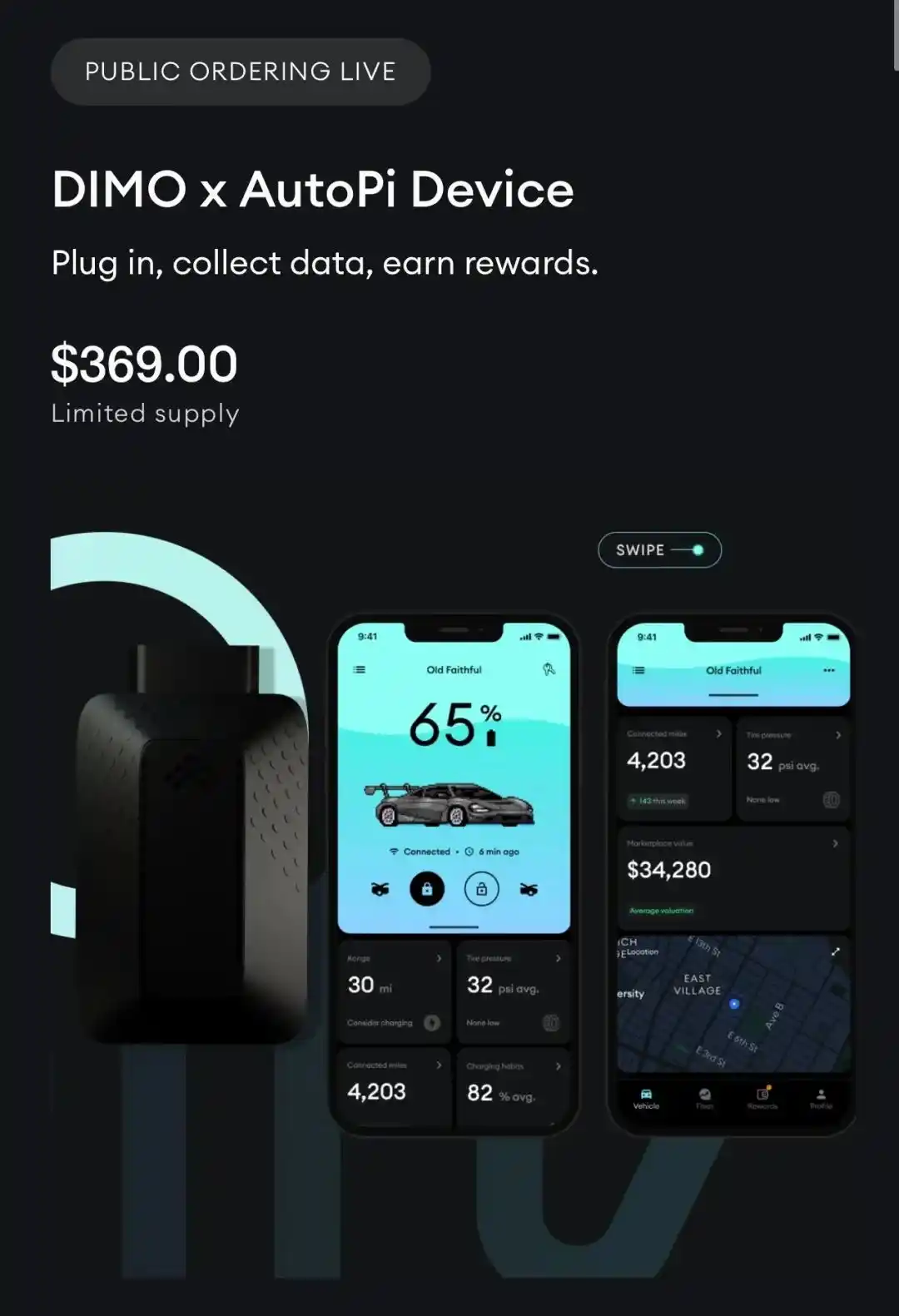
Dimo Device (source: Dimo website)
Therefore, the "back factory" has the above three advantages. As long as it operates in China in compliance with the law, it can export the production capacity to the international market.
Qiandian Hong Kong: investment and financing transfer station
This trip to Hong Kong has opened our eyes, but we should observe two aspects in practice. So the bottom line is,There are two characters whose words and deeds are worth observingThere are two important signals waiting to be presented.
The two characters are Li Jiachao and Xiao Feng. Li Jiachao expressed an open attitude to virtual asset innovation, licensing system will be implemented in the future. Xiao Feng affirmed that the application of Web3 must be Tokenization, and gave a speech "Three token modes of Web3 Application" and announced the HSK eco-points token. These two figures represent the unprecedented popularity of Web3 and token in Hong Kong, affirming what was once the most sensitive token topic in politics and business.
The two signals are:
1. From regulating specific objects to regulating behaviors.It is not a blanket rule that virtual assets are illegal, or that people of certain nationalities cannot trade and distribute them, and that once they are done, they are illegal; Instead, deals and offerings can be protected as long as they comply with Hong Kong's legal and regulatory framework.
2. Review and protection of OTC transactions.
At present, the two signals are not fully presented, so we need to wait and observe.
Another advantage of Hong Kong is its favorable investment and financing environment. This trip to Hong Kong, many people sneer that "money is more than the project", in fact, this is an advantage. From angel investment to subsequent Hong Kong stock market listings, entrepreneurs can communicate directly with VCS, PE and family offices here, which is more efficient and practical than "go to Silicon Valley to find a16z".
Therefore, Hong Kong is more like a reasonable and legal place to set up shop. It is also convenient to manage the afterplant, convenient for investment and financing, and has certain attraction and rationality.
Overseas growth: Place marketing, R&D and BD overseas
"Front shop and back factory" is only half of the chain. Web3 companies need to fully integrate into the global market, otherwise they still cannot get rid of their own limitations, and may even bring huge business risks. There are three main methods of growth that are lacking in most Asian-backed projects.
Growth way one: From the community, to the community
Part of the innovation in Web3 is the clear need for efficiency, and part is the discovery of new solutions through in-depth research of user behavior. This wave of demand is only possible where the Web3 ethos is most radical.
For example, musician Daniel Allen, who we invested in, signed himself up with the DAO and then distributed his proceeds directly to token holders and administrators. This has become a reality in the NFT community in Los Angeles. The governance tools involved in this process, the copyright tools, all have entrepreneurial opportunities. We combed through the technology stack of decentralized streaming media for him and found these tools to build.
We need to have an inner circle of teams in Europe and America to find out the habits of users, and then let our Asian team make corresponding products and quickly follow up the market demand.

Source: Daniel Allen on Twitter
Growth mode two: Obtain the legitimacy of decentralization
Whether the Asian team is "local dog" or "orthodox" is not a discrimination, but a real Web3 pain point. Because blockchain involves high-value transactions and the transfer of data, we need to ensure that in the future all this is on-chain and decentralized enough.
I think we still need to go overseas to communicate with these public chains and the management of ecology and ecology, who may not enter Hong Kong in the short term. It is still necessary to establish a good relationship and fully communicate with the core ecology team, join their hackathon, promote our own products, and embed our products into their existing products.
With the legitimacy, it will also obtain "endorsement" and "diversion", which has a huge effect.
For example, we invested in a decentralized storage roll-up project. The founder team made a very profound study on the technical route and strategic direction of the Ethereum community, and embedded their own products into the Ethereum technology stack. Finally, they obtained the grant from the Ethereum Foundation and guaranteed the legitimacy of the decentralized protocol. This strategic level of work is an important step to open up the gap between competitors.
Growth side three: international liquidity
Web3 is a global 7X24 value exchange network, which inevitably needs a large amount of virtual asset trading and liquidity. It should conform to the international market rather than the regional small market, so it is necessary to establish a global network of participants and qualified investors. I won't go into details here.
Finally
We've seen this whole "front shop, back factory, overseas growth" model being used by some teams with great results. And that's going to be a theme that we're going to invest in and explore.
Original link
Welcome to join the official BlockBeats community:
Telegram Subscription Group: https://t.me/theblockbeats
Telegram Discussion Group: https://t.me/BlockBeats_App
Official Twitter Account: https://twitter.com/BlockBeatsAsia