If Sui presses the acceleration key, can it become the next breaker of Layer 1
原文标题:《 加速发展的 Sui,能否成为下一个 Layer 1 破局者 》
原文来源: Daniel Li, CoinVoice
Layer1 Blockchain Sui announced its Mainnet launch in the second quarter of this year, kicking off a series of educational events and content called "Wave to Mainnet" designed to educate the community about the potential of the Sui protocol ahead of the Mainnet launch. Sui and Aptos, the leader of Layer1, belong to the same Meta chain, and they were founded almost at the same time in terms of project establishment. Compared with Aptos, Sui paid more attention to the innovation of underlying technologies, with the goal of becoming the first Internet-based programmable blockchain platform. Although Sui was far inferior to Aptos in terms of development momentum, projects driven by technological innovation often had the potential to accumulate steadily. Sui had accumulated rich technical advantages in the past few years. With the upcoming release of Sui's main network, it was believed that Sui would soon usher in a wave of development climax.
Sui cultivated quietly and Aptos stood in the spotlight
Aptos inherits nearly three years of open source technology and development experience of Diem project, which can quickly realize the construction of the underlying architecture and the layout of ecological projects. In contrast, Sui chose to build the Layer1 network from scratch, causing it to fall far behind Aptos in the development process. Therefore, in terms of attracting capital and investors' attention at the early stage, Aptos with rapid development was more attractive to investors than Sui with its underlying structure still being built. Secondly, both of them, as Layer1 public chains, are committed to improving the security and scalability of blockchain and creating a high-performance blockchain infrastructure network for billions of people. However, there are some differences in their strategies or priorities in achieving their goals.
Aptos focuses on marketing. Aptos is marketed as a unique product created by the best developers in the IT industry. Although it is exaggerated, it is effective. Last year Q4 started the main network and issued coins. Although the price is down more than 76%, it has been very strong since the beginning of the year and has recently pulled back, but the total market value is still $2.08 billion. Secondly, in terms of ecological project cooperation, Aptos pays attention to the cooperation with well-known enterprises, such as the acceleration plan launched with Google Cloud in the aspect of infrastructure; In terms of games, it reached cooperation with NPIXEL, a 3A game studio in South Korea; In terms of payment, it has cooperated with Web3 fintech company MoonPay to integrate ecosystem projects such as Petra. Partnerships with well-known companies have brought huge traffic and attention to Aptos, which has also contributed to the rapid development of its ecological projects.
Different from Aptos, Sui pays more attention to the innovative application of underlying technologies than marketing. For example, the Sui modified version of Move language can more clearly indicate the ownership, variability, and composability of objects, making it naturally suitable for building meta-cosmic facilities. In terms of ecological projects, Sui received far less attention than Aptos because the main network of Sui was not online and most of the projects were still in the test stage. As a result, Aptos was like a star in the spotlight a lot of the time, while Sui was more like a silent backstage cultivator.
Sui and Aptos were both Layer1 public chains with founding teams from Diem and the same Move track, so they had a competitive relationship from the very beginning. However, since Sui built Layer1 network from scratch, the development process lagged behind, and most of the attention of the early market focused on Aptos, so the competitive relationship between the two was not obvious at the beginning. It wasn't until the recent successful conclusion of Sui's Wave 2 testing and the announcement that Mainnet was coming online that Aptos became concerned and alarmed. Last month, Sui's CTO accused Aptos on Twitter of pressuring the Pontem team, the host of MOVECON (the first large-scale forum of Move Ecology), to cancel the Sui team's talk and even to remove the Sui Foundation from its list of event organizers. This indicated that Aptos had begun to regard Sui as its competitor, which also affirmed Sui's market position and potential from the side.
Compared with Aptos, Sui's underlying technology has obvious advantages
Although Sui had many shortcomings compared with Aptos, for example, Sui was inferior to Aptos in terms of ecological projects and community scale, Sui had always been committed to the innovation and application of underlying technologies, and had accumulated rich technical advantages in the past year. From the Sui-Move language to the Narwhal-Tusk consensus mechanism to the storage-fund token economics, Sui has made significant innovations at every level of blockchain projects, and in this respect Sui is unique even when compared to other new Layer1 public chains such as Aptos.
Sui-Move
Both Aptos and Sui use the Move language, but they are different. Aptos basically followed the classic design ideas of Diem white paper in design, while Sui was upgraded and adjusted to form a unique sui-move language. The biggest difference with Move is that Sui adopts an object-centric model rather than an address-centric model. Therefore, on Sui, almost everything, such as tokens, smart contracts, NFT, etc., can be represented as "objects". Each object has a set of properties, including owner address, read and write properties, transferable properties, functional properties, and so on. Sui-Move clearly indicates the ownership, sharing, mutable or immutable characteristics of the object, while Aptos does not. In addition, Sui's ownership API is more concise than Aptos's because it shows blockchain design more clearly. In terms of function, compared with Move language, Sui-Move has certain advantages in terms of security, smart contract support, programming pattern flexibility and compatibility.
Narwhal & Tusk
Sui's consensus mechanisms all minimize the communication needed between verifiers to process transactions in order to achieve lower latency. The consensus mechanism of Sui was divided into two parts: Narwhal and Tusk. Narwhal is a memory pool protocol used to store unacknowledged blockchain transactions and broadcast those transactions before the consensus protocol validates them. The protocol's mission is to reach consensus while maintaining data availability, and it is independent of consensus protocol and can tolerate asynchronous or intermittent failures. Tusk is an asynchronous consensus protocol that takes care of transaction sequencing. This protocol uses shared randomness to eliminate additional communication between nodes and allows each node to determine the overall order of transactions. When used in combination with the Narwhal protocol, high performance is ensured in the event of failure.
Theoretically, there is no known upper limit to the throughput scalability of Sui's design. Moreover, in terms of security, compared with synchronous blockchains (that is, most blockchains based on proof-of-work), Sui's security attribute can withstand harsh network conditions, network partitions or DoS attacks on validators, because it does not impose any synchronization assumption on the network.
Developer experience
The core feature of Aptos is seamless upgrades that allow developers to focus on building without disrupting users. In contrast, the Sui Development Kit (SDK) is much more convenient for developers. The SDK provides open source, generic, and user-friendly tools and allows developers to save a lot of time debugging smart contracts, waiting for audits, and building basic technology stack elements. In addition, the SDK tries to connect to other ecosystems and non-cryptographic use cases, such as: the game API connects directly to generic Layer1 instead of side chains or game-focused L2; "SuiEcho" guides the community by facilitating the portability of digital assets from other ecosystems to Sui; "Handshake" is a front-end tool that can serve as a channel for users to distribute, claim/redeem Sui digital assets (e.g., payments, merchant coupons) to encrypted and non-encrypted users.
Sui token economics
In addition to a series of technological innovations designed to optimize the composability and scalability of the system, Sui implemented a unique economics model of tokens. Different from the traditional proof-of-interest chain token economic model, Sui's token economic model adds the function of "storage fund". As blockchain is a kind of data structure that only increases and does not decrease, more and more data need to be maintained on the chain over time, and the cost will also increase accordingly. As a result, the later users of Sui need to pay a higher fee than the early users. The "storage fund" is basically born to solve this problem, making the early users pay more fees. Make the network accessible to all households at a similar cost level.
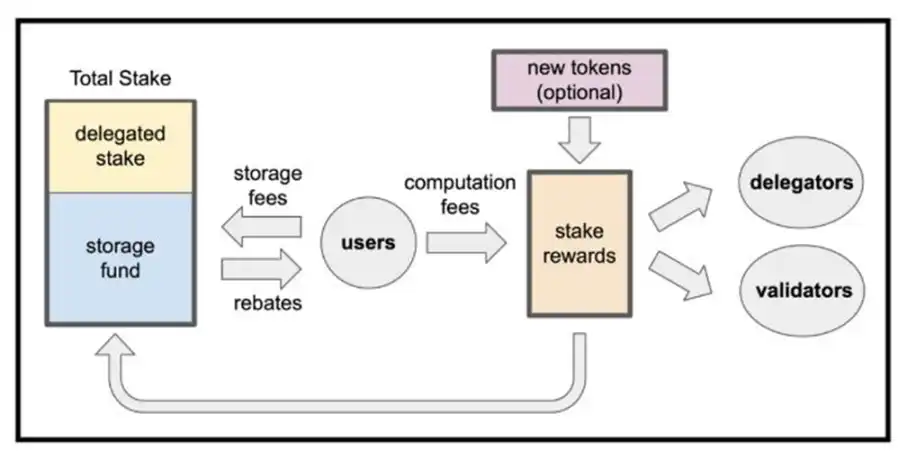
In addition, Sui's storage fund pays a verifier in the system, or the person who actually stores the blockchain data and does its maintenance. As the maintenance work increases, so does the expense to the verifier, which also incentivize more people to become verifiers in the system, and as more people become verifiers, the total amount of available storage space increases, further leading to lower gas costs for writing to the blockchain. Sui's token economics model is a typical representative of a highly scalable chain economy model, which uses game theory to ensure that gas fees remain relatively constant throughout the life cycle of the blockchain.
Review of Sui Ecological Project
Mixed liquidity trading application MovEX
MovEX is the first AMM+ Order Book Mixed Liquidity DEX on Sui, which combines the best of AMM and order Book to provide a liquidity trading experience for everyone by creating a mixed liquidity pool. Internally, MovEX has a clearing engine that distributes orders between the AMM and the order book, which ensures both minimal slippage for traders and fairness for liquidity providers. Liquidity providers can also provide single-sided liquidity in a custom price range, which can effectively manage volatile losses.
MovEX supports market price trading and limit order trading, two features common to centralized trading platforms. Ordinary users can provide liquidity to the flow pool at a customized price range; Professional traders and liquidity providers can become liquidity providers through the order book, similar to market makers on a centralized exchange. Currently, the MovEX product is still in beta, and users can play with it by linking to the app via Sui Wallet.
Sui Wallet
Sui Wallet is a browser extension that acts as a portal to the Web3 world, allowing users to connect to DApps and sign human-readable transactions from trusted DApps. It is the official wallet for Sui Blockchain, allowing users to create, import, and persist mnemonic and derived private keys, transfer coins and NFT, as well as view alternative tokens and NFT owned. Sui Wallet was originally developed for testing use by Sui developers, and is currently the most recognized wallet on the testnet.
Decentralized trading application Suiswap
Suiswap is the DEX of the automatic Market Maker mechanism (AMM) on the Sui chain, which supports the exchange and trading of native assets within the Sui ecosystem. At present, Suiswap supports users to receive test tokens for trading or set up LP to provide liquidity for the liquid capital pool. The final form of the product will not be seen until the main network of Sui goes online.
Excess mortgage lending application Leizd Protocol
Leizd Protocol is a de-centered lending application in the Sui ecosystem, which adopts the form of excess mortgage to operate the lending function. This should be used to decentralize the dollar stablecoin USDZ as an intermediate asset. Like the MakerDAO on the Ethereum chain, the risk of lending products can be controlled by minting stablecoin. In LeizdProtocol, the borrower can deposit crypto assets as security to make USDZ, then lend the required USDZ, convert it into USDT or USDC and other stable coins for use, and then withdraw the mortgage assets by returning the borrowed USDZ and interest at maturity. Depositors can also pledge crypto assets to mint USDZ for deposit interest, or convert USDZ into other crypto assets and then deposit in the deposit pool to earn interest.
The Leizd Protocol plans to be deployed on both the Sui and Aptos networks in multiple chains, allowing users to borrow from assets on both chains. However, the Leizd Protocol test product is not live yet, and the product is still in the concept phase.
NFT trading platform BlueMove
BlueMove, a platform that supports NFT creation and trading, has been successfully deployed on both the Sui and Aptos networks. The platform's smart contract uses a modular system and clearly defines the scope of execution through standardized signatures, allowing new features to be rolled out over time without compromising security, such as aggregate quotes, feature quotes, and multiple cancellations.
In addition, BlueMove has issued a total of 300 million MOVE tokens, of which 5% is used for airdrops, 40% is used to reward traders and collectors who actively participate in the platform, 15% is used to reward users for pledging MOVE tokens, and the rest is used for financing and team development. The main utility of MOVE tokens is on-chain governance and membership benefits.
Currently, users can buy or sell NFTS on BlueMove and earn MOVE rewards. In addition, users can also pledge MOVE tokens to get the platform's share of transaction costs and additional MOVE rewards.
Web3: Abyss Worlds
Abyss World is an action role-playing game developed by Metagame Industries based on the Sui Layer 1 blockchain with powerful Web3 technology and gaming experience. It brings together Web2 and Web3 gamers, allowing players to experience immersive gaming fun in a virtual world. Various characters, maps, and stories in the game will be powered by Sui Blockchain technology, allowing players to create real game worlds. According to the roadmap, Abyss World will officially open to public beta in the third quarter of this year.
In the gameplay of Web3, NFT is the key option to attract users to participate in the project early. On March 23, Abyss World started the first sales event of the NFT Gazer series. These NFT's are not just small pictures, but are tied to in-game rights and features: Those who hold them can share in potential in-game revenue, gain access to more rare items and skins, and gain early access to the game's private beta. In addition, due to the deep cooperation with Mysten Labs, NFT was not only bound to AWT, the original token of the game from Abyss World, but also the rights and interests of Sui token airdrop, which can be regarded as the head project of Sui Ecology at present.
summarize
Sui is the first licenseless Layer1 blockchain designed from the ground up and is dedicated to providing a more user-friendly experience for Web3 users. However, technology can only be valuable if it solves real problems, and can only be truly successful if people are willing to pay for it. Sui has been focusing on the innovation and application of underlying technologies, which has brought it rich technical advantages. With Sui's main network about to go live, now is the time to turn these technological advantages into market competitiveness. With the Wave to Mainnet series, Sui is moving from behind the scenes to the forefront, showcasing the technological prowess that has been built up over the years. Going forward, how the underlying technology will drive the overall DX/UX and who will be able to attract more users and liquidity will be questions that will be answered over time.
Original link
Welcome to join the official BlockBeats community:
Telegram Subscription Group: https://t.me/theblockbeats
Telegram Discussion Group: https://t.me/BlockBeats_App
Official Twitter Account: https://twitter.com/BlockBeatsAsia