Caught in a 'black on black' situation? Analyzing how MEV bots become ATMs for hackers.
Original Title: "MEV Robots Turned into Hacking ATMs"
Source: ODAILY Star Daily
This afternoon, a cryptocurrency user named 3155.eth posted that some top MEV robots are becoming targets for hackers. The transaction module in their "sandwich attack" has been replaced, causing losses of over $20 million. This could be a major turning point for the entire MEV ecosystem.
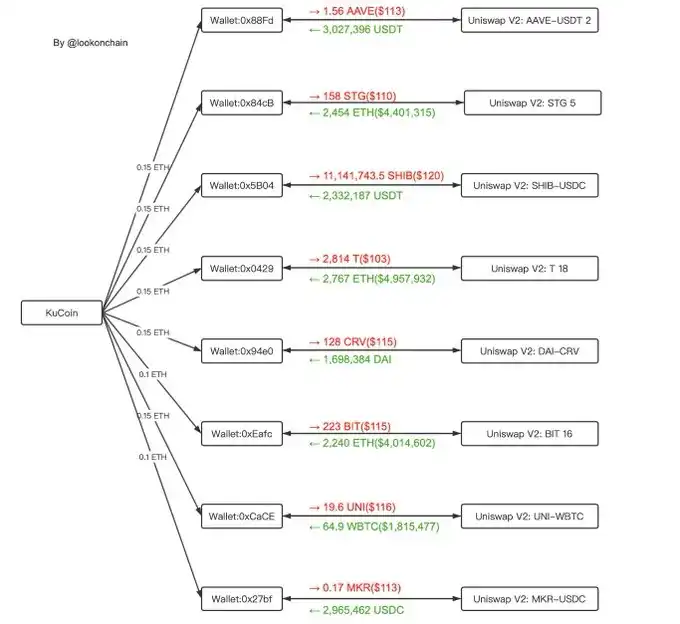
Odaily Star Daily found that a hacker attack occurred about 10 hours ago (Ethereum block height 16964664). The hacker used eight wallet addresses (with original funds from Kucoin on the chain) to attack five MEV robots, respectively:
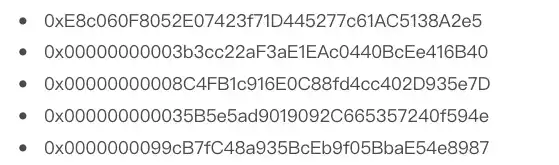
According to on-chain analysis firm Lookonchain, the current total loss is about $25.2 million, mainly involving five major currencies, as follows: 7461 WETH ($13.4 million), $5.3 million USDC, $3 million USDT, 65 WBTC ($1.8 million), and $1.7 million DAI.
Before understanding this attack, we first need to know what MEV is and how MEV implements sandwich attacks.
The so-called MEV is the abbreviation for "Miner Extractable Value" or "Maximal Extractable Value". Miners or validators have the ability to sort transactions within a block, allowing some transactions to be prioritized. Typically, some MEV robots will pay high GAS fees to obtain priority sorting of transactions by validators, profiting from the price difference. Of course, there are also validators who directly package their own transactions without paying high GAS fees but still prioritize them.
The benign form of MEV involves arbitrage and liquidation, while what DeFi players criticize is the "sandwich attack", which involves "cutting in line" before the original transaction to buy assets and then selling them at a higher price to the original buyer. Typically, a bundle can be split into three transactions: 1) a large purchase, 2) the transaction of the sandwiched user, and 3) a large sale.
The security company CertiK told Odaily Star News that the reason why the hacking attack was successful is that the hacker became a validator and was able to see the original information of the MEV robot bundle, thus replacing the second step with their own transaction and exchanging the MEV robot's funds with cheap tokens.
To mine transactions, validators need to access certain specific information, just like in the public mempool. Malicious validators can obtain information about the bundle. Typically, flashbot validators are reliable and have been verified (such as completing KYC on MevHUB) to increase the credibility of the data source. However, in this incident, the malicious validator obtained the necessary information, allowing them to act ahead of the MEV robots.
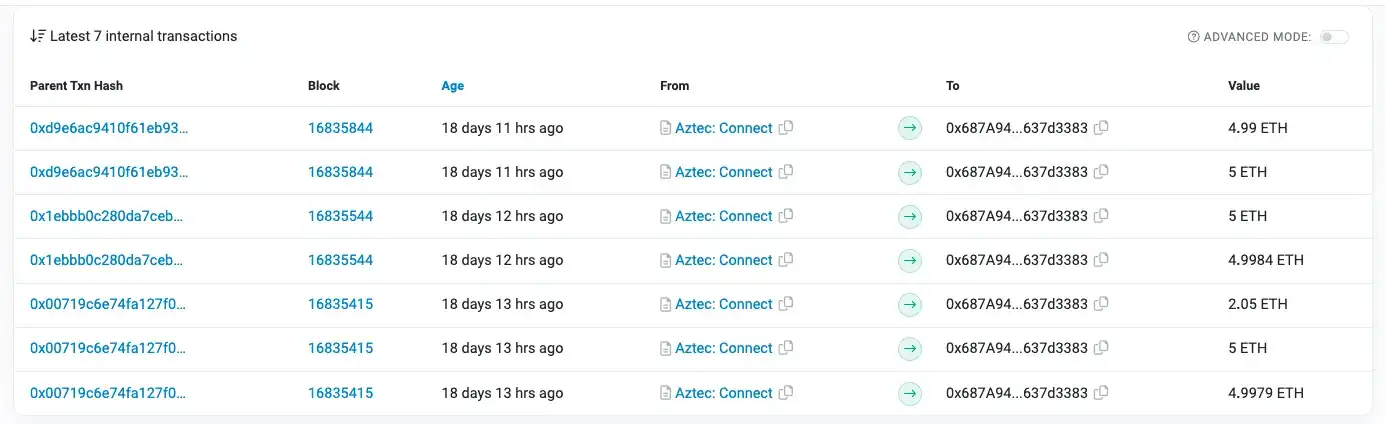
Odaily found through on-chain data that Ethereum block 16964664 belongs to Slot 6137846. Validator 552061 proposed the block and their 32 ETH funds were transferred through the privacy protection protocol Aztec Network by hackers in 18 days. The funds were sent to an address starting with 0x873f73, as shown below:
After completing the preliminary preparations, the attacker will test whether the MEV robot will front-run the transaction. For example, in the figure below, we can see that the attacker tests the MEV robot with 0.04 WETH, luring the MEV robot to front-run arbitrage. It was discovered that there was indeed an MEV robot monitoring the ETH/Threshold pool of Uniswap V2 and using all of its funds for arbitrage. During this period, the hacker also tested whether the MEV was using its own validator for block production.
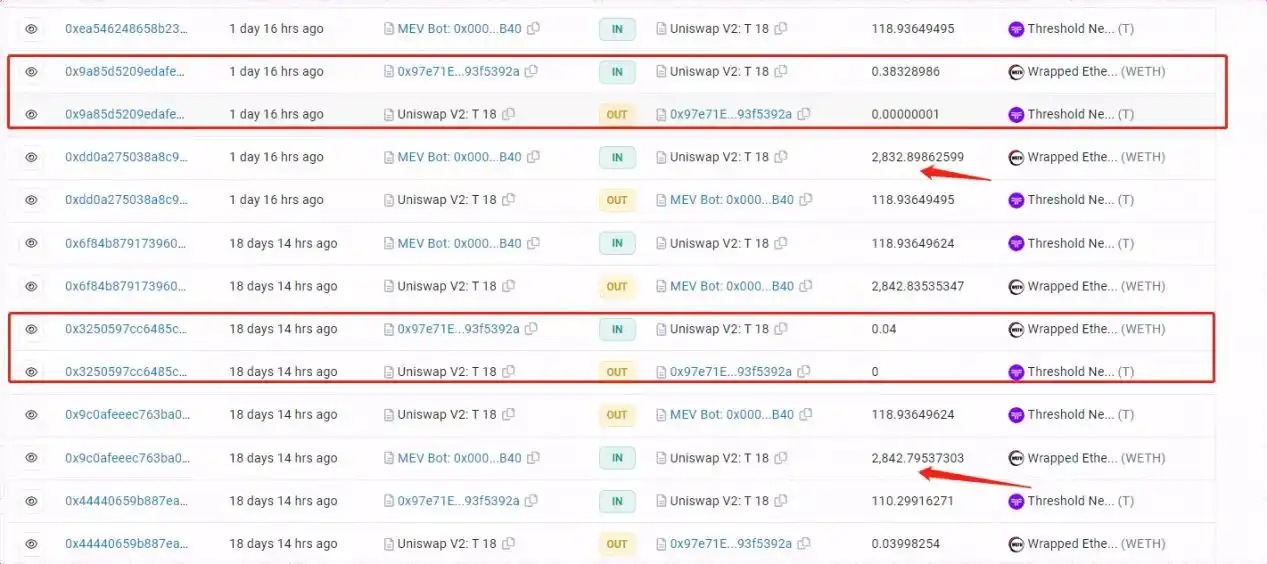
After successfully probing, hackers will use a large amount of tokens previously exchanged in Uniswap V3 to conduct exchange operations in low-liquidity V2 pools, enticing MEV to use all of its WETH to purchase worthless Threshold tokens; then exchange the Threshold tokens for all the WETH invested by the MEV robot. Since the WETH used by the MEV for front-running has already been exchanged in the attacked transaction, the operation of the MEV robot trying to exchange back to WETH will fail.
Other than the aforementioned Threshold token, the hackers also manipulated seven other addresses to manipulate the prices of seven tokens in the Uniswap V2 pool, including AAVE, STG, SHIB, CRV, BIT, UNI, and MKR, in order to profit, as shown below:
The security company Beosin believes that there are three main reasons why hackers can succeed: first, MEV uses all of its funds without risk control every time it arbitrages in low liquidity pools; second, V2 pool has low liquidity and is manipulated by hackers; third, hackers have verification node permissions and can modify bundles.
This attack incident also served as a wake-up call for MEV seekers. In order to avoid "sandwich attacks", it is necessary to adjust trading strategies in a timely manner and choose some "reliable" validators with verified historical records. Currently, the relevant funds have been gathered in the following three addresses, awaiting further action.
0x3c98d617db017f51c6a73a13e80e1fe14cd1d8eb;
0x5B04db6Dd290F680Ae15D1107FCC06A4763905b6;
0x27bf8f099Ad1eBb2307DF1A7973026565f9C8f69。
Original article link
Welcome to join the official BlockBeats community:
Telegram Subscription Group: https://t.me/theblockbeats
Telegram Discussion Group: https://t.me/BlockBeats_App
Official Twitter Account: https://twitter.com/BlockBeatsAsia

 Related Articles