Panorama and cutting-edge development of MEV track project
Original title: "In-depth | A comprehensive overview of MEV's frontier development and track project panorama"
Original author: Benny Attar
Original compilation : The Way of DeFi
The introduction to the dark side of the blockchain first appeared on Reddit in an article titled "Miners Frontrunning", in this historic article, based on the openness of the Ethereum mempool, the author outlines how miners can use it to front run The process of trading and arbitrage from it. Of course, this is not a new thing in the financial field. In the book "Flash Boys" published in 2014, Michael Lewis described the trading frontrunner in high-frequency trading, and then published "Flash Boys 2.0" paper, he applies these observations to the blockchain domain and shows that in this so-called How people use bots for widespread trade arbitrage in a fair financial system. According to statistics, until the merger of Ethereum in September this year, the cumulative value of arbitrage transactions in the blockchain system has exceeded 675 million US dollars!
MEV (Maximum Extractable Value) is probably the worst buzzword acronym in the blockchain industry, it is made up of validators, Miner nodes, block producers, etc. work together to obtain income by reordering transactions in a block. Of course, MEV is not exclusively extracted by block producers, arbitrage traders and bots called "seekers" also examine blockchain data for arbitrage opportunities. Usually, searchers and verifiers work together to find potentially profitable transactions on the blockchain, so MEV has also become a general term for arbitrage transactions that occur on the chain.

"https://www.wujiebantu.com/ai" target="_blank" rel="noopener nofollow">Unbounded layout AI generated
< /p>
MEV attack type
Arbitrageurs, bots and scripts can also be applied from the blockchain A considerable proportion of MEVs were extracted from . To some extent, MEV can be defined as the hidden tax behind every on-chain transaction, and before we analyze the big picture of MEV solutions, it is also important to understand the types of MEV attacks that occur in the ecosystem. Of course, there may be other types of attacks that we don’t yet know about, but below are some of the most typical exploits that exploit MEV.
Front-running
Front-running means that the robot pays close attention to the memory of a blockchain network Pool, and look for profitable transactions from it. Once such an opportunity is found, the frontrunning robot will initiate the same transaction and pay a higher gas fee to obtain the potential profit of the frontrunner.
DEX Arbitrage
Given that automated market makers can provide liquidity for tokens at different prices at any time, this It provides the possibility for those robots who want to arbitrage through price differences. For example: when two DEXs provide liquidity for a token at different prices, a robot can buy on one of the lower-priced DEXs and sell on the other. In fact, in many cases, DEX arbitrage is not always good for the development of the ecological network. More often, DEX needs to constantly rebalance the capital pool to maintain the healthy development of DEX.
A trailing transaction
A trailing transaction is when the transaction sender wants their transaction to be in the "target After the transaction order". Typically, these transactions may be to take advantage of new token listings, or rebase tokens (such as AMPL), or to take advantage of price differences after large transactions on DEX.
Clearing
As a backtracking strategy, the searcher continuously analyzes the blockchain Based on data on currency fluctuations and price oracles to determine where a borrower's lending agreement can be settled. Once the position can be liquidated, the bot submits the liquidation trade and profits from the liquidation fee
Sandwich Attack
The searcher scans the memory for potentially large transactions. Before the transaction occurs, the searcher buys an asset that will eventually appreciate in value, and immediately after the whale's transaction is executed, the searcher sells the same asset, thus "Clamping" this large amount of transactions (commonly known as clips), liquidity providers can also use sandwich attacks to create higher slippage.

Sandwich Attack Visualization of Arbitrage Bots (Source: < a href="javascript:;" target="_blank" rel="noopener nofollow">Liyi Zhou )

Liquidity provider sandwich attack Visualization (Source: Liyi Zhou )
Time Bandit Attack
Time Bandit Attack is a higher level form of MEV attack, namely Reorganize past blocks into which new blocks containing changed transactions are proposed, at the expense of network users. Although this kind of attack is extremely difficult to achieve, if it happens, it will definitely affect the security and consensus of the blockchain.
NFT MEV
Searchers or block producers can design transactions to be the first A person who buys a popular NFT, or buys more NFTs in the same transaction.
JIT Liquidity
Just-In-Time is a MEV transaction Another form of sorting, LP providers immediately mint and burn positions before and after swap. Although it is very competitive, it improves the execution of transactions, otherwise it will be affected by high prices. In addition, The number of transactions concluded through JIT liquidity is actually very small.

JIT Liquidity Visualization (Source: Jon Charbonneau, Delphi Digital )
There are some other interesting MEV attack forms, such as: cross-chain MEV, stable currency arbitrage, uncle-bandit attack, etc.
MEV benefits and Bad
At first glance, MEV appears to be an existential threat to the blockchain. Hidden transaction costs hidden under wallet signatures are certainly not economically beneficial for a new technology paradigm, and MEV is indeed one of the few reasons that degrades the experience for both novice and advanced users. For example: users suffer from greater slippage and poorer execution of large transactions (due to sandwich trading and DEX arbitrage), increased GAS and slower on-chain transactions (due to frontrunning transactions), and possible consensus stability threats (validator reorganizes the block), etc.
However, while there are negatives, the existence of MEV also has some positives, such as: arbitrage traders ensure that token pricing is the same across AMMs, Mechanisms that satisfy stablecoin parity, ensure smooth liquidation of DeFi loans, maintain incentives for block proposers to increase blockchain security (by providing higher rewards), etc.
Regardless of the positive and negative effects of MEV, MEV will always exist, especially in the post-merger blockchain world. Now, given the different ways of living with MEV and others in the blockchain, there are also different ways to face the impact of MEV. There are several different ways of classifying and treating MEVs. We can divide according to our cognition and views on MEV problems:
1. Offensiveness--MEV is inevitable, we should find an alternative method to More democratized value extraction.
2. Defensiveness -- MEV is an existential threat and we should prevent it.
Possible places for these solutions:
1. P2P layer
2. Application layer
In theory, all MEV protection schemes are established on the chain, But some are only used on the application level through specified frontends. Calling these user-facing platforms the application layer, and looking at the space for MEV solutions through this lens, I created four quadrants of MEV protection.
These four categories are.
1) Offensive on-chain protection
2) Offensive application layer
3) Defensive on-chain protection
4) Defensive Application Layer

In this article, I will I introduced the different players in each quadrant and how they solved the MEV dilemma, and I also offered some of my thoughts on the development of the industry. Due to the rapid development of the entire industry, some solutions cannot be fully covered. If there is a demand, I will publish a follow-up article to outline the solutions that I have not introduced.

Four-quadrant protection application diagram of MEV
Offensive on-chain protection
Flashbots
Flashbots is a Research and development organizations working to mitigate the negative impacts of MEVs. Through a series of product research, Flashbots has become one of the leading organizations to democratize and redistribute MEV revenue, while also bringing more transparency to the ecosystem. To understand the Flashbots ecosystem, we start with the Flashbots auction.
Flashbots auction
Flashbots auction is ether A private communication channel between Square users and validators for efficient communication of preferred order of transactions within a block. Flashbots auction was originally launched as a patch on the go-ethereum client combined with mev-relay (transaction packet relay) on POW Ethereum. Now on PoS Ethereum, Flashbots auction is built on on MEV-Boost (more on that later).
Flashbots auctions skip traditional open-bid auctions, which tend to create unnecessary network congestion and impose additional costs on bidders. Flashbots auctions allow users to privately communicate their bids and transaction order preferences without paying for failed transaction bids, while maximizing validator rewards and preventing frontrunning transactions. The combination of private transaction pools and sealed bids ensures fairness on the Ethereum network and the construction of the best blocks.

MEV-Boost
Flashbots auction moved to mev-boost , which is the implementation of the separation of proposer and block builder (PBS) in PoS Ethereum. MEV-Boost minimizes the downside of MEV by letting validators outsource block building to a competitive market of block builders and accept the most profitable block building through services called relays Influence. MEV-Boost enhances the security and decentralization of Ethereum, enabling validators to receive PBS-enabled MEV rewards regardless of the validator size, making MEV not just a game for the few.
Transactions are typically uploaded to the blockchain in two ways: public mempool or via private RPC (also known as Single Order Stream). Either way, the MEV-Boost transaction flow is similar. Transactions sent to the public mempool are sorted by "seekers". These bundles are usually sorted in such a way that they extract the most MEV. Seekers then send their bundles to block builders who maximize MEV profit. way to collect bundles while building them on blocks. Ultimately, they send blocks through the relay (with a set of bundles built in), the relay aggregates blocks from multiple builders and ranks them in order of reward, in addition to filtering and reviewing them, and finally, the validators The most profitable block received from MEV-boost is selected and added to the Ethereum network.

Source: Flashbots Github< p style="text-align:center;">
The Four Main Participants of MEV-Boost
1) Seekers are bots, veteran Ethereum users, traders, or anyone actively searching mempools for arbitrage opportunities that can find profitable trades and attempt to convert their trades to Included in a block, Seekers collect transactions, add them to a bundle, and send them to block builders.
2) Block Builders are a specialized entity that connects to Seekers and fetches bundles (consisting of transactions) that create the final block via Relays send to validators.
3) Repeaters collect blocks from multiple block builders and select the most profitable block (determined by builder's bid ) are sent to validators for proposals. Relayers play a vital role in censorship as they are able to pick and choose which blocks to include (more on that later).
4) The verifier uses MEV-Boost to subscribe to one or more relays, finds the most profitable block received by the relayers it subscribes to, and performs final verification and uploads to the chain.

MEV-Boost running process
Since Ethereum has not yet fully added PBS to its protocol, MEV- Boost is currently an accessory tool for the block production and MEV minimization ecosystem. With the upgrade of Ethereum, MEV-Boost will eventually be directly incorporated into the base layer of Ethereum through Proposer Builder Separation (PBS), and the roles of builders and proposers will be completely separated at the base layer. As shown in the figure below, most of the current MEV-Boost Boosted blocks are implemented by Flashbots:
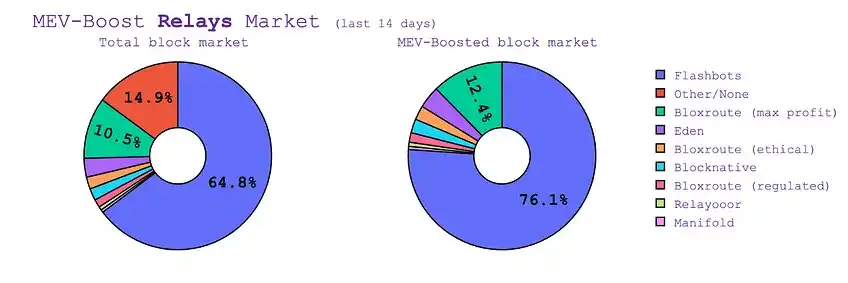
MEV-Boost repeater market share
What is most impressive, however, is that the full functionality of MEV-Boost operates entirely on trust.

Source: Jon Charbonneau
Flashbots Protection
In addition to Flashbot's MEV protection at the validator level, Flashbots offers several products for any blockchain user to protect themselves from MEV. Flashbots Protect is Flashbot's leading protection tool for users and developers.Flashbots Protect RPC Allows normal users to easily submit their transactions to Flashbots auctions by using a custom RPC endpoint in their wallet. For users, everything is the same, except transactions are sent to the Flashbots builder instead of the public mempool. Therefore, these transactions are completely private and will not be seen by arbitrage bots lurking in the mempool.
Review of issues, shortcomings and subsequent developments
Despite the incredible progress Flashbots have made, there are still some issues with their solution which are current Faced in the technical mode, for example, if the entire network is connected to the same relay and the relay is the highest bidder, it will naturally be selected by the validator, but what if the relay withholds the block? That would end up creating an endless stream of empty slots to post to chain, a concern known as liveness issues. Fortunately, Flashbots outlined two possible solutions once PBS is incorporated into ethereum Not only that, but if MEV-boost has no repeaters running or all repeaters are offline, then the beacon node will fall back to the public mempool to build blocks.
< p>Another problem with Flashbots is their centralization. Since it is a private organization that maximizes the interests of Ethereum, there will always be a line between what the Ethereum community wants and what it does not want. Recently, Flashbots announced that it would begin reviewing transactions blacklisted by the U.S. Treasury Department’s Office of Foreign Assets Control (OFAC) (i.e., all Tornado Cash transactions) in light of U.S. Treasury sanctions, and proposed Several philosophical questions related to blockchain. Regardless, the vast majority of transactions on MEV-Boosted blocks are OFAC compliant, and it's certainly moving in that direction.

Screenshot from MEV Watch November 8, 2022
Recently, Flashbots announced that they are working on the next iteration of their software - "SUAVE". Judging from the early preview, SUAVE seems to be a MEV-aware encrypted memory pool for users and wallets. They plan to develop in the direction of complete decentralization, open source, EVM compatibility, and support rollup and cross-chain. Very excited about this and hopefully this will be a new paradigm changing MEV.
3.2 Manifold Finance
Like Flashbots, Manifold Finance built its technical infrastructure to minimize the negative impact of MEV. The foundation of Manifold Finance is their Secure RPC system which allows users to submit secure and private transactions. By sending orders to RPC endpoints like Manifold's SecureRPC or Flashbots, users' trades are routed through an intermediary, which protects users from searcher arbitrageurs in public pools.
On top of their SecureRPC, Manifold provides several product. OpenMEV (formerly known as YCabal), an SDK that enables protocols and applications to prevent MEV arbitrage, fact On the Internet, Manifold Finance already has some big-name partners, such as: Sushi Guard, which is Sushi's OpenMEV implementation. Whenever you submit a trade on SushiSwap, if your trade qualifies for a refund of its transaction cost, you will get ~90% rebate. However, if your transaction is not eligible, it will be submitted immediately via a private RPC layer. While you won't get trade rebates, you still benefit from protected trade submissions. Manifold Finance also runs their own MEV relay (similar to Flashbots) which is censorship resistant (unlike Flashbots). You can see the entire ecosystem around SecureRPC in the diagram below.

Source: Manifold Finance Docs
The Manifold Finance ecosystem revolves around their FOLD token. All MEV captured by OpenMEV is then redistributed: 50% to users, 25% to validators and 25% to xFOLD stakers. They are expected to announce the V2 release of their staking product soon, which is what the community is looking forward to. However, as impressive as it is, Manifold Finance's documentation is incomplete, making it impossible to dig out the full technical details of its product. Also, I have some concerns with things like their staking organization, company and founder presence on social media, and their token economics model, whether these concerns justify not vetting transactions, especially when When this problem is very minor, it's an open question. Overall, Manifold Finance has an opportunity to take control of the MEV ecosystem, but only if they do it right.
3.3 BloxRoute
After Flashbots, BloxRoute is becoming the second largest repeater provider. They currently run three different repeaters: BloXroute Max Profit, BloXroute Ethical, and BloXroute Regulated. Here are their specs:

Source: BloxRoute official document ;
The chief Executive Uri Klarman has told CoinDesk that BloXroute believes that deciding whether a validator should or should not include sanctioned transactions is not a matter for us to consider, opting to launch a relay will review Tornado based on user judgment and specific laws.
In addition to BloxRoute's repeater product, they also have an offensive app product called BackRunMe that allows users to securely submit private transactions while allowing search Those who follow the transaction through MEV to generate additional arbitrage profits. The private trading feature keeps your trading pairs hidden from public pools of frontrunners and sandwich bots. Additionally, BackRunMe returns a portion of this extra profit to the user if a follow deal is available. These background transactions will not affect the transaction submitted by the user, because it happens after the transaction is confirmed, so it is a win-win for everyone. Currently, BackRunMe is available on SushiSwap and Uniswap V2.

Working principle BackRunMe

Profit sharing ratio Backrunning
BloxRoute also offers a protective product called Fast Protect , available for all Dapps on Ethereum, although it is not so beginner friendly, BloxRoute is also one of the leaders in MEV protection.
3.4 Eden Network
Eden Network is The fourth offensive on-chain solution for MEV. Similar to the three above, Eden has three related but distinct MEV protection products: RPCs, repeaters, and bundles. Eden RPC is an RPC endpoint that users can add to their wallets to send their transactions to Eden builders. Eden RPC powers Eden relays, which connect validators to the block builder network to maximize validator efficiency. In this way, users are guaranteed not to be ahead in Eden blocks. Finally, via Eden’s RPC, Seekers can send “bundles” to Eden’s network of block builders. Of all the MEV-Boosted blocks, Eden does a good job (close to Flashbots).

MEV-Boosted slot proportion source: MEVBoost.Pics
Another relay provider worth mentioning is Blocknative. Their repeater, called Dreamboat, is publicly available, transparent, but filters sanctioned addresses. The issue of transaction censorship is one that is up for debate, and one that has been discussed a lot in the blockchain community lately. No matter which side you are on, there will be some controversy, Flashbot and the whole MEV-boost ecosystem have done a lot of work for blockchain and MEV, and I am looking forward to the next development of the MEV space.

MEV-Boost controversy
In addition to the MEV-boost product, there are several well-known projects worth mentioning that are building products related to on-chain attack protection.
3.5 Skip Protocol
Skip Protocol is building MEV products that match its ecosystem on Cosmos, amplifying the effectiveness of MEV, and minimizing the impact of bad MEV, and rewarding those MEV Redistributed to validators and stakers. Skip found the following issues on the Cosmos chain, as this is a first-come, first-served mempool:
1) Execution risk: During periods of high chain congestion, there is no way to say that certain transactions are "more important" or more economically valuable to traders or the ecosystem, which happened widely during the May-September Terra crash.
2) Wasted block space and GAS: You will find that behind a lot of arbitrage opportunities there will be blocks with multiple failed transactions block (for example, Terra Classic block 5635240).
3) Profit Concentration: Almost all arbitrage opportunities are captured by very few addresses, which may be owned by several high-frequency trading organizations control, which amounts to a hidden tax on Cosmos users and validators.
4) Participant Integration:MEV Seekers and Validators are incentivized to vertically integrate their bots and nodes on the same on one server for faster mempool access and transaction broadcasting. (For example, we have seen progress in partnerships between MEV searchers and validators on priority access), which undermines long-term decentralization.
5) Chain stop risk: Mass spam may break full nodes or validators (when they expose ports).
Thus, Skip's proposed solution is to create a system of sealed-bid, closed auctions that allows traders to submit tipped transactions to validators, who Block cases are prioritized in blocks.

Skip Protocol transaction ordering
By doing this, validators can earn more rewards per transaction, and as MEV rewards are distributed to stakers , the pledge profit will increase, which is a win-win situation.
Recently, Skip announced their Skip-Select product, allowing validators to have full control over how they structure their blocks. Validators can choose how MEV rewards are distributed, choose whether or not Skip builds their blocks, choose compliance, choose governance, and various other various MEV preferences. This is part of their Sovereign MEV vision to allow Lisk stakeholders, validators and core developers to decide How their MEV marketplace works. To that end, they are developing the MEV-SDK, which brings these preferences and block builder rights on-chain. As of this writing, Skip is active on Juno’s testnet and mainnet, and will launch on Evmos, Terra2, and other Cosmos chains soon. Additionally, they have been negotiating various collaborations with Osmosis. You can track how many validators are actively running Skip on your dashboard here.
3.6 Jito Labs
Unlike the previously mentioned projects in the Ethereum and Cosmos ecosystems, Jito Labs' mission is to scale Solana with high-performance MEV infrastructure. Given that they fall into the offensive MEV category, they try to minimize the negative impact of MEV while maximizing the impact of good MEV and redistribute the benefits to users. With three different products working together, Jito leads the way in minimizing MEV on Solana.
First, validators run Jito-Solana, a modified Solana Labs validator client that allows validators to create "bundle" transactions that allow search Investors and high-frequency traders have the flexibility to execute trade sequences. The open-source Jito-Solana validator is the heart of the network, managing communication with Jito-Relay, which performs filtering and signature verification of transactions being processed. The highest bid and most profitable bundles are sent from relayers to validators for eventual addition to the chain. Additionally, Jito provides a block engine that connects relayers, searchers, and validators through an off-chain sealed-bid auction to add transactions to the chain. The block engine simulates each combination of transactions and forwards the highest paying batch of transaction packets to the leading validators for fast execution. When the auction expires, the most profitable bundle is sent to the leader, cleverly, this block engine is globally distributed to ensure validators and searchers have low-latency access no matter where they are .

Verifier MEV profits are redistributed at the end of each epoch, here's a cool spreadsheet by Jito , used to calculate the validator profit before and after MEV.
Finally, the offensive on-chain camp has made incredible progress in MEV protection shares. I hope to continue to see them innovate as validators are the foundation of every network. We will now analyze the ecosystem under the offensive application MEV.
Offensive Application Layer
Offensive Applications see MEV as inevitable, so they provide application and user-facing solutions to extract the value of MEV and democratize it as much as possible. We've already discussed BackRunMe above (as it's part of the BloxRoute product), so we'll dig into the other two major players in this camp.
4.1 Rook Protocol
Rook Protocol is One of the first MEV extraction solutions designed to capture MEV at the application layer, protect users and protocols from negative external influences, and reduce the total MEV available at the consensus layer. Ultimately, Rook redistributes MEV profits among participants in a way that increases overall network and market efficiency.
The Rook Protocol relies on ROOK to function, an ERC-20 governance and utility token used to discover the value of MEV in transactions as they are processed . Everyone using the Rook protocol — users, smart contracts, market makers, keepers, etc. — is connected to the ecosystem through the ROOK token. Keepers are automated bots that complete users' transactions, stake ROOK into smart contracts and receive xROOK in return. Keepers constantly observe the transaction mempool to look for arbitrage opportunities. Once a profitable transaction is found, Keepers will use their xROOK to bid for a chance to execute the transaction. The coordinating auctioneer module will give the green light to the Keeper that won the auction. transaction, allocating the cost that the Keeper paid for the opportunity. At the same time, ROOK token holders can put their ROOK into the Rook staking pool in exchange for xROOK, and a portion of the value captured in each bid goes directly to xROOK holders, giving them a utility that directly corresponds to the Rook protocol and MEV earnings.

The off-chain order book uses Rook's " Hidden Order Book" to host transactions that can only be done by Rook Keepers. Orders sent via the hidden book are inaccessible to other predatory MEV bots, thus allowing users to receive their trades at their target price. Rook's hidden order book can even be integrated through their own DEX, game, API or through their partners.

4.2 B.Protocol
B.Protocol is Another aggressive application-level MEV solution. However, it is mainly focused on the lending and liquidation space (contrary to other solutions mentioned, this one is biased in the direction of DEX, front-running and sandwich attacks). B.Protocol democratizes liquidation, ensures greater capital efficiency, and counters MEV.
On the B.Protocol integrated platform, it pools users' funds into a Backstop pool for liquidation. When funds sit idle, they stay in the yield platform and generate passive income (interest rate or liquidity mining rewards) for users. Once liquidation occurs, the smart contract draws the required funds from the backing to facilitate the liquidation and automatically sells the seized collateral. Once sold, the proceeds are deposited into the pool, generating a profit. This video gives a good overview of how it works.

By creating A democratic pool that anyone can participate in, B.Protocol shares MEV profits with users who deposit collateral and gives them liquidation priority. B.Protocol is currently live on several leading projects, including Liquity’s Chicken Bonds. What sets B.Protocol apart is that it is the only player in the MEV protection space that focuses on the clearing space, a niche category of offensive application layers.
At present, the number of participants in the MEV offensive application layer is relatively small, but each project has its own characteristics, and I am very optimistic about the future of this camp increasingly optimistic.
Defensive on-chain protection
As mentioned earlier, these solutions consider MEV to be an existential threat to the blockchain, so they eliminate it entirely via on-chain and consensus layers.
5.1 Chainlink Fair Ordering Service
This A major player in this space is the decentralized oracle network Chainlink, which securely connects smart contracts with off-chain data. This can be used in everything from financial markets, sports data, and even weather and carbon credits. Chainlink is now going a step further by implementing MEV protection for its smart contract add-ons by introducing (FSS). In short, FSS is an oracle network that can sort the transactions sent to the smart contract. It collects user transactions off-chain, generates orders according to the specifications of the smart contract developer, and distributes the transactions in a decentralized manner. The transaction is committed to the chain.

Fair sorting service process model
In addition, FSS can not only be used for smart contracts in the preprocessing stage, but also for block construction and rollup stages. Currently, FSS has another fully functional prototype, and there is an Arbitrum Pilot project. The entire blockchain and MEV community is looking forward to the full launch of the FSS in the coming months.
5.2 Secret Network
Secret Network is L1 blockchain built on Cosmos IBC with privacy-preserving smart contracts. Secret's smart contracts, known as "Secret Contracts", are private by default. Everything is encrypted (input, output, state, etc.) and cannot be viewed by others unless they are granted access. This opens up use cases that would be difficult to achieve on traditional public blockchains. "Privacy DeFi" built on top of these "Secret Contracts" can protect privacy in the decentralized financial ecosystem. Like traditional DeFi applications, users can trade, exchange, buy, borrow, and sell, but in its These data of users in the system are private by default. Because of this inherent privacy, orders are invisible in the mempool. Therefore, it is safe from MEV preemption and sandwich bots. Secret Network is one of the few protocols that embraces privacy as a right.
5.3 Comos 2.0
Recently, Cosmos Announced their version 2.0 protocol, in which they proposed a solution against MEV - Interchain Scheduler. Unexpectedly, the ATOM 2.0 proposal was rejected by the ATOM community. Even so, it is still necessary to explain the Interchain Scheduler in some detail.
Since the Cosmos ecosystem consists of multiple chains, there is a difference in the prices of decentralized DEX assets in the network. Besides creating obvious DEX arbitrage opportunities, it also introduces more sophisticated front-running and sandwich attacks. The Interchain Scheduler proposes to create an on-chain MEV marketplace to help Appchains of Cosmos sell a portion of their blockspace as tradable NFTs. Through the scheduler, they will reserve block space on participating blockchains through an auction, and the proceeds of this auction will then be redistributed across the ecosystem (stakers, validators, etc.).

Cross-chain scheduling process
Technically more complex, details can be found in Found here.
5.4 Other defensive on-chain tools and solutions
In addition to the above products, there are There are various other defensive on-chain solutions for MEV protection.
Submarine Sends:
This is an open source smart contract library that protects your contracts by temporarily hiding on-chain transactions Protect from the frontrunners. In short, the user submits his transaction to the hidden address, submits the data to the smart contract in a hidden way and locks it, once the submitted transaction remains on the chain, the smart contract unlocks the stored data and verifies it .

Submarine Sends transaction model
All code for Submarine Sends is publicly available on Github, but it hasn't been updated in a few years.
ZeroMEV
ZeroMEV is a complete A decentralized solution for Ethereum validators to protect their users from front-running and censorship. When using MEV-Boost, users sometimes get a few milliseconds ahead. To prevent this, ZeroMEV protects their users by ordering MEV transactions by time instead of gas price. In fact, ZeroMEV protects users from a difference of up to 500 milliseconds, and to use ZeroMEV requires only changing three lines of code in the original Geth. However, currently using ZeroMEV is purely altruistic, as validators may earn less since they only get tips after EIP-1559. However, validators can roll back transactions, creating more profit, and ZeroMEV is still an incredible validator MEV protection tool regardless.
Salmonella Attack
In order to cheat the sandwich deal Bots, Defi-Cartel has introduced a very neat technique to return the power to the traders. Salmonella's idea was as follows: Create a typical ERC-20 token that returns only 10% of the specified amount whenever someone other than the specified owner transacts with it - although the posted event log shows the full transaction. See here It had several major feats in its heyday.

Kattana
Similar to the previous one, this is another application to fool robots. Kattana is a terminal for cross-chain transactions between DEX and CEX. During their token launch, they set a trap for the front-running bots, preventing them from selling their tokens, and sometimes, the predator becomes the prey.
At the end of the day, the defensive on-chain protection camp is pretty advanced, technical, stealthy, and sometimes even humorous. Of course, this camp will make even bigger waves throughout the industry after the launch of Chainlink’s FSS.
Defensive application
Finally, we Let's talk about the last camp - the defensive application area. These solutions see MEV as an existential threat to the blockchain, so they provide applications and user-facing solutions to eliminate it entirely. Many of these are products that novice blockchain users will already be familiar with, but it is important to gain an in-depth understanding of their MEV protection features. To best explain them, they can be divided into several categories.
6.1 Automated Market Maker (AMM)
MEV Capture AMM (McAMM)
There has been a lot of talk lately about MEV capturing AMM. In a nutshell, the idea is as follows: AMMs have the right to auction off the first transaction of each block, thereby selling a potential MEV slot, and redistribute those profits to traders, stakers, and potentially even searchers Or, this proposal is very interesting.
Liquidity Concentration
2021 3 In March, Uniswap announced their V3 version. Among other things, they introduced a whole new paradigm for DeFi and AMMs: centralized liquidity. In short, concentrated liquidity gives LPs granular control over the price range over which their capital is allocated, resulting in greater capital efficiency while reducing slippage while also preventing any asset free fall. Since it has less impact on price per transaction, it certainly has less impact on MEV. Additionally, there is a fascinating JIT liquidity MEV technology on centralized liquidity pools that actually benefits traders. While centralized liquidity does not completely eliminate MEV, it certainly minimizes it.
There are various other MEV-resistant AMMs such as: Hashflow, Duality, SwapSwap and Wendy (a key feature of Vega Protocol). The field of MEV protection is thriving with innovation and I am very much looking forward to the next phase of development here.
6.2 DEX Aggregator
For those For those who are not familiar with DEX aggregators, the simple understanding is: they connect hundreds of DApps together and provide the best exchange ratio through these different liquidity pools.
1inch
This is the most famous and The most widely used DEX aggregator. Recently, they partnered with Flashbots to protect their users from front-running and sandwich attacks. Now through 1inch users can choose to have their transactions routed through Flashbots, which enables a direct connection between validators and 1inch. However, I'm not sure if it was updated or if it still works after the merge. Another leading protection tool offered by 1inch is "automatic slippage" which minimizes bots taking trades as The possibility of the target, as it has a low tolerance for slippage, so there is less room for manipulating the amount that the user needs to return.
CowSwap
You can understand it An aggregator that aggregates DEX aggregators. Transactions on CowSwap can be settled through on-chain automatic market makers, other DEX aggregators, etc. CoW is point-to-point matching, so everyone can get better prices, and no one pays unnecessary AMM fees because It searches for the potentially best trade price for all other liquidity. In the transaction center, CoW submits these transactions to the chain in batches, hides them in the public memory pool, and effectively prevents miners from reordering transactions and sandwich robots. CoW Protocol is certainly unique in this regard.
Some other defensive application layer MEV protection solutions such as MistX Labs, DFlow and Shutter Network. There is a lot of competition in this space, but each player makes an important contribution to reducing MEV and protecting users. One of my predictions is that in the future, DApps that do not protect users from MEV will not be favored by users, and MEV protection will become the industry standard.
The Present and Future of MEV
Now We've seen the full picture of the MEV solution, and more importantly, the issues that remain, as well as understanding where the next innovations will take place.
First of all, like most other problems in the blockchain, this problem is too complex, and the threshold for ordinary users to understand is high. The vast majority of blockchain users tend to trade with poorer execution rates, and while losing pennies per trade may not be such an issue in the short term, without understanding these issues blockchain will never It will develop into a larger application field. Furthermore, the solutions described above are also very complex and require an understanding of various actors, and the perception of MEV does not drive its adoption, which is a matter of philosophical category.
Secondly, these solutions that are being offered offer neither ownership nor entitlement to their network (except for ROOK and COW), they are purely of other protocols Add-ons or just a feature, very little profit is distributed. Those solutions that have profit distribution, are distributed in their own tokens, not in the tokens of the implemented DApps themselves.
Finally, in the current situation where many solutions have some event of private order flow or shielded transactions, there is an argument that private order flow has its disadvantages, it eliminates the blockchain's public nature, and may lead to centralization. I think the reality is that there is always a trade-off between the two.
Despite these concerns, the innovations taking place in the field of MEV protection are surprising enough. The length of this article highlights how important this issue is. It can be seen that the development of memory pools will be one of the important themes in 2023, especially in the trough of the bear market, where infrastructure is the main innovation position.

In addition, There are some predictions that major DEXs will become block builders in the future and create an interesting dynamic in this space. The rising interest in privacy-preserving chains and applications in the wake of the Tornado Cash debacle has also drawn some attention, particularly as MEV can ease privacy concerns through platforms such as Silent Protocol, Nucleo, and Aztec Network.
Due to the impact of FTX in recent weeks, I believe this will increase the focus on MEV, as more and more transactions will flow from DEX to the chain . In the end, the question of whether MEV is an existential threat to blockchain or a solvable challenge is ultimately in our hands, and a question I often think about is whether we need to learn how to live, deal with, or potentially profit from MEV, Or will we completely forget about it in a few years, but for now, we should do our best to reduce the impact of robots.
Original link
Welcome to join the official BlockBeats community:
Telegram Subscription Group: https://t.me/theblockbeats
Telegram Discussion Group: https://t.me/BlockBeats_App
Official Twitter Account: https://twitter.com/BlockBeatsAsia

 Related Articles