More interactions than Uniswap. How do airdropped Vela Exchange interact?

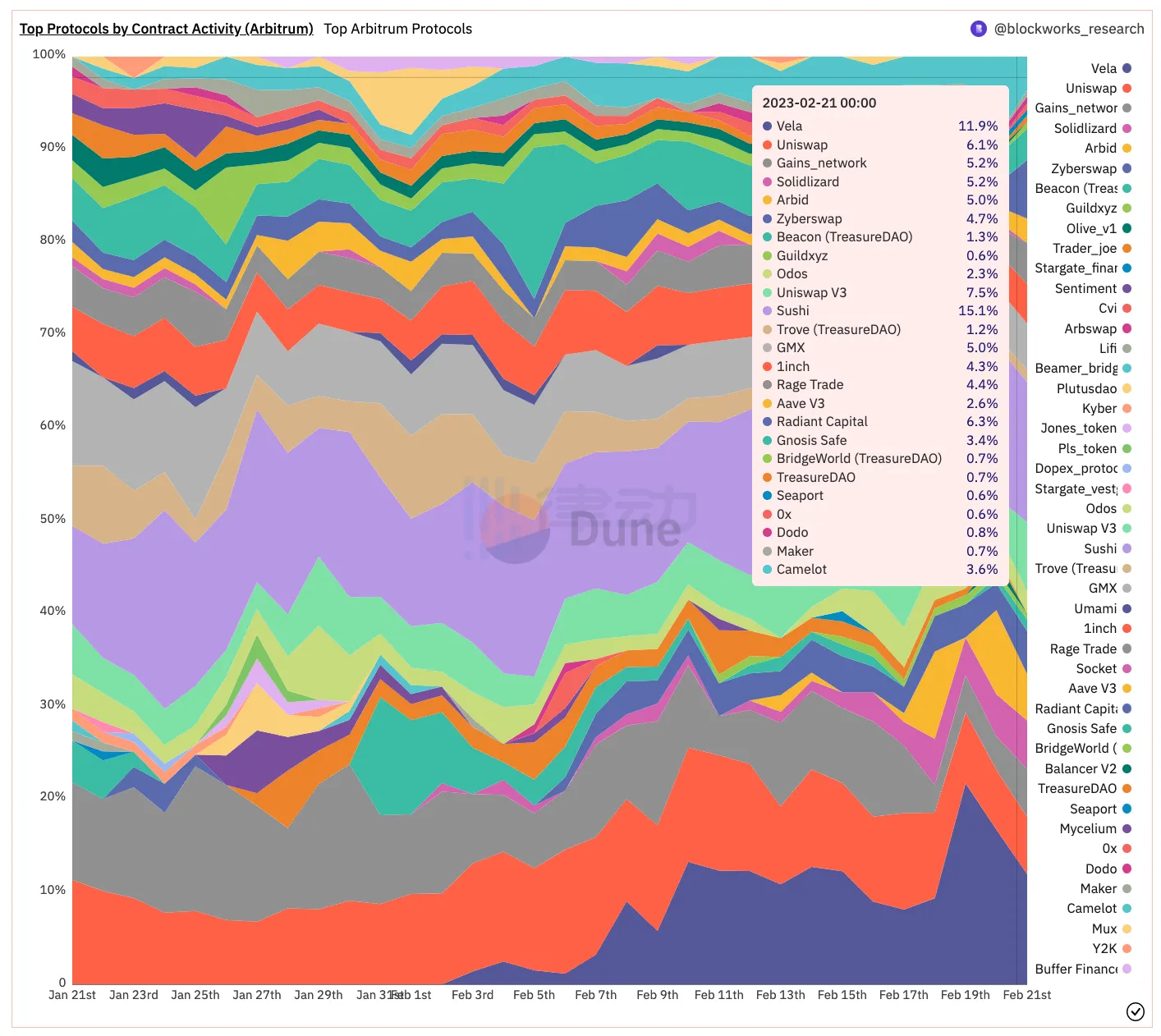
Due to the recent airdrop expectations, Arbitrum Eco's perpetual contract protocol Vela Exchange has received extremely high attention in many crypto communities. According to Dune Analytics, Vela's contract interaction activity has skyrocketed beyond Uniswap, and trading volume has increased rapidly, reaching $341 million in the last 24 hours. Arbitrum's DeFi leader GMX had just $111 million in sales over the same period, including its traffic in Avalanche.
This paper will review the basic structure and operation mechanism of Vela Exchange, its different features from GMX and other protocols, as well as the simple interaction process.
Related reading:Arbitrum Project Vela Exchange to confirm airdrops, what are the details?"
Mechanism introduction
Vela Exchange is a decentralized perpetual contract platform designed to improve the speed and security of DeFi derivatives trading by leveraging a hybrid model of off-chain order book and on-chain settlement. Vela users can build positions based on the performance of synthetic assets, with leverage up to 100 times, according to official documents. Vela Exchange's reward structure has been carefully balanced to manage the supply of tokens and rewards while maintaining high incentives for liquidity provision and trading.
Basic structure
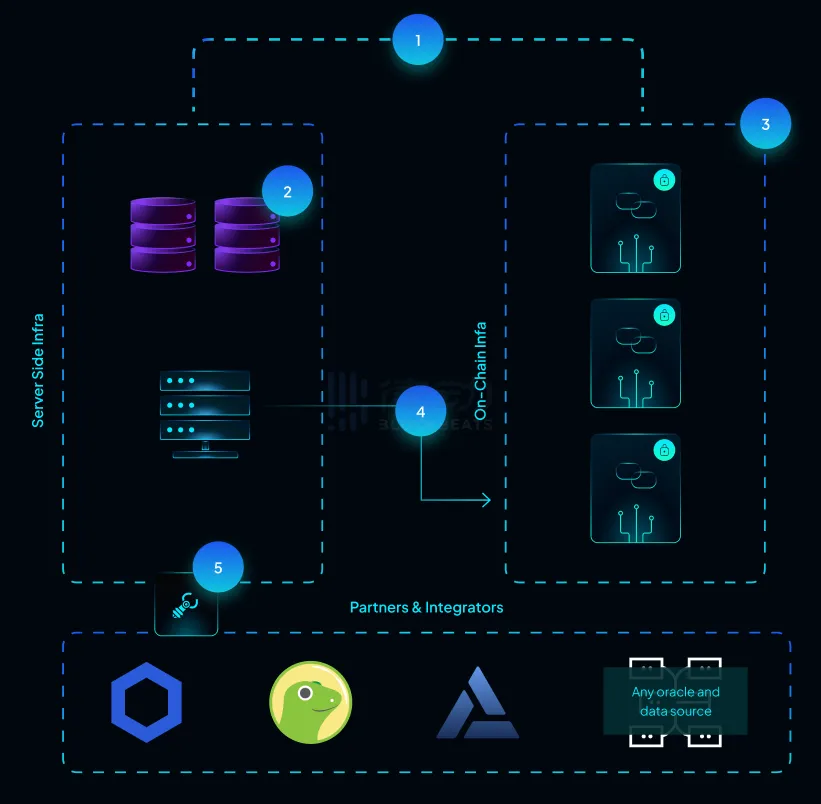
Vela Exchange's infrastructure consists of four main parts.Off-chain serverCache specific on-chain data to improve performance, such as historical transaction data, notifications, profile data, language Settings, etc.On-chain protocolHas all open positions, collateral, VLP/Vela pledge,Position management triggerHosted on the server to improve performance, pushed to the chain when conditions are met,Data portalExpose apis to third parties and extract data from prognostics, data providers.
All asset prices are fully operated and maintained by the Vela team through a proprietary price feed service called Vela Stream, and are designed to ensure performance, security and flexibility. The platform currently extracts data directly from several CEX and on-chain resources into a proprietary Vela Exchange price source. Vela Stream's price source is published on the chain and is transparent for each tradable asset and reflects a single aggregated price for the top CEX in the ecosystem.
In order to be able to perform trigger funds, fund management, clearing, and delay transactions (to reduce preemptive transactions), Vela Exchange has role-licensed access and the ability to destroy or mint dollar stablecoins in the protocol, but these stablecoins are not transferable or tradable. The Vela administrator has the right to suspend key contract functions on the agreement other than withdrawals in the event of an emergency such as agreement renewal, contract change, etc.
Trading mechanism
Vela uses collateral and leverage to define the amount of collateral and optional leverage levels. For example, if a user chooses 10 times leverage and $500 collateral, the purchase size is $5,000. In terms of trading assets, Vela offers three types of assets: cryptocurrency, forex and market cap.
Vela's clearing mechanism is quite novel. The price at which price clearing occurs is a function of the amount of assets [Q], the average entry price [E], the collateral [C], the liquidation plus the financing fee [F] and a slip point risk factor [f] (1% for non-FX assets and 0.3% for FX assets). This factor account has a built-in safety net to protect the agreement from losses beyond the collateral. The formula of position liquidation permit loss [A] (left) and strong flat price [L] (right) are respectively:
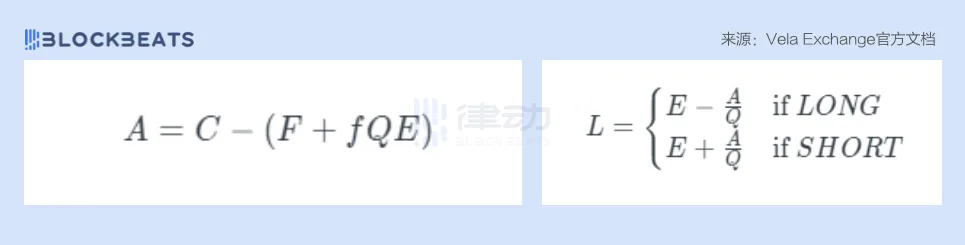
If liquidated, the trader will recover part of the collateral based on the slip point [S], which represents the difference between the actual liquidation price and. The collateral returned to the trader is:
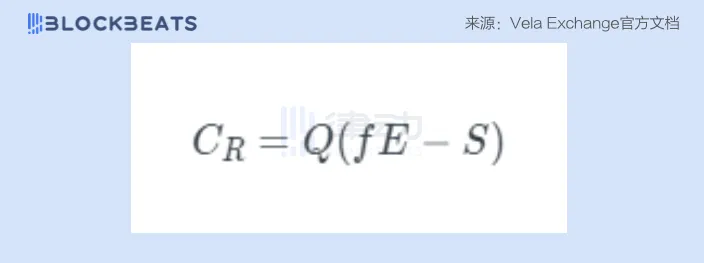
As an example, suppose the number of BTC/USD long trades using $1000 collateral is 1.25 BTC, the average entry price is 16,000, the total closing fee is $20, and the corresponding clearing price is 15,376. When the price fell rapidly near the clearing price, the fund was not forced to close until the price of 15,350, resulting in a slip point of 26.00. In this case, the agreement would return a total of $167.50 to the trader. Vela's VLP Vault can withstand up to fE=160.00 slip points without taking a loss.
Anyone other than the Vela team's clearing wallet can also trigger the clearing, but 100% of the clearing fee currently goes to VLP's LP as a reward for providing liquidity. In addition, Vela establishes long and short open interest (OI) limits, which are designed to protect the agreement from total OI exceeding TVL (in this case, VLP-backed liquidity). These limits are based on the percentage of TVL of the user and asset level for each tradeable asset. As the risk profile varies from asset to asset, these rates may change in the future.
Expense mechanism
There are two transaction fees, a holding fee and a capital fee, to be paid when trading on Vela. The holding fee includes a maximum of 0.1% of the opening fund for non-foreign exchange assets and 0.01% of the opening fund for foreign exchange assets at the time of opening and opening. Capital charges include interest accruing at the time of opening based on how much money is borrowed from the vault and the current capital rate. The longer the funds remain open, the higher the capital fee, which is paid when the position is closed.

Tokenomis
VELA & esVELA
The native Token of Vela is VELA (see the initial allocation and unlocking cycle below), and the pledge voucher esVELA can be obtained after the pledge. The esVELA will unlock the same amount of Velas continuously for the 6-month linear mortgage period. The esVELA used for the mortgage will not receive the mortgage reward. Claiming any number of VelAs or adding new Esvelas to the mortgage contract will reset the mortgage period. All pledged esVELA rewards are provided by VELA's repo model.
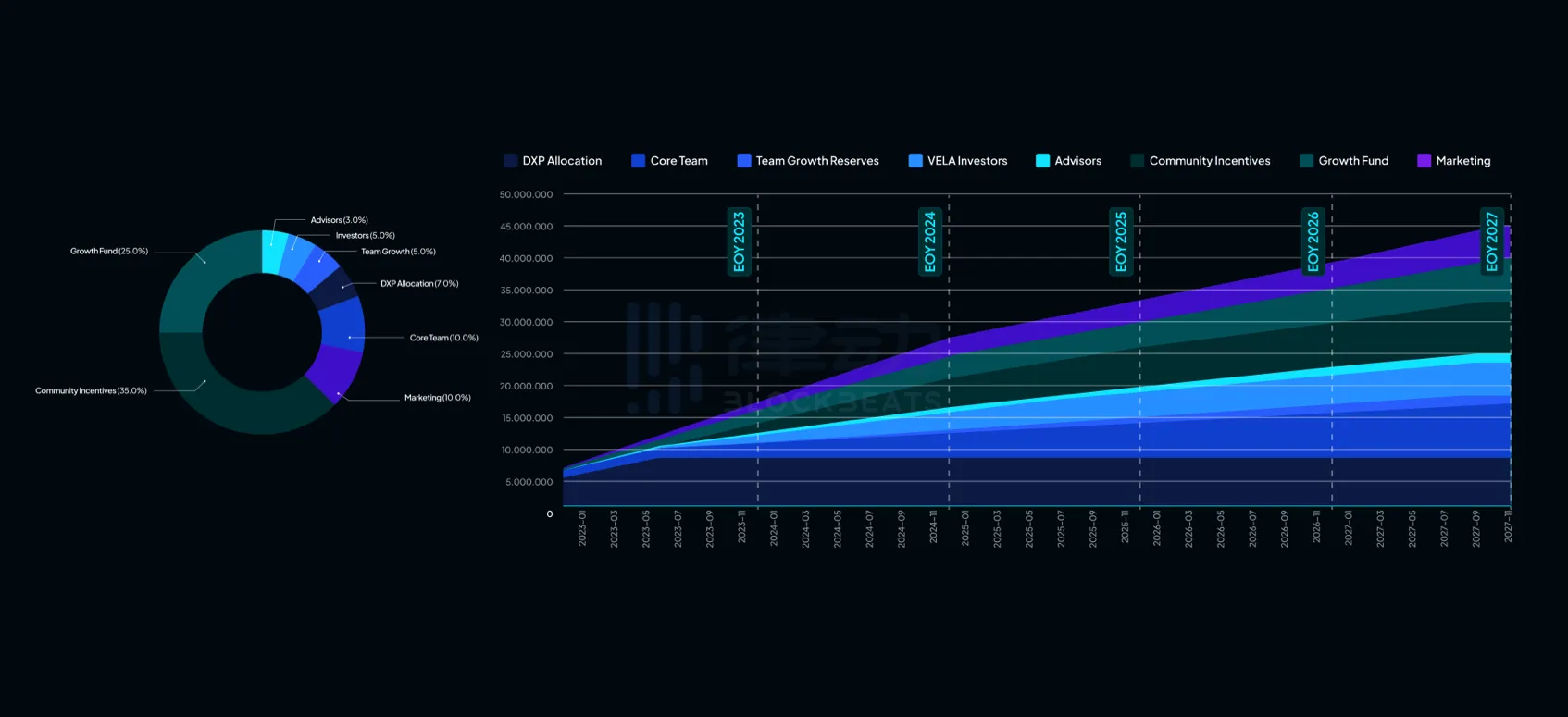
VLP
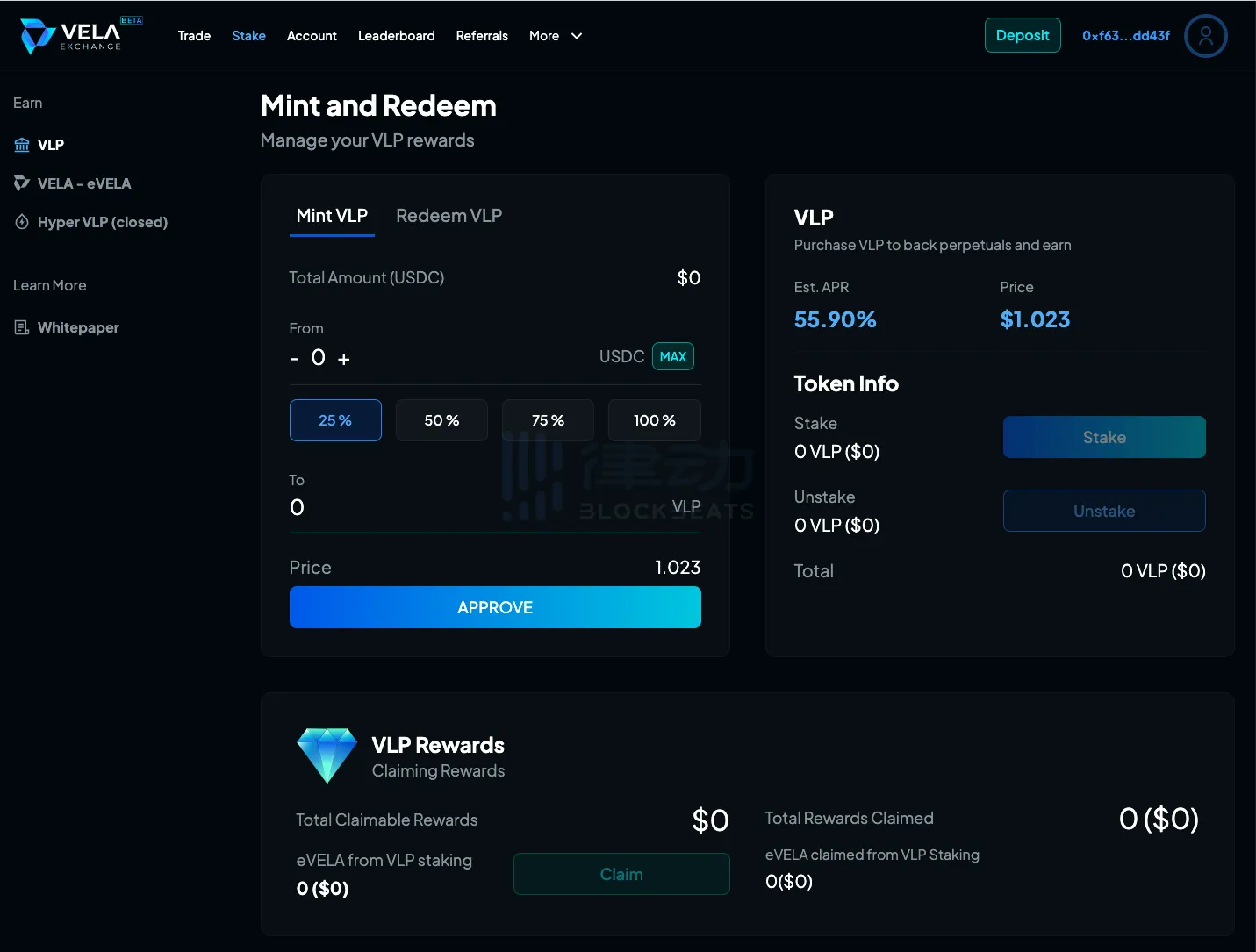
VLP is the LP Token of the Vela protocol, which is used to provide incentives to Token holders and mortgagors. A VLP is based on a USDC pledge that can be redeemed at any time, and anyone can pledge a USDC to mint a VLP and earn a fee based on the volume of transactions generated on the platform.
VLP also provides liquidity to traders, allowing them to leverage positions. If the trader loses, the VLP holder gains, and if the trader gains, the VLP holder loses. While VLP values are market neutral and not directly affected by crypto market volatility, there are still risks associated with owning VLP. In order to bear these risks, the VLP pledge can receive up to 60% of the platform fees generated by the trading activity.
Interactive process
Visit Vela Exchange's official website and connect to the wallet, where you can view your portfolio, standard assets, trading history, navigation menu, and social links, use the deposit button to deposit some USdcs, and then start trading, pledging, and claiming rewards on the platform.
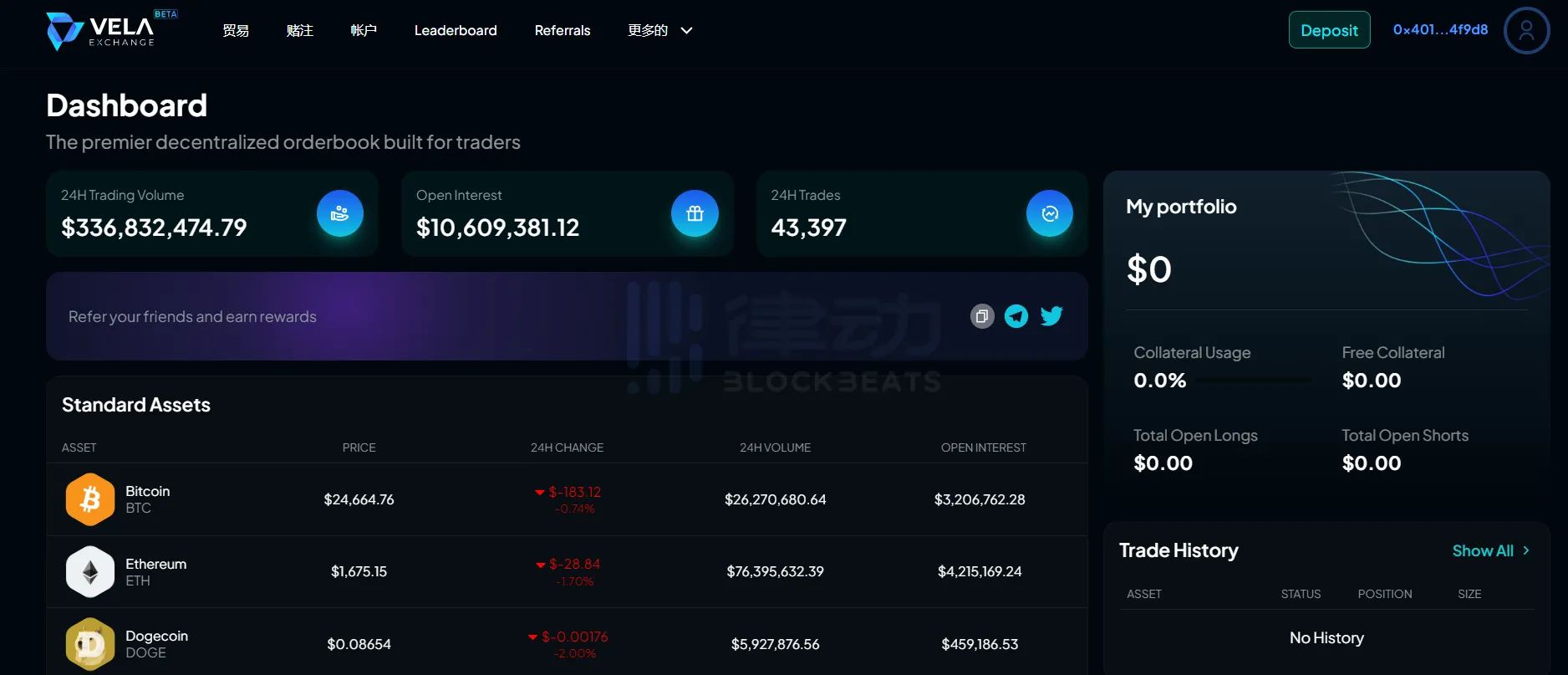
跳转到「trade」选项卡后的可选项为:先选择交易对、做多做空、设置抵押品(最低 5$)、选择杠杆(Crypto 最高 30 倍,其他资产最高 100 倍)。参数选择完成后便可开仓。

After jumping to the Stake page, you can cast or redeem VRPS on the VLP TAB. Pledge to receive VLP reward or cancel pledge if required. On the Vela-Evela TAB, you can buy Vela, Stake/Unstake for additional rewards.
Blockbeats warns that although Vela contracts are fully audited, users are still exposed to a number of potential risks. Such as counterparty risk, which is paid to the trader from the VLP pool if the trader makes a profit. There is also the risk of decoupling, which directly affects the VLP if the USDC decoupling occurs. In addition, the amount of open position available for perpetuals is limited by the total amount of USDC available in the VLP. Traders cannot open new positions if the platform open position reaches or exceeds the total TVL of the VLP.
Welcome to join the official BlockBeats community:
Telegram Subscription Group: https://t.me/theblockbeats
Telegram Discussion Group: https://t.me/BlockBeats_App
Official Twitter Account: https://twitter.com/BlockBeatsAsia

 Related Articles