Vest Exchange, perpetual contract AMM on Arbitrum

Recently, with the expected popularity of Token issuance rising, many DeFi derivative contracts in Arbitrum ecosystem have gradually entered the vision of industry participants, and many early new projects have also surfaced, one of which is Vest Exchange. Vest Exchange is an arbitrate-based AMM perpetual contract exchange designed to enable permission-free trading of any asset, even illiquid or long-tail assets.

There are three problems with existing on-chain perpetual contracts exchanges:
1. High barriers to listing: DeXs are reluctant to list low-volume, illiquid long-tail assets because their mechanisms cannot withstand extreme market conditions.
2. Lack of risk management: In 2022, market manipulation and prophecy attacks caused millions of dollars in losses in the DeFi world and multiple protocols were shut down as a result.
3. Unclear risk/reward of LP: LPS are exposed to multiple risks due to the imperfection of the mechanism, and some exchanges try to compensate for this problem by offering high fees to LP in return.
Vest Exchange combines academic research with modern market-making techniques to shape a forward-thinking risk engine that attempts to overcome these problems. By combining consistent risk determination with the underlying architecture of perpetual futures markets, they have designed adaptive pricers that can be used for every asset and in different market environments, seeking to unlock illiquid markets faster than any DEX or CEX.
Optimal margin requirement
To address the high barriers to listing, one of Vest Exchange's visions is to facilitate trading in illiquid subjects. Managing the risk of illiquidity requires appropriate margin requirements. In traditional finance, the typical approach is to run simulations according to industry standards and set a margin based on worst-case losses. While there is no industry standard for margin requirements in the DeFi world, most agreements provide fixed leverage regardless of the underlying assets.
Low margin requirements can expose agreements to bad debt, while high margin requirements can inhibit trading. The optimal margin requirement should strike a balance between prudence (minimizing solvency risk) and opportunity cost (maximizing capital efficiency). To achieve this balance, Vest devised an optimization problem to set the optimal margin requirement based on expected value.
A new exploration of AMM capital rate
Perpetual contracts, which never expire, exist only by relying on the capital rate, which anchors the marker and index prices. For Vest, an AMM-based perpetual contract exchange, the capital rate is even more important.
AMM trades do not require a traditional counterparty, instead LPS provide liquidity, and AMM exchanges match bulls and bears asynchronously. If a sharp rise or fall in prices creates a long-short imbalance, only one side of a market maker's buy and sell order can be traded. Market makers who take advantage of the bid-ask spread cannot find buyers for their inventory, resulting in volatile losses. They may withdraw liquidity, putting the whole exchange at risk. At this point, it is the capital rate that provides the incentive for arbitrageurs to correct the long-short imbalance. Capital charges also serve to prevent exchanges from going bust in the extreme event that arbitrageurs disappear en masse.
Many people have arbitrage experience with the funds rate, but knowledge of how the rate is calculated is often limited to the difference between the total number of long and short positions. In fact, AMM perpetual contract DEX has not completely solved the rate problem of funds.
In the early stages, DEX, which is partially used by AMM, directly applied the same capital rate formula as order-book exchanges such as Binance, after determining the price impact using methods such as x*y=k. This has resulted in some DeXs (such as Perpetual Protocol V1) where most of the trading is capital rate carry trading and they have to take millions of dollars out of their insurance fund to pay the capital fee. While the transaction fees may seem high, the agreements end up making only a fraction of those profits.
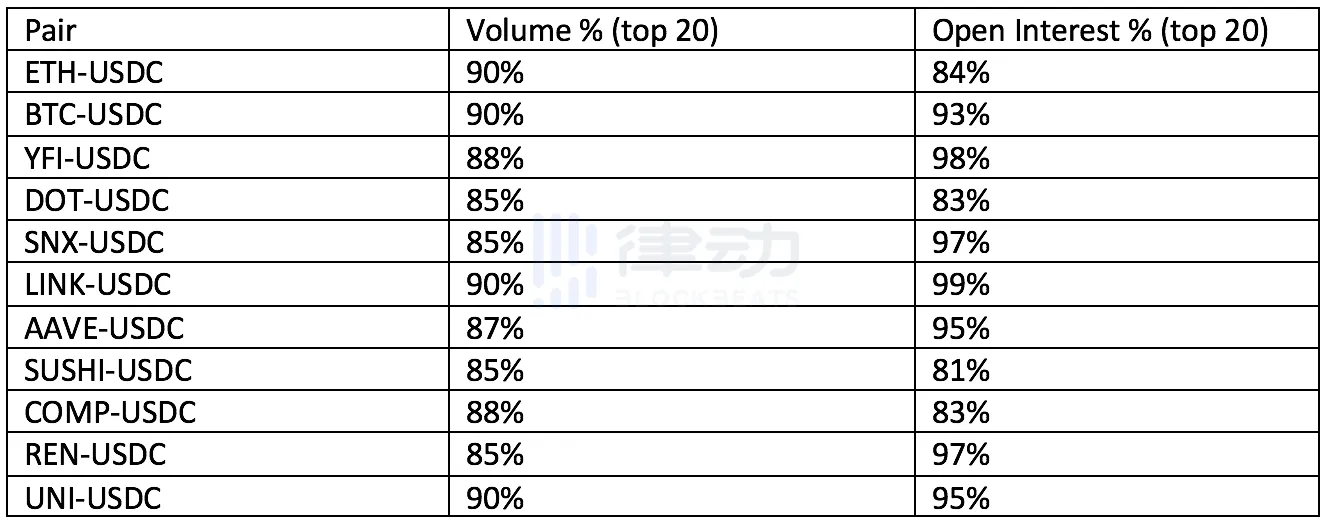
Rather than improve the capital rate and inventory risk issues, Perpetual Protocol V2 has chosen to build version V2 on top of Uniswap V3, allowing Perpetual V2's market makers to enjoy the aggregate liquidity benefits of Uniswap V3, Took on relatively higher inventory risk. As for the funds rate, Perpetual V2 updates the funds rate with the Ethereum block out, eliminating the need for traders to consider timing when holding positions, eliminating the potential for cyclical arbitrage.

The current fund rate mechanism used by the newer AMM DEX not only incentivizes arbitrageurs to correct long-short imbalances, but also prevents exchanges from going bust in extreme cases such as the collective disappearance of arbitrageurs. However, the problem remains: even when the formula is established, the lack of clarity in parameter Settings still leads to market inefficiencies. Traders may be overcharged, in contrast to arbitrageurs, LPS, and the agreements themselves, who may not earn enough to take on market risk.
Vest divides the capital rate into two types. The first one focuses on further preventing the occurrence of long-short imbalance and reducing LP inventory risk. The second is to satisfy the demand of arbitrageurs as much as possible to stimulate more trading.
Risk-based funding rates
In order to solve the inventory risk of LP, Vest proposed a formula that, by paying the capital fee, the inventory risk could decay to zero over time.
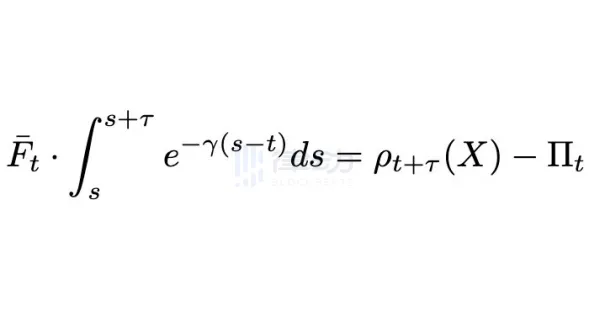
In general, the higher the gap between the total positions held by bulls and bears, the higher the total capital fee incurred. But defining inventory X in this formula simply as the difference between total positions held by many shorts creates a problem: if there is a situation where long positions far outnumber short positions, the total capital fee will be reduced and may only cover the exchange's inventory risk, leaving little incentive to pay arbitrageurs.
To incentivize arbitrageurs to correct the long-short imbalance in this situation, Vest defined inventory X in the formula as being related only to total long holdings, not to the difference between total long and short holdings, and allocated a capital fee pro rata between the exchange and the shorts. At the same time, defining the discount coefficient γ as the ratio of the absolute difference between total multi-short positions to total multi-short positions also pays arbitrageurs more capital fees when the long-short imbalance occurs. But as well as giving arbitrageurs an incentive to correct the long-short imbalance, such a design could also lead to overcharges for traders.
Adaptive capital rate
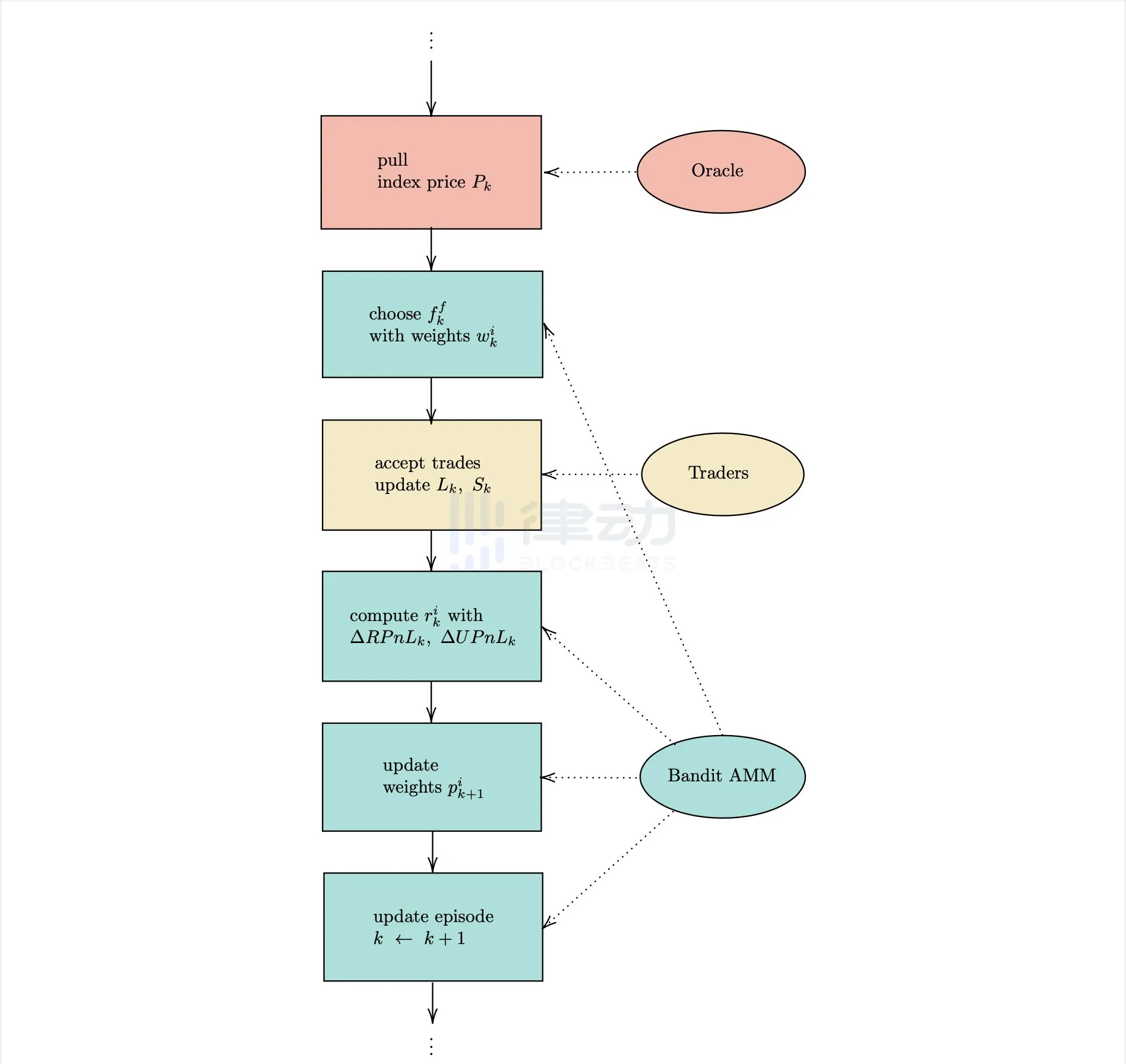
The first risk-based fund rate mechanism reduces risks by compensating for the difference between the total long and short positions. The other idea is to adjust the fund rate and capture the demand of arbitrageurs to correct the long-short imbalance and thus reduce risks. Guided by this line of thinking, Vest divided the total capital fee into two separate parts: basic compensation for exchange inventory risk and an additional floating rate to accommodate arbitrage requirements.
The search for the best funding rate is an exploratory and trade-off process, and Vest built a Multi-Armed Bandit model that uses reinforcement learning to unify the two funding rates.
Project schedule and investment background
Vest Exchange currently has onlyFour papersWe don't know how these new mechanisms and formulas will fit together. The DEX product shape and roadmap have yet to be announced, but official sources say the Vest Exchange beta network will be available soon.

On January 29, 2023, Vest Exchange announced the completion of a seed round of funding for an undisclosed amount. Jane Street, QCP Capital, Big Brain Holdings, Ascendex, Builder Capital, Infinity Ventures Crypto, Robert Chen (Ottersec), Pear VC, Cogitent, Moonshot Research, Fugazi Labs, etc. One of the most notable is Jane Street, one of the world's largest market makers and one of Wall Street's top quantitative trading firms.
Jane Street is known for their expertise in ETFs, but today they have expanded into everything from stocks and bonds to options and cryptocurrencies and have a significant presence in them. At Jane Street, where technology is at the heart of everything, the roles of trader and researcher are merged, with any employee dedicated to developing smarter trading strategies, signals and execution methods. They are also big fans of automation and have been looking for and extending the effective boundaries at which computers can replace humans in finance. It is worth noting that both SBF and Caroline Ellison, who were involved in the FTX/Alameda affair, used to work at Jane Street.
summarize
Vest Labs, the developer of Vest Exchange, was founded in Osaka, Japan, in August 2022. Some of the team members are from Tower Research Capital, a well-established high-frequency trading firm. Here's all we can find out about the team. When Vest Labs launched, it revealed that it had the backing of visionary VCS, quant trading firms and global institutions. In today's cryptocurrency market, Vest's low profile confuses many people by focusing on writing papers and researching instead of making extensive exposure through operational activities. Perhaps it is companies such as Jane Street that give them the confidence to remain mysterious and to devote themselves to research.
I have no idea what kind of DEX Vest Exchange will be, and it may end up looking like the rest of its kind, but these studies have already shown me another evolution direction for DeFi: not to continue stacking money Legos on the surface, but to the bottom of the heap that most people don't perceive.
Welcome to join the official BlockBeats community:
Telegram Subscription Group: https://t.me/theblockbeats
Telegram Discussion Group: https://t.me/BlockBeats_App
Official Twitter Account: https://twitter.com/BlockBeatsAsia

 Related Articles