MOVE Series 'Third Brother': A Comprehensive Analysis of the New Public Chain Linera.
Original Title: "Foresight Ventures: Comprehensive Interpretation of L1 Public Chain Linera"
Original Author: Maggie, Foresight Ventures
The competition in the public chain field is fierce, and new funds and teams are constantly entering the field. The current development directions include: Level 2 solutions built on Ethereum such as Optimistic and Arbitrum; the rise of high-performance Level 1 chains based on Move system represented by Aptos and Sui; and the focus on blockchain-based Celestia, etc.
Linera belongs to Level 1 chain, aiming to provide a secure, highly scalable, and low-latency blockchain to give Web3 applications faster response times and narrow the gap between centralized and decentralized applications. The founding team comes from Meta (Facebook) and has previously participated in the development of the Diem blockchain, demonstrating strong research and development capabilities. However, the technical team's background and number of members are significantly different from those of the Sui and Aptos projects. In June 2022, it received a total of $600 million in seed round investment from A16Z and other investment institutions.
Technically, the main features of Linera are:
1) Multi-chain structure (referred to as Micro Chain / Integrated Multi-chain by Linera), parallel transactions in multiple chains, thereby improving processing capacity and block generation speed. It claims to be better than mainstream scaling technologies (faster than single chains, more convenient for cross-chain than sharding, and faster dispute resolution than Rollup).
2) Elastic Validator, the validator hands over different microchains to different Workers for processing, and can horizontally scale Worker machines to handle traffic as system load increases.
3) Smart contracts are written in Rust language, borrowing the "resource-based" Move language to provide a more secure and composable blockchain programming language. Move is also based on Rust syntax. Linera only mentions borrowing from Move language, so it can be understood as a variant of Move language.
4) Adopting DPoS+BFT consensus algorithm, DPoS determines the weight of validators' voting rights, and BFT votes for block production. Linera adopts a multi-chain structure and BFT consensus, which can launch a chain with one click, but the performance of a single chain may be average. The validator is elastic and can be dynamically expanded to achieve good response speed. However, the degree of centralization is relatively high, and the cross-chain solution is not perfect.
From the perspective of development stages, the project currently has a white paper, no RoadMap, no GitHub repository, no product modules, and the project ecosystem has not yet started. It is in the early stage of development. Influenced by Meta and stimulated by Aptos and Sui, Linera's attention is also increasing. The Linera team released a white paper on December 19, 2022.
From the perspective of competitors, Linera is often compared to Aptos and Sui, but its technical team size, background, and financing scale are far inferior to Aptos and Sui. All three teams come from the Diem and Novi platforms and have received investment from A16Z, but Linera's pace is slower and its seed round financing amount is far less than Aptos (seed round $2 billion) and Sui ($36 million). All three have adopted/referenced the Move language in their technology. In terms of architecture, Linera is similar to Avalanche, adopting a multi-chain architecture, and both received $6 million investment in their first round of financing, also from A16Z.
Overall, Linera still has many areas that have not yet started and there is a high degree of uncertainty. The next step is to pay attention to the release of more information on its technical solutions and code in order to evaluate its technical feasibility and user experience. We also need to pay attention to the market's acceptance of single owner chains/permissioned chains. The next step is to focus on the construction of its nodes, the actual operation of the network project, and the development of its ecosystem.
1. Basic Overview
1.1 Project Introduction
Linera belongs to Level 1 chain, aiming to provide a secure, highly scalable, and low-latency blockchain to give Web3 applications faster response times.
Facebook (later renamed to Meta) once formed a team to develop the stablecoin project Libra (later renamed to Diem), but due to regulatory issues, it ultimately did not continue. The teams involved in the development of Diem have gradually separated and established their own teams to develop new public chain projects, and Linera is one of them.
1.2 Basic Information
Established around December 2021, the country/sector it belongs to, public chain token symbol, and fundraising situation are yet to be determined. It has received a total investment of 6 million USD from multiple investment institutions including A16Z.
1.3 Team
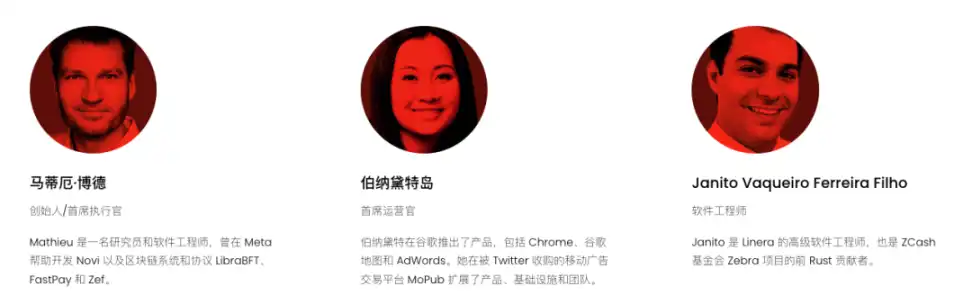
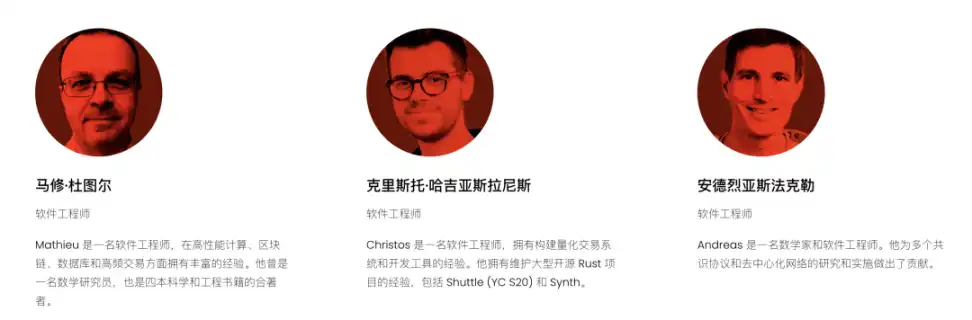
According to the official website and LinkedIn, the Linera team consists of around 8 members (compared to 64 for the Aptos team and 93 for the Sui team, the team size is small), and the website has job postings for Rust engineers. The specific information about the members is as follows:

1.4 Funds
Round financing amount valuation investment time number of investors investment party Seed round $6 million / June 29, 2022 led by A16Z, with participation from Cygni Capital, Kima Ventures, and Tribe Capital.
2. Technical Details
2.1 Vision and Technical Framework
Linera belongs to Level 1 chain, aiming to provide a secure, highly scalable, and low-latency blockchain to give Web3 applications faster response times and narrow the gap between centralized and decentralized applications.
2.2 Technical Principles
1) A multi-chain structure with elastic validators integrated
Integrated Multi-Chain Structure: Linera has multiple parallel chains (active and inactive) called microchains, with no limit on the number. Elastic Validators: A validator is a Web2-like elastic service that can verify and execute blocks of multiple chains in parallel, with each validator managing all microchains.
Validator is a Web2 elastic service: it can be understood that validators can increase or decrease the number of block validation and block execution services as needed. For example, if there are 2 microchains in the network, the node starts 2 validation services and 2 execution services to process the blocks of the two chains in parallel. Later, when there are 4 microchains in the network, the node can scale up to 4 validation services and 4 execution services to process the blocks of 4 chains in parallel.
a. Create Weilink.
Each chain has a unique ID, and the genesis file (configuration file) specifies several system microchains (such as the Admin chain used for managing validators). Users are encouraged to create their own new chains.
The owner of the chain needs to perform a chain-creation operation to create a new sub-chain. The new chain ID is equal to the parent ID plus the chain-creation index.
For example:
id2's owner initiated a chain-creation operation and included it in block B2_1.
The
node performed the chain-creation operation and created a new micro-chain with ID 2-1.
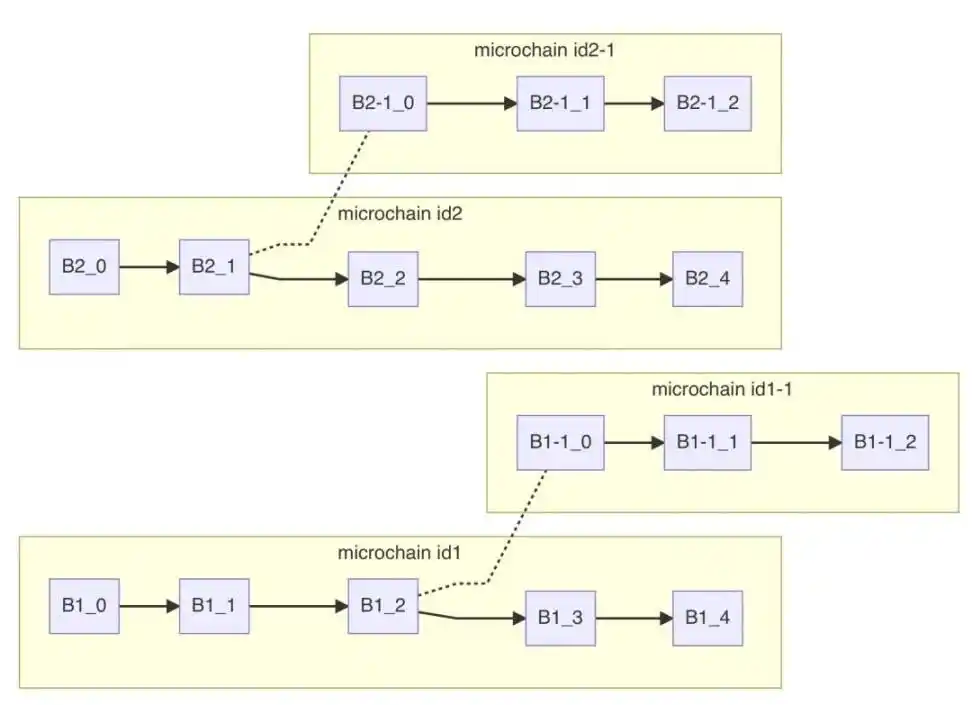
You can create the following three types of chains. In the Linera blockchain, the proposal, validation, and execution of blocks are separate. Each validator verifies and executes all microchains.
Single owner chain: Only the owner can propose blocks. The chain's owner is responsible for synchronizing the blocks, proposing blocks, and collecting votes. If the chain owner does not work, the chain cannot be extended. The content on the chain is completely controlled by the ChainOwner. Although the owner cannot tamper with past blocks, they can decide which transactions are included in the block during packaging, which is too centralized.
Permissioned chain: allows a group of people to propose blocks. Consortium chain. Similar to SubNet built by some projects in Avalanche.
Public chain, any user can propose an operation, and it will be included in the next block by validators.
b. Elastic Validator
The design of WeChain enables Linera nodes to process transactions in parallel. Validators can horizontally scale worker machines to handle traffic as system load increases.
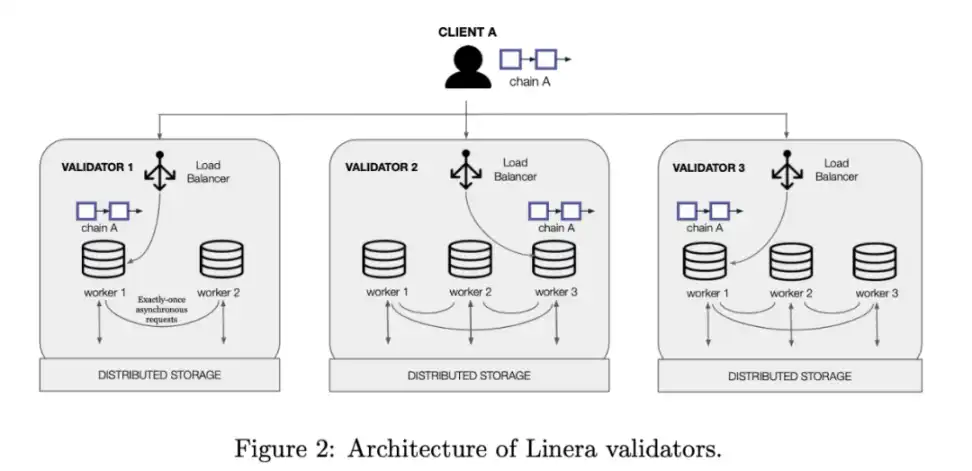
Validators can create multiple Worker machines to handle different microchains. The client communicates with the load balancer of each validator, and the validator internally dispatches queries to the appropriate worker. Workers within a single validator belong to one entity and therefore trust each other. This makes communication between workers - and Linera's cross-chain requests - fast and inexpensive. Workers can be horizontally scaled as system load increases, and validators only need to add worker machines to handle traffic.
c. Cross-chain communication
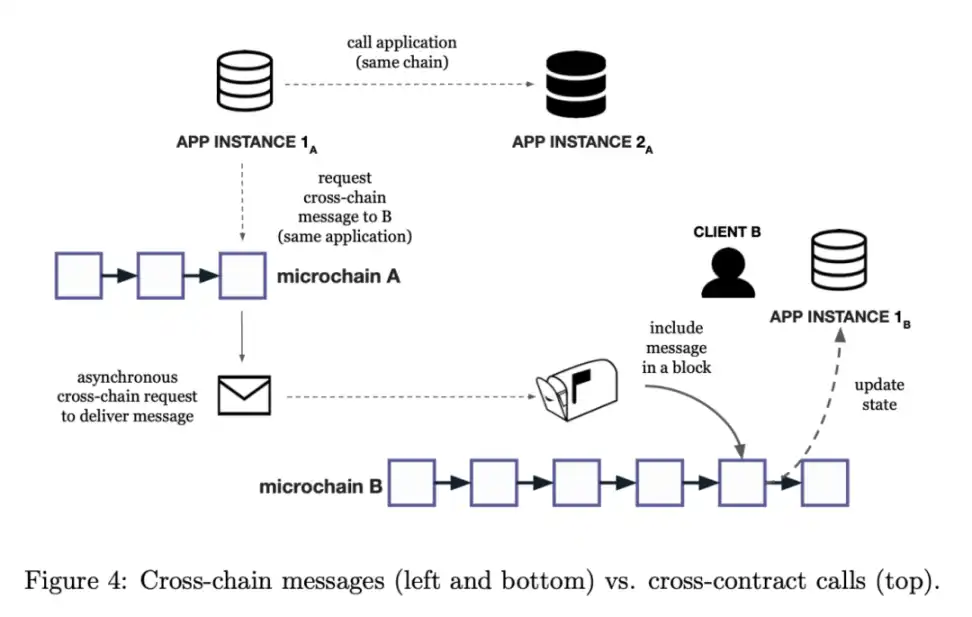
Cross-chain messaging allows applications to asynchronously transfer arbitrary data from one chain to another.
The local instance of the application maintains an inbox for each source that communicates with it. When the application wants to send a message to a destination, they return a value containing the message so that the runtime can perform the appropriate cross-chain request. There is no guarantee that the message will be received by the recipient. The current implementation enforces message selection in order. This strategy will be improved in the future, especially for public chains. This cross-chain design is not very secure on public chains except for one-to-one communication. In addition to one-to-one communication, Linera also supports one-to-many communication using channels - Pub/sub channels.
2) Contract Language: Referencing Rust language in Move
Linera initially targets Rust language as the smart contract target language. Rust smart contracts are compiled into Wasm bytecode and deployed on the chain. Nodes execute the Wasm bytecode contracts.
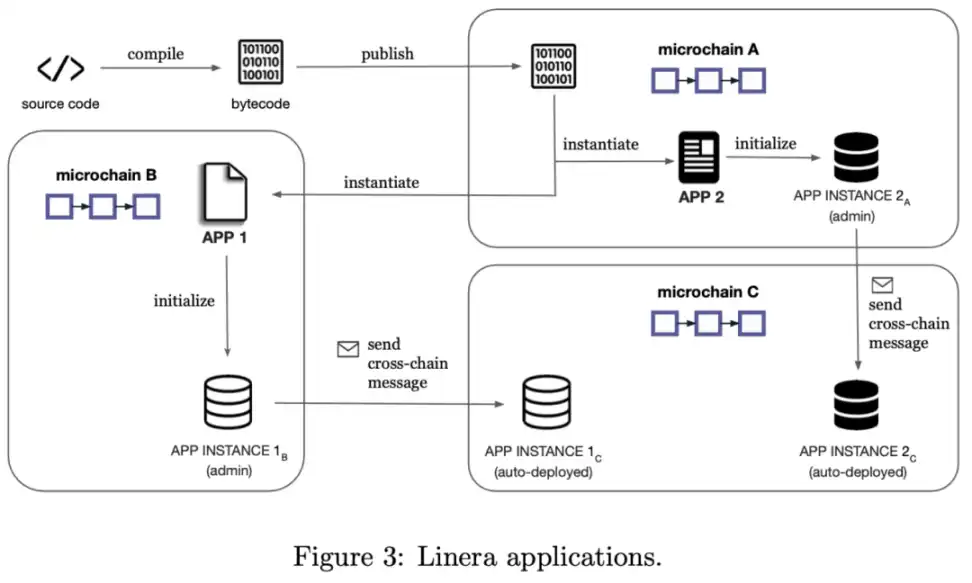
Applications on different microchains can share the same contract code, but use different data. For example, two different ERC20 Tokens on two different microchains can use the same contract code, but have different contract data (name, supply, balance, etc.).
3) DPoS + BFT consensus mechanism
In the Linera blockchain, the proposal, validation, and execution of blocks are separated, and each validator manages all microchains. The DPoS algorithm is used to determine the voting weight of validators, and validators run the BFT algorithm to reach consensus on blocks.
The consensus process for a single Owner chain is as follows:
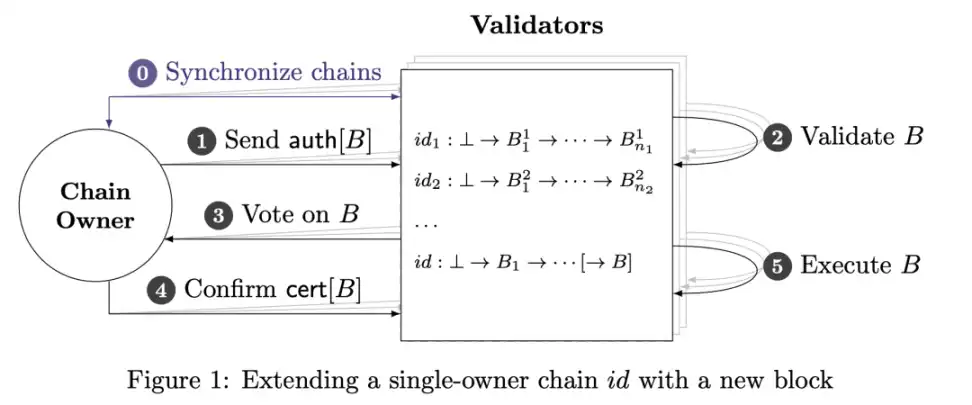
Step 0: Synchronize chain data between ChainOwner and validators. Step 1: ChainOwner packs and proposes a block. Step 2: Validators verify the block and vote for valid blocks. The weight of a validator's vote is based on the DPoS algorithm, which is related to the validator's stake and the stake delegated to them. Step 3: Validators send their votes to ChainOwner. Step 4: After collecting 2/3 of the total weight of votes, ChainOwner creates a certificate of the vote information and sends it to the validators. Step 5: Validators execute the block.
In addition, the consensus process of multi-Owner chains adopts a simplified version of BFT, while the public chain adopts the complete version of BFT.
2.3 Technical Summary
Multi-chain structure, can send chains with one click. However, the performance of a single chain may not be better than Aptos and Sui. With a multi-chain architecture, the more micro-chains created, the higher the parallelism and the greater the total throughput, but cross-chain communication is required between chains. It can be dynamically expanded and the node can be clustered to obtain a good response speed. The design of elastic validators allows nodes to be clustered and dynamically expand worker machines to cope with increased traffic. This is a good feature, but it also means that the cost of nodes is high. The degree of centralization is relatively high. The proposal right of single owner chain and permission chain is more centralized in the hands of one/multiple people. The cross-chain solution is not perfect. The information disclosed in the cross-chain part is relatively small. This cross-chain solution relies on the forced selection of messages in order, which is difficult to verify in the public chain and is not secure enough. The solution also mentions that this solution will be improved in the future.
3. Token Economic Model
暂未发布
translates to "Not yet published" in English.4. Competitive Technology Comparison
4.1 Industry Overview
Linera belongs to the public chain.
The main trends in the public blockchain industry currently include:
Ethereum Level 2: Ethereum 2.0 PoS upgrade successful, Layer2 comes to the forefront, Arb and Op's TVL continue to rise. ZK becomes a popular topic, and the competition for ZK rollup is becoming increasingly fierce.
High-performance single-chip chains: Aptos and Sui, two high-valuation and high-performance single-chip chains, have emerged, and the Move language has been successfully launched.
Modularized and specialized chain: Celestia introduces the concept of modularization with a focus on igniting, while privacy-focused chain Aleo secures strategic financing of 228 million US dollars.
4.2 Competitor Comparison
Linera is a public chain in the Move ecosystem, with competitors including Aptos and Sui. In terms of architecture, Linera adopts a multi-chain structure, similar to Avalanche, with the ability to launch chains with one click.
1) Team Funds
The financing scale of the public chain team Linera. Mathieu Baudet, the founder of Linera, is a software engineer at Facebook and a blockchain researcher at Libra/Novi. According to the official website, the team has a total of 8 members. In June 2022, they received a seed round investment of $6 million from investment institutions such as A16Z. Avery Ching, co-founder and CTO of Aptos, served as chief software engineer at Facebook for more than 10 years from September 2011 to December 2021, and was the technical leader of the Novi team, a cryptocurrency platform under Meta. The team has a total of 64 employees. In March and July 2022, Aptos Lab received two rounds of financing, with a total financing amount of more than $350 million, led by well-known institutions such as A16Z, FTX Ventures, and Jump Crypto. The development team of SuiSui comes from Mysten Labs, and CEO Evan Cheng served as the blockchain engineering technical director of Meta from 2018 to September 2021. The team has a total of 93 employees. In December 2021 and August 2022, Mysten Labs received two rounds of financing, with a total financing amount of $336 million, led by A16Z, FTX Ventures, Jump Crypto, A&T Capital, Binance Labs, and other participating investors. Ava Labs, the founding team behind Avalanche, was co-founded by Cornell University computer scientists and professors Emin Gn Sirer, Ted Yin, and Kevin Sekniqi in 2018. The team has years of experience and expertise in distributed system consensus protocols. In February 2019, they completed a $6 million Series A financing round, with participating institutions including A16Z and Polychain. In May and July 2020, they completed two public offerings of $12 million and $42 million, respectively, with a total of approximately $60 million raised through public offerings.
From the perspective of the technical leader's resume and team size, both Sui and Aptos are strong, while Linera is relatively weak.
2) Technical Comparison
There is not much detailed information publicly available about Linera at the moment, mainly conceptual statements, so it is not possible to compare some running data such as TPS. The ecosystem has not yet been built, so it is also not possible to compare the ecosystem. Only some evaluations can be made based on the existing disclosed plans.
Consensus algorithm:

You can see that PoS+BFT has become the mainstream algorithm for public chains today.
Blockchain Architecture
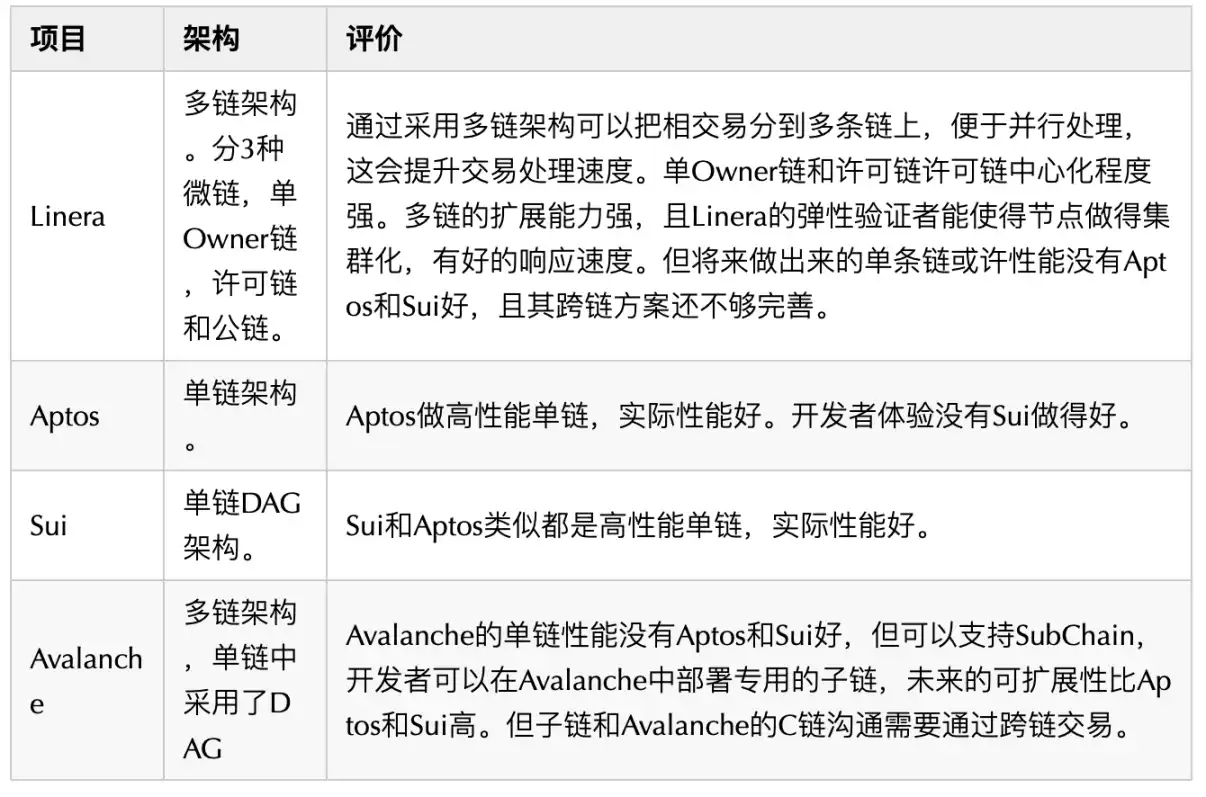
Smart Contract
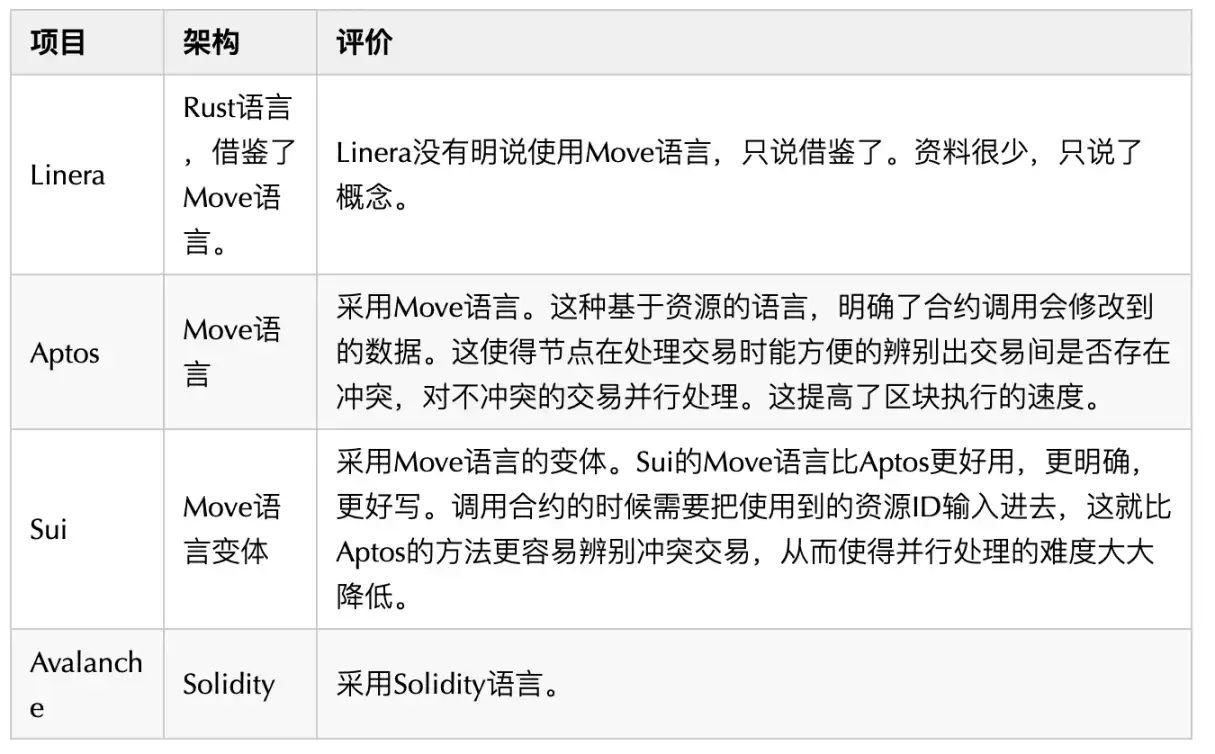
Summary
Linera project is still in its early stages, with only the whitepaper providing a conceptual introduction and no code or ecosystem yet. It shares similarities with Aptos, Sui, and Avalanche.
Technically, a multi-chain architecture is adopted, which allows for one-click chain issuance. It is dynamically scalable, can be clustered into node groups, and can provide good response speed. Its single owner chain and permissioned chain are not sufficiently decentralized. The cross-chain solution is not perfect.
Overall, Linera still has many areas that have not yet started and there is a high degree of uncertainty. The next step is to pay attention to the release of more information on its technical solutions and code, in order to evaluate the usability and user experience of its technology. Also, it is important to monitor the market's acceptance of single owner chains/permissioned chains.
Reference document
Linera official website: http://linera.io/Linera
Whitepaper: https://linera.io/whitepaper
Original article link
Welcome to join the official BlockBeats community:
Telegram Subscription Group: https://t.me/theblockbeats
Telegram Discussion Group: https://t.me/BlockBeats_App
Official Twitter Account: https://twitter.com/BlockBeatsAsia

 Related Articles