ArkStream Capital: The market may not only be L2, new public chains cannot be ignored
Original author: Ray, ArkStream Capital
The environment of the new public chain
If there is a law of gravity in the blockchain world, then Bitcoin and Ethereum are like the two brightest stars, illuminating this dazzling star field. The reason why they can shine among the stars and shine brightly is that they each have their own original technology landing (i.e. blockchain and smart contract platform), as well as years of continuous iteration and upgrading, which have accumulated a huge market value, a prosperous ecology and an active community.
Once, in the cryptocurrency cycle from 2017 to 2021, we often heard the term "Ethereum killer". Many new public chains aimed to surpass Ethereum and proposed their own technical architectures and implementation solutions. For example, Solana proposed Proof of History, Avalanche with the Avalanche protocol and subnet function, NEAR with sharding technology, Flow with consensus and computational separation, EOS with parallel processing and asynchronous communication capabilities, IOTA with DAG transaction structure, and Polkadot and Cosmos with native built-in multi-chain support. It has to be said that they have all achieved success in data indicators such as daily active users on the chain, DApps development, and TVL within a specific period of time. However, with different reasons (such as team collapse and capital collapse, etc.) and the successive launch of Ethereum's Rollup second layer, the situation is quietly changing. The most obvious is that in DeFiLlama's public chain TVL rankings, Arbitrum and Optimism have surpassed most Alt L1s. In addition, some innovative projects have also shifted their focus to the Rollup second-layer network. The most representative example is the derivatives platform GMX that migrated from Avalanche to Arbitrum.
At the current point in time, the stable development of Bitcoin and Ethereum, as well as the rapid growth of the second-layer network, are obviously squeezing the once lively Alt-L1 market. Many Alt-L1 projects seem to be in a "stagnant" bottleneck period, which foreshadows a not optimistic future for the new public chain. Taking the new public chains of the Move system, Aptos and Sui, as examples in the past year, the market's voice on them has changed greatly. Before the mainnet was launched, everyone was keen to deeply interpret their white papers and technical architectures, and to have beautiful visions of their application scenarios. Developers were frantically learning new contract languages and competing with DApps project owners for various ecological niches of new public chain DApps. However, after the mainnet of the public chain was launched, especially after the token issuance, with the downturn of the DApps ecosystem and the sluggish TVL data, everything seemed to be far away from us again.
PS: Considering that the privacy public chain emphasizes anonymity and protection of user privacy, and the storage public chain emphasizes decentralized storage, their design concepts and technical routes are somewhat different from general public chains. In order to make the discussion more focused and in-depth, we will not discuss the privacy public chain and storage public chain for the time being.
The necessity of new public chain research and development
It can be said with certainty that it is undoubtedly a challenging undertaking to develop and implement a new public chain to challenge the two giants of Bitcoin and Ethereum, or even the newly thriving second-layer network. This makes us wonder whether it is necessary to continue to develop the new public chain?
The answer is yes. From the perspective of Mass Adoption, the entire Web3 has had a variety of new application scenarios such as DeFi, NFT, Metaverse, etc. since 2020, and the popularity of users has risen to the level of millions or even tens of millions. However, even so, compared with those technologies that have already achieved Mass Adoption, such as search engines and instant messaging, Web3 still has huge room for development. If the public chain of Web3 infrastructure is compared with traditional cloud computing, the number of applications and users of public chain services are still in a rapid development stage, and it is far from reaching the mature stage of large-scale application. Therefore, the large market cake in the future and the rapid changes in demand will give rise to public chains with excellent service capabilities and response speeds. At present, in the field of public chains, Bitcoin and Ethereum have taken the lead and gained wide recognition and market share, but this does not mean that other Alt-L1 and new public chains have no room for survival, and there is no opportunity to overtake in certain segments. For this reason, institutions are willing to invest a lot of money in the field of public chains, not simply for financial investment considerations, but based on the judgment of the future of Web3 and the importance of public chains.
Hard power and soft power
When we study and analyze public chains, we can evaluate them from two aspects: hard power and soft power. Hard power mainly focuses on the technological innovations involved in public chains, such as P2P networks, consensus mechanisms, block data structures, smart contract languages and virtual machines, token economy, etc., as well as the ability to adapt and adjust the technology development route to the current situation. Soft power is more about business operation capabilities, ecological construction and capital coordination. In the process of research and development, implementation and development of public chains, these two strengths are indispensable. If there is only hard power but lacks soft power, it is easy to fall into the dilemma of closed-door development; and if there is only soft power but lacks hard power, it will inevitably not go far.
As for hard power, Alt-L1 is prone to technical rigidity and stubbornness, which is why we emphasize the ability to adapt and adjust the technology development route to the current situation. Soon after Bitcoin was founded by Satoshi Nakamoto, the entire network and community developed organically. When it came to major functional changes and new functional support, the overall progress was slow and conservative, but now it has also begun to keep up with the times, such as the recently popular Ordinals protocol. Before Ethereum's expansion plan officially entered the Rollup-centric, the Plasma solution was once popular. In the new version of Ethereum's development roadmap released last year, we can see that the focus at the protocol level is mainly on the optimization of the security and decentralization of the PoS consensus mechanism, the combination of data sharding and Rollup, and the original goals of eWASM and state sharding have been replaced by other functions.
Exploration of Innovative Technologies
When Ethereum's Frontier was launched in 2015, it provided a basically available network, including features such as PoW consensus mechanism, transactions, account model, and the core EVM smart contract platform. In the years since then, Ethereum has been continuously iterating and upgrading, such as: the more stable and efficient Homestead in 2016, Metropolis Byzantium that supports ZK-Snarks proof chain verification through precompiled contracts in 2017, Beacon Chain that supports PoS functions in 2020, London Hard Fork based on the market transaction fee model EIP-1559 was introduced in 2021, and the Paris upgrade (ETH Merge) that officially closed PoW and opened PoS in 2022. Ethereum adheres to the spirit of openness and freedom of blockchain, starting with rich programmability, and has never stopped. With the upgrades in the past, it has demonstrated the attitude of a public chain to continue to develop in the exploration of innovative technologies.
For this reason, whether it is the new public chain that has not been launched in the primary market, or the old public chain that has been launched in the secondary market for a long time, those new public chains that are brave enough to explore innovative technologies are all worthy of our attention and learning.
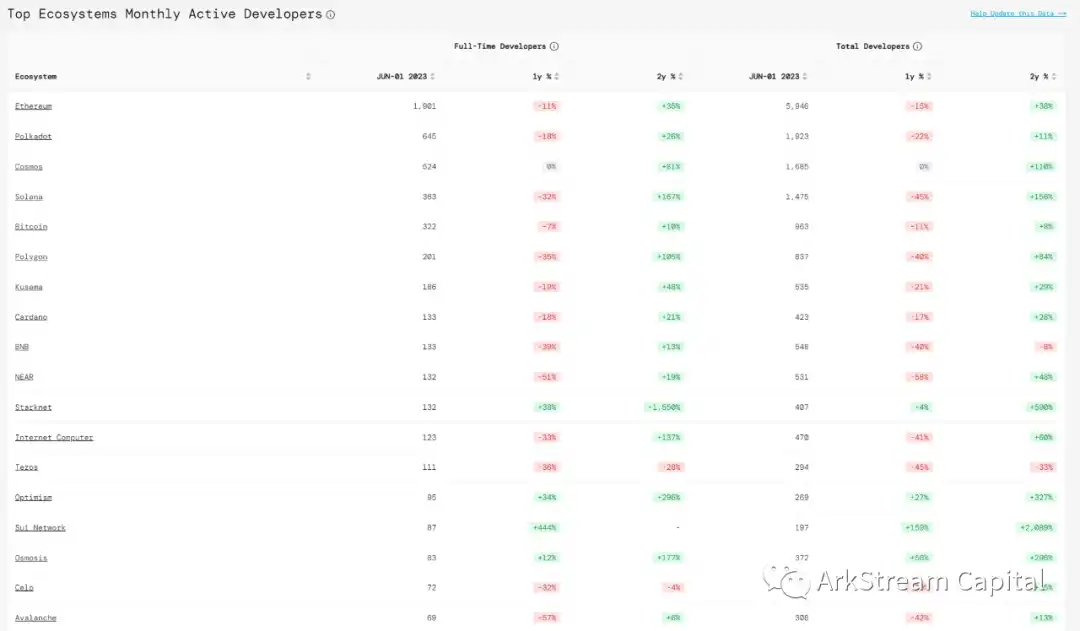
Next, let's ignore the pros and cons of the design of the public chain economic model and the performance of the market tokens. Combined with the open source developer data panel provided by Electric Capital, we will select some interesting public chains other than Ethereum and conduct further research on their unique or iconic innovative technologies.
Polkadot - Substrate
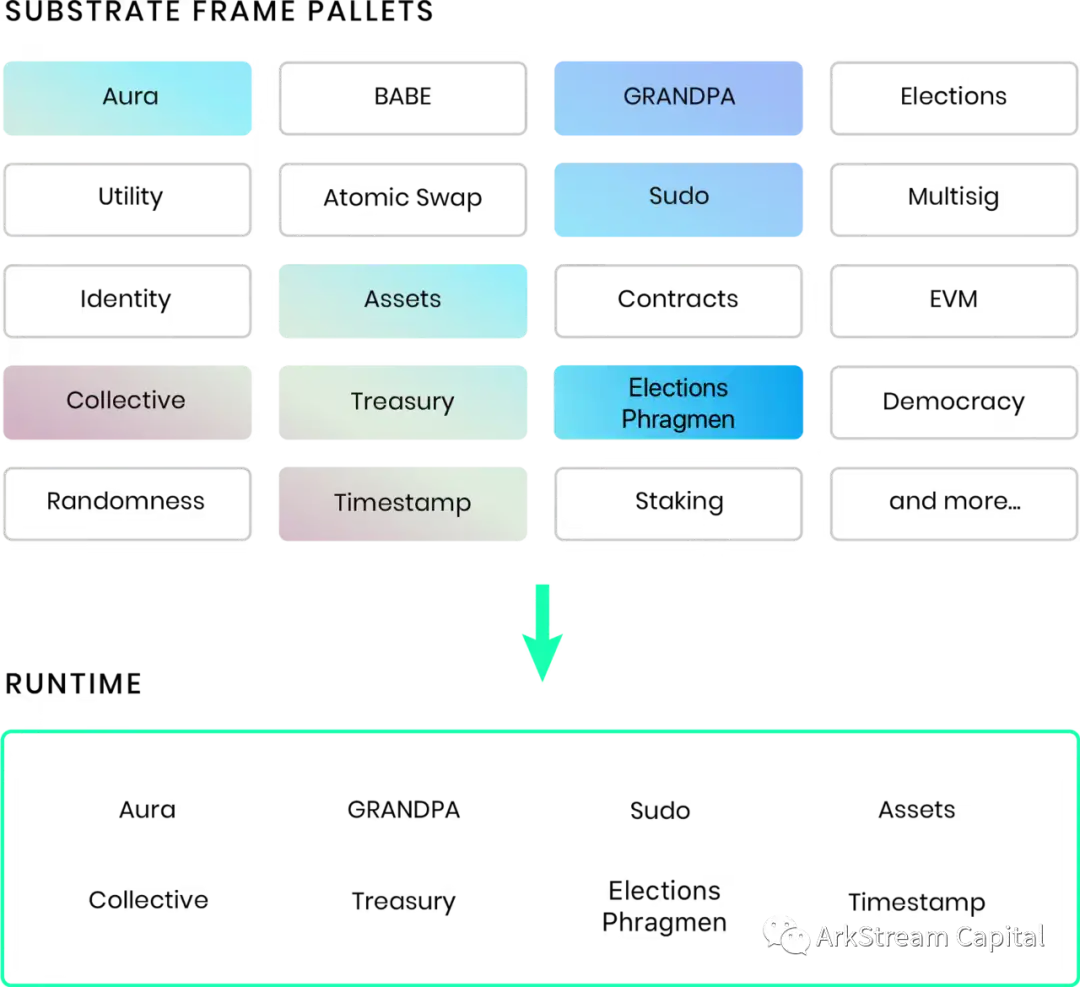
Polkadot uses blockchain parallelization technology to introduce the concepts of relay chains and parallel chains, and realizes shared security and intercommunication of multiple blockchains through the cross-chain communication protocol XCMP. The technical framework that supports these functional features of Polkadot is Substrate. Substrate provides the smallest development unit Pallets, which abstracts various functional modules, such as assets, pledges, and EVM, and provides the development framework Frame and blockchain customizable Runtime based on Pallets. Combined with the unique asynchronous model and parallel chain sharding mechanism, Substrate provides the ability to process a large number of transactions simultaneously, improving the throughput and performance of the overall network. In addition, Substrate also supports pluggable consensus mechanisms, and developers can choose different consensus algorithms according to their needs. In addition, Substrate has built-in Ethereum EVM and WASM runtimes, which also facilitates application migration and development in the Ethereum ecosystem. Finally, Substrate supports on-chain hot upgrades, which can upgrade and update the blockchain without interrupting the network.
Cosmos - Tendermint / Sovereign Chain / App Chain /IBC
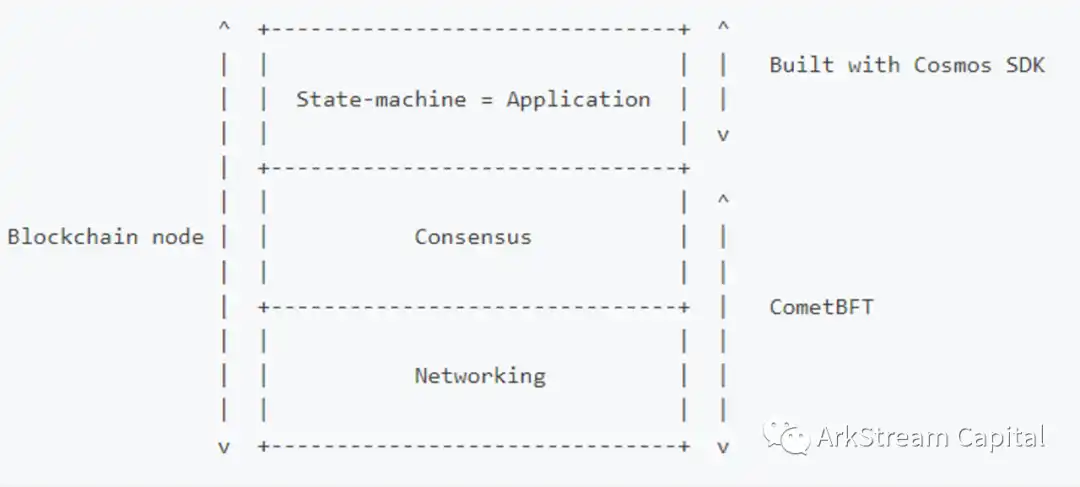
Tendermint is one of the first PoS consensus algorithms to implement Byzantine fault tolerance, and is also one of the inspirations for Ethereum's PoS algorithm. The concepts of Sovereign Chain and App Chain perfectly embody the decentralized multi-chain concept of Cosmos, allowing each sovereign chain to have its own consensus mechanism, economic model and governance rules, and also allowing specific applications or services to build small application chains directly through the Cosmos network. The two can communicate and interact with each other using IBC, and as a whole build a multi-chain Internet advocated by Cosmos.
Cosmos' two core development kits: CometBFT (Tendermint Core upgrade successor), a consensus engine that implements the Tendermint consensus algorithm and defines the application chain interface ABCI, and Comos SDK, which supports IBC and CosmWasm. The corresponding ecological features are the Cosmos Hub, the center of the Cosmos network, and various Zones connected to the Cosmos Hub. Since the launch of the Cosmos mainnet in 2019, IBC has long supported the initial interconnection of Zones, the interconnection of Zones and Hubs, and more abundant and complete functions such as inter-chain accounts (ICA) and inter-chain security (ICS). The Cosmos Hub will also take September 2022 as a key turning point, and officially transition from the first stage of initiation to the second stage of integration.
Sei Network - Optimized for Trading
As a popular Cosmos ecological application chain launched recently, Sei has a built-in order matching engine, sub-second settlement speed, parallel processing of orders, single-block order execution and other features. All of these customized functions of Sei are completed at the base layer, mainly through ABCI++ to achieve some of their optimizations, ABCI++ is an upcoming upgrade of Cosmos' ABCI, which makes each step of the consensus programmable.
Solana - Proof of History
Proof of History (PoH) is an innovative time proof technology, which can be understood as a global clock implementation mechanism in a distributed system, used to coordinate operations and time order between nodes in a distributed system. By embedding timestamps in each block, PoH builds a globally shared time series in the Solana network, allowing nodes in the network to easily verify the order and time of transactions. In this way, not only can the throughput and performance of the entire network be improved, but malicious tampering and replay attacks can also be effectively prevented.
NEAR - Nightshade Sharding / Beacon chain
Derived from the early sharding ideas of Ethereum, it also inherits the concept of Beacon chain, but optimizes the block producers and validators of each shard. Each shard has a group of block producers responsible for generating blocks and packaging the transactions and status data in the blocks. Since each shard is relatively independent, each block producer only needs to focus on the shard to which it belongs, and can generate blocks independently without coordinating with block producers of other shards. Validators only need to verify the transactions and status of their own shards, without paying attention to the status of the entire network. This can improve the efficiency of block generation and verification, so that more transactions and status updates can be processed.
Avalanche - Avalanche Consensus
The Avalanche protocol introduces a voting mechanism with an avalanche effect, which enables nodes to quickly reach a consensus and form a consistent decision sequence in the entire network. The key to the protocol lies in the process of multiple rounds of voting and iterative decision-making. Through continuous voting and feedback, the nodes in the network gradually converge to a consistent consensus result. Since nodes can vote and make decisions in parallel, the parallel processing capability of the entire system is improved, and the Avalanche protocol also allows dynamic entry and exit of nodes and adaptive adjustment of voting rules and parameters, thereby achieving flexible scalability.
Flow - Multi-node Architecture
Pipeline multi-node architecture. The execution node is responsible for the execution of transactions, and achieves massive processing and computing operations of transactions. Verification nodes monitor and verify the calculation results of execution nodes, ensure that execution nodes correctly execute smart contracts according to the rules, and verify the accuracy and consistency of calculations. Consensus nodes are responsible for the ordering of transactions and the generation of blocks, and their task is to ensure the security of the network. Such a multi-node architecture is like implementing the execution layer, data availability layer, settlement layer, and consensus layer advocated by the current modular blockchain directly at the public chain level.
Monad - Asynchronous Concurrent Transactions
Monad is an EVM-compatible L1, and transactions are also EVM-equivalent. In order to improve TPS, Monad will identify and mark transactions that do not affect each other, thereby eliminating the common dependencies of these transactions, and then achieve high concurrent transaction performance through the mechanism of asynchronous execution.
Diem/Libra - Move
Since its birth, Facebook/Meta's Diem (formerly Libra) has attracted much attention from all over the world. Whether it is due to criticism from traditional regulators or doubts from the native Web3 world, Diem's original intention is to serve billions of people around the world so that they can fully enjoy financial services comparable to traditional bank account payment systems. To this end, Diem has designed high-performance verification nodes in terms of technology, as well as the Move language and corresponding Move virtual machine that take into account asset security and smart contract execution efficiency. However, due to regulatory and policy reasons, Diem failed to launch the mainnet as scheduled. As a result, after inheriting these technical accumulations, the Diem team derived three public chain projects with different exploration routes, which are Sui Network, Aptos and Linera mentioned later.
Sui Network - Causal Order / Object Model
A DAG-like processing method is adopted for transactions, combined with a unique object model and a snapshot-like version number management mechanism, so that transactions no longer need to be arranged in a complete order, but only need to be arranged in a causal order, so that a large amount of parallel execution capabilities can be obtained naturally. Of course, the technical support behind this also comes from Sui's optimization and adjustment of the object system of the Move language, adding many asset attributes related to Web3.
Aptos - Block-STM
Block-STM's parallel execution engine is like the optimistic fraud proof Rollup, which directly introduces an optimistic lock concurrency control mechanism in the first layer of the public chain. Of course, optimistic locking technology has always been widely used in traditional databases. However, since optimistic locking is prone to high conflict rates and retry rates in scenarios with frequent write operations, it is not as suitable for concurrent high-frequency scenarios as pessimistic locking. Here, Aptos has also optimized this through solutions such as preprocessing and transaction splitting.
Linera - Microchains
If Sui Network and Aptos have made good use of Diem's Move language features, then Linera has inherited Diem's consensus mechanism very well. Even tracing back to the source, Linera's technical architecture comes from Facebook's original FastPay project, and FastPay is more like the predecessor of Diem/Libra, providing specific design concepts and in-depth technical details in large-scale payment scenarios with fast, secure and low latency.
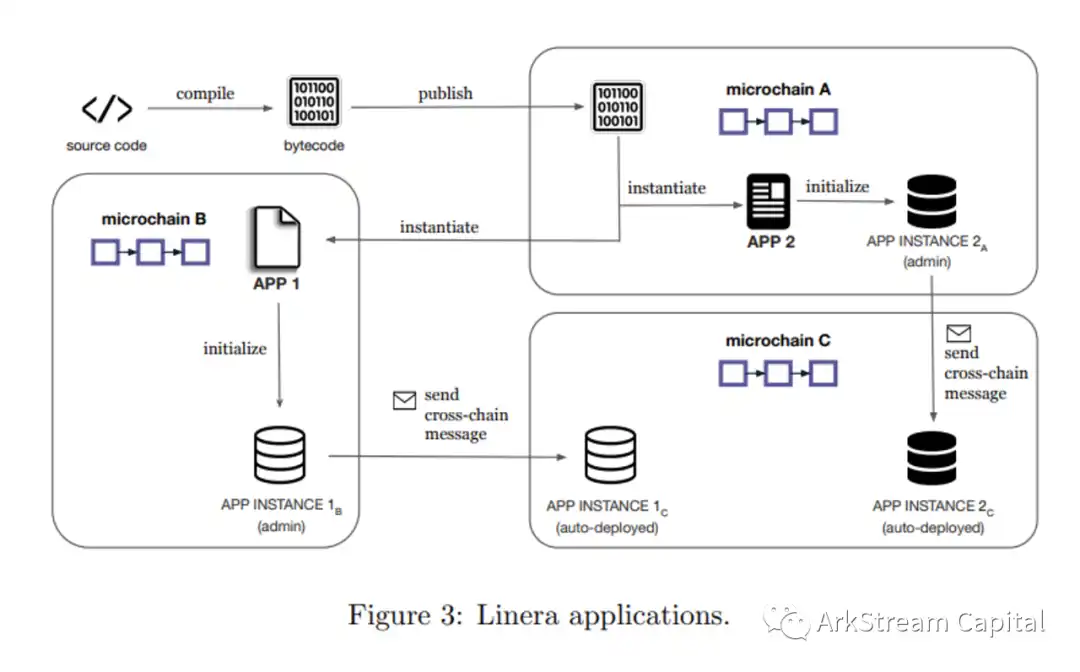
Linera has done a lot of research on the scalability of the architecture, mainly through Microchains. Microchains are maintained by the user end to form a Multi-chain network. Microchains can be public or private, and the communication between Microchains uses asynchronous messages. The entire network uses the same set of validators and DPoS consensus to ensure and execute, and the validator node is responsible for message delivery and state synchronization. In addition, the validator node also undertakes the operation and maintenance of public Microchains.
To some extent, Linera's technical architecture and concept have similar designs to the popular cloud native. Microchain corresponds to containers of many images, and App corresponds to instances of images. Such an architecture, like cloud native infrastructure, has good performance in elasticity and fault tolerance. Of course, how to safely and efficiently solve the communication and synchronization between Microchains is a different core problem that Linera has to face and solve as a public chain.
Just as cloud-native architecture has gradually occupied the selection of traditional application architecture through its own advantages in the past decade or so. This phenomenon of catching up or even overtaking makes us believe that the investment in Linera is our firm expectation that Linera, which is based on the mature solutions of Diem/Fastpay and has unique innovative technologies, will one day surpass Ethereum in certain application scenarios in the future.
Conclusion
I don’t know if it’s an illusion, but after reviewing the innovative technologies of these public chains again, I actually feel that the Rollup As A Service framework popular in Ethereum Layer2 is so similar to Cosmos’ SDK and Polkadot’s Substrate (Optimism’s OP Stack, Arbitrum’s Orbit, Polygon’s zkSupernet, Starknet’s Appchains and zkSync’s Hyperchains). Even some ideas of the new narrative Restaking are somewhat similar to Polkadot’s staking DOT for slot auctions and Cosmos 2.0’s ICS. The rise of Layer2 is closely linked to the strength of Ethereum. However, the exploration of new public chains is as important as Layer2, or even more important. The innovation and breakthroughs of new public chains in technology and solution exploration will greatly increase the upper limit of the basic service capabilities of the entire Web3 industry.
When the past public chains have accumulated more mature experience for the entire industry, the public chain track is more likely to give birth to a more powerful new public chain in the exploration of innovative public chains. Just as Satoshi Nakamoto was able to creatively propose Bitcoin, a decentralized blockchain network, using the proof-of-work mechanism and UTXO model, combined with public-private key cryptography, P2P networks, and chain blocks, now and in the future, we have reason to believe that based on the innovative technologies of the above-mentioned new and old public chains, in the Web3 world, there will inevitably be public chains that combine the strengths of hundreds of schools and realize the important task of Mass Adoption. We can see that innovative public chains, especially those based on the Cosmos system (such as Sei Network) and the Diem system/Move language system (such as Linera), will continue to explore the possibilities of blockchain in different dimensions, challenge the status of Ethereum, and extend the ceiling of public chains!
Reference
https://developer.bitcoin.org/reference/
https://ethereum.org/en/developers/docs/
https://polkadot.network/development/docs/
https://docs.substrate.io/
https://docs.cosmos.network/main
https://ibc.cosmos.network/
https://cosmos.network/cometbft/
http s://docs.sei.io/
https://docs.solana.com/
https://docs.near.org/
https://docs.avax.network/
https://developers.flow.com/
https://monadlabs.substack.com/
https://developers.diem.com/docs/welcome-to-diem/
https://aptos.dev/
https://docs.sui.io/
https://linera.io/developers
Welcome to join the official BlockBeats community:
Telegram Subscription Group: https://t.me/theblockbeats
Telegram Discussion Group: https://t.me/BlockBeats_App
Official Twitter Account: https://twitter.com/BlockBeatsAsia