MOVE language and the rise of new public chain

Original title: Solidity Idity Strongest Rivals: MOVE Language and the Rise of the New Public Chain
Author: Jason | @jason_chen998 | BuidlerDAO researcher
Frank | @Monolithmatrix | BuidlerDAO Researcher
Move little prince | Zhihu: Hand write Move smart contract
There are two bright trends in the new public chain narrative: one is the high-performance new public chain with Move programming language as the core, and the other is the modular blockchain represented by Celestia. With the help of this article, we briefly talk about the latest rise of the Move language system public chain three giants, and from the technical perspective, they behind the Move language what is good.
Quick look at the article:
01/ Move language is the rise of the Big Three
02/ Current Track Overlord: Aptos
03/ Resource features: Move really realize the digital assets & NBSP;
04/ Summary of technical differences: Solidity V.S. Move05/ Move Future Vision & Course Learning & NBSP;
1. The rise of the three major public chains of Move language;
· In 2019, Libra, Meta (formerly Facebook) 's super-sovereign digital currency project in global circulation, was launched, which was expected to be the peak of its success, and then was forced to transform into Diem due to regulatory restrictions. This year & have spent In late January, Diem was sold to Meta for about $182 million. The Libra and Diem teams left a legacy in the process -- the Move language that made up for the Solidity and EVM flaws, and the public-link teams that grew out of it, such as Aptos, Sui, and Linera.
· In December 2021, Sui, which got the earliest start, announced A Series A financing of USD 36 million. Investors include A16Z and NFX, Scribble Ventures, Redpoint, Lightspeed, Electric Capital, Samsung NEXT, Slow Ventures, and Standard Crypto, Coinbase Ventures, and others.
· In March 2022, Aptos completed a $200 million funding round, also led by A16Z.
· In June 2022, Linera announced the completion of a $6 million seed round, led by A16Z, including Cygni Capital, Kima Ventures and Tribe Capital.
· In July 2022, Aptos completed a financing of $150 million, led by FTX Ventures and Jump Crypto, and participated by A16Z, Multicoin Capital and Circle Ventures; Meanwhile, Sui is reportedly seeking $200 million in Series B funding at a valuation of $2 billion.
· In August 2022, Aptos announced that AIT3 will be launched on August 30. The project side announced that AIT2 was very successful, with more than 225 community nodes participating in the test in 44 countries and 110 cities worldwide. According to the project roadmap, the main network will be online after the completion of the test network.
It is not difficult to find that A16Z deliberately bet on the "Move language system public chain track", hoping that three public chain run out of the next cycle. The tripartite trend of Move language is also taking shape.
Of the three public chains, the one with the fastest development and ecological progress is undoubtedly Aptos. By far, it has a stronger community, more active developers, and a more robust dApp ecosystem, which we break down in detail in Part 3 of this article.
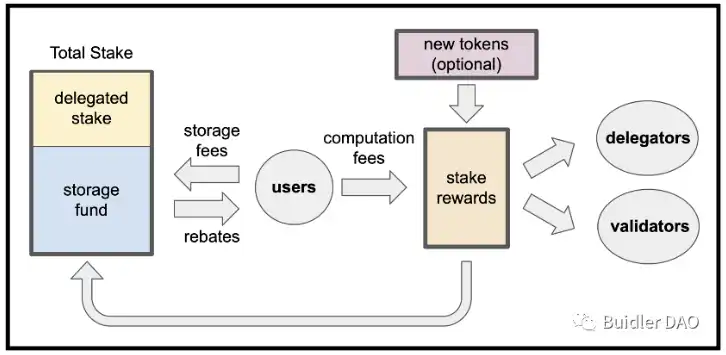
Sui, in second place, has released its own Tokenomics ($Sui) white paper. Its economic model has a unique feature: computation fees and storage fees are paid separately. When users submit data on the chain, they pay both a storage fee and a computing fee (commonly known as GAS). The money goes to the Stake Rewards and is transferred to the Storage Fund. Storage fees are transferred directly to the Storage Fund, which is used to subsidize future increases in Storage costs as the network grows and matures. This design returns the storage right of the data on the chain to the user, and the user can choose to delete the data on the chain to cancel the storage fee. In addition, Sui's development kit (SDK) tries to connect other ecosystems and non-encrypted applications, including Gaming APIs, SuiEcho, Handshake, and other featured SDKs. However, its ecological application layout is very poor compared to Aptos, with only a few wallet related ecological projects reported publicly.
Compared to Aptos and Sui, Linera started late and kept a lower profile, showing only the link to its official website and mission in its official Twitter post on June 18. Refer to Honeycomb Tech's research in "The New Generation of Public Chains Reattack the Impossible Triangle" : Linera is committed to introducing the rate of these two payment systems into the applied blockchain network, so that the operation of users on the chain can be confirmed in a fraction of a second. In terms of network performance, Linera introduced the concept of "linear scaling" - doubling the capacity of a system by increasing the number of machines. Currently, blockchain's model of prioritizing "sequential" execution allows accounts and smart contracts to interact in a series of transactions (such as flash loans), but prevents linear scaling. In Linera's linear scaling model, operations from different user accounts can run simultaneously in different threads of execution.
Current track Overlord: Aptos
According to Honeycomb Tech, Aptos launched the Developer TestNet in March this year, and in May Aptos launched the Incentive TestNet registration, and divided the Incentive Testnet into four rounds: "Decentralized launch," "Pledge," "Governance and Upgrade," and "Dynamic Validator Topology." Currently, its test network has reached more than 20,000 nodes, making it the largest known proof-of-interest node community today. Aptos says the community has grown far beyond their wildest expectations. According to the plan, the remaining two phases of the Aptos incentive test network are expected to be completed over the next two months, and by the end of September, Aptos will have launched the main network.
Although in the long term, the final winner of the new public chain is not clear; However, in the short term, Aptos undoubtedly occupies the position of the king of the "Move language chain track", which is jointly laid down by its development rate and ecological construction.
Aptos's star team allowed it to receive a lot of star capital in the early days. According to ForesightNews, Avery Ching, its co-founder and CTO, spent more than 10 years as a chief software engineer at Facebook and was the technical lead of the Novi team, formerly Meta's crypto platform; Most of the development team, including Alden Hu and David Wolinsky, participated in the development of Diem and Novi. Its design focuses on absolute security, scalability, and trusted neutrality, with the ultimate goal of being able to process 100,000 or even 160,000 transactions in a second. With this strong technical team, Aptos has also fully demonstrated its R&D capabilities, creating the following outstanding marginal advantages:
1. The Aptos team's consensus mechanism - Byzantine Fault Tolerance (BFT), to understand this concept, please refer to this CSDN article: https://blog.csdn.net/qq_40713201/article/details/124618644) four iterations, in order to realize high transaction throughput, low latency and high stability, and in a third of the validation of node failure, still can guarantee the stable operation.
2. It is expected to have faster transaction processing speed than the old public chain. According to the data of Aptos test network, the current network can process more than 10,000 transactions per second, and the main Aptos network can process 160,000 transactions per second under ideal conditions. According to public information, the Aptos Max TPS is far faster than established chains, including Solana, in recent tests of the speed of major chains.

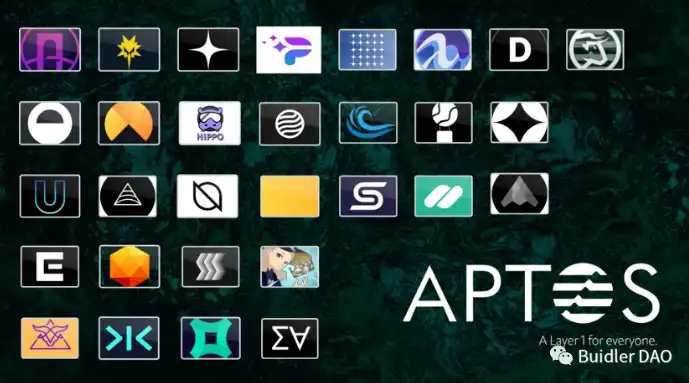
3. Aptos officially announced more than 30 ecological projects in July. Although many of them are in the test network and development stage, only wallet and DEX can interact with each other, but compared with other Move language ecological public chain is far ahead. The types of eco-projects announced today include mainstream Dapps such as Wallet (Hive), DEX (Pontem Network), Liquidity Protocol (NjordFinance), NFT (Topaz.so), browser (Aptosscan) and data analysis tool (Dapptos View) The track.
4. Make full use of the Move development language and the current mainstream public chain Solidity language to differentiate competition. Let's take a closer look at the key advantages of the Move language from a technical perspective.
3. Resource feature: Move really realizes digital assets
Move language is known as one of the most suitable languages for writing blockchain smart contracts, and has been used for many times to compare idity with the current mainstream Solidity. The main reason is that Move has more appropriate processing for the core Token assets of blockchain. To make up for the defects of Solidity in its intuitiveness and safety, here we will focus on the most unique Resource types of Solidity.
The security problem has become the core problem to be solved by the asset chain. In Web2, if product Bug or data leak, it is difficult to lead to user asset loss, which can lead to product collapse, personal information leakage and black market selling at most. However, due to asset link, once a Bug occurs in smart contract, it will directly lead to outflow or lock up of countless user assets behind it. We can also often see from the news that hackers have attacked some trading platforms or cross-chain Bridges, resulting in hundreds of millions of asset losses. BuidlerDAO has also produced a large number of research reports to study these incidents, most of which are caused by relatively low-level problems in contracts and being targeted by hackers. This brings up a key attribute for the reader to note: Solidity is a programming language for blockchain smart contracts, but not for assets on blockchain chains.
Why do you say that? For example, Solidity treats tokens as a numerical variable in the same way that most programming languages do. In this case, the Token transfer process is about adding and subtracting. In order to transfer 10 yuan to Li Si, the balance of Zhang Sam-10 is used first, and then the balance of Li Si +10.
So in Solidity the asset is a number that can be added or subtracted. In this case, the contract code needs to be very strict. For example, there are some problems in adding or subtracting. Because the process involves adding and subtracting back and forth between several wallets through a lot of code logic, it's hard to guarantee that something won't go wrong.
The reason for this is that assets are not specifically defined in Solidity and are just treated as variables like age, phone number, etc. The definition of an asset is supposed to be unique, just like in the physical world, I have a gold bar in my hand, and I'm going to give it to someone, and whatever happens in between, that gold bar doesn't go from 1 to 2. So what we often call digital assets in Solidity are only called numbers that can be added or subtracted, not assets.
Move's programmable Resource is the core to make it secure and powerful, realizing a real sense of digital assets. Resource is a data type. A data type is a way of defining a data structure:
Characters: such as name, address, String;
Numbers: such as age, phone number, can be an Int;
True or False: Some opposites can be represented by Boolean true and False.
Move believes that Token assets are special and important data, which should not be defined and represented by ordinary numeric types. Therefore, a separate Resource is created to define the on-chain assets. This approach presents three features:
1. Resource still exists as a value in Move and can be stored as a data structure or passed and returned as an argument.
2. Resource can safely represent digital assets. It is special in that it cannot be copied, discarded or reused, but it can be safely stored and transferred. Moreover, the value of Resource type can only be created and destroyed by the module that defines the type, so it implements the meaning of the asset rather than the number.
3. Resource ADAPTS to blockchain application features, such as binding to accounts. Resource data must be stored under the account, so the corresponding Resource asset will not exist until the account is allocated, and the Resource must be "used" as soon as it is removed. After the asset is removed from the account using the built-in Move_form method, Either you pass it as a return value that has to go somewhere, or you destroy it, which means you use as much of the asset as you take. Remember how Solidity works? It reduces the balance of one address and adds it to another address and then makes the decreasing and increasing numbers consistent with each other through code. So Solidity is strictly implementing asset usage based on code logic, but Resource encapsulates the concept of assets at the bottom level instead of adding or subtracting. Avoid assets being created out of thin air and accessed at will greatly improve security. Think of Move Token moves as moving bricks from one place to another while Solidity is adding and subtracting, subtract from one place and add to another.
To sum up, Move is a more native and fit programming language dedicated to publishing digital assets, which realizes the direct integration of programs and digital assets.
Iv. Summary of technical differences: Solidity V.S. Move
After transitioning from Bitcoin Script to Ethereum Solidity, Solidity is definitely a success after experiencing the baptism of DeFi. But analyzing the most visible security breaches in the last six months -- PolyNetwork, Horizon, Nomad, Solana, and more -- makes one shudder. Contrast impossible triangle, how to guarantee the safety of assets on the chain, has become the main problem that the whole industry urgently needs to face, A16Z is taking a look at this potential just need, a breath to lead the Move of the three major public chain.
In the future to embrace the Web3 era, behind these loopholes, VM is constantly looking for defects, such as fixing the original overflow problem, but it is difficult to improve the underlying design defects. Unlike previous development experiences, DeFi applications are essentially open source and transparent financial systems with high security requirements. Therefore, it may be a better choice to design a more secure, reliable and low-threshold smart contract language for financial scenarios. Here let's dig into Solidity and compare it with Move:
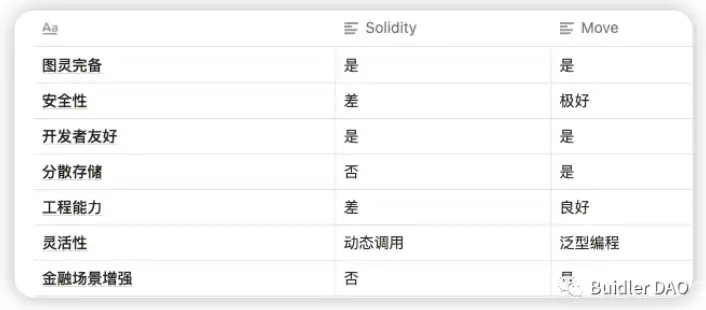
As can be seen from the above, Move adds a lot of features based on Solidity and has excellent security and engineering capabilities. Move drew valuable lessons from Solidity's real security vulnerabilities and made major innovations in the underlying security design, making the open source system more secure and reliable while ensuring the expressive power and flexibility of the language.
For example, suppose there are 100 tokens. In Solidity, a hacker can easily duplicate 100 tokens into more tokens (see the Unlimited Issue bug). However, in Move, as long as the Token is defined as Resource, the Token cannot be copied or modified at the VM level. Hackers cannot steal the Token by copying.
For Move, similar advantages are many:
Resource oriented programming
Move has been enhanced specifically for the financial scenario, introducing resource-oriented programming. In common scenarios such as FT and NFT, Move defines data as resources to ensure data security at the VM level.
Purely static language
Dynamic calls are the cornerstone of Solidity. All cross-contract calls are made through dynamic calls such as DelegateCall, but it is also the gateway to most security breaches such as TheDAO attacks, PolyNetwork cross-chain attacks, etc. Based on the real experience of Solidity, Move has adopted a completely static implementation to better secure the on-chain assets.
Formal verification
Formal verification is FV(Formal Verification) when a mathematical tool is used to analyze the space of possible actions of a design, rather than computing the result of a specific value. That is, to prove mathematically that the program is secure. Move comes with formal validation tools that enable us to use mathematical techniques to test and prove the reliability of contracts, which is an advantage that Solidity cannot match.
Distributed storage
In the era of Web3, users have the ownership of data. Solidity centrally stores the contract data in the form of Map. If there is a loophole in the contract, for example, if the Owner of the contract is obtained, all the user data will be attacked. Move skillfully uses Resource to store the data in each user's own Account, which not only ensures the security of the data, but also really achieves the ownership of the data belongs to the user. The Owner of the contract does not have the permission to modify the data.
Programming toward generics
For the sake of security, Move is designed as a pure static language, but the flexibility is not reduced, Move through generic oriented programming, to ensure the extension of the contract, increase the reuse ability of code.
V. Move the future outlook and course learning
From Script to Solidity is a change in the ability to express contracts, and from Solidity to Move is a change in the ability to secure contracts.
Move is developer friendly. The Move language is all about lowering the safety barrier for developers. Contract developers can focus on business logic without having to worry about code security. Only by allowing contract developers to write high security code without feeling it, and away from security vulnerabilities caused by low-level bugs, can DeFi be more secure and users feel more at ease. Move also has many nice features (such as engineering capabilities) that we haven't covered in this article, but are well worth exploring.
In the study of the hot topic of the new public chain, our researchers coincidentally found that to understand the narrative of this round of new public chain, we must understand the technical details of Move and public chain technology innovation.
Therefore, Buidler DAO and Move Language senior evangelist (Little Prince) of 3NJOY Lab team created a series of pure public welfare technology courses. We hope that with the help of the new public chain this trend, continue to provide a solid Buidl for the industry, to the industry to provide a new course -- from the start of Move grammar, from shallow to deep, step by step into the advanced features of Move, hand teaching, suitable for all kinds of learning Move friends, please look forward to.
Reference article:
- Mysten Labs & Sui: vs. Aptos, other L1s . State Io
https://medium.com/@state_xyz/mysten-labs-sui-vs-aptos-other-l1s-d046b598a914
- The New generation of public chains attack the Impossible Triangle again. Honeycomb Tech
https://mp.weixin.qq.com/s/yS3heq0qbdcPwX3WVYMnKw
- Renewed war on the "Xin Xin Public Chain"? First look at Aptos Ecology. ForesightNews
https://foresightnews.pro/article/h5Detail/8874
- 30 new public links. Beep News
https://mp.weixin.qq.com/s/e1cyqDKsYfcQ3DZJ238D9w
-Why do I think Move will eventually outperform Solidity. 3NJOY Lab
https://www.odaily.news/post/5180762
The original link
Welcome to join the official BlockBeats community:
Telegram Subscription Group: https://t.me/theblockbeats
Telegram Discussion Group: https://t.me/BlockBeats_App
Official Twitter Account: https://twitter.com/BlockBeatsAsia

 Related Articles