Alpha Hunting: The Rationale Behind OKX Ventures' Early Bet on SUI
Original Author: OKX Ventures
As the Web3 technology stack continues to evolve, smart contract languages are gradually migrating from Ethereum's Solidity, which has been dominant, to the Move language, which is more secure and resource-abstract. Move was originally developed by Meta for its cryptocurrency project Diem (formerly Libra), featuring resource-first design and formal verification friendliness, and is gradually becoming an important language option for the underlying architecture of the new generation of public blockchains.
Against this backdrop of evolution, Aptos and SUI have emerged as dual core representatives of the Move ecosystem. Aptos, launched by the original Diem core team at Aptos Labs, continues the native Move technology stack, emphasizing stability, security, and modular architecture; while SUI, built by Mysten Labs, inherits the Move security model and introduces object-oriented data structures and a parallel execution mechanism, forming the SUI Move branch with more performance breakthroughs and innovative development paradigms. It has reshaped on-chain resource management and transaction execution patterns. It can be said that SUI is a Layer1 that truly reconstructs the mechanism of smart contract execution and on-chain resource management from first principles; it's not about chasing "high TPS", but about rewriting how a blockchain should operate. This makes SUI not only powerful in performance but also paradigm-leading, serving as the technological foundation born for complex on-chain interactions and large-scale Web3 applications.
1. Breaking Through and Reshaping the Public Chain Landscape
After Solana entered the Firedancer era, its performance curve may remain ahead; however, it is still in the "single-chain high-frequency trading" paradigm. SUI seeks to respond to needs beyond the performance arms race with a horizontal stack + end-to-end privacy/storage approach. This sets it apart significantly from Aptos (also Move but still single-dimensional scaling) or Sei (specialized chain, deep liquidity concentration). For investment institutions, this means:
· If you value high TPS + sustainable transaction fees, Solana & specialized chains may bring returns faster;
·If focusing on the "New Type of Application" and horizontal interface control, SUI's alpha comes from the undersaturated SaaS/privacy/offline track;
·Aptos and SUI highly overlap in DeFi and BTCFi, requiring cautiousness against track internal looping.
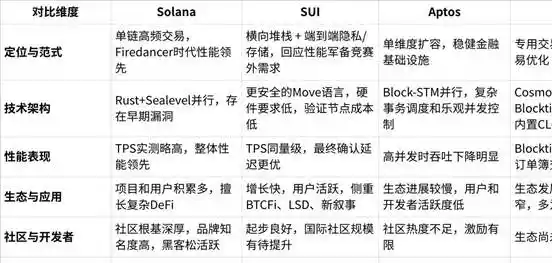
Comparison to Solana: Solana has gone through multiple rounds of bull and bear cycles, with a large ecosystem. As a latecomer, SUI has clear advantages: it adopts a more secure Move language, avoiding the vulnerabilities caused by Solana's Rust+Sealevel parallelism. Also, SUI has lower hardware requirements, lower validation node costs, and is favorable for decentralization. In terms of performance, both are similar, with Solana's TPS slightly higher, but SUI has lower confirmation latency. In the ecosystem, Solana has more projects and users, focusing on complex DeFi (such as Serum, Drift), while SUI is growing faster, once matching user activity levels, achieving differentiation through new fields like BTCFi and LSD. Solana's community is mature, while SUI's international community size needs to expand. In the future, both can coexist, with Solana leaning towards a native crypto ecosystem and SUI focusing more on Web2 penetration and game socialization. Both pursue performance limits: Solana relies on Firedancer for multithreading, while SUI depends on Mahi-Mahi upgrades.
Comparison to Aptos: Aptos and SUI both originate from Libra/Diem, with Aptos launching ahead, once achieving the aura of the "first Move chain" and a high valuation. In the past year, Aptos' ecosystem has developed slowly, with lower user and developer activity compared to SUI. Reasons include: Aptos uses a complex Block-STM parallelism, with noticeable performance drops under high concurrency, whereas SUI has a more efficient object model. Aptos is positioned as robust financial infrastructure, focusing more on DeFi and NFTs, with a style akin to Ethereum clones; SUI attempts a more diverse narrative, with rapid user growth (8.03 million new coin-holding users far surpassing Aptos), but with higher risks. In terms of incentives, Aptos had airdrops but lacks continuous incentives, while SUI, although without airdrops, has strong foundation support, with better monthly active addresses and on-chain transaction volume compared to Aptos. Aptos has a strong team and financial strength and may focus on institutional finance or the East Asian market in the future, but the current market is more bullish on SUI.
Sei Comparison: Sei is a specialized trading chain that emerged in 2023, based on Cosmos, focusing on order book trading, with a block time of approximately 500ms. It aims to seize the Solana downtime market, experiencing a short-term surge in popularity, but its Total Value Locked (TVL) and user growth are not sustainable, and its ecosystem development is limited. With a narrow focus and reliance on liquidity mining, it is difficult to form a complete ecosystem. In contrast, SUI follows a general Layer 1 (L1) route, supporting various applications and exhibiting stronger risk resistance. Sei lags behind SUI in terms of cross-chain compatibility and language advantages, although it may transition or fully integrate into the Ethereum Virtual Machine (EVM) ecosystem, it is currently unlikely to pose a threat to SUI. Of particular note is Linera incubated by Mysten, focusing on high-frequency micropayments, which may serve as an SUI scaling sidechain with a different positioning than SUI.
Ethereum L2 Comparison: The Ethereum Layer 2 ecosystem (such as Arbitrum, Base) is thriving, with TVL exceeding $20 billion each. SUI boasts ultra-low latency and high concurrency advantages over Ethereum L2 solutions like Rollups, with low gas fees, making it suitable for high TPS games and other applications. Ethereum L2 benefits from a strong network effect and security endorsement. The competition between SUI and L2 is fundamentally a competition between a new paradigm (public chain) and a traditional paradigm (Rollup), which may coexist in the long term, while in the short term, it depends on who can better meet the application's needs.
II. Rapid Growth and Impressive Ecosystem Data
Since the SUI mainnet launched in May 2023, user growth has shown exponential trends: by April 2025, over 123 million user addresses had been created on the SUI chain. This number is almost approaching the cumulative address volume of old-school public chains like Tron. In the latter half of 2024, the average monthly active addresses on SUI were about 10 million; starting in mid-February 2025, this metric saw a steep increase, stabilizing at over 40 million by mid-April, more than quadrupling the monthly activity. On the user acquisition front, a “turning point” emerged at the end of 2024—average daily new wallet addresses surged from 150,000 to a sustained level of over 1 million.
In particular, the rise of a new public chain often accompanies significant cross-chain fund inflows. In the latter half of 2024, SUI welcomed the first wave of traffic through third-party bridges: by November 2024, approximately $9.448 billion in cumulative funds had bridged into SUI. As of mid-2025, the total cross-chain lock-in volume on SUI (bridge TVL) was about $25.5 billion. This indicates that besides internal DeFi TVL, a significant amount of assets remain in the bridged assets, supporting the liquidity demand on SUI. Furthermore, as DeFi activities heat up, the stablecoin supply in the SUI ecosystem has soared: in mid-April 2025, the stablecoin market cap on SUI hit a historical high of over $8 billion. This scale is already comparable to stablecoin levels on old-school public chains like Tron, underscoring the increasing trust of users in the SUI network for value storage and transfer. In terms of stablecoin composition, USDC remains the absolute mainstay, with a market cap share consistently above 60%. USDT was also issued on SUI at the end of 2024, maintaining a certain level of activity.
Although still lagging behind Solana in throughput, SUI has fully covered high-frequency scenarios such as on-chain order book DEX, real-time PvP, and social interactions. Due to its fast finality + DAG parallel execution, it naturally fits the track for microtransactions, in-game asset exchange, and social "like/comment" type of interactions. With the upcoming Mahi-Mahi upgrade targeting>400,000 TPS, SUI is continuously solidifying its scalability moat. However, the 150-minute downtime event on 2024-11-21 serves as a warning, and the core protocol's stability under high load conditions still requires ongoing validation. Additionally, the low average Gas fee is a key selling point for SUI to attract developers aiming to build "on-chain real-time applications"; however, if peak fee rates repeatedly hit highs, user churn is likely in gaming and social scenarios. Stakeholders need to monitor the storage fund parameters and the pace of L2 solutions to assess the long-term cost curve.
Currently, SUI's ecosystem data is very promising: first, the resilience of its capital structure is taking shape. The 2025 Q2 steady-state TVL is approximately 1.6 to 1.8 billion USD, with stablecoins + LSD ≈ 55%, able to retain value even without incentive subsidies—indicating that the "sticky capital" post-hot money cycle has begun to settle. Furthermore, the institutional address holding ratio has increased from 6% to 14% (doubling in six months, Artemis standard calibration), retail funds' proportion has decreased but their activity has increased, making funds more concentrated yet more active, providing a safety cushion for the next round of leverage/derivative expansion.
Second, the developer retention rate is higher than peer blockchains. According to Electric Capital's statistics, the 24-month survival rate (devs committing on GitHub for two years) is SUI = 37%> Aptos 31%> Sei 18%. The key driver here is: the object model + Walrus / Seal native SDK reduce the mental cost of "rewriting on-chain structure"; most teams are willing to write their first contract on SUI rather than porting it.
Third, the user structure exhibits bimodality (DeFi + content entertainment) driving on-chain interaction diversification. DeFi contracts account for approximately 49% of on-chain calls; content applications such as FanTV, RECRD, Pebble City contribute about 35% of call volume. Social and consumer applications have yet to truly take off, representing a potential blue ocean. The Web3 transformation of content creation (music, video) has begun in SUI but can be further advanced. Especially since SUI has many users in Southeast Asia, considering social products tailored to the user habits of that region may be beneficial. Localized on-chain short videos, on-chain fan tipping, and the like might find a market. As these products grow, they can lead to businesses such as advertising, data analysis, forming a positive feedback loop for the ecosystem economy. The growth period for Social products is relatively long, but once successful, they exhibit strong stickiness.
For example, by March 2025, the on-chain BTCFi locked amount on the SUI network surpassed 1,000 BTC; by April, BTC-related assets accounted for 10% of SUI's total TVL, covering assets such as wBTC, LBTC, stBTC, and others. In other words, approximately $250 million worth of Bitcoin was already at work on SUI. These Bitcoin assets on SUI are fully utilized: users can collateralize BTC-pegged assets to the lending protocol in exchange for stablecoins, achieve "earnings on holdings," or provide BTC/stablecoin liquidity to earn trading fees. One-stop liquidity protocols like Navi quickly supported BTC as collateral and introduced yield aggregation strategies such as "BTC Plus."
Fourth, Potential Growth Trajectory: RWA and Native Derivatives as Two Major Blank Spaces. On the RWA front, Seal/Nautilus offers compliant privacy + verifiable computation, serving as a natural base for issuing bonds and fund shares; collaborations have already been made with Open Market Group (planning to issue RWA yield certificates on SUI) and 21Shares (whose existing SUI ETP has a scale of approximately $300 million) to test asset/tokenization of physical assets/bonds. The opportunities this brings include RWA issuance-end SaaS, compliant identity-as-a-service, on-chain secondary exchanges, and valuation oracles. Regarding native perpetuals/options, the current on-chain Perp OI is around 20m, with Bluefin holding about 70%. The difference between Hyperliquid-style applications and SUI lies in "performance vs. liquidity aggregation." If SUI decides to implement composable/cross-protocol matching at the consensus layer (such as DeepBook 2.0), there is an opportunity to establish unified derivatives infrastructure, with a potential 10x growth ceiling.
III. Forward-looking Layout, SUI Foundation, OKX Ventures, and Mysten Labs Emerging as Key Eco-Strengths
A thriving ecosystem relies on the catalysis and empowerment of strategic capital. Throughout the process from the budding to the rapid rise of the SUI ecosystem, OKX Ventures has played a crucial role. Its investment strategy is not a simple financial bet but a forward-looking, systematic layout based on a profound understanding of SUI's technological architecture and ecosystem potential, thereby catalyzing the prosperity of the SUI ecosystem.
The SUI application ecosystem currently revolves around financial categories (DeFi + BTCFi) as the absolute focus, followed by entertainment categories (GameFi/NFT/Social). AI-native tools and derivatives are still in the early stages. The real blank spots are RWA lending and on-chain derivatives: the former awaits Seal/Nautilus' privacy-compliant solution to land, and the latter requires stronger matching depth and risk hedging tools.
OKX Ventures is widely recognized by the market as one of the earliest discoverers and strategic co-builders of the SUI ecosystem. Shortly after the launch of the SUI mainnet, when the ecosystem was still in its early stages, OKX Ventures, with its keen judgment, decisively invested in several core projects such as Cetus, Navi, Momentum, and Haedal. These projects cover key tracks in the DeFi field, such as decentralized exchanges (DEX), lending, and liquidity staking (LST), laying a solid foundation for the subsequent explosive growth of the SUI financial ecosystem. For example:
· Momentum: An innovative DEX deployed on the SUI blockchain, co-founded by former Meta Libra core engineer ChefWEN. Since its launch in 2025, the trading volume has rapidly surpassed $1 billion, with over 200,000 active users, making it one of the fastest-growing liquidity platforms on SUI. It adopts the ve(3,3) model, where token emissions, transaction fees, and rewards are 100% returned to users, achieving a deep interest alignment among traders, voters, and liquidity providers. Momentum manages a TVL of over $500 million, supports stablecoin and multi-asset trading, and is gradually establishing itself as a core liquidity engine in the SUI ecosystem with its low fees and high efficiency.
· Haedal: Haedal is a leading liquidity staking protocol on the SUI blockchain, where users can stake SUI or WAL to earn haSUI and other certificates, allowing them to actively participate in DeFi applications while engaging in governance. Since its launch in early 2025, TVL has exceeded $200 million, with the daily active wallet exceeding 44,000, becoming a leader in the LSD track. Its Hae3 technology architecture includes HMM market makers, HaeVault yield optimization, and HaeDAO governance system, increasing basic staking rewards to over 3.5% and deepening collaboration with multiple core SUI protocols. With high security and capital efficiency, Haedal aims to become an alternative to Lido in the SUI ecosystem, leading the reshaping of the LSD market structure.
· Cetus: Cetus is a decentralized exchange and liquidity protocol deployed on Sui and Aptos, supporting various liquidity algorithms such as CLMM, RFQ, and DMM to meet both retail and institutional demands. Its multi-curve strategy design and efficient Tick pricing mechanism significantly improve capital efficiency and build the main settlement and aggregation infrastructure on SUI. Despite experiencing a security incident in 2025, the team promptly patched the vulnerability, recovered funds, and launched a compensation plan, becoming a model of secure governance. After the relaunch, trading volume quickly rebounded, with a daily peak exceeding $3 billion, and TVL stabilized at over $1.2 billion. Cetus is building the key infrastructure for Move ecosystem liquidity with high performance and composability.
·Navi: The first Sui-native one-stop liquidity protocol, integrating lending, liquidity mining, automatic leverage, and isolated markets, with a 2025 TVL of 2 billion USD and over 830,000 users. Launched a 10 million NAVX ecosystem fund to support incubation and deep integration with major DEXs, providing underlying liquidity and liquidation for DeFi projects.
The investment by OKX Ventures is not an isolated "point" but rather connects to form a "face," creating a strong ecosystem synergy. The DEXs invested in by OKX Ventures provide liquidation venues for lending protocols, while lending and LST protocols create new assets and liquidity sources for DEXs, collectively building a self-reinforcing DeFi ecosystem. More importantly, OKX Ventures' contribution goes far beyond the capital level. As a top global crypto platform, its industry resources, market insights, and technical support have greatly accelerated the product iteration, market promotion, and user acquisition of these early-stage projects, driving the maturity and prosperity of the entire SUI ecosystem. This "investment + empowerment" model is a key catalyst for the rapid distinction of the SUI ecosystem among many public chains.
Simultaneously, the investment by the SUI Foundation and Mysten Labs at the infrastructure level has also established a profound competitive barrier for the ecosystem. Mysten raised over 3 billion USD cumulatively from 2023 to 2024 for SUI development. A large part of these funds was allocated to the development of "thick infrastructure" such as Walrus, Seal, Nautilus, and others. This strategy differs from ecosystems that focus more on end-user applications like Solana: SUI chooses to first address the shortcomings of the underlying infrastructure, then promote application innovation through grants and hackathons (such as the 2024 Overflow Hackathon, which attracted participation from over 350 projects). The richness of the infrastructure also brings about technological stickiness within the ecosystem: once developers are accustomed to and rely on the unique services provided by SUI (such as Seal's secure storage, Nautilus' trusted computing), their willingness to migrate to other chains diminishes, as other platforms may lack equivalent functionality or require rebuilding. Furthermore, this infrastructure strengthens SUI's capacity to accommodate emerging fields. For example, the Walrus+Seal combination gives SUI a unique advantage in supporting DApps requiring privacy and massive data for fields such as social, AI, while Nautilus may attract cutting-edge developers looking to achieve on-chain AI inference, secure multi-party computation.
IV. Value Proposition: From "Fastest L1" to "Programmable Internet Stack"
Over the past year, the public has continuously referred to Sui as a "high-performance parallel chain." However, at the recent event, Evan Cheng, Co-Founder of Mysten Labs, provided a more ambitious description: "Blockchain is not just trading; Sui is a global coordination layer that weaves compute, liquidity, and data into the programmable foundation of the next-generation internet."
The team aims to incorporate traditional internet components—compute power, storage, identity, liquidity, privacy computation—into a single native protocol stack and make each layer available for external applications to use on-demand. Six components (Sui Mainnet, DeepBook, SuiNS, Walrus, Seal, Nautilus) are already running on the mainnet or public testnets, all with open-source licenses or on-chain governance. They offer a new path: The true differentiation of Sui lies not in single-point TPS but in "horizontal composition."
Currently, this infrastructure has entered the production phase. The Mysticeti consensus engine brings sub-second finality (P50 latency around 0.39 seconds), with no congestion even during peak hours; the DeepBook public matching layer reduces matching latency to 390 milliseconds, with daily orders exceeding one million, accounting for over 40% of all on-chain transactions; in terms of identity, SuiNS has minted 280,000 domain names, while zkLogin has completed over 12 million social logins in three months, covering nearly a third of daily active users; since the launch of the native storage mainnet, Walrus has written 580 TB of data, increasing shard utilization from 8% to nearly 12%; Seal offers MPC/TSS secret management services, covering 40+ enterprise applications; Nautilus supports verifiable computation, allowing TEE inference results to be uploaded on-chain as Move objects, with 7 AI projects currently in testing, three of which have publicly disclosed a total fundraising of $17 million.
Based on these capabilities, Sui has opened up multiple growth directions. The first is Web2 SaaS Migration. The team has listed over 30 Web2 services such as Dropbox, GitHub, eBay, YouTube, etc., as potential cases that may be "rebuilt on the six layers of Sui" in the future. Currently, non-financial interactions such as content distribution, social networking, and identity verification account for approximately 42% of mainnet usage but contribute only 11% of transaction fees, indicating that a large number of "low Gas, high-frequency" Web2-SaaS transactions have started to migrate to the main chain. The lack of B2B middleware (such as billing, permission management, content acceleration, DevOps registry) around these applications represents a high-uncertainty, high-reward new frontier—an area with high entry barriers, significant subsidy potential, and enormous opportunities.
Another overlooked direction is offline networking and extreme scenarios. The Sui team is testing non-IP networks such as SMS, LoRa, HAM, satellite, underwater acoustics, and is attempting to encapsulate transactions as "offline shards," aggregating back to the chain through an enclave-token and zero-latency zk-tunnel. This technological path, targeting weak network scenarios such as India, Southeast Asia, post-disaster relief, is a real need not yet covered by mainstream L1/Rollup. Once implemented, it will trigger a wave of lightweight hardware/client startup opportunities such as LoRa POS, SMS wallets, zk-tunnel SDK, and more.
Furthermore, in the blockchain x AI narrative, Sui does not emphasize "on-chain modeling" but focuses on "AI verifiability". Evan Cheng categorizes the integration of AI and blockchain into four quadrants, with Sui focusing on making AI weights, inference logs, and data sources auditable on-chain through Seal + Nautilus. Such capabilities are better suited for regulatory and institutional needs. Already, entrepreneurial projects have included "AI Inference as a Service + auditable ledger" in their Pitch Decks, with MechColony achieving verifiable NPC behavior trees in 6 weeks. The core value of such projects lies not in computing power but in trust distribution—once Sui establishes a reputation in "trusted AI," downstream applications such as data markets, copyright distribution, and model NFTization will naturally converge.
In terms of technical progress, the Sui ecosystem is also constantly improving. From basic consensus, protocol upgrades to development experience, and user tools, breakthroughs have been made. The protocol supports dynamic version control and on-chain/off-chain hot updates, allowing for multi-round seamless upgrades, reducing hard forks, and enhancing stability. Mysticeti introduces a DAG asynchronous pipeline, achieving sub-second finality and 12,000 TPS throughput; the Move language introduces generic specialization, macro expansion, and debugging tools, greatly increasing development efficiency; wallet-side integrations with Phantom, Slush, etc., optimize user interaction experience and asset security. In terms of ecosystem philosophy, Sui emphasizes decentralization (widely distributed resources), composability (flexible module collaboration), true ownership (user control of data and identity), and is committed to building a universal infrastructure that serves the Web3's scalable implementation.
In early 2025, Sui achieved multi-network smooth upgrades through protocol version control and hot update mechanisms, enhancing network compatibility and consistency. The Mysticeti consensus engine deployed has compressed consensus latency to sub-second levels and maintained stable throughput under heavy load. Move language also completed upgrades such as generics, macro expansion, and with wallet integrations significantly optimized developer experience and user interaction flows.
In terms of ecosystem components, the Sui ecosystem has built a full-stack architecture covering storage, encryption, and privacy computing through underlying protocols such as Walrus, Seal, and Nautilus, significantly improving on-chain and off-chain data processing efficiency and data sovereignty. Walrus, with its layered architecture and Red Stuff encoding, achieves low-cost, high-concurrency, and multi-chain compatibility in decentralized storage and data availability, suitable for NFTs, AI, DeFi, and other big data scenarios; Seal provides threshold encryption and programmable access control to promote on-chain privacy and digital rights management implementation; Nautilus realizes verifiable off-chain computation based on TEE, natively supporting Move to expand applications such as AI inference, oracle, and blockchain games. In addition, the Sui ecosystem also brings together middleware and development tools such as SUIPlay, Move, DeepBook, zkLogin, SUIBridge, forming a "decentralized full-stack" covering modules such as computation, communication, identity, payment, and security.
In terms of security governance, Sui has also demonstrated remarkable rapid response capabilities. After the Cetus hack incident, Sui coordinated validator nodes through on-chain governance to freeze the hacker's address, recover $162 million in assets, and achieve the first "keyless transfer." The Foundation, together with project parties, provided a $30 million loan, combined with the fund recovery and gradual token release compensation mechanism, resulting in a user recovery rate of 85%-99%. Subsequently, Sui established a $10 million security fund, promoted protocol open-sourcing, enhanced audit incentives, and optimized governance processes to enhance transparency and community participation. Although this also sparked discussions on decentralized power centralization, it undoubtedly showcased Sui's comprehensive crisis response and community governance capabilities and experimental spirit.
All of this indicates that Sui is transitioning from the narrative of being the "fastest L1" high-performance chain to a higher positioning of the "programmable internet stack."
Disclaimer:
This article is for reference only. The views expressed in this article are those of the author and do not necessarily represent the views of OKX. This article is not intended to provide (i) investment advice or investment recommendations; (ii) an offer or solicitation to buy, sell, or hold digital assets; (iii) financial, accounting, legal, or tax advice. We do not guarantee the accuracy, completeness, or usefulness of such information. Holding digital assets (including stablecoins and NFTs) involves high risks and may be subject to significant price fluctuations. You should carefully consider whether trading or holding digital assets is suitable for you based on your financial condition. For your specific situation, please consult your legal/tax/investment professional. You are solely responsible for understanding and complying with relevant local laws and regulations.
This article is contributed content and does not represent the views of BlockBeats.
Welcome to join the official BlockBeats community:
Telegram Subscription Group: https://t.me/theblockbeats
Telegram Discussion Group: https://t.me/BlockBeats_App
Official Twitter Account: https://twitter.com/BlockBeatsAsia

 Related Articles