Binance's new storage chain, BNB Greenfield, looks at its ambitions and challenges
Original title: Binance's Trinity of Ambitions and Challenges from its newly released storage chain
原文作者: jason_chen,今天有更懂这个世界一点了吗
Binance released the Greenfield Whitepaper on the storage chain last week: github.com/bnb-chain/gree... However, I did not see a great deal of hot spots in the industry and did not reflect in the price of the currency. There is not much research on the storage field, mainly because there are too few players on this track, mainly Arweave and Filecoin. But storage is definitely the most important track in the field of blockchain.
I'm going to help you sort out the outline and history of the entire storage system so that you can get a better understanding of it. As we briefly discussed earlier, people often confuse decentralized storage with on-link. Blockchain is a distributed ledger, and it also has data storage capability. However, what we currently refer to in a broad sense, whether NFT or Mirror, is not linked to the blockchain.
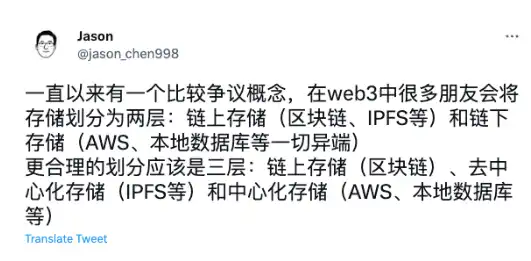
In order to ensure that the data cannot be tampered with, every full node needs to be backed up. When there are 10,000 miners, even for storing 1MB of information, 10GB of the whole network will be consumed, which is very cost-effective. Therefore, the proposed solution is to store the data in the chain, and then put the storage address in the chain into the blockchain for index. As you can see, metadata is indexed to an ipfs link, which opens to a folder.
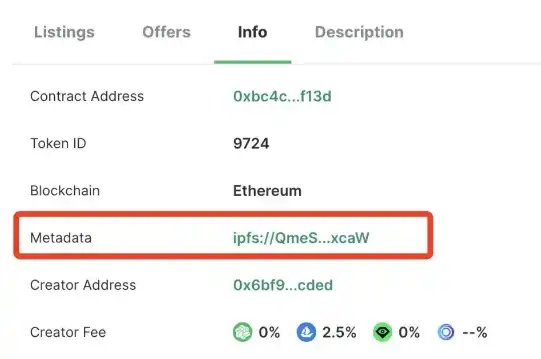
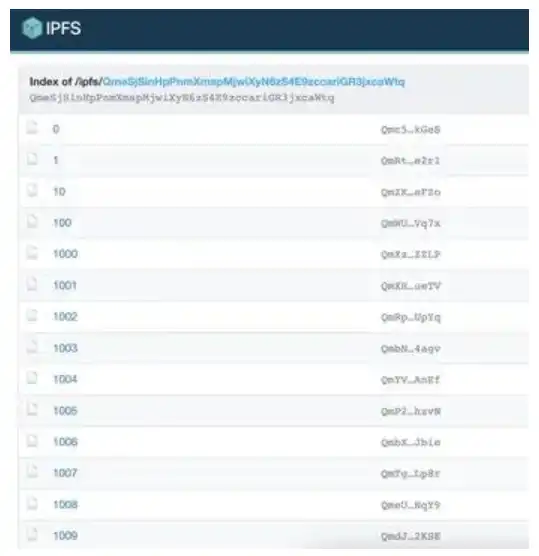
This is an extension of IPFS, which is a content-addressing peer-to-peer distributed storage system. The opposite of content addressing is address addressing. For example, when we store photos in the cloud, the computer needs to know the IP address and domain name of the photos so that it can find the data in the corresponding place. But if the replication does not exist or the server is down, the files are lost.
But someone might have downloaded that photo before and saved it on their computer, but your computer doesn't know that they have it, so the solution to this decentralized storage problem is to solve the problem of searching by content instead of by address, so you don't have to tell the computer where to get the photo, you just have to tell the computer what the photo you want to look like, The computer then goes around asking if anyone has a photo like this, and sends it to me if it does, but the content may be very large, and direct violent retrieval is very time-consuming, so it hashes the content of the file and stores the hash value as the file name. In this way, only other hash values with the same hash value of the photo can be retrieved very quickly, and then the other party can send me a copy of his photo after finding it. In this way, the efficiency will be fast. The above is the general principle of IPFS, and the storage goes through three stages: centralized, multi-centralized and decentralized.
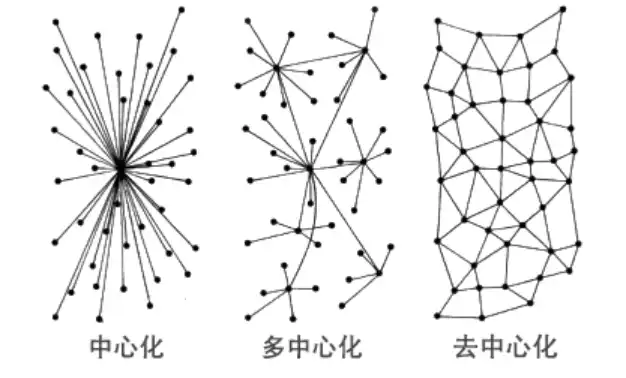
Therefore, although IPFS is similar to blockchain in thought, it has no direct relationship with blockchain itself. However, if it wants to run stably, many users need to contribute their storage space and network to become nodes. Therefore, Filecoin, inspired by Bitcoin, is an incentive layer on top of IPFS. So what you have to understand is that no matter what kind of storage you have, you still have a physical hard disk, and decentralized storage is a sharing economy, and people who have spare hard disk resources can contribute to it.
In fact, when I talked about blockchain +AI with you yesterday, some people also mentioned computing power sharing, which has already been played out in Playcloud and Ji-router for a long time. I will talk about computing power sharing with you later when I have time.
While Filecoin is a layer on top of IPFS to incentivize storage providers, Arweave takes storage and chain even further by developing blockweave, which compares the traditional blockchain chain structure to Blockweave. Each block is linked to the next block and two blocks above it: a previous block and a historical recall block, and nodes must make access proofs when they exit the block.
Unlike the pow computational proof, miners with rare blocks in the blockweave history get a bigger payoff in the long run by having access to older random blocks in the history of Blockweave, allowing nodes to store as much historical data as possible. It also doesn't consume as many resources as POW, so Arweave is more raw and permanent than Filecoin.
As I said just now, blockchain itself is capable of information storage, and some people call blockchain a decentralized database. But in fact, the most important responsibility of blockchain is to undertake a decentralized ledger for recording transactions rather than a database, and storing large amounts of data is not the core of blockchain in terms of the division of responsibilities.
If you compare blockchain to a computer, although there is memory to store a small amount of data, but more need to have an external hard disk to store a large amount of data, rather than all jammed into the memory, so decentralized storage takes the responsibility of the external hard disk, as long as the stored things can be guaranteed to interact with the computer and memory and remain unchanged. For example, etherscan can see that the Input Data of each transaction of Ethereum is the information written into the blockchain, but it can only be the field data of simple key value type, so it still needs to be supplemented by an external "hard disk".
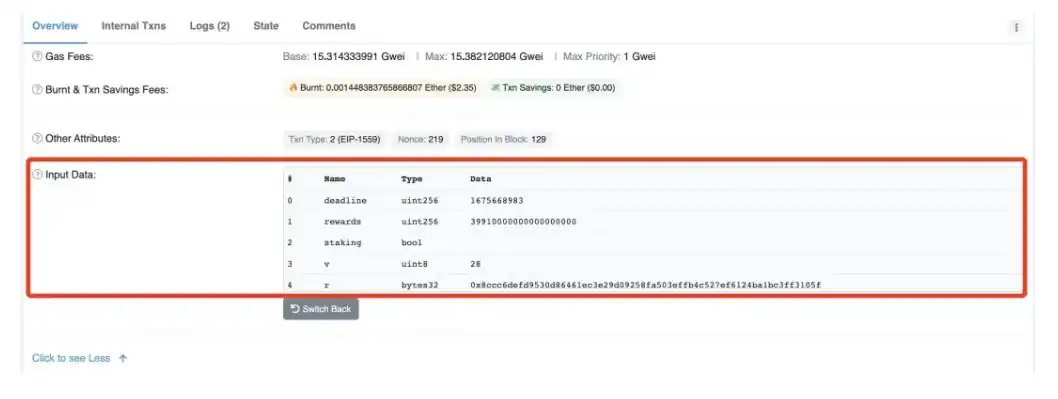
That's how the whole storage system works, Filecoin and Arweave, and you should be very aware of the importance and complementarity of having a blockchain, which is one of the reasons why Binance is a participant. With such a large track and such a concentration of competitive head effects, the entry of Binance's mass should have caused an uproar, but there has been little
I think the main reasons are:
1. 存储是离用户很远的下面一层,用户很难感知和理解到,而且目前存储也都是 toB 再 toC,如 Mirror 接入了 Arweave,我们在 mirror 写文章,但是我们却不知道存在了 Arweave
2.Greenfield 白皮书宣发那天恰好撞上了 Nostr 这个大热点,和汪峰一样挺不赶巧
3. Storage track, not yet broken out
The premise of storage is to have content, but now the web3 application layer is lack of content production sources, such as the largest track defi, which has nothing to do with the content, NFT track and content touch the edge but not much, is a small picture to save, There aren't many applications that are supposed to have as many "content storage" scenarios as web2, so the storage track is far and away from the user.
However, with the explosion of web3 application layer, resulting in a large number of UGC products with C-side interactivity, there is a natural need for content storage, so the endgame is visible, but the problem is that I can't see the milestones of the endgame process. Here is my investment logic.
As I have analyzed the LSD track before (see the previous article on Lido and SSV), I have deduced that as Ethereum is cut to POS, these low-threshold pledge services such as Lido will emerge first, resulting in a large number of verification nodes. However, the centralization of operators will greatly damage the network security of Ethereum. Therefore, the final game must solve the problem of operator centralization. After seeing the final game, I found three milestones, beacon chain online of 20, POS merger of 22 and Shanghai upgrade of 23. The purpose of finding milestones is to let you have a psychological expectation of the arrival time of the final game and find the right opportunity to enter, otherwise the ambush will wait for years too early. 2023 Shanghai upgrade after the great stimulate pledge enthusiasm, thus operator centralization problem exposed, so Shanghai upgrade first half a year is a good time to enter, otherwise 2020 the first milestone entry these two years will be dry.
The end game to save can be seen, but I still can't see the milestones in the middle, but with the completion of the infrastructure, and I also saw the socialfi and other application layer started to roll this year, I think the end game will not be too late, maybe we can try a small number of layout to save the relevant assets, does not represent investment advice, everyone DYOR.
Back to Greenfield, as mentioned at the beginning, its ecology is structured around the trinity of users: the BSC chain, Greenfield, and dapps. Binance has a transaction chain, and then a storage chain, and developers build their own Dapps based on those two, and Greenfield is a side chain with a native cross-chain bridge to BSC, both using BNB as a Token. This one-two punch out completes the Binance ecosystem.
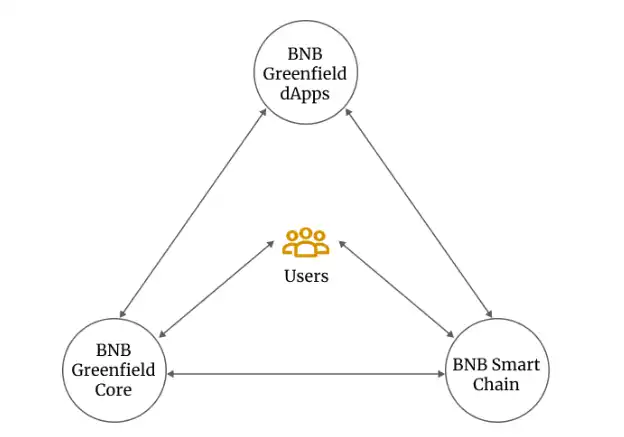
So while the storage track is big enough to interest Binance in doing it himself, it's also an important part of Binance's ecology
At its core, Greenfield is a network of storage chains and storage nodes, much like Arweave
The storage chain has its own governance logic and incentive system, which stores metadata, block state data, account information, permissions, billing and other data

It's worth noting that the metadata is on the chain, there's a separate object storage system that stores the object data down the chain, again in the case of NFT, metadata is on the chain, not IPFS, but the most space occupied image in the metadata itself is still down the chain, This design may be Binance considering the performance and cost of using the data and then through the on-chain metadata led to the object data down the chain.
BNB 作为存储链的原生 Token 用于治理和缴纳 GAS,可以在 BSC 和 Greenfield 之间流动,所以这个角度算是给 BNB 又找了一个价值赋能,但是我个人不觉得 BNB 的价格会为此吃到很多存储赛道的红利,因为 BNB 价格是一个复合体,存储赋能只是影响价格的一个因素,如果你们想投资存储赛道,BNB 我认为不是一个好标的,还不如直接去投专门做存储的 token,因为这些 token 的赋能是 100% 来自于存储红利,当然一切 DYOR 另外值得注意的是 Greenfield 格式是全面兼容以太坊 EVM 的,所以也便于现有的产品进行接入 还比较有趣的是对权限组的管理比较细致,可以控制每个账户对于增删改查等数据操作的权限,这个挺实用的。
In terms of data integrity, challenge proof is introduced, which is similar to OP, which can submit challenge transactions to nodes. Greenfield will also randomly send challenge events, similar to sampling check. If the challenge is accepted, the verifier will check the challenged nodes. If the challenge fails, the data will have a frozen period and will not be challenged again, so as to avoid the waste of resources.
What is interesting is that it is not only used for data storage, but also supports economic value creation based on data. For example, the data permission just mentioned can also cross the chain to BSC and become the digital assets of BSC. This is interesting, my data is valuable, and the data operation can also be valuable to me.
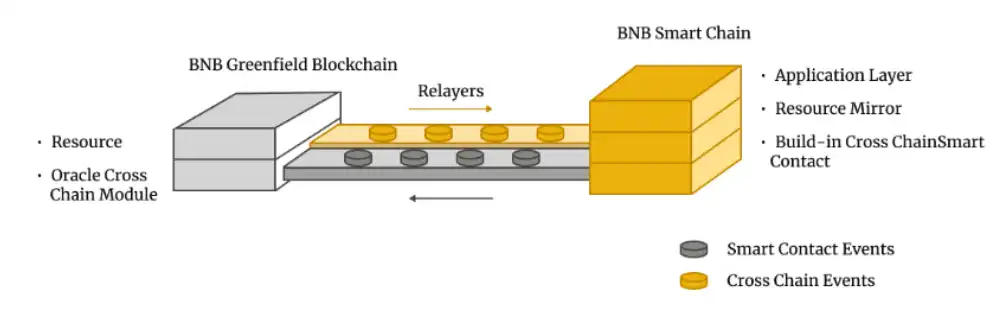
The participants of the whole Greenfield ecosystem are as follows: BSC undertakes dapp deployment, data resource mirroring, cross-chain and consensus, while Greenfield undertakes payment, data resource, cross-chain and consensus. Note that Greenfield also has its own governance mechanism, etc. So it has its own consensus and then the SP node interacts with Greenfield and on the right is the network structure, much like the OP set with electors and so on.
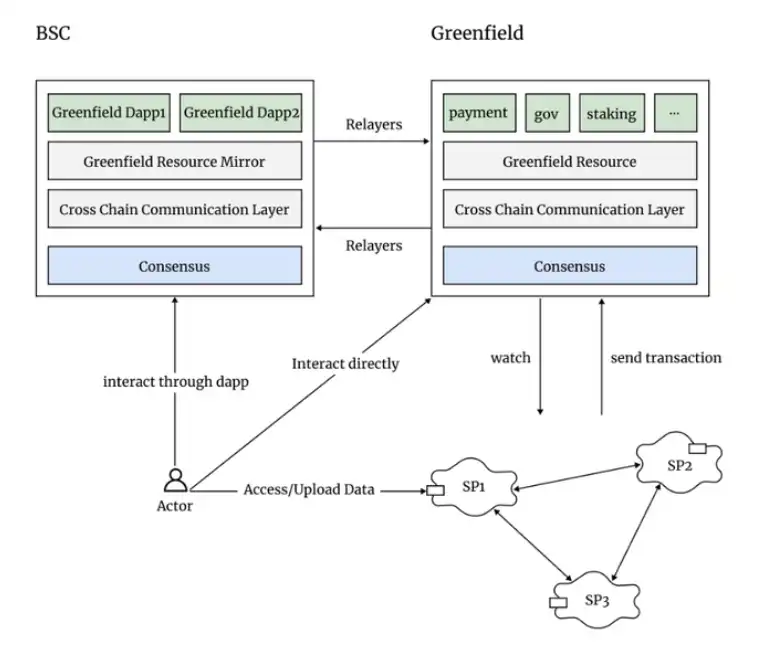
The account system in Greenfield is independent, and the format is compatible with BSC and Ethereum, so it also has the conditions for wallet to support Greenfield in the future. Interestingly, Greenfield as a chain is developed based on Cosmos. Cosmos as the big brother of Layer0 seems to be gaining ground. The recently popular Canto is based on Cosmos, but I personally feel that Canto's set is a bit luna, DYOR.
Binance's trouble is that BSC forks Ethereum, unlike aptos and solona, which don't have their own technology systems, so it's hard to cultivate their own developer community. This problem is also encountered by many EVM chains. Greenfield, as a storage chain for developers, Building developer loyalty is tricky, so Binance needs to get existing Dapps to switch to Greenfield before attracting incremental Dapps to join.
I spent almost a day showing you the situation of storing track based on Binance Greenfield. Personally, I am optimistic about storing track. I look forward to the outbreak of more application layer products with real usability. aptos and layer, these chains that improve performance, have already built the infrastructure for the explosion of the application layer, waiting to build a nest and attract the phoenix, the content may be subjective and biased, please forgive me if there is any mistake, welcome to exchange and discuss.
"Please follow me on Twitter @jason_chen998" for the latest information and to discuss with me.
Original link
Welcome to join the official BlockBeats community:
Telegram Subscription Group: https://t.me/theblockbeats
Telegram Discussion Group: https://t.me/BlockBeats_App
Official Twitter Account: https://twitter.com/BlockBeatsAsia