Assessment of the current development status of the SSV.Network ecosystem.
Original Title: "Popular Concepts of ETH2.0: SSV.Network Ecosystem Inventory - Decentralized Staking Infrastructure"
Original Author: Maverick, Wu Shuo Real
SSV.Network DAO recently launched a $50 million ecosystem fund to support the development of applications based on Distributed Validator Technology, a key component of Ethereum's decentralized roadmap created by Ethereum co-founder Vitalik Buterin. SSV.Network hopes to use the funding to further strengthen DVT as a critical Ethereum infrastructure.
SSV.Network is a completely decentralized open-source Ethereum staking protocol developed jointly by the Ethereum Secret Shared Validator network Obol and the non-custodial Ethereum 2.0 staking protocol Blox. SSV can securely split validator keys between untrusted nodes or operators while maintaining distributed control and activity of Ethereum validators, providing a secure and robust method for ETH staking. Currently, SSV.Network is in the testnet phase. The recently released Shifu V2 version of SSV.Network will allow upgraded nodes to participate in all responsibilities used in Ethereum consensus.
SSV is the native token of SSV.Network, with a total supply of 11 million and most of it is in circulation. The token is mainly used for (1) payment: operators represent stakers to operate validators and receive SSV rewards; (2) governance: submit votes and vote on DAO decisions; (3) donation: provide funding to developers and contributors to help develop the network.
Operators, partners, and funding recipients make up the basic ecosystem of SSV. Currently, there are over 20 projects being built on top of DVT.
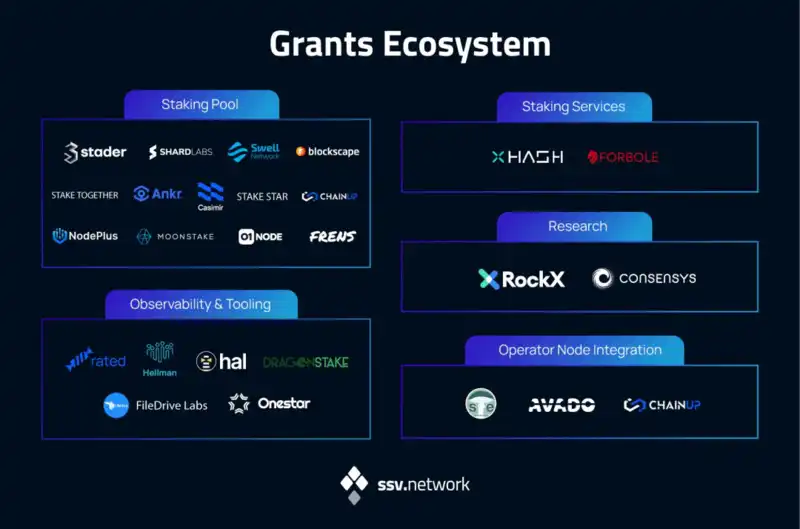
Staking Pool: SSV.Network's Staking Pool model is mostly integrated with protocols. There are currently no native Staking Pool projects in the officially certified projects. Staking Pool projects based on the SSV network, such as Swell Network, ANKR, Spectrum, and Steader, have already launched the function of staking on SSV.Network. However, projects such as Chainup, Shard Labs, Moonstake, Infinite Lux, 01 Node, Onestar, Blockscape, and Tardust have not yet launched or are about to launch the staking function on SSV.Network.
Pledge Service
Blox staking: Blox is a non-custodial ETH staking platform, claiming to be the first non-custodial staking solution for Ethereum. Its native token is CDT and is released in two phases. The team previously established and operated Blox Finance. After receiving funding from the Ethereum Foundation, Blox developed SSV nodes for Ethereum staking. Users who stake with Blox need to prepare 32 ETH and a cloud account created by the user. Stakers need to pay a certain fee for cloud services every month. The project will not take away the rewards obtained by users from staking. There is no limit to the number of validators when using Blox to run validators.

XHash: An unmanaged enterprise-level staking service provider on SSV, where users can stake assets in a non-custodial manner. XHash ultimately charges nearly 9% of staking rewards as fees. Currently, there are over 1,100 validators and over 35,000 ETH staked on XHash.
Forbole: Multi-chain staking service provider, an SSV official sponsored project, currently not yet online for staking on SSV.Network.
CryptoManufaktur: Founded in 2020, the company provides various price feedback in the Chainlink ecosystem, and later joined the Ethereum ecosystem construction. It has cooperated with the Ethereum Foundation to provide test solutions for the beacon chain, and has worked with Blox to launch their DV (Distributed Validator) project, which is currently active on the Prater test network.
Suspected RUG: 0 neinfra
Observability and Tools
DragonStake: One of the SSV funding projects, the team's focus is on building blockchain security and operating validators for different proof-of-stake networks. The staking function of SSV.Network is still under testing and has not yet been launched.
Hal: Hal is an information notification application for Web3, currently with over 20,000 users. Users can use the application to query and monitor multiple blockchain networks, including data on SSV.Network, and receive notifications via email, Telegram, Discord, Twitter, Slack, or Webhook in real-time.

FileDrive Labs: SSV-supported decentralized storage project, aimed at enabling everyone to benefit from distributed storage and building high-performance, user-friendly, and scalable storage infrastructure and applications.
Operator Node Integration
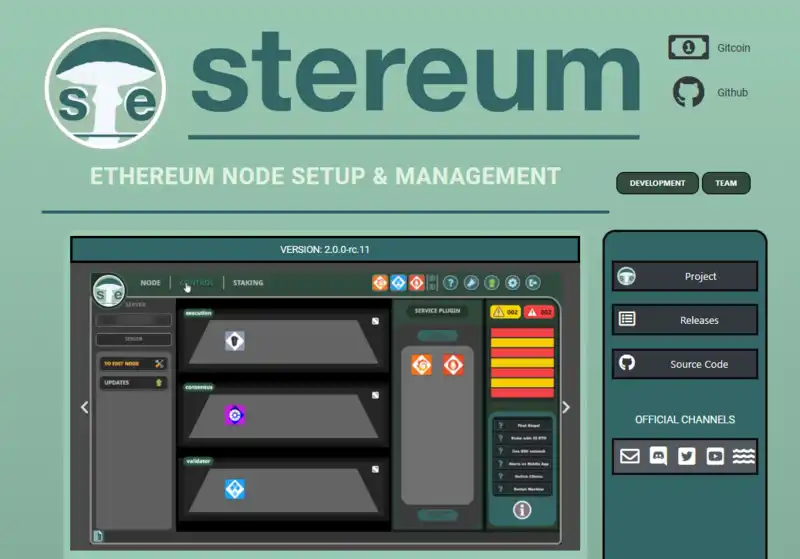
Stereum: SSV-funded tool for managing, configuring, and maintaining Ethereum nodes. Users can install and configure Ethereum nodes while maintaining user privacy on the Ethereum Goerli test network or the Ethereum mainnet.
SSV.Network is dominated by an integrated protocol on the network, which may be related to the fact that SSV itself is not directly aimed at C-end users, and its service targets are more pledge service providers, node operators, and centralized trading platforms. However, another major advantage of SSV.Network is its ability to cooperate with decentralized autonomous organizations. The DAO partnership program launched at the end of 2021 has attracted a number of institutions such as Digital Currency Grup, Coinbase, OKX Ventures, NGC Ventures, Allnodes, RockX, AMBER, and Skillz. The services provided by SSV.Network are equivalent to outsourcing, helping them reduce the cost of using infrastructure when making pledges.
As a decentralized staking infrastructure, SSV.Network benefits from the rewards brought by the ETH 2.0 staking track. Naturally, it is built around staking, but it does not focus on attracting user deposits. Instead, it serves as an infrastructure for validators. This model may also expand to other POS public chains in the future.
Reference:
https://cointelegraph.com/news/ssv-launches-50 m-ecosystem-fund-to-support-eth-staking-tech
https://abmedia.io/20220111-ssv-network-non-custody-staking-protocol
Original article link
Welcome to join the official BlockBeats community:
Telegram Subscription Group: https://t.me/theblockbeats
Telegram Discussion Group: https://t.me/BlockBeats_App
Official Twitter Account: https://twitter.com/BlockBeatsAsia

 Related Articles