Explore the intrinsic value of SSV from cost, positioning and service objects
A Brief Analysis of the Intrinsic Value of SSV
Original author:Blockchain binary knife
The merger of ETH executive layer (formerly 1.0) and consensus layer (formerly 2.0) is expected to be completed in the second quarter of this year. After the merger is completed, ETH's consensus mechanism will officially switch to PoS and network sharding will be enabled. SSV is expected to serve as an important infrastructure for ETH pledge. About the introduction of SSV project, Mr. Lu wrote a long article before, you can go here to check, I will not repeat it here. This paper will analyze the intrinsic value and value capture of SSV projects from my own perspective.
Cost of running ETH verifier
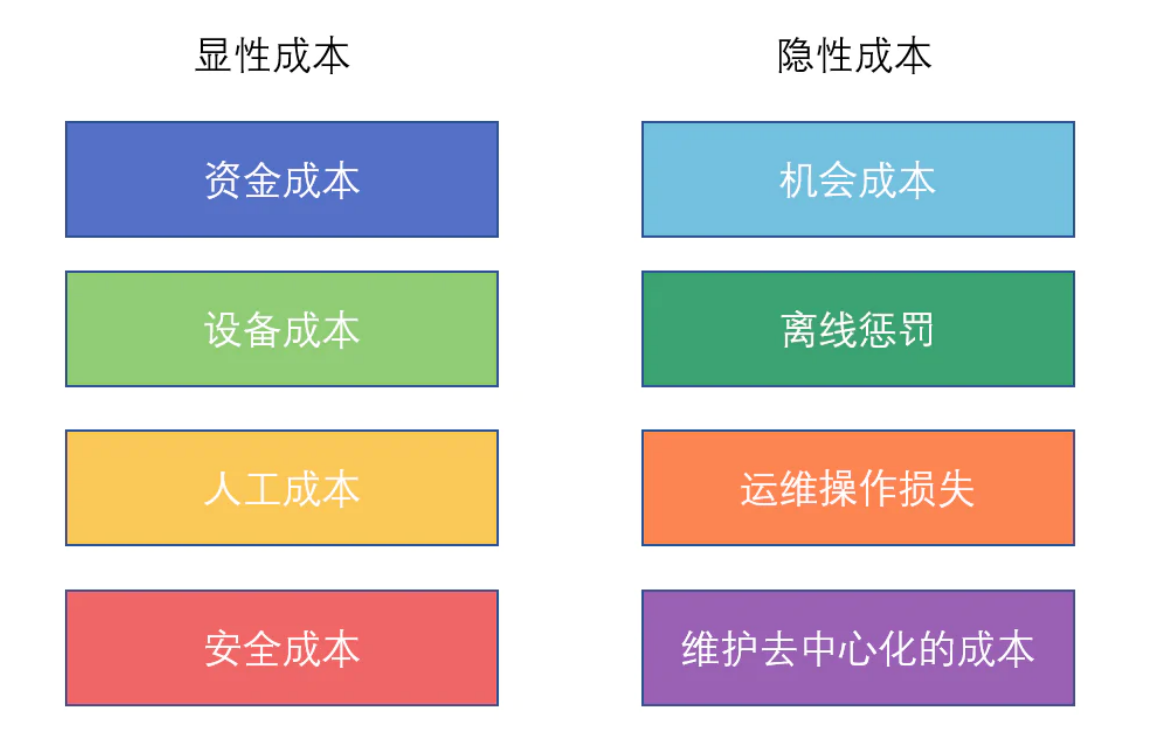
Currently, if we want to prepare to run an ETH verifier, we need to bear the following costs:
cost
Explicit cost
Cost of capital: 32 integer times ETH pledge
Equipment cost: the cloud server running the validation human node
Labor cost: server operation and maintenance personnel
Security cost: The set of costs involved in ensuring security
Hidden costs
Opportunity cost: the opportunity cost caused by pledging ETH
Offline penalty: Offline penalty caused by node breakdown or disconnection
Operation and maintenance operation loss: cheating penalty loss caused by operation error
Intangible assets: loss of network value caused by node centralization
Let's break down these costs one by one:
The cost of capital
Ethereum consensus layer requires each verifier to pledge 32 ETH as security (non-split). One account can run multiple verifiers, so users need to prepare 32*N ETH (N is the number of verifiers, which is an integer) for pledge. Currently, the cost of 32 ETH is about $90,000. It is an unaffordable cost for most retail investors.
So a suitor such as Lido Staking starts a business as an asset-management broker, where users supply Lido with their own bits of ETH (less than 32). Lido sends them a stETH pledge, Then the scattered ETH collected from each user is combined into an asset portfolio of 32 ETH, and each portfolio is created as a verifier, which is operated by Lido itself. The user gets Staking, and is a way for many retail Staking to participate in ETH Staking.
The cost of equipment
Verifiers need to submit network blocks and vote on blocks, and need to stay online 24 hours a day. Renting a cloud server is the most reasonable choice.
Artificial cost
You need to hire operation and maintenance personnel to manage a huge server cluster and deal with all kinds of unexpected exceptions.
Safety cost
You need to perform security defense and network optimization for server clusters to prevent external attacks. For example, CDN, firewall, jumper, sentinel node, system permissions, status monitoring, resource monitoring, and server DISASTER recovery.
Hidden cost analysis:
The opportunity cost
The pledged ETH needs to be locked, and the pledge can be redeemed only after 2048 epochs (about 9 days) have been served. After redeemed, it takes about 27 hours to unlock. Therefore, when the market fluctuates greatly, or there is a need for funds, the lack of liquidity will cause a certain opportunity cost.
Lido's way of issuing stETH solves part of the liquidity problem. Users who pledge stETH can exchange it back to ETH on Curve.
Offline punishment
The validator has to vote for the transaction in the slot in which he or she is located, and can have part of the pledged ETH deducted if the validator does not respond immediately.
Loss of operation and maintenance
According to the introduction, the punishments caused by operation and maintenance errors are mainly divided into two categories: double signature and surround voting. Both acts will be considered malicious cheating and will be subject to significant forfeiture penalties. You can click here for details
Intangible Assets: The consensus value of network decentralization
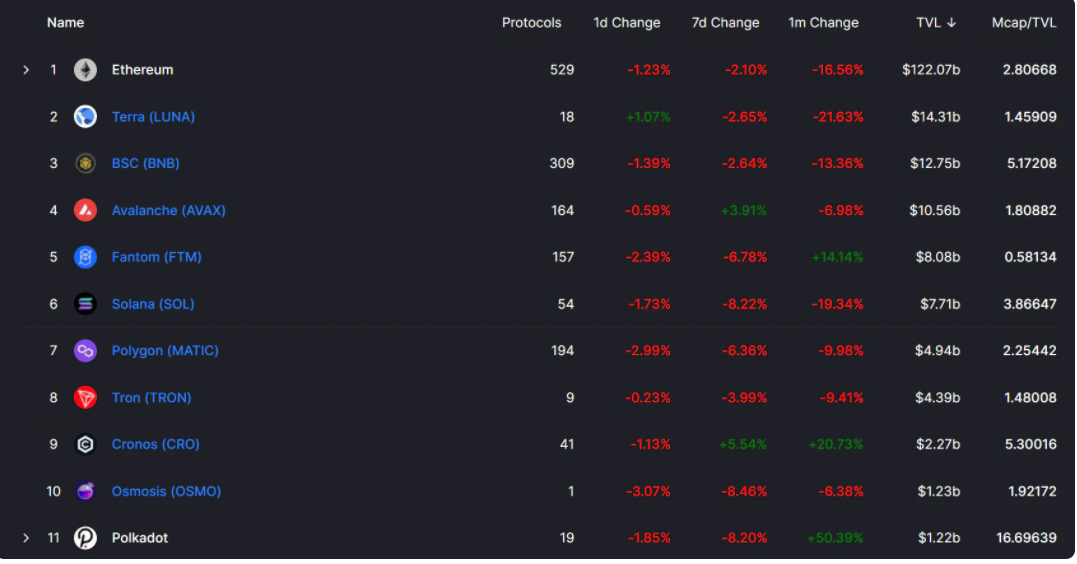
Ethereum's TVL currently exceeds $120 billion, which is more than the 2nd ~ 10th place combined. On the one hand ethereum has a first-mover advantage, with the most DeFi protocols and staboin assets, as well as numerous whales. Ethereum, on the other hand, is also recognized as one of the oldest and most decentralized public chains. This consensus makes more staboins and financial protocols more willing to be deployed on Ethereum, and the wealth effect created by a large amount of capital attracts more users and funds, forming a positive cycle. This is also the brand premium that network decentralization brings.
So projects spend a lot of money (in the form of marketing, Grants, etc.) to incentivize users and build nodes in an effort to make the network relatively decentralized and avoid centralization of power.
Mainstream public chain TVL
The difference between SSV and Lido
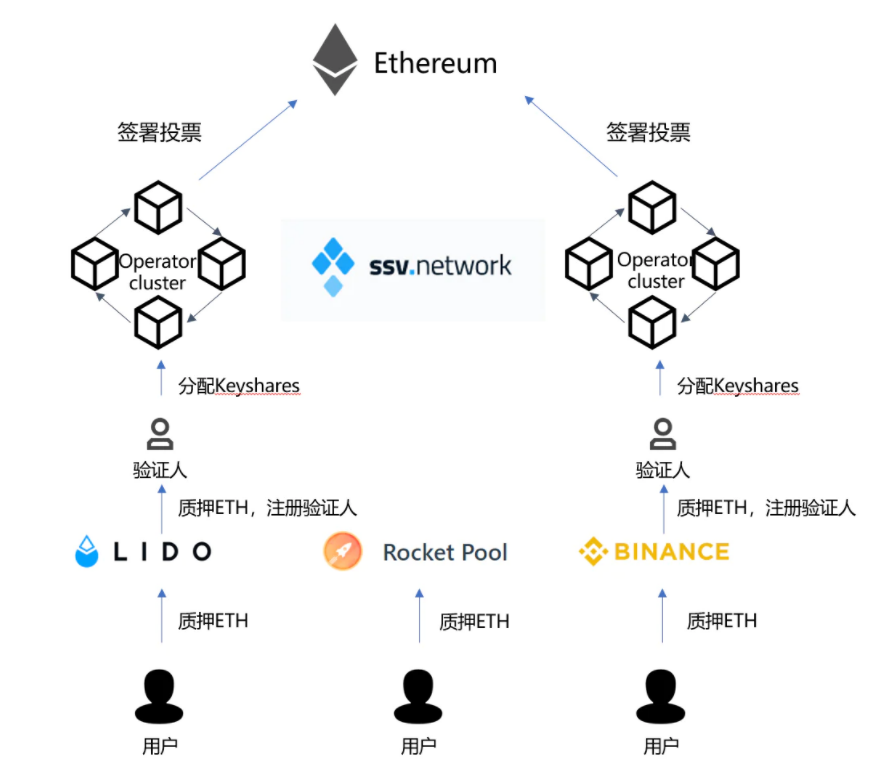
Before talking about SSV staking, there are many people who are not sure what the difference is between SSV and Lido, who are also on a track with Eth staking. Let me outline the difference: they are staking differently.
- The SSV is an infrastructure for authenticators, but does not perform asset management. That is, the SSV does not absorb ETH from users and then combine them.
- Lido is a real pledge service provider. Users provide ETH to Lido, and Lido has the right to control users' assets.
ETH Pledge track ecology and SSV positioning & NBSP;
Service object of the SSV
Here we can actually find that SSV actually serves two groups of people
- Long-term position, need to ensure the security of funds (do not trust assets to a third party), but do not want to do it themselves
- Value capture of SSV, ETH pledge service provider led by Lido, Rocketpool and Binance
From the above we know the cost of running ETH verifier, and what SSV needs to do is to outsource these costs from the original verifier and pledge service provider, and all these costs will be borne by SSV Operator. Therefore, SSV will become a huge node operation and maintenance service provider -- Operator crowdsourcing network.
Professional people do professional things. For service providers like Lido, outsourcing operation and maintenance services has the following advantages:
1. Reduce operation and maintenance pressure. No need to hire and set up node operation teams, and all nodes can be outsourced to SSV
2. Reduce server expenses and management costs
3. Reduce security risks. Under the original self-operating mode, if it is breached by hackers, a large number of nodes on the platform will break down, causing losses to users
4. The pledge service provider does not need to care about network upgrade and operation, and only needs to pay SSV to the SSV Operator regularly, which is convenient and saves worries.
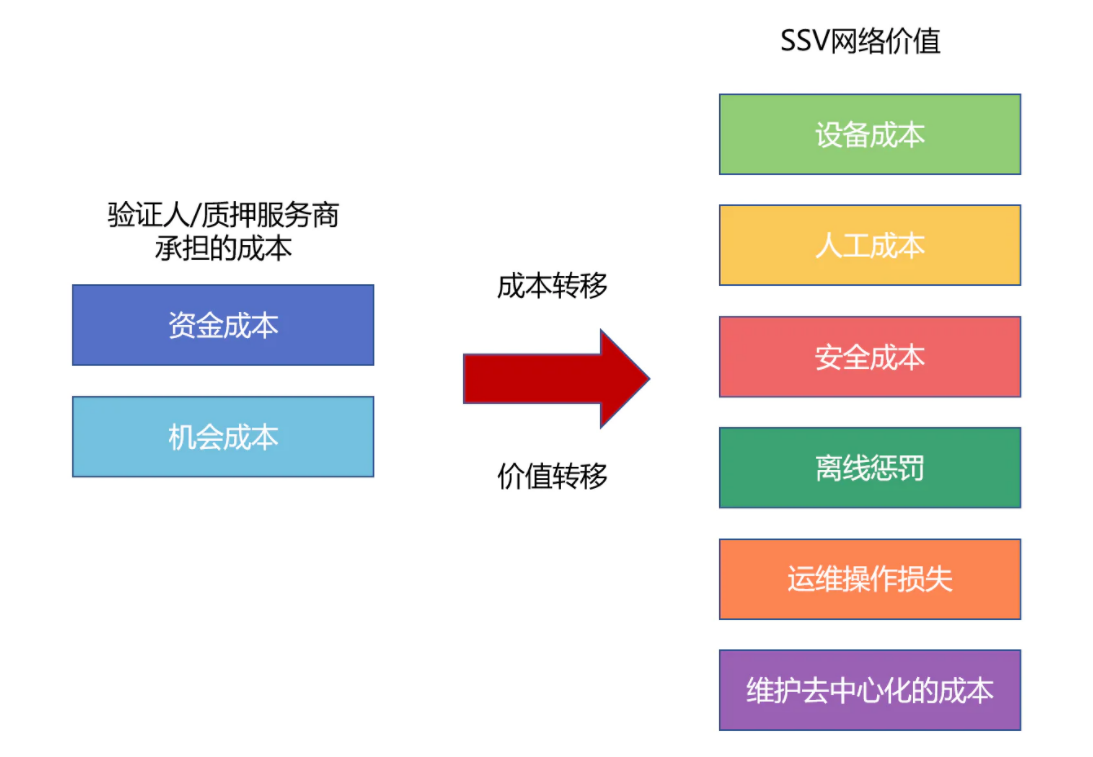
Value capture of SSV
Therefore, the real value capture of SSV comes from the cost he saves for Lido and other pledge service providers by undertaking node operation and maintenance. The cost is distributed to each Operator through the scale effect of SSV Network itself. And finally pay Operator in the form of SSV token. In my opinion, the real value of SSV is the sum of the costs on the right. SSV will capture a lot of "cost value" and enjoy the market dividend of Ethereum as the network size increases and the validator size increases.
Is it possible to apply this technology to other PoS chains
** First of all, it is technically possible. ** Theoretically, SSV can be integrated as long as the common chain is PoS and the authenticator's operation key and account private key are independent, as is the case with Cosmos Ecology.
However, there are major mechanical differences between Ethereum and other PoS public chains:
1. The etheric lane after is the decentralization of as much as possible, so his design thought is all validation pledge, the number of the ETH verifier can receive reward has nothing to do with the number of pledge, and ordinary users cannot entrust the ETH verifier, such can have more people to build node, enough makes the etheric fang node dispersed and decentralized.
2. Other PoS public chains are all about performance (higher TPS), so their general practice is to limit the number of active verifiers (e.g. Cosmos starts with 101 active verifiers, increases by 10% per year and ends with no more than 300). Users need to delegate their tokens to active validators to get staking. In this mechanism, the income of the verifier is directly related to the votes it can attract, so the verifier has the motivation to attract a large number of pledges from users, thus leading to the concentration of voting rights and chips. Therefore, for project owners, they can only reduce the degree of network centralization by dispersing voting rights, but there is a long way to go.
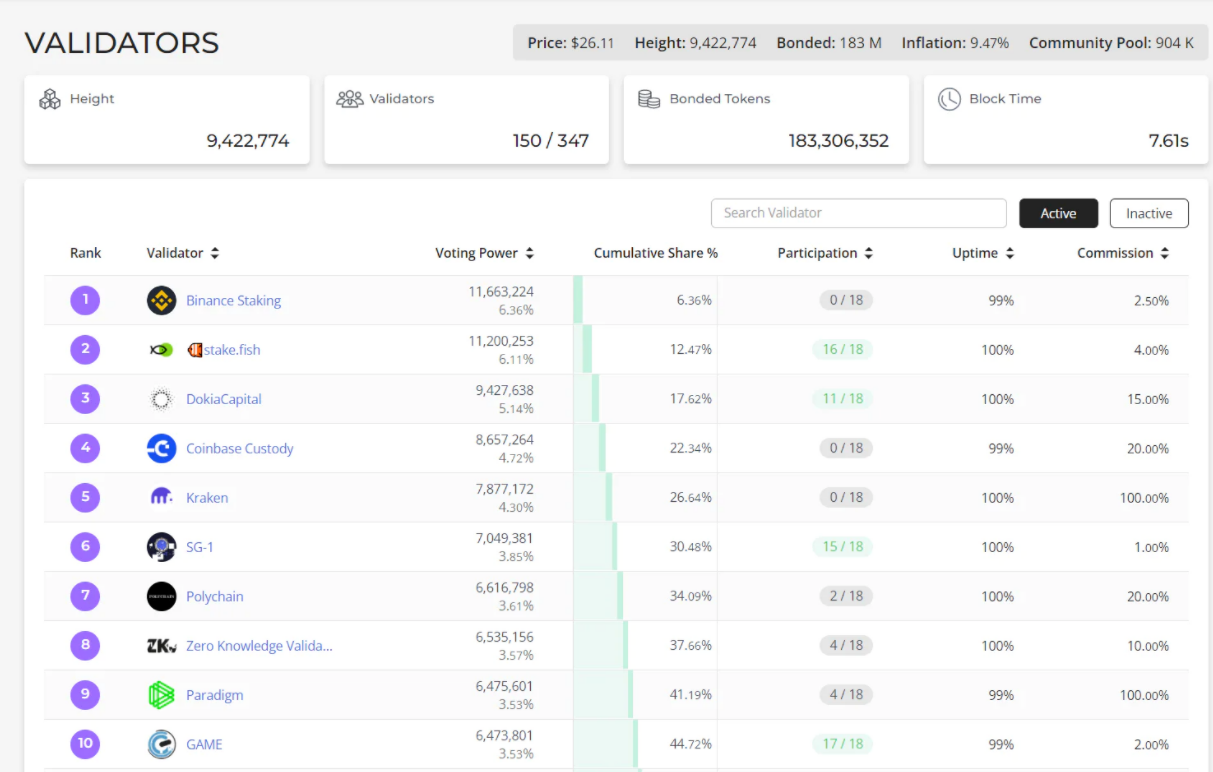
The top 10 nodes on the Cosmos network accounted for nearly 50 percent of the votes
Therefore, SSV may not have great acceptance in these networks, because the limited number of active verifiers makes it difficult for SSV to implement decentralization for these networks. At the same time, many active verifiers are run by professional node service providers, head VCS, exchanges and project parties. These nodes themselves already have considerable brand endorsement effect, and more or less have set up a professional node operation team. Also, the node configuration requirements of these PoS chains are much higher than those of Ethereum, making SSVS deployed on these networks more costly for operators. If these validators are willing to pay more to integrate SSVS, As a means to operate and maintain DISASTER recovery and reduce the probability of offline being slash, it still needs time to investigate.
conclusion
SSV is currently conducting the V1 incentive test network, which will last until April. The V2 test network is also being developed and is expected to be ready for testing in April. SSV is expected to launch its main network this year.
To sum up, SSV is worth paying attention to as ethereum merges this year.
The original link
Welcome to join the official BlockBeats community:
Telegram Subscription Group: https://t.me/theblockbeats
Telegram Discussion Group: https://t.me/BlockBeats_App
Official Twitter Account: https://twitter.com/BlockBeatsAsia

 Related Articles