How does Parallel get out of GameFi Ponzi?
原文标题:《 一文详解 Parallel 如何走出 GameFi Ponzi 怪圈 》
原文作者: 隔夜的粥,DeFi 之道
In February, Paradigm's first TCG from the Web3 franchise Parallel will enter Closed Alpha, and following a vote on Echelon's proposal, Parallel will also unlock Prime Token, its core ecosystem asset, on March 1st.
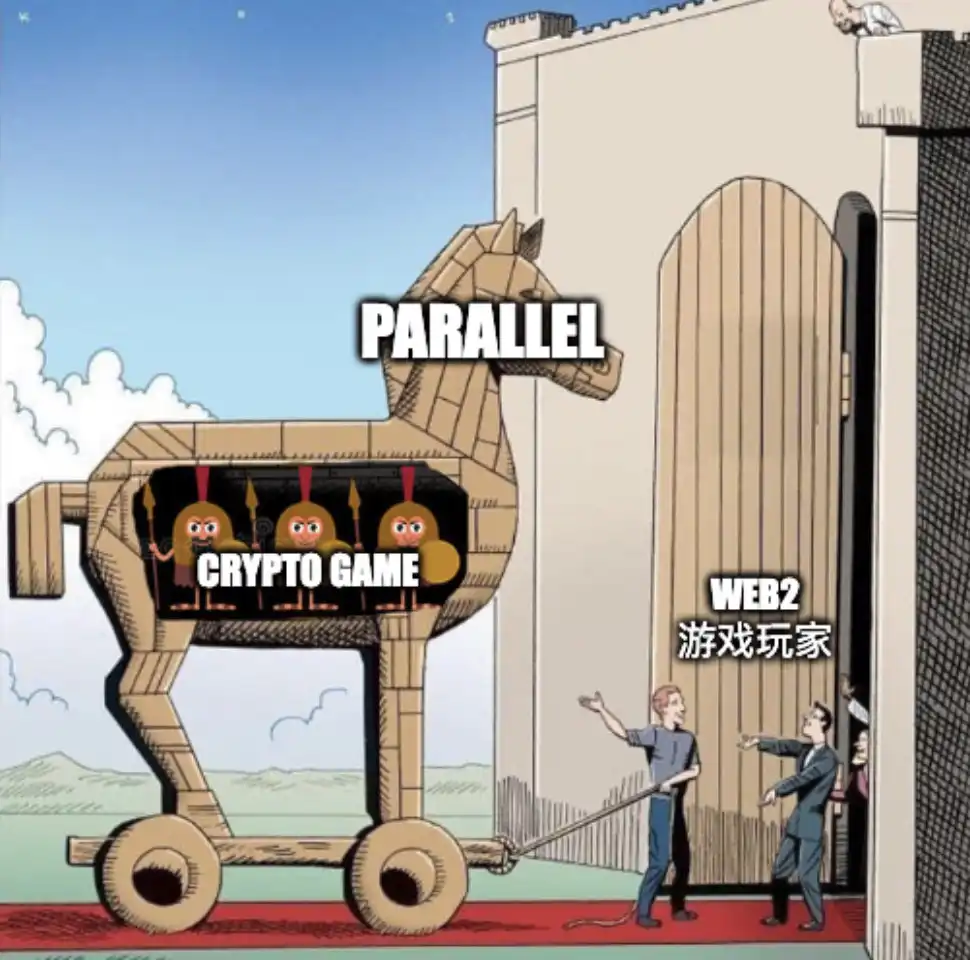
In this article, I will analyze Parallel's Trojan Horse strategy from the perspective of participants, and how it can use sustainable design to get out of the Ponzi cycle of Crypto games. In addition, Parallel provides a composable game design method that is also worth learning and reference.
Before we can understand Parallel's ecosystem design, we need a brief overview of the game's backstory.
I. Parallel backstory
Parallel's story begins shortly after on Earth, where resources are running out and energy has become a scarce commodity, and scientists, desperate for a solution, try a new fission reaction experiment using antimatter. But The experiment failed and triggered a global catastrophe known as "The Event," when a new type of radiation began to spread across the Earth, killing billions of humans and animals.
Against the backdrop of an existential crisis, three spacecraft called Genesis were built to take a large number of survivors off Earth, one to Mars, one to Europa (Jupiter II), and one to the asteroid belt. After thousands of years, humans avoided extinction and survived in five separate groups called Parallel. Since then, The "spectacular" event has been called "The Priming" by those who survived it. The Earth became habitable again, and a new energy source called Prime emerged. The five Parallel Parallel groups eventually clashed for control of the Earth and Prime energy.

The Earthen: During The Priming, some humans were found to have natural immunity to radiation, surviving when billions died, and The Earthen are the descendants of those survivors left behind on Earth. Earthlings are nature-oriented and they have a deep connection to their environment. After hundreds of years of living on a highly radiated Earth, Earthlings have evolved to manipulate the energy Prime using only their bodies.
The Marcolian: In the Great Escape, a ship called Soleil Rouge travels to Mars, where a scientific research colony already exists. The refugees from the Red Sun united with the Martian colonists to form a new scientifically-minded and military-oriented society. The Marcolian people are the descendants of these people.
The Kathari: Artemis Proxima is heading for Europa (Jupiter 2). In Europa, refugees built a city beneath the icy crust of a moon. An act of terrorism destroyed the colony's ability to grow anything. The Katari have turned to genetic engineering to survive, copying food and even the human body. Kathari are cloned descendants of Europa refugees.
The Augencore: The third ship to leave in the Great Escape event is The Fortitude, whose mission is never to tie a ship's survival to a planetary body, so the ship moves from asteroid to asteroid to mine for resources. The low-gravity environment had taken its toll on the crew's aging bodies for decades, so they began experimenting with elective surgical enhancements. Eventually, mechanical body enhancement became a standard way of life on the Fortitude, which was renamed Caine-1, and Ogenkul is a descendant of the original crew.
The Shroud: Long before the epic event, there was a human mission to an Earth-like exoplanet called Kepler-1649c. The ship that carried out the mission, The New Dawn, was threatened by a black hole during the mission. It escaped from the black hole, but its eventual whereabouts in space remained a mystery to all but the ship's crew. Centuries later, when New Dawn returns, its inhabitants, known as The Shroud, have been forever changed in ways beyond human comprehension.
Parallel's "Trojan Horse" strategy
Looking back at previous online games, such as Axie Infinity (AXS) or STEPN, game developers often set up various barriers to emphasize Web3 ownership, the most common of which is forcing players to hold an NFT in order to participate in the game. This inevitably leads to user experience friction. It leads to Ponzi games, which we also call GameFi. They tend to have explosive growth because they attract a large number of speculative players for a short period of time, but when the speculation ends, the daily active count and market value of the game all fall off a cliff.

而一些链游为了改善 P2E 机制,选择加入了免费玩(F2P)的策略,以扩大潜在的游戏玩家群体,例如 Gods Unchained 、Skyweaver 等卡牌游戏都是采用的这种策略,它们让玩家通过玩游戏获得非 NFT 卡,并通过 Token 升级为 NFT 卡来参与 P2E 游戏,然而这种策略的重点依旧是以 P2E 为主,而 F2P 只是作为一种引流的手段。
Parallel's first TCG, on the other hand, adopted a true Trojan horse strategy by packaging itself as a traditional Web2 game to appeal to both traditional free-to-play gamers and premium gamers, who could use payment methods such as credit cards to purchase card pack draw cards (non-NFT), It also consumes various items that don't affect the balance of the game, like traditional games like Hearthstone and MARVEL SNAP.
In the traditional Web2 gamers oriented system design, the Parallel introduces a player nontransferable called GLINTS game currency, to be used for consumption in the in-game store, and the resulting income of 20% will be turned to Echelon foundation, It is used to support the Prime ecosystem through buy-backs and liquidity support, while the remaining 80% is used for the subsequent production of games, comics, movies, etc., in the Parallel ecosystem.
而面向更高阶的 Web3 游戏玩家,Parallel 采用的是 win-to-earn (W2E) 机制,这意味着持有 NFT 卡并在竞技比赛中获胜的玩家才能获得 Prime Token 奖励,并且每个账户每天的奖励次数存在限制,而在一副卡组(40 张)当中,NFT 卡的数量越多,获胜赢得的奖励也就越完整。

In addition, players are prompted to use advanced cards (NFT) to their advantage during the course of winning the game. This design actually incentivize players to collect as full a set of NFT cards as possible, thereby turning traditional Web2 gamers into potential Web3 gamers.
Three, Crypto game sustainable road, how to get out of GameFi Ponzi cycle
As mentioned above, in both Parallel system designs, traditional gamers play a familiar game environment and spend dollars to do so, while Web3 gamers participate in the riskier Crypto gameplay and receive a portion (20%) of the game revenue from the traditional gamer community.
This allows most players to avoid high-stakes economic games and simply pay for the experience. On the other hand, the high risk Crypto economic game can also increase the sustainability of the game through continuous external income.
除此之外,为 Crypto 经济游戏设计各种 sink 消费场景,也是增加游戏可持续性的关键,在 Parallel TCG 游戏的例子当中,这包括艺术家签名、抽卡、兑换 GLINTS(消费皮肤)、复制 NFT 卡、支付 P2P 交易服务、铸造化身和装备等,这些消费场景的目的是让经济系统保持健康,从而减轻 Prime Token 投机活动带来的负反馈影响。
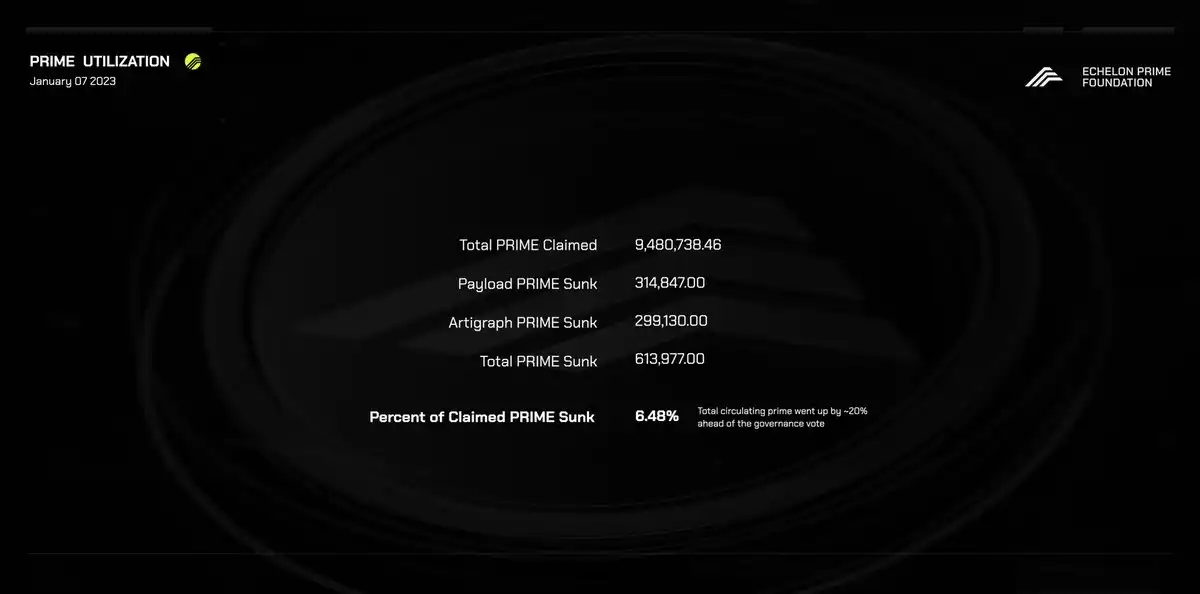
(当前 Parallel 参与者已通过 2 次 sink 活动消费了 6.48 % 已认领 Prime Token )
However, it is important to note that these designs can only be successful if one or more games can attract traditional players, which will be the key to the success of Parallel and other Crypto games out of the Ponzi cycle.
Fourth, another idea of composability
We know that in addition to the benefits of ownership, Web3 games can also provide composability in the form of on-chain games, a potential benefit that many on chain game explorers are looking for.
Parallel, using the offchain approach, offers another idea of composability by creating a library of 3D assets for each NFT card that can be used for other types of games to follow.
For example, in MOBA game design, players can use units/equipment to build an army in PVP strategy matches, and the equipment and units can be combined, depending on the proportion of NFT in the army, the winning PRIME ratio will be different, which is the same system as Parallel TCG. And leverage the same asset pool.
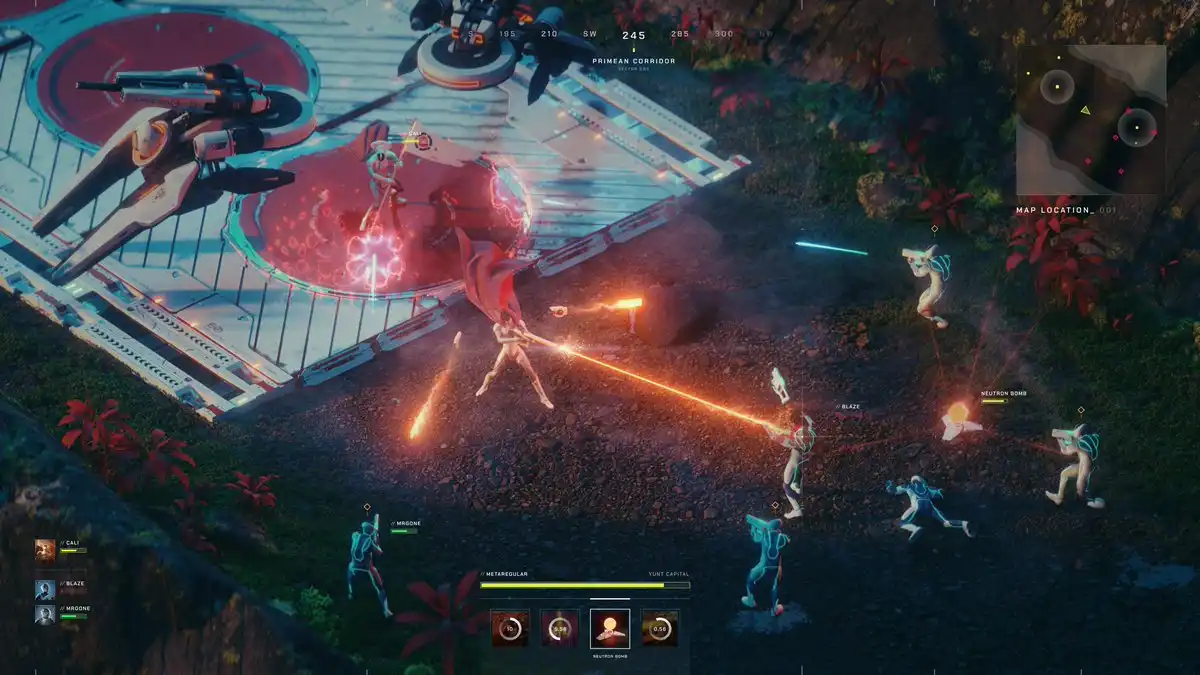
(Note: Parallel MOBA game design, not yet in development stage)
Other types of games can be developed in the same way, either by Parallel Studio itself or by an external developer who votes through Echelon Foundation.
This composability is also an upgrade from traditional games.
V. Current situation of the Parallel project
In October 2021, Parallel closed A $50 million Series A funding round led by Paradigm, valuing the project at $500 million.
Parallel NFT currently has a cumulative transaction volume of 73,043 ETH on the Opensea platform, which generates around 7300 ETH in gross fee income for Parallel Studio due to the 10% royalty on its game assets. However, taking into account that about 1% of this is allocated to MP card and The Core card holders, the NFT secondary market brings in about ETH 6574 for Parallel Studio.
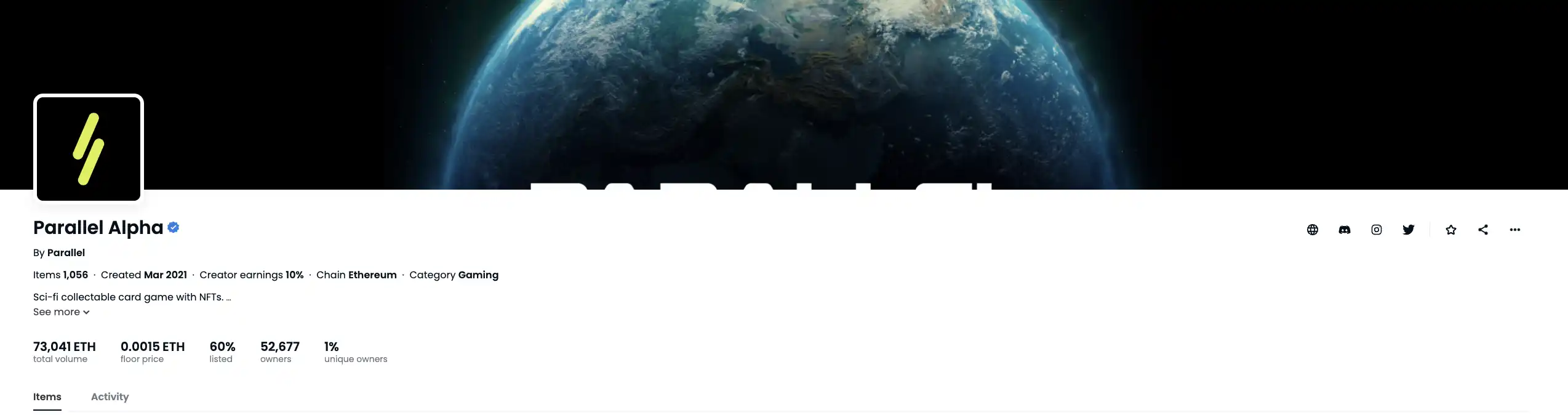
In addition, Parallel has also raised over 10,000 ETH in 6 card pack sales in presale (PS15) -PD5 and will raise around 1,500 ETH in the final PD6 campaign.
Up to now, Parallel Studio has the funds to develop 1-2 high quality games. Parallel TCG has been polished for about 2 years since its development in early 2021 and is scheduled for Closed Alpha testing in February this year. The official game is expected to launch in the second half of this year.
On the secondary market side, after the first hype period following the Paradigm investment news in 2021, the unit price of most non-rare NFT assets has fallen back to the floor price of 0.0015 ETH (approximately $2).
The Prime Key, the game's main NFT asset, recently traded for around 13.5 ETH (currently worth $17,500).
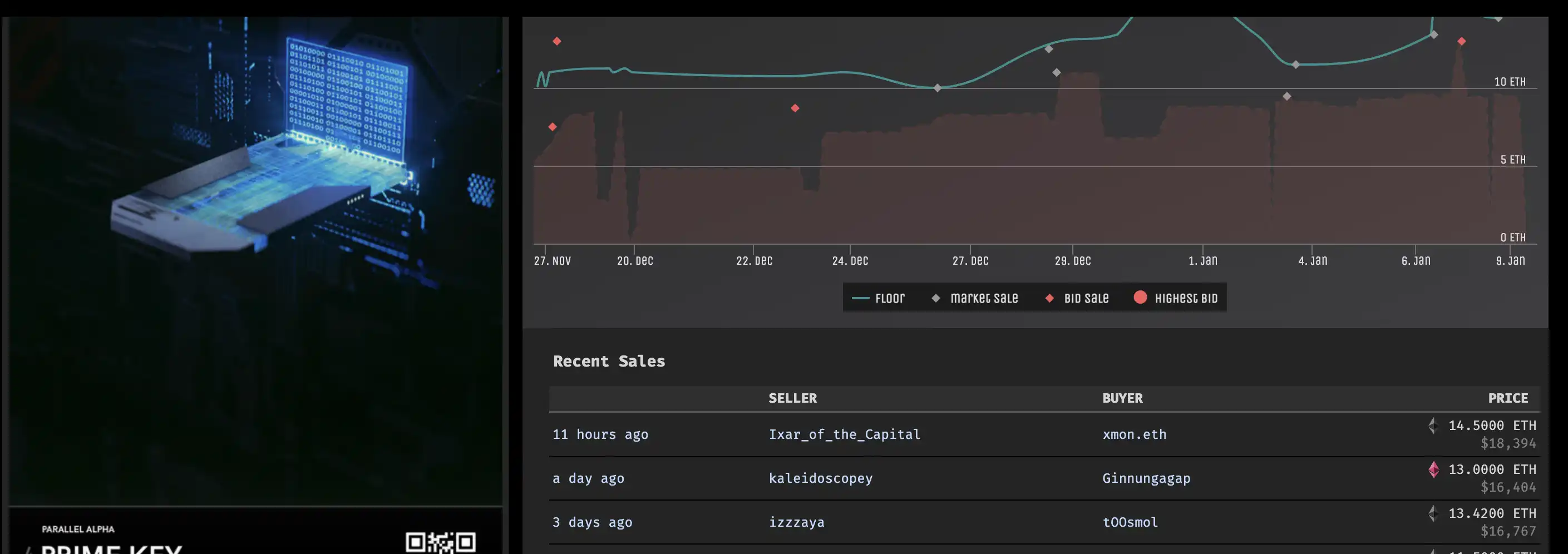
考虑到每个 Prime Key 当前对应大约 4550 Prime (注:PK 卡持有者已领取掉了一半 prime Token ),二级市场当前对 Parallel 项目的整体 FDV(注:总量为 1.111 亿)估值大约为 4.26 亿美元,相比 21 年末牛市融资时的整体估值仅下降了 15%。
Six, final thoughts
With its games-first design approach and unique "Trojan horse" strategy, Parallel has the pieces in place to appeal to a large number of traditional gamers and possibly convert some of them to Web3 gamers over the course of the experience. On the other hand, since Parallel does not force players to adopt the Crypto style of play, it may not experience the same rapid growth in market value as the familiar GameFi games, and therefore may not be on the radar of speculative players.
In the end, it is the ability of Parallel's game products to find a market fit that will determine the future of the project, and the following playtests will provide the answer to that question.
展望未来,我们期待能够看到更多游戏优先的 Crypto 游戏项目,无论是 offchain 链游还是 onchain 链游,从而让更多传统玩家能够认可 Web3,而不是让偏向 Token 经济游戏的 GameFi 摧毁这个行业。
Original link
Welcome to join the official BlockBeats community:
Telegram Subscription Group: https://t.me/theblockbeats
Telegram Discussion Group: https://t.me/BlockBeats_App
Official Twitter Account: https://twitter.com/BlockBeatsAsia