2022年那些Web3「闹剧」" 可以翻译为 "Web3 'dramas' to expect in 2022.
Original Title: "Inventory of 2022 Web3 Project Party's Cool Operations"
Original Author: iambabywhale.eth, Foresight News
2022 is coming to an end, and this year the Web3 world has been in a downturn along with the global economy. In addition to the macro environment, the successive defaults of institutions such as Terra, Three Arrows Capital, Celsius, and FTX have dealt a more serious blow to the Web3 field, which was already affected by the macroeconomic environment.
The market situation is heading straight down, and there is no sign of a rebound even at the end of the year. In the "cryptocurrency winter" that is likely to continue, let's take a look back at the many Web3 projects that have made people laugh and cry with their "crazy operations" this year, and welcome 2023 with a relaxed attitude.
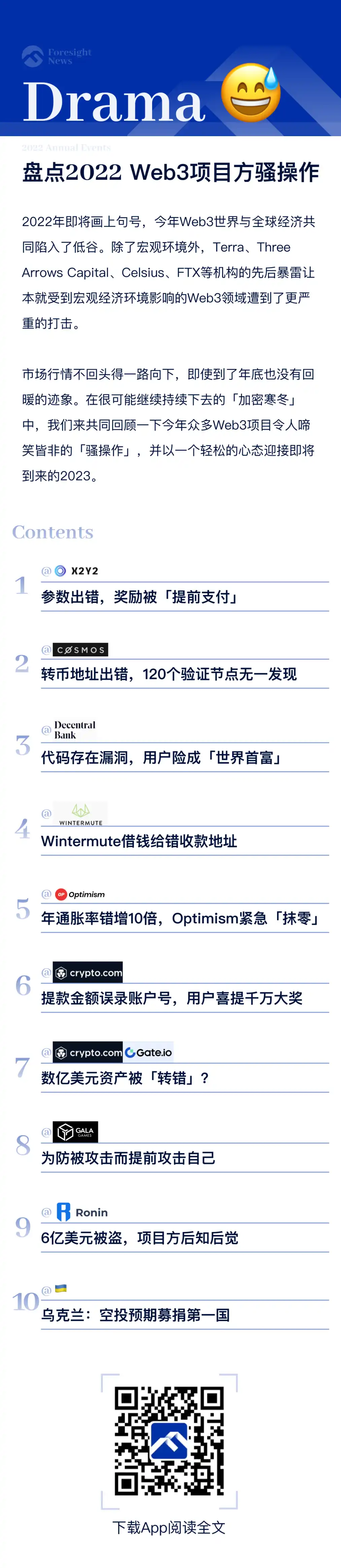
Parameter error, reward is "prepaid"
At the beginning of the year, the ILO of X2Y2 in the NFT market attracted considerable attention, and the model of distributing transaction fees to holders in full made people expect X2Y2 to be a "decentralized OpenSea". When the NFT market was still hot at the beginning of the year, X2Y2 Token rose in a short time and then fell all the way. When everyone was surprised, the project team discovered the problem during the halving of the pledge: an error occurred when setting the initial parameters of the pledge reward contract. Due to the parameter error, X2Y2 distributed 56% of the total reward of 2 billion in the first 30 days, instead of the originally planned 18%.
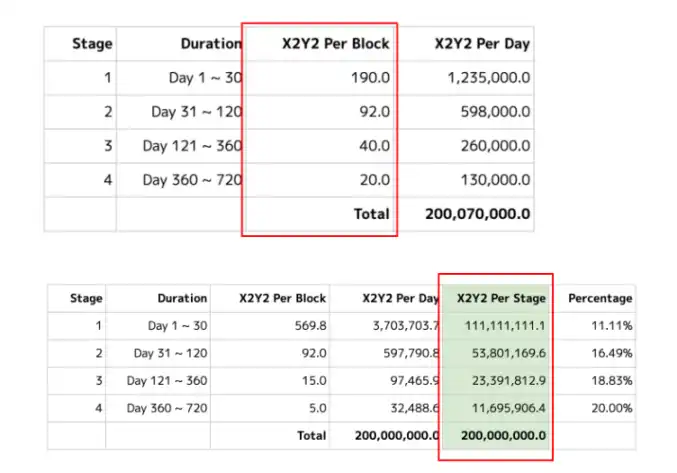
The top of the picture shows the planned reward quantity, and the bottom shows the actual reward quantity.
This mistake at that time made many users who had high hopes for it difficult to accept. Later, X2Y2 also launched a Token destruction plan to minimize the consequences of this mistake. Today, X2Y2 has developed into a strong force in the NFT market, and the mistake has gradually been forgotten.
Transfer address error, not detected by any of the 120 validation nodes
At the beginning of this year, the two projects Evmos and Juno, which were airdropped to ATOM stakers in the Cosmos ecosystem, briefly gained popularity. However, both projects faced many difficulties in their airdrops and mainnet launches. Juno in particular has made some outrageous moves more than once.
First of all, a whale who obtained millions of JUNO Tokens was targeted by the Juno community for cashing out a portion, so a proposal to reduce the whale's holdings from 3 million Tokens to 50,000 Tokens was proposed and ultimately passed. However, given that the whale exploited a loophole in the airdrop rules to obtain a large amount of Tokens and is still promising to sell most of them after staking, this "centralized" proposal is somewhat understandable.
After the
tag, an even more astonishing operation occurred. A developer mistakenly transferred 3 million JUNO tokens, which were supposed to be sent to the community address, to the wrong address. What's even more unbelievable is that none of the 120 validation nodes on the network noticed the error in the receiving address. Subsequently, the community had to submit another proposal to transfer the funds back to the community address, finally putting an end to this farce.
Code vulnerability makes users almost become "the richest person in the world"
As the issuer of the NEAR native over-collateralized stablecoin USN, Decentral Bank can be said to have created the shortest lifecycle of algorithmic stablecoins: 6 months. FTX and Alameda Research, as one of NEAR's main investors, caused NEAR's price to plummet due to bankruptcy, resulting in insufficient collateralization of USN and ultimately leading to NEAR giving up on USN.
Amidst a deteriorating market environment and uncertain future, NEAR's decision to take drastic measures to reduce costs may not necessarily be a bad choice. However, what we want to discuss today is not the event itself.
On July 8th of this year, just over two months after its official launch, USN was found to have a huge vulnerability that almost caused a major loss. The vulnerability occurred when users attempted to exchange USN for USDT through Decentral Bank, but failed due to a lack of USDT in their wallets. Additionally, a counting error in the contract refund process resulted in a refund amount that was 10 trillion times larger than intended. As a result of this vulnerability, a user was able to exchange 5 USN for USDT and received a refund of nearly 10 trillion USN after two attempts.
Fortunately, the vulnerability was not widely exploited, thus avoiding irreparable losses. In the current context where the security of algorithmic stablecoins is increasingly questioned, although stablecoins have their important strategic value, it is necessary to carefully consider whether to launch them and the timing of their launch.
Wintermute borrowed money to the wrong payment address
The airdrop of Ethereum Layer 2 network Optimism is one of the few hotspots in this year's bear market, but some of the operations that followed have left people stunned for this star project that raised billions of dollars.
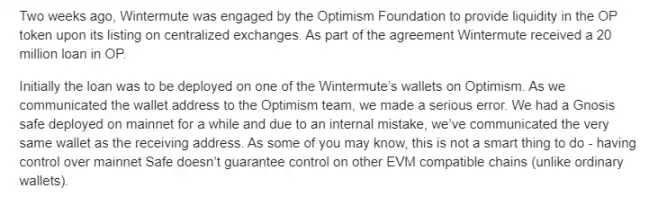
The first outrageous operation occurred in June, but the protagonist of the story was not Optimism, but Wintermute, a market maker who mortgaged 50 million dollars and borrowed 20 million OP for market making. Due to an internal team error, Wintermute provided Optimism with a Gnosis Safe multi-signature wallet address deployed on the Ethereum mainnet instead of a prepared Optimism address. This outrageous mistake allowed a hacker to steal the 20 million OP through a replay attack. Afterwards, the hacker traded 1 million OP for Ethereum, transferred 1 million to Ethereum founder Vitalik Buterin's address, and returned 17 million OP. Finally, Wintermute stated that they would return the remaining 2 million OP, and the story ended here.
Annual inflation rate increases by 10 times, Optimism urgently "zeros out"
Continuing from the previous story, the second incident happened in October. Optimism announced on Twitter that the total supply of OP Token would have a 2% annual inflation rate upon release. However, when the contract was deployed, the rate was mistakenly set to 20%. Later tonight, the contract logic will be updated to the expected 2%. Fortunately, the inflation of OP Token is not set to begin until 2023, so it has not caused too much impact.
Optimism, Wintermute, Juno, and X2Y2 have all experienced low-level mistakes such as incorrect addresses or parameters. This tells us that for irreversible on-chain transactions, it is still important to be careful and cautious.
Withdrawal amount mistakenly recorded as account number, user wins tens of millions of jackpot
As one of the first cryptocurrency trading platforms to be hit by FUD after FTX's bankruptcy application, Crypto.com has temporarily "survived" by publicly reserving information. However, this trading platform has also done some "stupid things" this year.
The first thing, although not happening this year, has not been properly resolved until this year. In May 2021, two female users from Melbourne received 10.5 million Australian dollars when withdrawing 100 Australian dollars from the cryptocurrency trading platform Crypto.com. It was not until the annual audit in December 2021 that Crypto.com discovered the mistake. According to Crypto.com, an employee mistakenly entered the account number as the withdrawal amount when making the payment, resulting in a large amount of funds being transferred to their bank account. Crypto.com then filed a lawsuit, and the Supreme Court of Victoria ruled in August that the funds must be returned to the company.
Billions of dollars in assets were "transferred incorrectly"?
If the first thing can still be understood, the second thing is full of doubts. On November 13th, Twitter user @jconorgrogan tweeted that on-chain data showed that a Crypto.com address had transferred about 285,000 ETH to the Gate.io address of the trading platform in October, and then a few days later Gate.io returned it to another address of Crypto.com, but both addresses subsequently appeared on the list of cold wallet addresses for offline storage of user assets published by Crypto.com. Crypto.com CEO Kris replied that "this should be a new cold wallet address, but it was sent to an external trading platform address on the whitelist. We worked with the Gate.io team and the funds were subsequently returned to our cold wallet. To prevent this from happening again, we have implemented new processes and features".
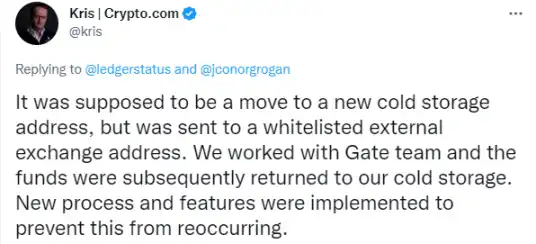
From Kris's perspective, Crypto.com mistakenly transferred hundreds of millions of dollars worth of Ethereum to Gate.io. If this is true, it can only be said that such a mistake is too outrageous and may directly send Crypto.com away. However, many people speculate that this may be a borrowing behavior for proof of reserve, and only the parties involved may know the true situation.
Preemptively attacking oneself to prevent being attacked
On November 4th Beijing time, pGALA, a token from Gala Games, cross-chained to BNB Chain via pNetwork, suddenly plummeted to almost zero. Later, through on-chain information, it was discovered that an unknown address created pGALA tokens worth 1 billion US dollars out of thin air on BNB Chain and almost depleted the pGALA/BNB liquidity pool.
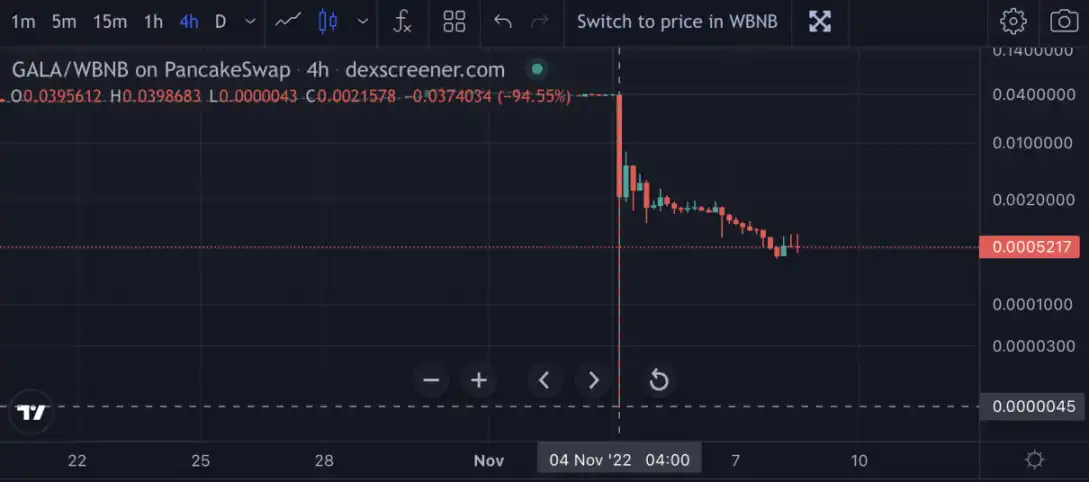
Originally, everyone thought this was a typical hacker attack, until 2 days later...
On November 6th Beijing time, the pNetwork team noticed a configuration error in the pNetwork cross-chain bridge for GALA. Due to the error, ownership of the pGALA smart contract deployed on the BNB Chain has been taken over by a hacker. The affected fund pool involves $400,000 and the attacker who gained ownership of the smart contract did not launch any attack at that time.
After
, pNetwork contacted Gala Games and decided to suspend the cross-chain bridge. Through a white hat operation, they drained the liquidity of the pGALA/BNB PancakeSwap pool in an attempt to preserve BNB so that funds can be returned to all liquidity providers once the situation is under control.
Later on, we saw a large number of additional issuances and price drops. Regardless of whether pNetwork's depletion of the liquidity pool was reasonable, their failure to immediately clarify the situation resulted in the incident of Huobi being trapped due to the failure to close the recharge channel in a timely manner. Such clever behavior is indeed not advisable.
6 billion dollars stolen, project party realized too late
In March of this year, Axie Infinity's sidechain, Ronin Network, was hacked, resulting in the theft of assets totaling over $600 million, including 173,600 ETH and tens of millions of USDC. The attacker was able to operate for nearly two months simply by transferring the stolen assets. The attack is suspected to have been carried out by a North Korean hacking group, who gained control of some of Ronin Network's validation nodes by infiltrating the computers of technical personnel through false offers, ultimately gaining control of the liquidity funds.
The most puzzling aspect of this incident is that the fund theft occurred on March 23rd, but the project team did not realize that the funds had been stolen until March 29th when they attempted cross-chain transactions and found no liquidity. As a result, they missed the best opportunity to rescue the stolen funds. Although some of the funds were intercepted by the project team and law enforcement agencies, most of the funds still ended up in the hackers' pockets.
Of course, the early birds who knew about this incident did not benefit from it. Cryptocurrency KOL Cobie publicly stated that funds were stolen by the project party and tweeted that 6 days ago, he discovered that the Axie Infinity sidechain Ronin Network was stolen for 600 million US dollars and shorted AXS with high leverage. Because no one noticed the presence of the hacker for 6 days, it was liquidated within 24 hours after shorting.
Ukraine: Expected to be the Top Country for Airdrop Fundraising
Obviously, the Ukrainian government is not a Web3 project party, but its use of airdrop expectations to attract donations is indeed very professional.
Going back to the beginning of the year, a not-so-small war broke out between Ukraine and Russia. Subsequently, the Ukrainian government itself and some third parties opened up channels for cryptocurrency donations. The Ukrainian government then announced that it would airdrop donors and announced on March 2nd Beijing time that a snapshot would be taken at 0:00 on March 4th Beijing time. On the day of the announcement of the snapshot time, the donation amount exceeded 50 million US dollars, and many cryptocurrency users who did not originally intend to donate participated in the donation army for the sake of the "airdrop".
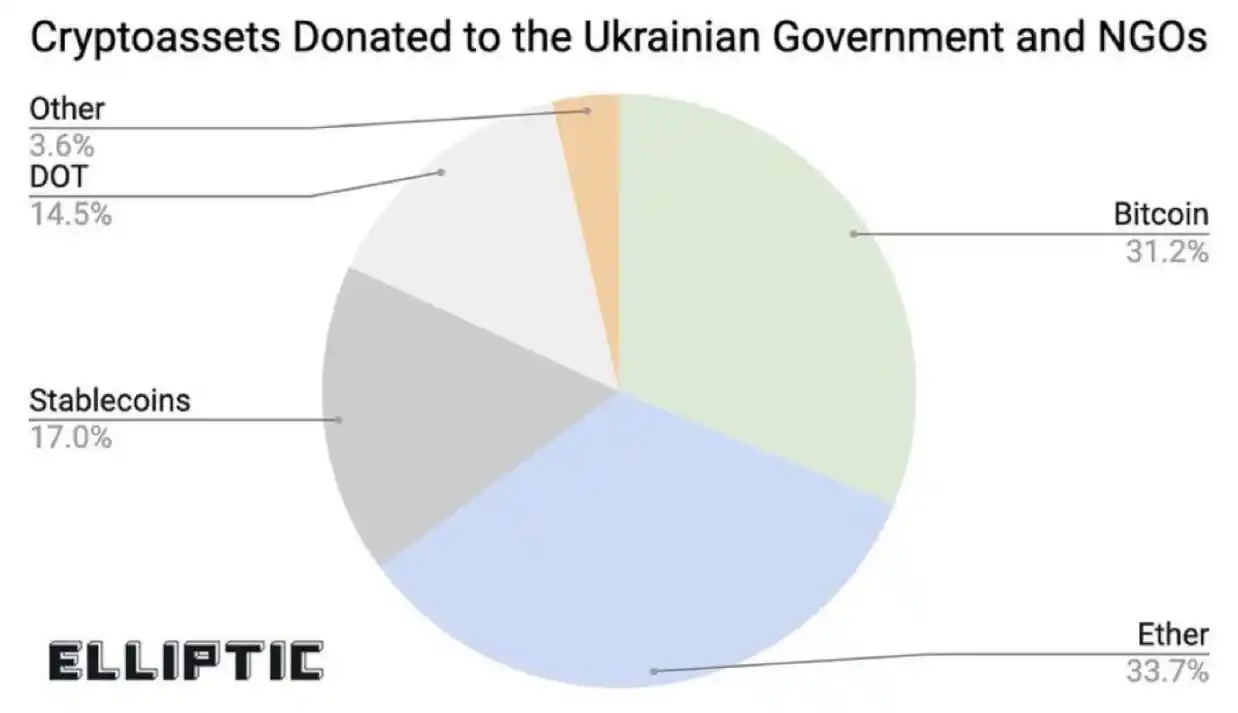
Just when everyone was eagerly waiting for the airdrop to be distributed, Ukrainian Deputy Prime Minister Mykhailo Fedorov announced on Twitter the day after the snapshot time was announced that, after careful consideration, the airdrop would be cancelled and a plan to issue NFTs to support the Ukrainian armed forces would be announced soon.
This move may not have any impact on those who already want to help Ukraine, but it has greatly angered the crowd of people who donated money for the airdrop. Afterwards, the Ukrainian government introduced various "play styles" to raise funds, but their inconsistent behavior has clearly turned off many people, who have self-mockingly referred to it as being "anti-rubbed".
Original article link
Welcome to join the official BlockBeats community:
Telegram Subscription Group: https://t.me/theblockbeats
Telegram Discussion Group: https://t.me/BlockBeats_App
Official Twitter Account: https://twitter.com/BlockBeatsAsia

 Related Articles