Review 2022, look forward to 2023
Original title: "Revisiting 2022, Looking forward to 2023"
Original author: Zixi
< /p>
It's the end of the year again, let's try to summarize the story that happened in 2022, and see what may happen in 2023. 2022 is a year of highs and lows. Although Ethereum fell to 3800 at the beginning of the year, we can still see the enthusiasm for transactions on the chain and the popularity of the NFT market. However, after the Luna crash and the FTX crash, the entire market began to slump, and there was no new narrative direction.
The article is divided into three parts. What to watch and what to watch next year.
1. What has been bullied this year?
1.1NFTFI
NFTFI is actually a track that everyone gave high hopes at the beginning of the year. Based on the enthusiasm of NFT at the beginning of the year, countless outsiders rushed to the hot track of NFT one after another. At the beginning of the year, countless bigwigs spent a lot of money (100E+) on BAYC; Houdi’s gas war was so terrifying that the price of a mint NFT was more than 2E. When the floor price of a single blue-chip NFT was above 10E, people began to think, how can the general public participate in such a high price?

< /p>
Figure 1: Opensea's trading DAU this year, the number of transactions, the volume of transactions, etc. are declining

Figure 2: NFT index
So at the beginning of the year, everyone was concerned about NFTFI This track is full of enthusiasm and anticipation. Everyone hopes that there will not only be lending transactions such as P2P and P2Pool on this track, but lowering the entry threshold has also become a major direction. Therefore, we have also seen new concepts such as index trading, fragmentation, crowdfunding, buy now and pay later this year. In the first half of this year, crowdfunding models began to appear on partybid and others, and BNPL of NFTs began to appear on Cyan and others. Let us take NFT lending, which has a relatively large market space, as an example. If you look at the borrowing volume alone, the overall borrowing volume will remain basically unchanged after next May, with BnedDAO and NFTFI contributing more than half of the borrowing volume. But in fact, let us observe the number of users of the platform. The total daily activity of this market is only about 100, and the number of people covered is still too small. The limited daily activity and transaction volume is partly due to the decline in the popularity of the NFT market.
Let me tell you another cold joke, why the decline of BAYC's E-standard from ATH to the present (66%) is lower than that of ETH's U-standard (75%) Woolen cloth? The reason is that the liquidity is not good, and no one is willing to buy and sell frequently to reflect the real price in the market. Of course, the price cannot fall. Then why did the floor price drop from 70ETH to 50ETH recently? It is because some holders want to cash out, so they can only lower the price in the hope that someone will buy it. In the end, the oracle feeds the price to trigger the liquidation point, causing a bunch of big monkeys to liquidate, so the death spiral begins. It has come to the point that it needs to rely on serial liquidation to effectively fall, and generate a large enough trading volume, which is enough to show poor liquidity.
So people are too optimistic about the development of NFTFI this year, but this year's Sudoswap really made the market feel refreshed.

Figure 3: NFT lending market Borrow volume
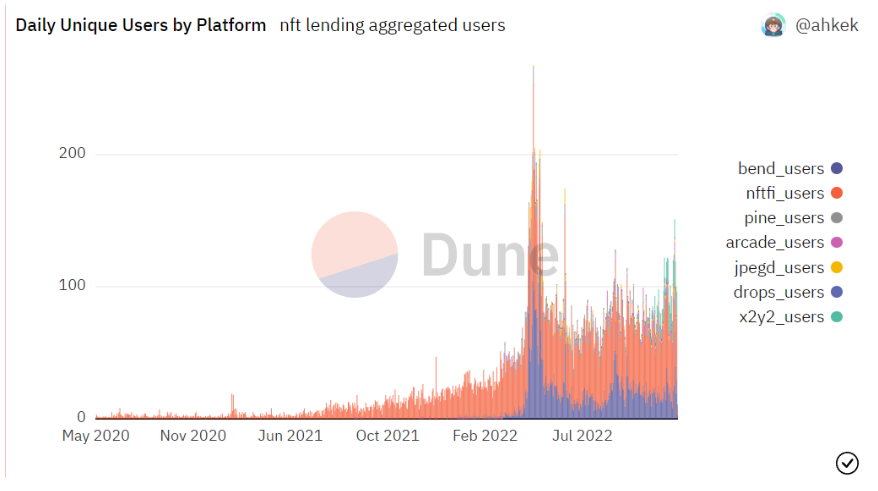
Figure 4: NFT lending market DAU
1.2 C-side applications such as SocialFi/MusicFi
Let’s not talk about whether the blockchain infrastructure is enough to support it now Social/music products on the chain. In the past, there have been low-level public chains such as deso that specifically support social networking, but their development has not been satisfactory. The core is that the ecology and user side have not been established. The logic of SocialFi is different from that of DeFi and GameFi, but it is similar to that of MusicFi. It is based on the love generation of big V/musicians to purchase related fan Token/NFT. The logic of SocialFi is simplified to - if a big V wants to realize his social capital (obtain token), then he needs to spend time and money to prove the value of his social capital (POW proof of work).
Similar to the logic of BTC/ETH, this also shows that the blockchain-based Web 3 is very suitable for the development of SocialFi. That is, the essence of SocialFi can be understood as a big V (or an individual) using their own influence based on blockchain technology to build their own social capital (that is, their personal brand reputation) on the one hand, and to build their own fans They seek benefits.
But it is precisely because of the above logic that SocialFi also has a big problem now:
2. For social platforms, content mining Mine is very difficult to define.
3. For social platforms and Token distribution platforms, the empowerment of platform Token value is more important.
4. Fewer users. At present, SocialFi still needs a long way to go to develop. Its track scale is still small, its mechanism is relatively primitive, and there are few aborigines of Web3. There are very few SocialFi users who are willing to use products with poor experience.
The problem of the MusicFi track still exists:
1. From the perspective of the user side, There are still fewer users in the entire Web 3, fewer users are willing to spend limited time listening to Web 3 music, and there are very few users who are willing to spend real money to buy NFTs without royalties. In essence, it is still very difficult to rely on restricted content to rob users of their limited time.
2. From the perspective of IP, there is a lack of leading stars such as Taylor Swift and Jay Chou, and the current Web 3 musicians are relatively long-tailed. But we have also seen some top stars represented by Wang Feng try to get involved in web3 music this year.
3. From the perspective of the project side, the economic models of many project parties are not perfect, and the empowerment of tokens is weak. The whole project is more like "I create Given this environment, users want this demand, so I issued a coin.” Music projects with a strong social nature are similar to SocialFi. When SocialFi’s project Token is poorly empowered and adopts content mining to start a cold start, the consequence is that users start to create unlimited spam content, falling into a death spiral of mining, withdrawing and selling. Therefore, when the music project starts Listen to earn and Create to earn, if the token is not given a reasonable value, the death spiral will also be the final result.

Figure 5: social and music with defi and gamefi horizontal Contrast
1.3 Cross-chain bridge
Last year, cross-chain bridges were generally regarded as the core in the market From the perspective of infrastructure, this is also very obvious. After all, the public chain structure last year was one super and many strong, and new public chains emerged one after another. There are many public chains such as BSC, Luna, Solana, Tron, Avalanche, Polygon, Harmony, etc. in the market. Due to the trust problem in the centralized official cross-chain bridge, and the scalability is relatively poor. Therefore, third-party cross-chain bridges represented by highly scalable Anyswap and cbridge began to flourish last year and early this year.
But what happened this year? When Luna crashed, the Terra public chain disappeared; when FTX crashed, Solana suffered; Aptos and Sui were not paid by players; the TVL on the chain dropped, firstly due to the drop in token value, and secondly due to a sharp drop, liquidation began (on the other hand, it was still There is such an abstract story that nearly 70% of the TVL on Solana is double-counted). Coupled with the complex contract inherent in the cross-chain bridge, it has become a hotbed for hackers.
Looking at a set of interesting data again, according to a report recently released by Chainalysis, the amount stolen from cross-chain bridge attacks accounted for 10% of the total number of stolen cryptocurrencies in 2022 69%, a loss of $2 billion. There have been 13 cross-chain bridge attacks this year, including the recent Nomad cross-chain bridge attack that cost $190 million, and the Ronin cross-chain bridge attack that cost as much as $624 million in March this year. Since last year, the multi-chain coexistence and the competition pattern of one superpower and many strong ones has gradually become an oligopoly pattern of ETH+BSC+Tron.
The cross-chain bridge is one of the most important infrastructures in the public chain, but for investors, due to the existence of hackers, it may not be a very profitable business. But it is undeniable that excellent cross-chain aggregators such as LiFi, Chainge, and Dbridge have appeared on the market, reducing the use and investment risks of users and investors. But (cross-chain) aggregator, a low-threshold, highly competitive business, but a frequently used tool, can it bring excess returns to investors? It is worth thinking about.

Figure 6: 2 billion US dollars in the cross-chain bridge this year Hacked

Figure 7: Stargate’s transaction volume bucked the trend , the trading volume is gradually decreasing
2 What I am optimistic about next year
2.1 Compliance supervision
Before talking about compliance and supervision, let me share a little story.
I saw a project in March of this year, which was a cross-chain bridge. One of the characteristics of this cross-chain bridge is that it requires KYC. At the beginning of the year, I couldn’t understand the need for KYC for dapps on the chain. After all, the blockchain is an anti-regulatory world, and KYC always feels that I have lost the spirit of the blockchain. But after the interview, I understood why the project party needs KYC. This is a cross-chain bridge project made by a large traditional financial market maker. They have an extremely large amount of funds for making markets in markets such as traditional stocks.
They are also very optimistic about the entire crypto track in the near future, and they have begun to try to use part of the funds to make markets on-chain and off-chain. Off-chain market making is already very complicated, so they try to open up the market-making space on the chain, but multiple chains will lead to the dispersion of funds. In their daily market making, liquidity is required to move across different chains. If CEX is used, the huge amount of funds will lead to the upper limit of daily deposit and withdrawal, and there are some trust issues in the centralized cross-chain (combined with the FTX incident, this is really forethought).
If you use the fluid cross-chain of the cross-chain bridge, the pool of the cross-chain bridge is very small, and there are large slippage and wear in the cross-chain; Adding liquidity to the pool, mixing your own clean money with a pool that may be black money that you don’t know where it came from, and being targeted by hackers from time to time, will inevitably be subject to supervision——Big traditional market maker Under the strong supervision of the SEC, there is no need for them to be under the iron fist of supervision for the petty profits of the current crypto market making.
So is there a way that I can continue to make markets in crypto while avoiding all the problems mentioned above and complying with the regulation?
KYC. After passing KYC, market makers can throw money in for liquidity. At the same time, other institutions and individuals after KYC are welcome to come in and release liquidity. On the one hand, it reduces cross-chain wear and tear, and on the other hand, it also caters to the needs of supervision, allowing larger traditional financial market makers to enter the market together to develop the land that has not yet been fully developed for on-chain market making, and make the cake bigger together . After Tornado cash was sanctioned by the U.S. Treasury Department in June this year, I became more convinced of the need for compliance and supervision. At this stage, the entire market value of the blockchain is not as big as Apple, which is half. We not only need to improve infra, but also bring in traditional financial institutions from the C-end and Old Money to expand the market together.
Therefore, following the direction of supervision, KYC service-oriented projects began to appear in the market. For example, through ZK DID, users use their own information to generate ZK-Proof in the form of ZK through their own devices under the chain, and then only need to pass Proof to verify whether they are whitelisted users. For example, one day the iron fist of regulation hit Uniswap, requiring Uni not to provide services to users in Russia, Iran, and North Korea. A feasible way is for Uni to cooperate with KYC service providers. Users must show their zk proof to prove that they are not citizens of the above countries before they can use Uni. On the one hand, ZK proof protects the private information of users, and on the other hand, it has also been approved by the regulator, making Uni’s money cleaner and more compliant, and more likely to attract traditional institutions to enter the market.
2.2 Developer Tools
First share a case. In 2021, Alchemy will benefit from the carnival of the bull market. In April 2021, the valuation of the B round is only 505 million US dollars. From the data disclosed in this round, the number of customers has increased by 97 times in 8 months, and the number of enterprises has doubled in the first quarter of 2021Q1. From the NFT business growth of more than 13 times; in October 2021, it received a C-round investment with a valuation of $3.5 billion. The founder said that "the business growth rate is much higher than the valuation growth rate"; The value reached $10.2 billion, and the team stated that "from the close in October to now, the user base has increased by 50%". Alchemy's valuation has doubled nearly 20 times within a year, and customers, businesses, service developers, and communities have all shown massive growth.
In 2021 and 2022, we see a very interesting phenomenon - more and more web2 developers have a great interest in the crypto/web3 world . According to Github statistics, there will be approximately 73 million web2 engineers worldwide by the end of 2021. According to Electric Capital data, by the end of 2021, there will only be 18,000 web3 monthly active engineers, with a penetration rate of less than 0.025%. Judging from the statistics of LinkedIn and ok in 2021, test engineers and cryptography experts are one of the two fastest-growing professions.
Superimposed by the current phenomenon that major Internet companies in the United States, China, India, and Singapore are slowly laying off workers, more and more web2 engineers are beginning to seek the next outlet. According to relevant rumors, "In the Bay Area alone, there are currently about 3,000 Chinese web2 engineers seeking new opportunities"; due to the downturn in the domestic economy, more and more engineers from major Internet companies in China, especially from Byte and Tencent, began to I started my own web3 journey. Therefore, from the data point of view, the 2 dev market is an incremental market that may be sexier than 2C and has a more definite direction.

Figure 8: Number of web3 monthly active engineers
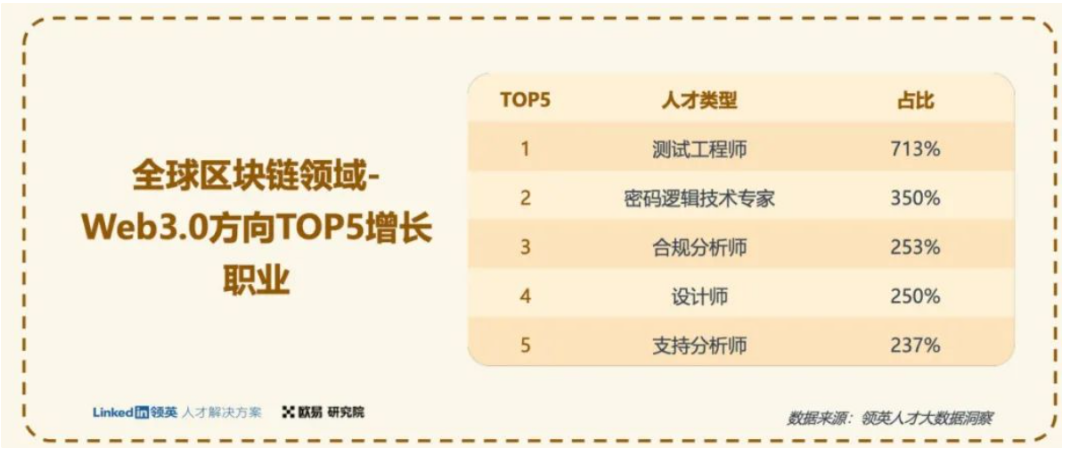
Figure 9: Growth career direction in the global blockchain field< p>
We take JSONRPC and API as an example, one of the markets where developers and Dapps deal with the most. RPC is not a market with barriers. Any project party or individual can build a full node to provide full-chain data for their own projects. But this is accompanied by high fixed costs and monthly operation and maintenance costs. For the project party, it starts at 10,000U per month, and self-built nodes may also face complex operation and maintenance problems such as maintenance, which is not worth the candle.
Therefore, the RPC business will continue to be centralized, which also explains the rapid expansion of node providers such as Alchemy and infura, which is essentially a Matthew effect. very high market. In addition, there are also high-quality node suppliers such as quicknode and Infstone in the market. RPC is a very winding track. In addition, on the basis of RPC, service providers can use their strong engineering implementation capabilities to provide cloud databases (datacloud) and APIs. In terms of providing cloud databases, decentralized/centralized multi-chain real-time databases have appeared this year. Developers no longer need to spend a lot of cost and time to analyze the data on the chain. They only need to use SQL to call out and focus on Just develop the product.
In addition, developers still have many strange API requirements, which greatly affect the progress of product development. If there is a product with a multi-chain real-time database, and developers can call the data combination API independently, it will meet the long-tail needs of developers and greatly reduce the time for many developers to reinvent the wheel. In the second half of this year, this type of product will start financing in the middle of this year, and the new Infra competitors - overseas Space and time, Goldensky and domestic Chainbase, etc., are competing with the old Infra-Alchemy Infura Instone The Graph in the Central Plains.
In addition, a number of data analysis tool products have appeared on the market. In addition to the more versatile dune, footprint, etc., there are also data analysis tools in more subdivided fields. For example, specifically for defi, NFT, gamefi, public chain, financing data, black and white lists on the chain, etc., such as defillama and tokenterminal, etc., the means of monetization are nothing more than SaaS subscriptions or API interface calls, which are more or less commercialized Realization problem.
The database in the subdivision field can connect the cleaned database of its own subdivision field to more general databases such as space and time, chainbase, etc. First, the general database can improve its own data, and second, the refined/segmented track database can increase its own monetization channels, which is equivalent to turning the refined database into a general database with more developers and ecological docking API Marketplace, followed by revenue sharing.
3 What are you still observing next year
3.1 DeFi
< br>
Affected by FTX and Babel, etc., CeFi has once again become the target of public criticism. Let’s give an example first to explain what problems exist in the black box-manipulated asset management CeFi. CeFi attracts users essentially by relying on APY. If there are two large institutions X and Y in the market, X makes 5% APY to attract users, and Y makes 6% APY.
If the branding of X and Y are similar, and the backer behind them is also similar, most users will choose Y deposit, after all, the APY is high. However, because of market competition and income issues, in order to acquire customers, X can only increase to 6.5% or 7% to attract customers. The seemingly innocuous APY is actually harmless during the bull market. The powerful trading, quant and structured products in CeFi institutions will allow institutions to obtain returns much higher than 5%-7%.
But the problem is that once the market changes too much, and CeFi institutions are no exception, there is a situation of increased leverage. When encountering 312,519, and the Luna incident, traders have not yet If you have time to adjust your position, you will be easily taken away by the market plunge. This led to the fall of the recent stars of the market FTX and Babel. Would the customer acquisition problem above be solved if users knew where the high APYs were coming from?
So DeFi has recently returned to people's vision. We have seen that in the near future, the ratio of DEX/CEX spot trading volume has stabilized at 15%, which has dropped by about 40% compared to the bull market at the beginning of the year. After all, it is now deeply bearish, and the overall activity on the chain is very poor. But now judging from the transaction volume on the chain, 61% comes from Uni, 27% comes from Curve, and 9% comes from Dodo. From the point of view that the price of derivatives transactions comes from Dex, and the liquidity of derivatives transactions comes from Dex, etc., now DEX is more like the infrastructure of the entire DeFi. Although the Dex model is constantly innovating, it is undeniable that Uni’s market share has remained stable at around 70% this year. This may come from the dependence of the user/chain market maker/trading bot transaction path and the deep advantage of uni.
Benefiting from CeFi's wind review this year, can politically correct DeFi run in a new direction next year? This still needs to be observed.

Figure 10: Dex/CEX spot volume comparison

Figure 11: DEX Market share
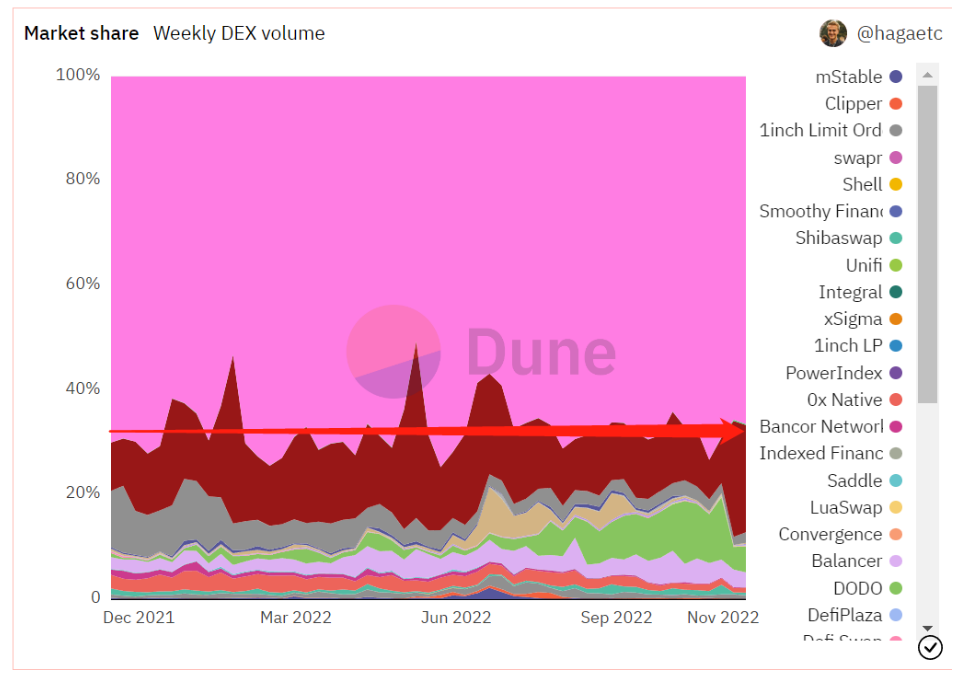
Figure 12: Weekly DEX Market Share
3.2 Enterprise Server Track
Enterprise Server Track is also a very interesting direction. Now there are more and more startups in the blockchain. In the early days, it was not a big problem to rely on excel to manage. However, with the increase of personnel and income and expenditure, refined management is becoming more and more important. Unlike physical companies, many revenue and expenditures of crypto start-up are carried out on the chain, which leads to the poor adaptation of traditional SaaS tools.
In the North American market, blockchain enterprise service companies have emerged, such as the flow payment protocol Zebac (which received financing of 28 million US dollars in March 2022), Developers manage Convex ($26M in April 2022) and Meow financially ($22M in July 2022). While the direction is interesting, is it a big track? The monthly fee is 1,000 U. Assuming that there are 1,000 blockchain early-stage companies using the product after working for a period of time, the income is only 1,000,000 U.S. dollars per month.
A year’s income is as high as 20 million U.S. dollars. If you take the PS standard 15-20 of Nasdaq SaaS company to calculate, then it is only 400 million U.S. dollars ceiling. Not to mention how long it will take to get 1000 companies under BD, and whether they can have a monthly income of 1000U per company. Convex raised US$26 million in financing at one time, and the valuation is at least US$130 million to US$260 million, so the returns to investors may still be limited.
The ceiling of the enterprise service track still needs to be observed.
3.3 Traffic track
Traffic track is a common topic, usually refers to The track where traffic such as games, wallets, music, and social networking enters.
On the game track, many major manufacturers (Funplus, Photon Games, Ubisoft, etc.) have begun to slowly deploy and explore web3 games this year, but as for whether players are willing Paying the bill requires further observation.
For social networking, we have seen Tencent, Meta, Twitter, etc. boldly explore web3 social networking, some new web3 social networking products, such as debox, etc., and some social networking Search protocols such as lens, rss3, mask, etc. We are looking forward to the next bull market, web3 can have its own social platform, this social platform can attract enough new people into the circle, and slowly convert users.
For wallets, a "new concept" represented by AA and ERC4337 appeared this year. But if you think about it carefully, isn’t social recovery, gas subsidies, etc. just fried rice? Argent, loopring and other wallets have actually realized the similar capabilities of the current 4337 AA contract wallet a few years ago, but they still haven’t come out.
Essentially, because creating a wallet requires gas fees, social recovery logic is buggy and troublesome, it is not compatible with other DAPPs and requires BD and other features, so development is difficult . But everyone believes in the fact that wallets serve as traffic portals, so I still want to observe what kind of wallets can occupy a certain market space in the market recovery next year or two.
3.4 layer2
layer2 is a great direction in 2022. This year we saw that Scroll of type3 zkevm is trying to switch to type 2.5 or type2; zksync of type4 began to gradually shift to type3 zkevm, and zksync 2.0 was launched; Taiko’s testnet of type1 zkevm was also launched. But in fact, a really useful and usable zkevm is still a little far away from us.
In the NTU V God lecture before, I asked Vitalik about the distance between zkevm and us. If we want to achieve the real type 1 zkevm, it may take another 10 years. During this period, we not only need to overcome the shortcomings of the algorithm and optimize the circuit algorithm a lot, but also rely on the stable circuit algorithm to design the Asic mining machine and accelerate the proof. generate. Currently, it takes about an hour to generate a type1 zekvm proof. Although it does not affect normal use, once it involves cross-chain and coin withdrawal, it will affect the user experience.
In short, in the current situation where the modular public chain is gradually becoming a consensus, the positioning of L2 is becoming more and more important. Based on Starkware, we can also iterate app chains for L3 and L4. Although the theory is very good and the market share of Ethereum is gradually increasing, it will take time for l2's technology to be implemented, and ecological construction will also take time.

Figure 13: Different types of zkevm< p>
Finally, I will put a calendar of this year's encryption world, mourning the hardships of people's lives.

Figure 14: Crypto World 2022 Calendar
Limited by the size of the article, I will not repeat it further. In fact, there are still many possibilities, such as the new track represented by the knowledge graph - it can be used to trace entities instead of addresses. This is a new idea; on-chain advertising encourages users to feed data to ML /AI to generate models, and finally use algorithms to accurately distribute advertisements to users (web3 bytes); with the explosion of web3 games and music, can web3 cloud rendering that provides computing power through retail idle machines be established; can the new decentralized wireless Change the model of traditional operators.
However, many of the stories this year cannot be avoided. In the past six months, there have not been many new concepts. I hope that in 2023, there will be a new narrative direction.
Original link
Welcome to join the official BlockBeats community:
Telegram Subscription Group: https://t.me/theblockbeats
Telegram Discussion Group: https://t.me/BlockBeats_App
Official Twitter Account: https://twitter.com/BlockBeatsAsia

 Related Articles