Week 50 on-chain data analysis: the market is in a slightly bearish state with continuous low trading volume in derivatives.

Original Title: "The Radiance of the Sun and Moon, Dawn Again and Again | WTR 12.12"
Original Source: WatchToweR Crypto
Insight into endless cutting-edge technology; foreseeing the future, leading the new era of investment research.
This Week Review
From December 6th to December 12th this week, the highest price of Bingtang orange was around $17239, and the lowest was close to $16666, with a fluctuation range of about 3.4%.
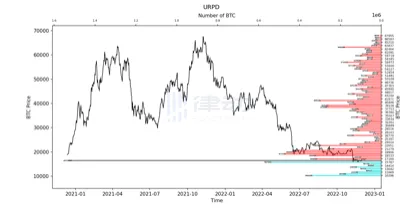
Observing the chip distribution chart, there is a large volume of chips traded around $16474, which will provide certain support or pressure.
• Analysis:
1. 17,000 to 20,000 is approximately 2.09 million pieces;
2. 12000 ~ 16500 约244万枚;
2. 12000 ~ 16500, approximately 2.44 million coins.• The probability of not breaking through 18500-20000 in the short term is 69%.
Important News
The content you provided is:
On the economic news front.
• United States
1. Labor Department data shows that in November, the year-on-year growth rate of PPI (Producer Price Index) was 7.4%, which is slightly slower than the revised 8% from the previous month, but higher than the market expectation of 7.2%.
a. In November, PPI increased by 0.3% compared to the previous month, which is the same as the revised data from the previous month at 0.3%, but higher than the expected 0.2%.
2.12 The University of Michigan's Consumer Confidence Index for the month showed that...
a. US 1-year inflation expectations fell to 4.6%, a new low since September 2021, down from the previous value of 4.9%.
b. The consumer confidence index for December rose from 56.8 in the previous month to 59.1, far exceeding the market's general expectation of 57, but lower than the same period last year of 70.6.
The consumer confidence index for December is 60.2, higher than the expected 58.8; the future consumer confidence index is 58.4, higher than the expected 54.5.
3. The Federal Reserve reduced its balance sheet by $92.294 billion in November, with its total assets decreasing from $8.676 trillion to $8.584 trillion.
4. This week's released data shows that multiple sets of economic data have exceeded expectations:
a. US factory orders for October increased by 1%, exceeding the expected 0.70% and the previous value of 0.30%.
b. November ISM non-manufacturing PMI was 56.5, exceeding the expected 53.1 and the leading value of 54.4;
c. November Markit Services PMI final value is 46.2, exceeding the expected 46.1 and the leading value of 46.1.
5. This week, the two-year treasury bond yield reached 4.2%, while the 10-year treasury bond yield was 3.4%, with a difference of 0.84 percentage points between the two.
a. This week, the 10-year US Treasury bond yield has risen by about 9 basis points, reversing the trend of two consecutive weeks of decline;
6. This week, the US dollar index closed below 105.00, with a cumulative increase of about 0.4%.
7. The number of initial jobless claims in the United States reached a 10-month high of 230,000 people, higher than the previous value of 225,000 people and in line with the expected value of 230,000 people, indicating a cooling job market.
8. Private clients of Bank of America have been buying bonds for 41 consecutive weeks, and for the first time in 11 weeks, they have invested cash in the stock market.
9. The expected value of CPI on the 13th of this month is 7.3%, with a previous value of 7.7%. The expected value of CPI seasonally adjusted annual rate is 7.3%, with a previous value of 7.7%. The monthly rate is 0.3%, and the seasonally adjusted core CPI annual rate is 6.1%, which is expected to be lower than the previous value.
•UK & EU
1. This week, the yield on 10-year benchmark UK government bonds closed at 3.17%, while the yield on 10-year German government bonds closed at 1.92%.
In February, investors withdrew a net of $1.7 billion from European stock ETFs. The resumption of selling has brought the cumulative net outflow since March to $27 billion, reversing the inflow of $27.2 billion in 2021.
3. European natural gas has risen for the fourth consecutive week.
a. Last month, European natural gas inventories rose sharply to 96%. With the weather turning colder, current natural gas reserve levels have dropped to 90%.4. Germany, the Netherlands, Austria, Denmark, Estonia, and Luxembourg, six EU member states, have warned that they cannot accept other EU member states attempting to further lower the upper limit of natural gas prices.
a. EU countries plan to approve a natural gas price cap at the Energy Ministers' meeting in Brussels on December 13th, but there are significant differences in opinions among the countries.
5. The price ceiling for Russia's maritime crude oil exports has come into effect for G7, the European Union, and Australia. However, some major customers in Asia have exceeded the price restrictions imposed by the West.
•Asia
1. In the week ending December 3rd, foreign investors sold ¥1.1 trillion (approximately $8.02 billion) of Japanese bonds, compared to ¥45.1 billion sold the previous week.
2. The yield on Japan's 10-year government bonds has repeatedly exceeded the Bank of Japan's upper limit of 0.25%, with this week's yield at 0.247%, just one step away from breaking through once again.
3.10 Tokyo CPI hit a record high in 40 years, nearly double the central bank's target of 2%.
4. According to data from the National Bureau of Statistics,
a. In November, CPI rose 1.6% year-on-year, a decrease of 0.5 percentage points from the 2.1% increase in the previous month; CPI fell from a 0.1% increase in the previous month to a 0.2% decrease.
b. PPI decreased by 1.3% year-on-year, with the same decline as last month, and has been declining for two consecutive months; influenced by the rising prices of coal, oil, non-ferrous metals and other industries, PPI increased slightly by 0.1% month-on-month, and has been growing positively for two consecutive months.
•Others
1. WTI January crude oil futures fell 0.61%, falling for six consecutive days and hitting a new low since December last year; Brent February crude oil futures fell 0.06%, falling for seven consecutive days and hitting a new low since December 24 last year.
2. This week, US crude oil fell by 11.20% and Brent crude oil fell by 11.06%, marking the first time in a week that they have fallen by more than 10% since April 1st.
3. The Keystone pipeline, a large oil pipeline spanning the United States and Canada, has been shut down after a leak and is scheduled to partially restart on Saturday.
Encryption Ecology News
1. VanEck's executive Matthew Sigel, a giant in the asset management industry, stated that it is expected that financial institutions will tokenize over $25 billion worth of off-chain assets on the blockchain next year in order to simplify custody and settlement processes while reducing costs for clients.
2. Hedge fund Presidio Trading has launched a cryptocurrency market risk strategy fund, which is planned to be opened to qualified investors in the first quarter of 2023 with an initial capital limit of $10 million.
3. Stablecoin issuer Tether has launched a stablecoin CNH anchored to offshore RMB on the Tron network.
4. Ark Investment founder Cathie Wood said that we need the "Ice Orange" ETF, which can rescue many people from the collapse of FTX.
5. Payment giant PayPal announced that it will expand its cryptocurrency services to Luxembourg in the coming days. Customers can buy, sell, and hold cryptocurrencies such as Bitcoin and Ethereum in their PayPal accounts.
6.E Ethereum Shanghai upgrade is scheduled for March 2023, which will release the beacon chain staking withdrawal for Ethereum. The Ethereum improvement proposals included in the Shanghai upgrade are EIP3540, EIP3670, EIP4200, EIP4570, and EIP5450.
7. The UK Treasury Department has stated that it will expand existing tax incentives to the cryptocurrency sector to achieve tax relief for investment managers.
8. The European Union will require cryptocurrency companies to report tax details to regulatory agencies.
9. The US SEC requires listed companies to disclose their exposure to cryptocurrency risks and potential impacts.
10. The Hong Kong government's Legislative Council will establish a licensing system for virtual asset service providers, which will take effect in June next year. Virtual asset trading platforms will be treated the same as traditional financial institutions.
11. Hong Kong asset management company Pando Finance announced the launch of two actively managed blockchain ETFs focused on virtual assets, which began trading this Thursday and are open to both traditional and retail investors.
12. After Hong Kong allows more local people to access digital assets, three asset management companies have applied to launch trading platforms for ETFs for Hong Kong retail investors. They are Samsung Asset Management, Future Asset Global Investment (Hong Kong) Limited, and CSOP Asset Management.
Long-term Insight: Used to observe our long-term situation; Bull market/Bear market/Structural change/Neutral state.
Mid-term exploration: used to analyze what stage we are currently in, how long this stage will last, and what situations we will face.
Short-term observation: used to analyze the short-term market situation; as well as the possibility of certain directions and certain events occurring under certain conditions.
Long-term Insight
• Net position status of various groups
• High weight multiple selling pressure status
• Participants with 1-2 years of experience
(Net position status of various groups as shown below)
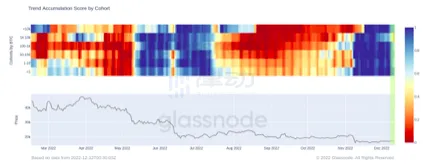
The state of increased holdings by various groups has begun to decrease, and the previous joint increase in holdings has begun to show a preliminary decline. However, there is currently no selling phenomenon, only a mild selling by the group holding 1k-10k coins.
(High weight multiple throwing state)
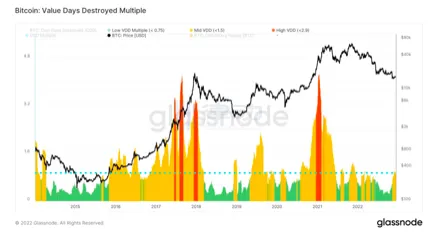
High weight multiple throwing pressure state display, the current market belongs to the state of slightly greater throwing pressure.
If viewed from the right side, it may still require further pressure relief to better execute plans such as purchasing.
(Participants in the 1-2 year chart below)
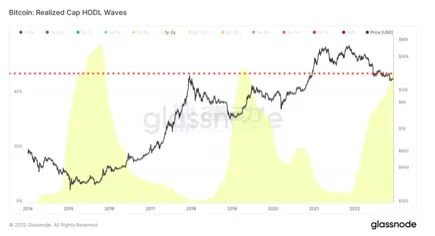
Because their cycles are not long, they often represent new capital and groups in longer stages, and are generally classified as bear market participants in construction.
This type of funds, according to observation, tends to show higher accumulation and growth at the bottom of bear markets.
As the market rises, they are slowly selling off their assets, which are often one of the mainstays of the market.
The slow increase in holdings is still continuing, with a proportion similar to that of the increase in 2019.
Mid-term exploration
Long-term holders suffer supply losses.
• Average selling life
• Long and short-term cost groups
• Long-term holder cost change rate• Short-term trader cost change rate
•Stablecoin circulation•已实现持有比例 -> •Realized holding ratio•Net Position of Whale Exchange
Long-term holder status rating: Test
(Long-term holders suffer supply losses)
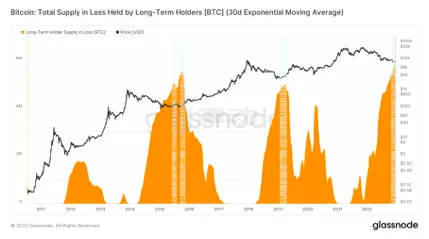
-The loss status of long-term holders has reached a new high since 2011. In this state, they may be more prone to maintaining a skeptical attitude towards the market.
- About 5.8 million sugar oranges in their positions are in a state of loss.- Due to the position being in a state of loss, oneself will be in a more agonizing state.
-The current market situation may be a test for them.
(Average Selling Life)
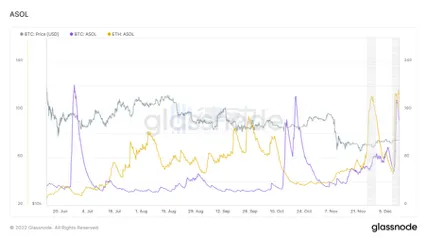
Observing the signs of long-term holders' sales from the average selling lifespan.
Recently, there has been a surge in data.
Compared to before, it has a relatively urgent nature.
The current situation has slowed down slightly.
Long and short-term holding cost rating: Slight contraction in the cost reduction situation for short-term traders.
(Cost Group for Long and Short Term)
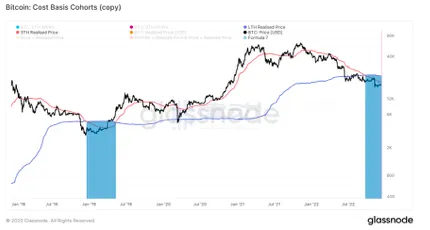
Cost group statistics for long-term and short-term holding costs.
The blue area: Short-term cost < Long-term cost.
The current situation is still sliding with low short-term costs, indicating a lack of short-term traders in the market.
Deeply analyze the changes in long-term and short-term cost rates.
(Long-term holder cost change rate)
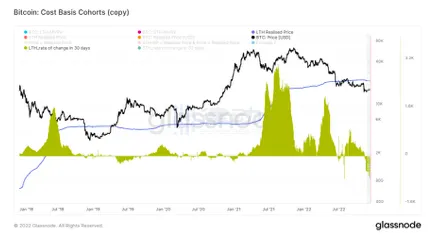
Yellow area: Long-term cost change rate.
From the current situation, it is still in a declining state.
Possible long-term holders may engage in two types of behavior:
1. High-cost chips reduction;
2. Low-cost chip accumulation leads to a decrease in holding cost.
(Short-term trader cost change rate)
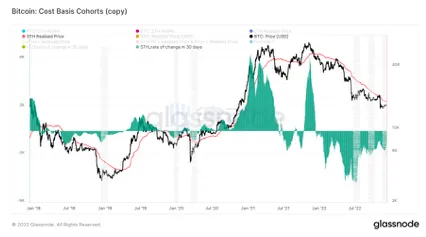
The situation of cost reduction for short-term traders is constantly shrinking.
From the current state, they may gradually shrink to reduce costs, but there are currently no signs of "chasing highs".
This may indicate a slight prelude to liquidity repair, but currently they are still in a "reduced" state and need to be observed.
Fund Sentiment Rating: Slightly Slowing Down
(Stablecoin circulation volume in the following figure)
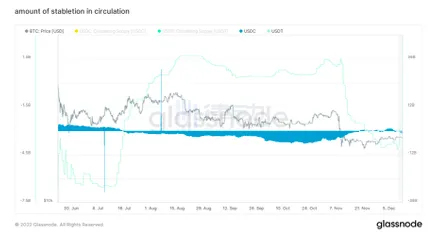
The circulation of USDC has slightly decreased, while USDT has shown a stagnant state after an increase.
The funding sentiment has slightly slowed down.
(As shown in the figure below, the holding ratio has been implemented.)
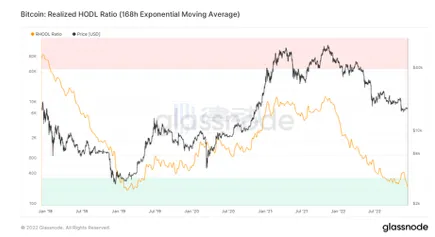
From the perspective of the realized holding ratio, it is currently in a declining state, and the current issue may be that short-term traders have not widely participated.
Perhaps the market lacks the sentiment of speculation and hype.
(Net Position of Whale Exchange as shown in the figure below)

There are still slight signs of capital inflow to the exchange in the whale community, which may indicate that there is still pressure testing and wallet organization going on.
Overall, the current intensity is relatively light.
Short-term Observation
•Derivative risk coefficient• Option intention transaction ratio• Derivatives trading volume•Option implied volatility•Profit and loss transfer amount• New addresses and active addresses
• Net position of Bingtang Orange Exchange
• Net position of Auntie Exchange• High weight selling pressure•Global purchasing power status•Stablecoin exchange net position• Off-chain exchange data
Derivative Rating: Slightly risky, with low interest.
(Derivative Risk Coefficient)
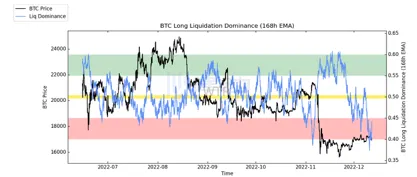
Derivative risks are slightly on the edge of danger, compared to previous higher risks, and have started to decline as market prices fall.
(See Figure: Option Intention Transaction Ratio)
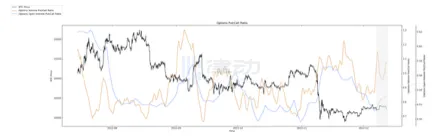
There is preliminary put option protection (meaning a small number of experienced participants believe the market will fall and buy put options to protect their prices), but the overall trading volume is not large.
(Derivative trading volume in the following figure)


The trading volume of derivatives is relatively low and has been consistently low.
The enthusiasm of the participants is very low, and it has fallen to a two-month low.
(See Figure: Implied Volatility of Options)

The implied volatility of the options market has not changed much, and the options market as a whole is also in a mild wait-and-see state, with little game-playing between buyers and sellers.
Emotional State Rating: Emotionally Calm and Recovering
(Profit and Loss Transfer Amount)

The selling pressure that trampled on emotions and profits is slowly decreasing, and the overall market sentiment has entered a calm and recovery phase.
Often without the impact and guidance of certain emotions, the market generally does not experience too much price distortion and irrational pricing.
(New Address and Active Address)

The overall atmosphere of the address has become relatively calm, and the market atmosphere is beginning to ease.
The growth atmosphere remained consistent with the previous two weeks, with no significant increase or decrease.
Spot and selling pressure structure rating: selling pressure is falling and gradually shrinking.
(Net Position of Bingtangcheng Exchange)

The accumulation attitude has a slight increase, and with the passage of time, market observers may gradually try to take a small amount of chips to seize market positions.
(Net Position of E-Tong Exchange)

There was no accumulation, consistent with last week, and there are more observers than holders of the cryptocurrency.
In the short term, the trend of accumulation is gradually dissipating.
(High Weight Throw Pressure)

The high weight pressure continues to decline, which is a slightly positive phenomenon.
This means that the selling pressure in the market is starting to decrease, giving a chance for more breathing room.
Of course, this needs to be combined with macro interest rate expectations.
Purchasing Power Rating: The degree of decline is reduced compared to the previous few weeks, and the purchasing power of stablecoins is still decreasing.
(Global purchasing power status)

The degree of decline has improved compared to the previous few weeks, but it has not changed quickly. Participants around the world are still waiting for the deadlock to be broken and watching.
(Net Position of USDC Exchange as shown below)

Stablecoins have experienced a slight outflow, which may indicate that purchasing power is no longer as strong as before to support them. The market is currently in a relatively complicated state.
(Net Position of USDT Exchange as shown below)

This stablecoin is also weakening.
There is currently no strong buying power or strong selling pressure, and the market is now in a brief stalemate. Perhaps someone needs to break this state.
Off-chain transaction data rating: willing to purchase below 15000.
(Coinbase off-chain data as shown below)

There is strong buying interest at the price levels of $15,000, $14,500, and $14,000.
(Binance off-chain data as shown below)

There is a slight intention to purchase at the price points of $15000, $14500, and $14000.
(Bitfinex off-chain data as shown below)

There is an extremely weak buying intention at the price levels of $16600, $16200, and $15800.
This Week's Summary
Summary of News:
1. Important US CPI index will be announced next week on the 13th; the latest interest rate points will be announced on the 15th.
2. With the cooling of domestic and foreign demand easing the pressure on the supply chain and energy prices falling to their lowest level since February 2022, the increase in PPI in November has slowed down, but still exceeded expectations, which may further prompt the Federal Reserve to continue with high interest rates.
With the change of the environment and the adjustment of policy intensity, the process has entered the middle and later stages, and the impact of future fiscal policies may decrease.
For investors, it is necessary to search for diversified investment portfolios and various strategies to hedge against potential risk exposure and volatility in a faster and more intense manner.
Meanwhile, more participants need to work harder to find better targets.
How to choose turning points? How to adjust combinations and when to adjust them?
Will be one of the important weight points to boost performance.
From a macro perspective,
The anti-globalization trend is still continuing. For enterprises and investors, it is extremely important to make good decisions and layout for the short-term and long-term ecology under this trend.
And the compliance development of the encryption industry in Hong Kong is also important. The policy of rapid opening may force the policy process of the US SEC, and even the road of ETF in spot trading.
Long-term speaking, in the next cycle, the narrative of grassroots entrepreneurship may gradually shift to stories involving participation between countries and institutions.
It is possible that in the next few years, policies regarding encryption compliance will have spread to countries such as the United States, the European Union, Southeast Asia, and some parts of South Africa.This was not available a few years ago, regardless of the current conditions and policy support or the basic ecosystem.The grand and arduous road is far from simple, with many difficulties and inexplicable complexities along the way, as well as moments of brilliance.There are ideas of despair and fireworks of faith ignited.There is a large ideological dispute, as well as a strong conviction that persists.There are dark moments of utmost darkness, as well as dazzling moments that attract the attention of the masses.
Many people will leave, and even leave forever. More people are just passing by and pedestrians, perhaps pushed here by the turbulence of the tide.
Anyway, this is not a simple road, and even more people will become cannon fodder under the bell of the times.
Perhaps the final outcome may not be satisfactory, but it is still worth remembering and cherishing.
On-chain Long-term Insights:
1. The state of increased holdings by various groups has begun to decrease, and the collective state of increased holdings is beginning to diminish.2. High-weight multiple throwing pressure status display, the market throwing pressure is still slightly higher. If it is on the right side, further waiting for repair may be needed.
3. New funds and groups in the longer stage are generally classified as bear market participants, and they continue to increase their holdings, similar to the bottom state at the end of 2019.
•Market positioning:
Long-term, the market still needs time to repair and adjust.
On-chain Mid-term Exploration:
1. The loss supply of long-term holders has reached a historic high;
2. Long-term holders are currently facing a test, with slight signs of selling;
3. The long-term cost is slowly decreasing, which may be due to the sale of high-cost chips or the acquisition of low-cost chips.
4. Short-term cost slowly shrinks with a decreasing trend, but there is no sign of "chasing high";
5. The entry speed of stablecoins has slightly slowed down.
6. Currently lacking speculation and hype sentiment;
7. There is a slight pressure measurement and wallet organization phenomenon in the giant whale industry.
•Market positioning:
Slow down.
Funding entry has slowed down slightly, and the current "chasing high" sentiment is slightly insufficient.
On-chain short-term observation:
1. The trading volume of derivatives is sluggish, and the willingness to trade has also fallen to a low point within the past two months;
2. The risk model of derivatives shows that the market has entered a slightly risky area;
3. The market sentiment is gradually calming down, and sentiment is an amplifier of prices; this means that the probability of short-term irrational pricing is decreasing;
4. The market selling pressure is gradually decreasing, but at the same time, the support of purchasing power is slowly insufficient;
5. The trend of accumulation is weak, and more people are waiting for the deadlock to be broken;
6. Under-chain transaction data shows a willingness to purchase below 15000;
7. The probability of not breaking through 18500-20000 in the short term is 69%.
•Market positioning:
Indecisive; there is not much selling pressure nor buying power support, even derivative traders are also watching and waiting. Someone or time is needed to break the deadlock.
Strategy recommendation: Blind trend strategy has limited space and is not recommended for use.
Risk Warning:
The above are all market discussions and explorations, and do not constitute directional opinions on investment; please be cautious and prevent market black swan risks.
This report is provided by the "WTR" Research Institute.
Golden Egg Diary; Deer Won't Get Lost; Forex Brother; Yu Yuan; Kirin; Kitkat
This article is from a submission and does not represent the views of BlockBeats.
Welcome to join the official BlockBeats community:
Telegram Subscription Group: https://t.me/theblockbeats
Telegram Discussion Group: https://t.me/BlockBeats_App
Official Twitter Account: https://twitter.com/BlockBeatsAsia

 Related Articles