Pantera Capital: Bitcoin halving cycle forecast and outlook for 2024

Original title: "Pantera Capital: Predicting Bitcoin Price at Halving in 2024"
Original translation: GaryMa Wu said blockchain
FTX related updates
We wanted to provide an update on the FTX situation and how it affects us. To summarize, this month, FTX and Alameda Research over-leveraged with FTT Token as collateral. As of this morning, both companies have filed for bankruptcy. The total losses are unknown, but online estimates are as high as several billion dollars. User deposits within the FTX trading platform are also trading at a significant discount. This may mean that those who have funds on FTX have lost most of their funds.
In general, our approach to these situations first focuses on protecting as much of the portfolio as possible. Then, once we have taken all possible measures, we can update our limited partners on what we have done and the situation of our funds. But most importantly, our goal is to reduce the risk of permanent capital loss. The market fell sharply on this news, which will be reflected in our results, but when markets rebound, we expect to do so as well. The main thing we want to avoid in this situation is a permanent loss of assets.
Our approach is to generally reduce exposure to centralized counterparties while maintaining some trading flexibility. Our main risk/loss in the FTX incident came from our Blockfolio acquisition proceeds, which were denominated in FTT and FTX shares. We liquidated as much of FTT as possible on Tuesday, November 8. Prior to the collapse, our FTX stock and FTT Token positions totaled less than 3% of our firm's total AUM on Monday evening.
As soon as the news of FTX/Alameda's difficulties broke on Tuesday morning, our team immediately assembled a virtual war room to assess the impact on our early portfolio and take action. Our goals were to 1) identify potential risks that our portfolio teams might face and 2) directly reach out to at-risk teams to provide any help we could.
We have run this test in similar stressful environments in our industry (e.g., 3AC bankruptcy, 2018 crypto winter). In times of crisis, “we have to move fast.” Speed is of the essence for businesses caught in a crisis, and it’s more important than ever to survive and emerge stronger on the other side of it.
We identified and reached out to portfolio teams from our early-stage Token and blockchain ventures that we believe may have potentially significant counterparty or custody exposure to FTX/Alameda. After speaking with or receiving investor updates, the vast majority of portfolio teams reached out reported having little to no counterparty or custody exposure to FTX/Alameda. Our initial impression is that this limited exposure is partially attributable to the proactive risk management and custody/financial management practices that we look for and regularly highlight to our founders, but we expect the coming weeks and months will provide more insight.
In the short term, those who lost funds on the FTX exchange will suffer. More broadly, we expect further price volatility across the crypto ecosystem as concerns about contagion prompt asset holders to adjust their portfolios. Assets associated with FTX (Solana and its underlying projects, Aptos, etc.) are likely to be hit hardest. This incident may also be a setback for adoption, as some retail users who lost funds choose to leave the space, while others who may have joined earlier are scared to stay on the sidelines. We expect that institutions that were previously cautious about the space will deepen their skepticism. This is expected, but unfortunately not yet severe enough to warrant alarm. They may take longer, but we believe they will eventually come, and sooner than many expect.
Regulators may respond, but we are cautiously optimistic that this move will have a positive effect in the medium and long term. As this crisis has highlighted, central intermediaries for financial transactions are opaque and often untrustworthy. Nowhere is the need more evident than for decentralized, trustless protocols that allow users to trade, hold, and transfer their assets without relying on entities such as FTX, Celsius, or Voyager. As centralized intermediaries exist in the cryptocurrency space, they should and may soon be subject to stricter regulation of reserves, audits, and risk controls, especially if these intermediaries interact with retail users. In contrast, decentralized protocols are public, open, more transparent, and do not require users to trust in the same way. We hope that regulators will realize this and shift their focus from regulating DeFi to regulating centralized institutions operating in the space.
On a personal level, the FTX collapse reminds us of what we are doing. Our mission as a company and an ecosystem is not to replicate the risks and inefficiencies of the traditional financial sector. It is to build a more efficient, decentralized, and open financial ecosystem. This vision makes us more motivated than ever and makes us more grateful for the support of limited partners who share the same vision. This process may not always be easy or smooth, but it is necessary. We want to thank each and every one of you for participating with us.
Bitcoin Halving
The Bitcoin protocol’s money supply function is the opposite of quantitative easing. The Bitcoin code states that a total of 21 million Bitcoins will be issued, and the supply of new coins will decrease over time.
Today, 6.25 Bitcoins are issued every ten minutes, independent of human will.
Every four years, the “block reward” is cut in half, hence the name “halving.” This process continues until 2140.
Bitcoin’s supply and distribution rule set is purely mathematically based and is predictable and transparent by design.
Halving is Coming
The next halving is expected to occur on April 20, 2024. The mining reward will drop from 6.25 BTC/block to 3.125 BTC/block.
The efficient market theory states that if we all know it will happen, then it must be priced in. To paraphrase Warren Buffett on Dogma: "Markets are almost always efficient, but the gap between almost and always is $80 billion to me." So even if we think everyone knows something, that doesn't mean there isn't a ton of money to be made.
If the demand for new Bitcoins remains constant, and the supply of new Bitcoins is cut in half, this will force the price to rise. Prior to the Bitcoin halving event, demand for Bitcoin also increased due to expectations of higher prices.
For years, we have stressed that the halving is a big event, but it takes years to play out. The typical bottom occurs 1.3 years before the halving, and on average, the market peaks 1.3 years after the halving. It took 2.6 years for the full impact to be seen.
Bitcoin has historically bottomed 477 days before the halving, then climbed all the way up, and then started to rise again. The post-halving rally lasts an average of 480 days from the halving to the peak of the next bull cycle.
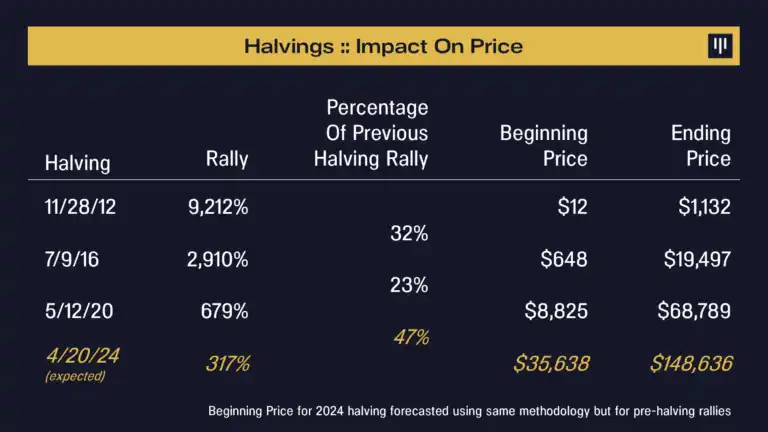
If history repeats itself, the price of Bitcoin will bottom on December 30, 2022. We would then see a rally that continues until early 2024, followed by a strong rally after the actual halving. The chart below shows what might happen if Bitcoin repeats its performance after previous halvings.

Stock-To-Flow Model Price Prediction
The framework we use to analyze the impact of halvings is to look at the change in the stock-to-flow ratio with each halving. The first halving resulted in a 17% reduction in new Bitcoin supply. This had a huge impact on new supply, and a huge impact on price.
As the proportion of new Bitcoin supply decreases from the first two halvings to the next, the impact of each subsequent halving on price will likely taper off. Below is a chart depicting past halvings of supply reductions, as a percentage of Bitcoin that was in balance at the time of the halving.
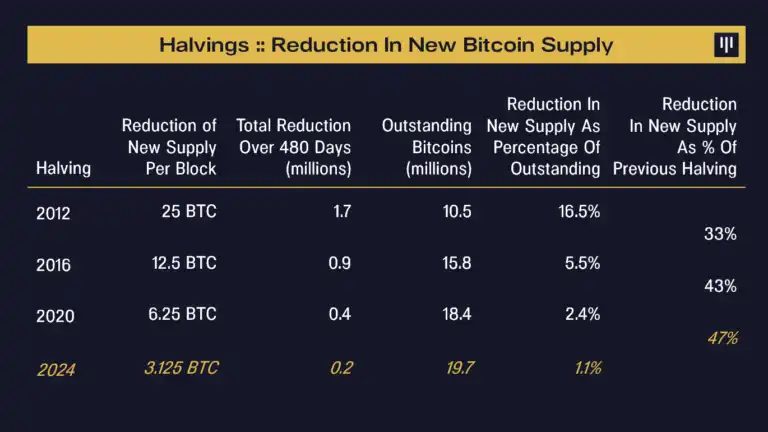
The 2016 halving of new Bitcoin supply was only one-third of the first halving. Interestingly, it had only one-third the impact on price.
The 2020 halving reduced new Bitcoin supply by 43% from the previous halving. Its impact on price was 23%.
The next halving is expected to occur on April 20, 2024. Since most Bitcoins are now in circulation, each halving will reduce the new supply by almost exactly half. If history repeats itself, Bitcoin will rise to $36,000 before the next halving and $149,000 afterward.
Conclusion
When people wonder if the halving is fully reflected in the price, I am reminded of a quote from Kraken co-founder Jesse Powell. On a conference call with investors during the last halving:
Q: Has the market priced in the halving?
Jesse Powell: Bitcoin itself, it's not even priced in yet.
Original link
Welcome to join the official BlockBeats community:
Telegram Subscription Group: https://t.me/theblockbeats
Telegram Discussion Group: https://t.me/BlockBeats_App
Official Twitter Account: https://twitter.com/BlockBeatsAsia
 Related Articles