Why social penalty is the right choice in PoS?
Original title: "The Case for Social Slashing"
Original author: Eric Wall, Encryption Research Institute
Original compilation: Kxp, BlockBeats
"You will punish them to nothing".

Contributed by Denis Pourteaux
Do you enjoy studying the philosophy of Crypto? Do you enjoy wrestling with moral dilemmas and are willing to challenge yourself to discover the right answer when all the options are difficult?
If so, then you are in luck.
In proof of stake, the ethical dilemma of social slashing is the current Crypto philosophy One of the funniest puzzles. In this post, I want to show you that if you care about Ethereum, social penalty is the only right thing to do, and why we can't just drop Proof of Stake because of this conundrum.
Background
On August 8, 2022, the U.S. Department of the Treasury added Tornado Cash addresses on Ethereum to the OFAC SDN list. Days later, Tornado Cash developer Alexey Pertsev was jailed in the Netherlands.
Affected by this, DeFi apps like Aave and Oasis immediately started blocking sanctioned addresses Use its web interface.

Some smart people decided to "pollute" the wallets of industry leaders and influencers with sanctioned funds to ensure that the true impact of actions taken by these disappeared from the community.

One of the biggest supporters of DeFi can't use DeFi because the US authority updated a blog post?
However, this catastrophe must be a lot of fun for the Bitcoin community, because they don't I don't believe that Ethereum's "DeFi" can be both decentralized and censorship-resistant.

Even so, the real killer is not the censorship front end itself. The great thing about DeFi is that anyone, anywhere can host a website and interact with Ethereum's underlying smart contract system.
This is the sad thing about sanctions: in practice, the authoritative approach of the United States is The North Korean hacker group does nothing but make life harder for ordinary people.

TRM Labs is a (un)popular company that has helped many DeFi protocols comply with sanctions.
If censorship just happens on some fronts then the industry will eventually figure out the frictionless way to Allowing those unfortunate enough to be placed on sanctions lists to circumvent these restrictions.
However, things can go very badly when Ethereum internal processes are also subject to scrutiny up.

Today, most miners (>90%) outsource block building to Flashbots, which helps miners aggregate profitable transactions to mine. Flashbots decided to expedite the open sourcing of its relay in response to concerns that Flashbots would gate-keeper non-OFAC-compliant transactions, or even prevent them from entering the blockchain.
After Ethereum starts using Proof of Stake next month, stakers (validators) will have The right to decide whether or not to leave various items in the blockchain. Until PBS arrives, they should be in charge of deciding which block building method to use.

Clearly, Coinbase will comply with the law, but what impact will this have?

Because of this, these comments from Coinbase CEO Brian Armstrong are sobering : Many validators are effectively controlled by regulated entities that must comply with US regulations.
So, what's the problem here?
One of the core functions of blockchains such as Ethereum is to provide neutrality and resistance to censorship. That's why we still use them even though they are sometimes slow and expensive. So, if anything threatens censorship resistance, it also threatens the very foundation of these blockchains.

Currently we can quit the validator group on Ethereum, you can opt out before the Shanghai hard fork enables withdrawals. That way, you neither lose ETH due to slashing, nor are you penalized for inactivity. The problem is that all exits need to go through an exit queue, which is finite, so even if Coinbase wanted to, it could take 1-2 months to unstake all their ETH.
Nowadays, the decision of individual miners not to include certain transactions in the blockchain is no longer Nothing new. In fact, the Bitcoin mining pool Marathon has been used in the past to mine " OFAC Compliant Block". And, the Ethermine mining pool has responded to the recent OFAC addition and is now reviewing Tornado Cash transactions on Ethereum.

While this situation is somewhat concerning, we do not consider it an "attack" on the system unless miners or validators commit to Valid but non-OFAC compliant blocks are removed from the blockchain. Currently, Marathon doesn't have nearly enough hashrate for such a censorship attack, so we don't have to worry too much about censorship yet.
Bad Situation
At present, many projects are making the situation of Ethereum worse, so people can't wait to find a solution:
1. Unlike previous sanctions that only targeted individuals, the US authority included smart contract addresses on the OFAC sanctions list for the first time. Coupled with the news of the previous Tornado Cash developer Alexey Pertsev's arrest in the Netherlands, one can't help feeling that authorities are stepping up their intervention.
2. Many teams developing DeFi applications (along with Ethermine mining pools) quickly responded to these sanctions , according to some, they even have a tendency to "overreact".
3. With the merger completed, Ethereum will replace all validators with validators in a month miners, but the composition of these validators and their stance on OFAC compliance are not well known.
4. The proof-of-stake mechanism has an inherent flaw, that is, Coinbase, Kraken and Binance, etc. Regulatory escrow entities play too many important roles in this mechanism.
5. Ethereum will focus on ensuring the security of proof of rights and interests in design, so we will soon It is difficult to unstake a large amount of ETH in a short period of time. For a large staker like Coinbase, it will take at least 1 to 2 months to withdraw from a group of validators (this is not the same issue as the completion of the Shanghai hard fork, and many people mistakenly regard it as the first problem).
6. Some people worry that in the proof of stake, "put the signature proposed by other participants into the Non-OFAC compliant blocks" than "hash the chain tip" in Proof of Work. Logical or not, regulated entities may be more reluctant to sign non-OFAC-compliant blocks during proof-of-stake proof-of-stake than miners who are required to mine on the latest chain tip in proof-of-work.
It must be emphasized that point 6 is just speculation. Regulators have so far given no signal that OFAC compliance should involve changing the behavior of validators such that the order of blocks in the blockchain can be manipulated.
However, there are still uncertainties and concerns about overextension Not without reason. If Ethereum got into this situation only because it was clamped by OFAC regulations during the merger process, and the network experienced 1-2 months of actual regulation in a state of chaos, then this must be a big blot on the history of the Ethereum network, It’s also a bad start to overdoing the proof-of-stake.
Furthermore, if the censorship stops simply because Coinbase "chooses" out of their staking to respect Ethereum community values, it seems that Ethereum's censorship resistance is not credible, because it still obeys the orders of regulated corporate entities, which cannot be called censorship resistance.
Our secret weapon - Proof of Stake
< /p>
When Andreas Antonopoulos was asked if a national player controlled 51% of the hash rate and used it to destroy Bitcoin, we What to do? This is one of the best responses to an audience question I've ever heard.
Removing Proof of Work and starting the entire BitcoinASIC industry from scratch for everyone This threat sounds extreme, even far-fetched, but it can also be formulated as a logical plan, which is a powerful deterrent to anyone who tries to attack Bitcoin. This is a mutually assured destruction mechanism that forms a Nash equilibrium between attackers and defenders.
In my personal opinion, this is the key to the security and censorship resistance of the blockchain prerequisites.
Vitalik released a video on Proof of Stake, the main content of which is:
p>
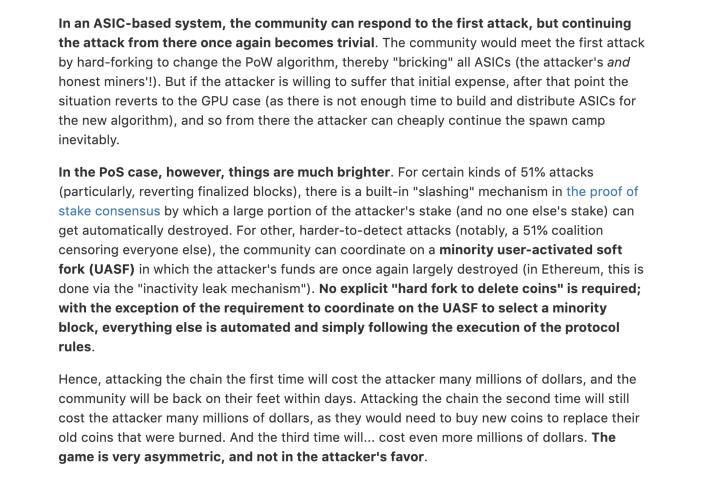
As long as I am right If Ethereum is interested, then even compared to PoW, this asymmetric advantage of the defender has been one of the key motivations that I think Proof of Stake deserves to be explored in depth. Also, if the second largest Crypto is willing to use Proof of Stake, that must be a good thing too.
Vitalik's description of the advantages of PoS is certainly correct in my opinion, but he ignores Two important things. Proof of rights and interests also needs to be discussed in the context of the entire Ethereum, and cannot be separated separately:
2. Principal agent problem: When the "attacker" in this case is like Coinbase When such an entity is established, the burned money is not Coinbase's own, but the billions of dollars pledged by institutional customers and retail investors through Coinbase's escrow pledge service. Therefore, Ethereum's UASF fork is still "unfair".
Solving Crypto’s Moral Dilemma
What follows is a discussion of the above moral dilemma and a counterargument.
Ethereum's UASF fork is "not fair"
If this action is taken, then EthereumUASF will likely end up hurting a group of customers who staked on Coinbase. In my opinion, there's really nothing unfair or unusual about this, or even any difference from PoW:
< /p>
1. After the merger, Ethereum's supply inflation rate is expected to be 0% or even lower. Unstaked ETH will be less diluted than Bitcoin, and you won't feel "stressed" about staking. Those who participate in staking through staking services are not innocent, and they hand over valuable resources to potential attackers for profit. All stakers, including individual stakers as well as joint stakers, are responsible for understanding the risks involved in staking.
2. Most people know that if Coinbase uses their pledge for secondary consumption, Then according to the agreement, it will definitely be punished. What is certain is that whether Coinbase did it through negligence or on purpose, it and its customers will be punished. Even if the attack they were involved in was censorship, the situation shouldn't be any different. Any subject involved in deliberate censorship should be punished, and this process should be completed automatically, but now due to practical and technical reasons, it still needs the assistance of off-chain coordination. In my view, scrutinizing such behavior is not enough to change the moral bar.
3. There is also a principal-agent problem in proof of work. Since mining pools are notoriously easy to reconfigure, we can ignore them for now, Blockstream's hosted mining creates a similar situation for miners. It's also a more "convenient" form of mining and costs less, but it will also lead to the principal-agent problem with dire consequences if Blockstream is forced to do anything unpleasant on behalf of authority or other attackers . Blockstream isn’t the only one offering these services either, they are sprawling. The whole process is opaque, and you may not even know it's happening.
4. If the system uses proof of work and miners participate in this review, then the defense mechanism Proof of work will be waived. This behavior is not a good thing for everyone, and people's hashing devices will become useless overnight. If this was Bitcoin, it would be billions of dollars lost to innocent people. Coinbas stakers played at least one role in the conspiracy by greedily funding a participant unlikely to maintain the network.
If these arguments are not enough to make you think about this issue from another angle, then you can consider the following of this point of view. Proof-of-work and proof-of-stake are different mechanisms for resisting authority control, and the interesting thing about proof-of-stake is that it at least gives the authority a reason to solve this problem—they can’t play the “environment” card against it. This, combined with the asymmetrical advantage we just explained, makes "proof of stake" and "proof of work" have different "defensive properties". Instead of betting on just one, we will use both mechanisms to fight authority.
Ethereum's UASF fork "not working"
There is no doubt that due to UASF's dependence on DeFi (oracle machine, multi-signature side chain, L2 sequencer, Stablecoin), UASF is in the It is harder to implement in Ethereum, although this has nothing to do with PoS, it still needs to be solved.
However, I don't think UASF will fail because of these dependencies. While many validators are now reviewing the base layer, this does not mean that every oracle or stablecoin issuer needs to drop everything and accept the OFAC chain. Yes, maybe USDC will support OFAC, but will USDT too? I have yet to see US authorities actually coercing Tether into anything.
In either case above, there will need to be a coordinated delay before the OFAC chain starts . During this time, you have time to unwind any DeFi positions involving USDC and any other stablecoins that have been marked as supporting the OFAC chain, and redeem all USDC. You can also withdraw from oracle systems that do not support your blockchain after a fork.
While this is bound to cause confusion, especially for those who for whatever reason don't have time to People who adjust their positions, but the final development of the situation will definitely not be as dramatic as you imagined.
Ultimately, such chain splits will be resolved by the market. I'm not saying Bitcoin's UASF is comparable, but previously when Bitcoin's Segwit2x fork rebel Bitcoin UASF fork was priced on Bitfinex's futures market, the latter retained 85% of its value while the former only gained 15%. In my opinion, this ultimately led to the failure of Segwit2x, and it happened in the futures market even before the moment of the fork.

87% chose to support Ethereum UASF over OFAC fork

Who will help develop the OFAC fork? This person will not be Vitalik
The final argument
My final point is that it is more likely that the OFAC chain will not actually work.
First, consider that all validators on the OFAC chain are vulnerable to DDoS attack. If you submit a long, complex transaction and make an unexpected call to a sanctioned address at the end of the transaction, the transaction will need to be rejected and validators will not be able to charge any gas fees for it. This allows any user to abuse the validator's computing resources.
To solve this problem, validators can provide protection by setting filters and increase the attack costs for spammers, but the cleanest solution might just be to change the code so that they charge for all invalid and sanctioned transactions.
Such changes not only require the participation of hard forks, but also require a lot of work. But it would be nice for OFAC validators to coordinate their review fork as a hard fork, as protections would need to be rebuilt between this chain and the neutral chain. OFAC validators may want to focus their efforts on censorship attacks, otherwise if individual validators start actively censoring, other validators may be penalized for inactivity.
Again, who will help maintain this OFAC client? I strongly encourage you to listen to last week's All Core developers conference call where Geth developer Marius Van Der Wijden made the following observations:
< /p>
If we allow censorship of user transactions on the network, we are basically failing.
If we start allowing users to be censored on Ethereum then the whole thing will lose its meaning and I will leave the ecosystem for something that can Something else that provides that assurance - I think a lot of people feel the same way as I do.
I think censorship resistance is the highest goal of Ethereum and the entire blockchain space, so if we compromise on this point, there is nothing to be done in my opinion do things now.

I doubt they could even get a client to land successfully. Maybe a particularly good Geth developer will stay on the OFAC team and leave some "accidental" bugs in it?
Also, who wants to go to an OFAC meeting? Do you want to?

It doesn't take us too much to think that the OFAC chain is basically a dead end. Otherwise, how do you think the OFAC chain should work? Should all validators agree to review a list of addresses? Can this list include all sanctions lists of all countries? If everyone wants to sanction the other, how will you reach a consensus?
 < /p>
If you want, you can do a US OFAC chain and a Chinese CCP chain. But all these fragmented chains will have to compete with Ethereum, which tends to have great meetings and strong developers.
By the way, if you are building a US-OFAC chain, why bother deploying it What about decentralization? You could run a stake-free US proof-of-authority network. When you want to control transactions coming in and out, and trying to decentralize network validators, it just leads to more problems. But having said that, compared with the general ETH, how much value is the currency in this system, I don't think the result will be so ideal.
Conclusion
< /p>
We may only have one chance to get Ethereum on track, and that chance is not the OFAC chain. If you support the UASF fork (which is the only viable option), then you will potentially help prevent actors like Coinbase from staking if they feel they have to participate in base layer censorship.
We don't have to risk losing all the assets of our customers for UASF fork. If you are a large staker, it is wiser to exit as quickly as possible (1-2 months).

Brian's response comes a day after the vote to cut the Coinbase fund closed, in which a majority voted in favor, including Vitalik, Bankless hosts Ryan & David, Anthony Sassano , Larry Cermak and Polychain Olaf among others voted in favor.

We can get rid of these entities that threaten the neutrality of our platform, and we have every opportunity to build a better future for Ethereum. This includes preparing the code for a UASF-ready consensus client and being fully prepared as a community. You can discuss this issue with peers who also support Ethereum, so as to determine your position.
You may wish to think about it, do you support neutrality or OFAC? Support Alexey Pertsev or those who sent him to prison?
Original link
Welcome to join the official BlockBeats community:
Telegram Subscription Group: https://t.me/theblockbeats
Telegram Discussion Group: https://t.me/BlockBeats_App
Official Twitter Account: https://twitter.com/BlockBeatsAsia

 Related Articles