Messari: Explore which crypto trends may spark the next bull run

Original title: " Messari: Three Crypto Trends and Challenges for the Next Bull Run "
Original source: Messari
Original compilation: PANews
The next bull market will be driven by technologies and trends that are still building in the current bear market, but not all technologies or trends are equally valuable. So, let’s explore which crypto trends could inspire the next bull run in this article.
In fact, we can use a framework to evaluate encryption trends. The main factors considered by the framework include:
1. Innovation
2, 10x value potential
3. Total Addressable Market (TAM)
4. Value Capture
5. Competitiveness
With this framework in mind, we might be able to evaluate the following three trends to see if they actually have the power to catalyze the acceleration of the next bull market.
1. Application Agreement
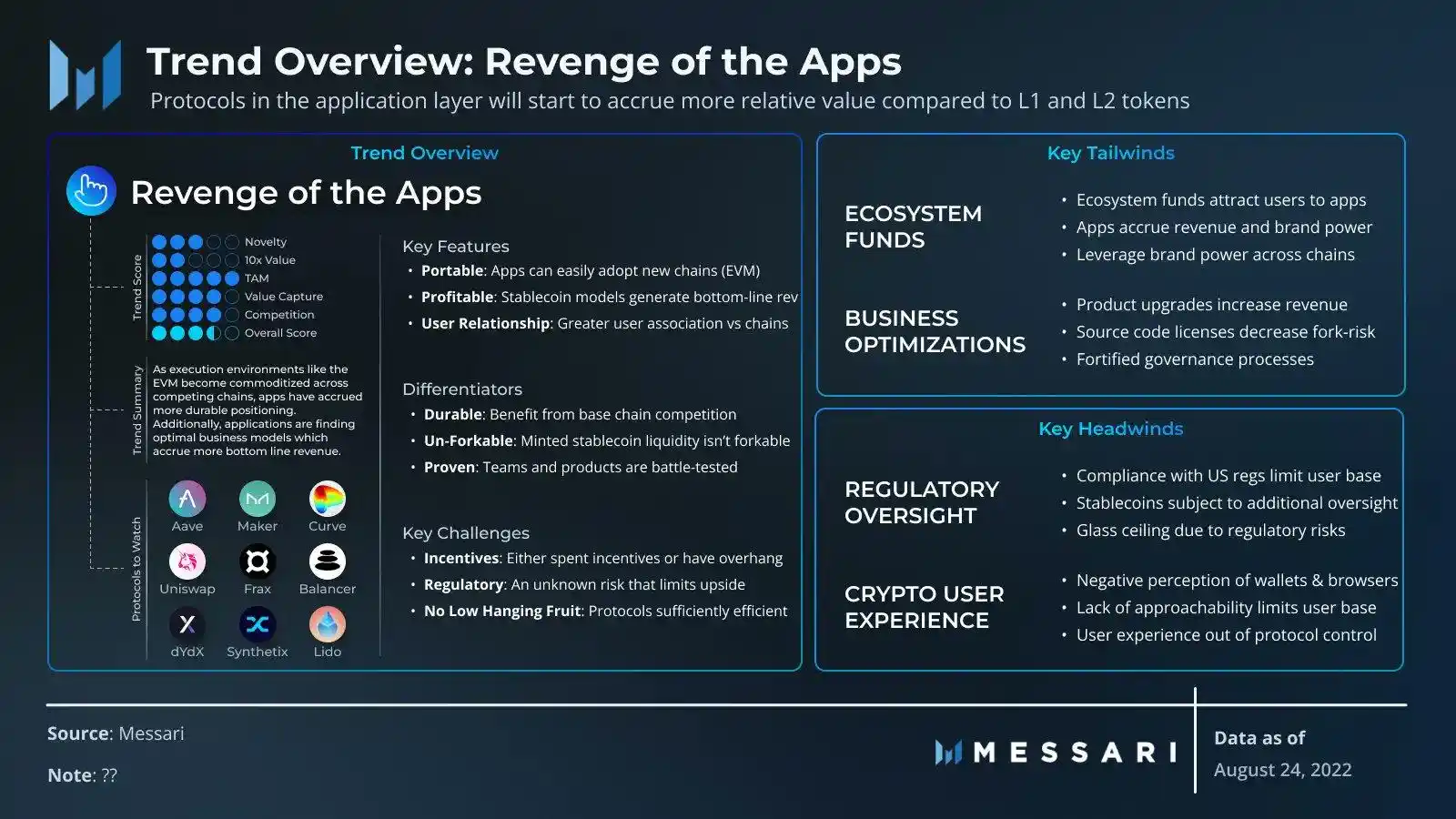
In the past, the encryption industry seemed to place more emphasis on network protocols than application protocols. But now, the dynamics of market competition have undergone subtle changes. The new ecosystem will go to great lengths to achieve EVM compatibility so that application protocols can be easily deployed.
As blockchain competition becomes more and more fierce, execution environments such as EVM begin to explore commercialization and profit models. In this case, encryption applications have gained a more stable industry positioning. Not only that, the encryption application itself is looking for a more optimized business model, aiming to accumulate more "bottom line revenue".
Application Protocol Development Trends
1. Core Features
Portability: APP can now easily adapt to the new (EVM) blockchain;
Profitability: Using the stablecoin model, the application protocol can generate "bottom line income";
User relationships: Application protocols can generate better user relationships than traditional network protocols.
2. Key differences
Sustainability: the application protocol will benefit from the competition of the basic chain;
Unforkable: The minted stable currency liquidity will not face the risk of fork;
Verifiability: The product and team are battle-tested.
3. Main challenges
Incentives: need to provide ETH incentives, or provide excess incentives;
Regulation: need to face the risk of regulatory uncertainty;
Favorable factors
1. Ecological Fund
The ecological fund will attract more users to the APP;
APP will accrue revenue and brand power;
Leverage brand power to expand more blockchains.
2. Business optimization
Product upgrades will increase revenue;
The source code license will reduce the risk of forking;
Enhancing Governance Process
Disadvantages
1. Supervision
Compliance requirements from US regulators will limit user base growth;
Expect additional regulation of stablecoins;
2. Encrypted User Experience
Users have negative perceptions of crypto wallets and browsers;
Lack of accessibility limits user base development;
User experience is beyond protocol control.
Second, decentralized social interaction
Decentralized social networking provides people with chain reputation, organization (DAO) and content ownership, among which content ownership is the key, because it provides a way for people to finally obtain the value they create, which means that the Internet will re- Build value streams.
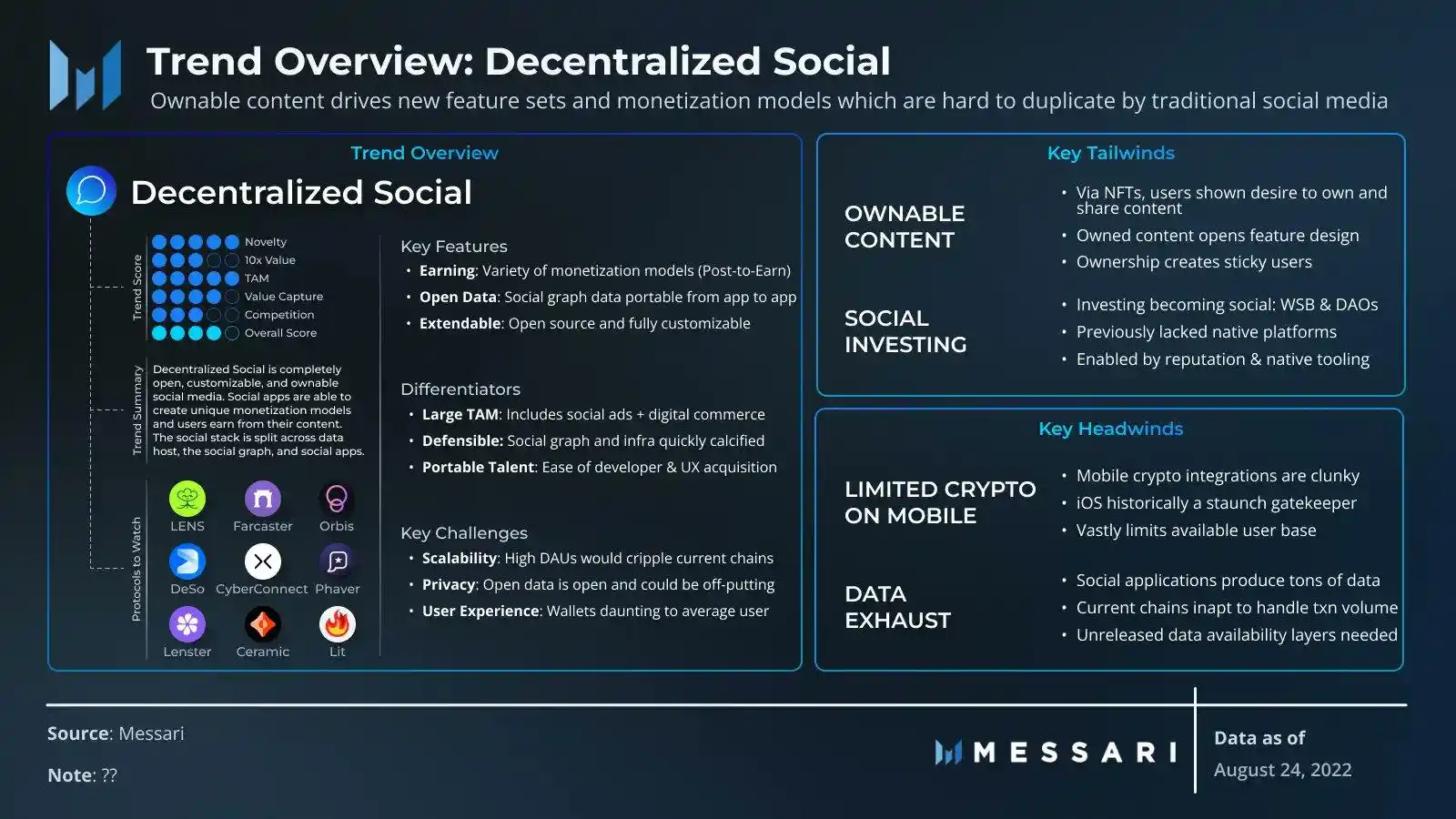
Decentralized social networking is a completely open, personalized and "possessible" social media. Social APPs can create independent profit models, and users can also earn income through the content they create. Products include data hosts, social graphs and social applications.
Decentralized Social Development Trend
1. Core functions
Income: There are various profit models, such as P2E;
Open data: social graph data can be migrated between applications;
Scalability: Decentralized social is open source and fully customizable.
2. Key differences
Large addressable market: includes social network advertising and digital commerce;
Defensibility: social graphs and infrastructure can be completed quickly and effectively consolidated;
"Portable Capabilities": Developers and users experience more convenient access.
3. Main challenges
Scalability: The scale of daily active users of decentralized social applications is generally high, which will put a certain pressure on the blockchain;
Privacy: The data of decentralized social applications is open, and due to the lack of privacy, some users may feel unhappy;
User experience: In terms of wallet experience, ordinary users may be slightly poor.
Favorable factors
1. The user "owns" the content
Through NFT, users hope to own and share content;
User-owned content will enable more functional design;
When users have mastered the content ownership, user stickiness will be further improved.
2. Social Investment
Investment activities will become more social, such as WSB and DAO;
Lack of a native social investment platform in the past, it may have great potential for development in the future;
Investing parties need to establish credibility in the community, and there will be a number of native tools that provide investment credibility.
Disadvantages
1. Mobile encryption will be restricted
Encryption integration on the mobile side is not efficient;
iOS has always been a "firm gatekeeper";
Greatly limits the available user base.
2. Data problem
Social application products usually generate massive data;
The current blockchain is difficult to handle massive transaction data;
Availability layer required to support unpublished data.
3. Web3 games
The goal of Web3 games is to allow players to own the ownership of their digital items in the game, and use Token to create an in-game economy, and then promote players participating in the game to gain a sense of accomplishment in the game and become attached to this feeling, and are more willing to Invest money in the game.
Driven by the "play while earning" game model like Axie Infinity, Web3 games are becoming more and more popular, and more and more Web3 games have begun to integrate Token into their own mechanisms. While there hasn’t been a sustainable Web3 game so far, the space has attracted significant investment aimed at developing the next “big game.”
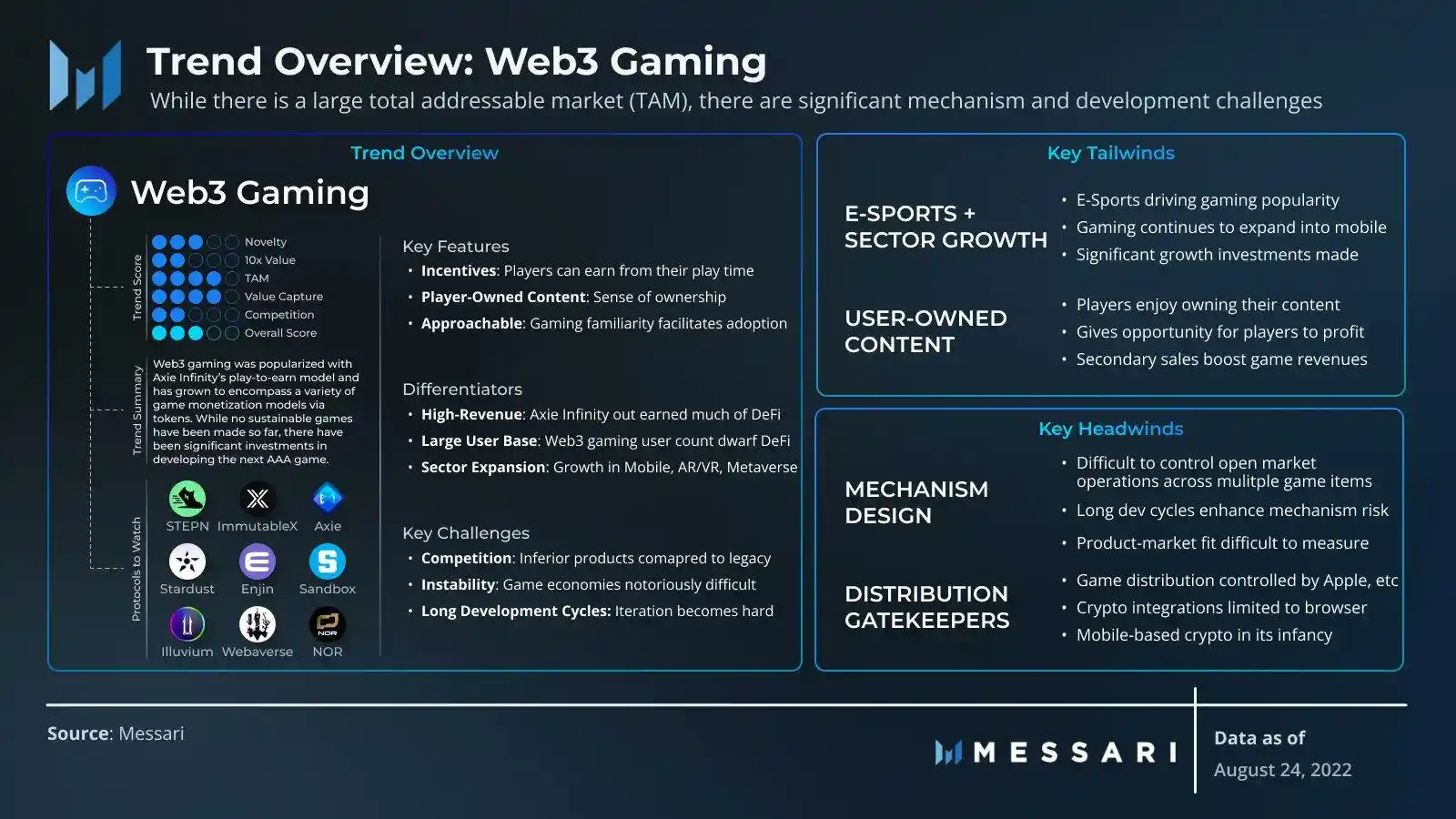
Web3 game development trend
1. Core functions
Incentives: Players can earn income by investing time in the game;
Player Owned Content: Players own "game content ownership";
Games are easy to pick up: Quicker pick-up helps further drive adoption of Web3 games.
2. Key differences
High income: Participating in earning games like Axie Infinity may earn more income than participating in DeFi;
Defensibility: the liquidity of minted stablecoins will not face the risk of bifurcation;
"Portable Capabilities": Developers and users experience more convenient access.
3. Main challenges
Competition: Compared with traditional games, Web3 games are still at a disadvantage;
Instability: the economic stability of the game needs to be improved;
Longer development cycle: Web3 games are more difficult to iterate.
Favorable factors
1. E-sports + market growth
Esports-driven games are more popular;
The game market will continue to expand to the mobile terminal;
The game industry is easy to attract investment, which in turn drives the market to grow significantly.
2. The user "owns" the content
Gamers prefer to "own" content themselves;
Game players have a better chance of profiting;
Increased secondary sales can boost game revenue.
Disadvantages
1. Web3 Game Mechanism Design
For multiple game projects running on the open market, it is more difficult to control;
Excessively long development cycle will increase the risk of game mechanics;
Product/market fit is difficult to assess.
2. Game distribution
Major game distribution is still controlled by big companies like Apple;
The encryption integration of the game is still limited;
The mobile-based crypto game market is still in its infancy.
Original link a>
Welcome to join the official BlockBeats community:
Telegram Subscription Group: https://t.me/theblockbeats
Telegram Discussion Group: https://t.me/BlockBeats_App
Official Twitter Account: https://twitter.com/BlockBeatsAsia