Bankless: Learn about 5 popular NFT distribution methods and their pros and cons
Original title: "Bankless: Understanding 5 Popular NFT Distribution Methods and Their Pros and Cons"
Original Author: William M. Peaster, Bankless
Original Compilation: DeFi Do
Earlier this summer I wrote a primer on the NFT smart contract approach article.
Finding out a basic smart contract approach is half the battle when launching an NFT project. The other half comes from deciding which NFT Drop (delivery, generally refers to the primary market snap-up) method to use.
Of course, NFT contracts and Drop methods can be configured in various combinations, and it is completely It is possible to mix different drop methods in various ways.
In the current NFT ecosystem, there are some basic drop methods that you need to pay attention to.
Popular NFT delivery methods
01 First-come-first-served (FCFS) casting method
An NFT delivery method, Minting is open to the public or selected NFT community members on a "first come, first served" basis.
Variations:
Permissionless - anyone can cast on the basis of FCFS, example: Bored Ape Yacht Club.
Token-gated (Token-gated) - anyone holding a specified Token Anyone can mint coins on the basis of FCFS, example: Blitnauts , can only be minted by Blitmap holders.
Sweepstakes based - need to use a lottery system to assign a limited number of approved lists for FCFS minting, example: Boki final sale)
Price-tiered——In a series, different supply tiers have different casting prices, for example, NFT ID 0-999 is 0.1 ETH, 1000-1999 is 0.2 ETH, etc. Example: Hashmasks.
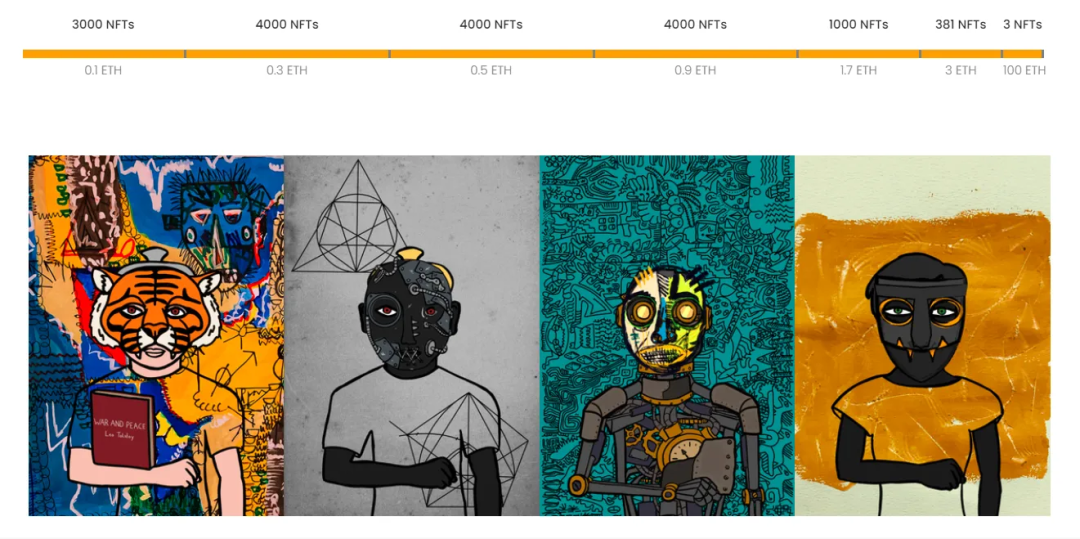
Hashmasks casting layer, the image comes from thehashmasks.com
Advantages:
Easy to implement for builders
Easy to use for minters
Disadvantages:
Low-price, high-demand FCFS minting can lead to "gas wars" that congest entire chains (e.g. Ethereum).
Prone to transaction failure at the end of a minting event
Easy to be overwhelmed by bot minters
Regardless of timezone as FCFS minting is usually fast< /p>
02 Dutch Auctions (DAs)
A method of NFT distribution in which a series of NFTs start at an initial minting price (e.g. 10 ETH) and that price decreases periodically by a specific amount (e.g. every 30 ETH 0.25 ETH per minute), until a specified price floor or demand equilibrium is reached and all NFTs are sold out.
Example:
< /p>
Art Blocks - To ease the gas wars and focus on supporting artists instead of minters, since 2021 Starting this summer, the generative art app Art Blocks began enabling artists to offer their collections through Dutch auctions.
Azuki - Anime-themed PFP collection was minted via Dutch auction in January 2022, but the collection was minted in minutes, Its initial minting price of 1 ETH never dropped.
Forgotten Runes Warrior's Guild - Phase 1 release of Forgotten Runes Wizard's Club expansion series begins with Dutch auction; initial minting price set at 2.5 ETH, but Down to a final assigned 0.6 ETH during the minting process.
Advantages:
< p>Bringing Transparency to the NFT Bidding and Price Discovery Process
Cons:
Often favor the wealthiest collectors who are able to mint at or close to the original auction price.
03 Free Claim/Free Casting
A method of NFT distribution in which NFTs of collections can be minted for free, except for the gas costs associated with claim transactions. More recently, projects opting for this style often rely on higher-than-average secondary sales royalties for revenue.
Example:
< /p>
CryptoPunks - It may seem hard to believe now, but when the most Token When the revolutionary NFT series launched in 2017, all "Punks NFTs" were free to claim!
The image is from Larva Labs< p>Loot - Dom Hofman August 2021 Free launched Loot, an on-chain collection of adventure gear. All NFTs in the collection were claimed from the smart contract within hours.
goblintown - the wild goblin-themed NFT series that swept the NFT field earlier this year, featuring "1 free + gas mint per wallet" Published with the delivery style of .
Advantages:
< p>The low cost makes these NFTs accessible to many users.
Incentives for continued project delivery as continued progress will support better royalty income over time
Cons:
The rise of the low-fee/zero-fee NFT market could erode the future revenue prospects of free minting projects
Easy to be overwhelmed by robo-minters
< /p>04 Nounish Auction
An NFT delivery method pioneered by Nouns DAO, which needs to generate and auction a new NFT every day indefinitely. Recently, however, we’ve seen a wave of projects adopting Nounish issuance while adjusting their NFT cadence, releasing multiple NFTs per day, etc.
Image from nouns.wtf
Variants: ;
Nouns DAO - "A noun, every day, forever " is the slogan of Nouns' main project. The underlying protocol generates an avatar from the feature library, auctions the avatar, and settles the auction once a day.
Lil Nouns DAO - Auction of a Lil Noun NFT every 15 minutes forever.
WizardsDAO - Auction of 3 Wizard NFTs per day until the total supply of the collection reaches 2000 NFTs.
Advantages:
< p>This release/distribution method is a new original method on the chain, and the project can be used to gradually build an NFT Community.
The tempo and parameters can be customized in different ways.
Disadvantages:
< p>This delivery method is ultimately experimental
High demand may cause the auction to The price aspect becomes unacceptable to many
The Nouns protocol is elegantly designed and quite complex, requiring professional Solidity developers to fork and build it.
05 Open editions
< /p>A method of NFT distribution in which there is no hard supply cap for NFTs released by creators or projects.
Variation:
Infinite - Infinite OE means that the collection has infinite possible supply and the minting never closes. A recent example is the project "The Room of Infinite Paintings".
Timed - Timed OE is a delivery method that does not have a set supply cap, but only provides open minting for a limited time window. A recent example is Zora’s “State of Mind” project, which ran for three days earlier this month and raised over 123 ETH during that time.
Advantages:
< /p>
Flexible for creators and collectibles as everyone gets one.
Easy to start with modern Web3 creator tools
Honorable mention: Bonding curves and MultiRaffle
In the past year, one method of NFT distribution seems to have disappeared No longer popular, that is the bonding curve (Bonding curves) casting method.
One of the pioneers of this format in the NFT space is the EulerBeats project, which sells along a price curve determined by a specific mathematical formula (and allows resale) its NFT. As stated in the EulerBeats documentation:
"Any collector can set The price formula for purchasing prints. As the number of prints in circulation of a particular original increases, the price of the next print to issue it increases at an exponential rate. [...] The bonding curve acts as a liquid market, allowing print holders to burn their prints Token , thereby reducing the current engraving of the relevant original Token supply, in exchange for the burnt price received at the time. Thus, the burning process returns ETH from the reserve to the engraving Token burner.
Finally, one NFT delivery method that hasn't gotten a lot of attention, but which I think deserves more adoption, is MultiRaffle . It is a reference implementation of a lottery created by Anish Agnihotri and Hasu of Paradigm.
In short, MultiRaffle is the fairest and most efficient Research results on NFT distribution methods. Thus, in MultiRaffle, the duo optimizes for untappable fairness, prevents race conditions, and maximizes minting cost-efficiency from top to bottom.
I believe some MultiRaffle experiments have been implemented, although since Agnihotri and Hasu as early as October 2021 I haven't personally seen any experiments since publishing their related research post. It's a pity.
Original Link
Welcome to join the official BlockBeats community:
Telegram Subscription Group: https://t.me/theblockbeats
Telegram Discussion Group: https://t.me/BlockBeats_App
Official Twitter Account: https://twitter.com/BlockBeatsAsia


 Related Articles