Bloomberg: In Market Meltdown, SBF Faces Test of His Ever-Growing Empire

Original Title: "Sam Bankman-Fried Expands FTX, Alameda Empire By Bailing Out Failing Crypto Firm"
Original Authors: Hannah Miller & Olga Kharif, Bloomberg
Original Translation: Hu Tao, Chain Catcher
Over 14 frenetic days in June, cryptocurrency billionaire Sam Bankman-Fried embarked on an unprecedented deal spree in the industry. Deals came fast and furious: The FTX co-founder and CEO bought two companies, backed crypto platform BlockFi, and attempted to bail out another, Voyager Digital, with a hefty loan.
All in all, Bankman-Fried committed to around $1 billion, a staggering risk even for someone worth $10 billion, as the market shed $2 trillion in value in just eight months amid a crypto crash. To his legion of fans, this further cemented SBF, as they call him, as crypto's patron saint, a benevolent, deep-pocketed investor and philanthropist defending the industry at its neediest moments.
Perhaps another interpretation is that Bankman-Fried's maneuvering and trading revealed the full extent of his master plan to dominate the crypto industry. Like other financial titans before him — the John Pierpont Morgan of a century ago and the modern-day Warren Buffett — he is leveraging competitors' misfortunes to expand his empire at fire-sale prices. If there is an industry-saving element to the bailout schemes he's orchestrating, it's also because a crisis large enough would eventually imperil his core businesses.
"He's not doing this out of the goodness of his heart," said Chris McCann, who has known Bankman-Fried since 2018 and is a general partner at Race Capital, one of the earliest venture capital investors in FTX. "His ambition knows no bounds at this point."
Of course, all of this could backfire. In Wall Street terms, the whole thing feels like he's trying to catch a falling knife, as evidenced by Voyager Digital's bankruptcy filing just days after its rescue loan. If successful, Bankman-Fried would gain direct and indirect control over the industry. For many loyal crypto enthusiasts, this is a disquieting thought, as they believe decentralization sets their market apart from the traditional financial system operated by a few big banks and trading firms, and for the better.
“The entire industry connecting with FTX is risky,” said Elliot Chun, Partner at cryptocurrency M&A and strategic advisory firm Architect Partners. “This is generally not conducive to a free market, especially the kind of free market embraced by cryptocurrency enthusiasts.”
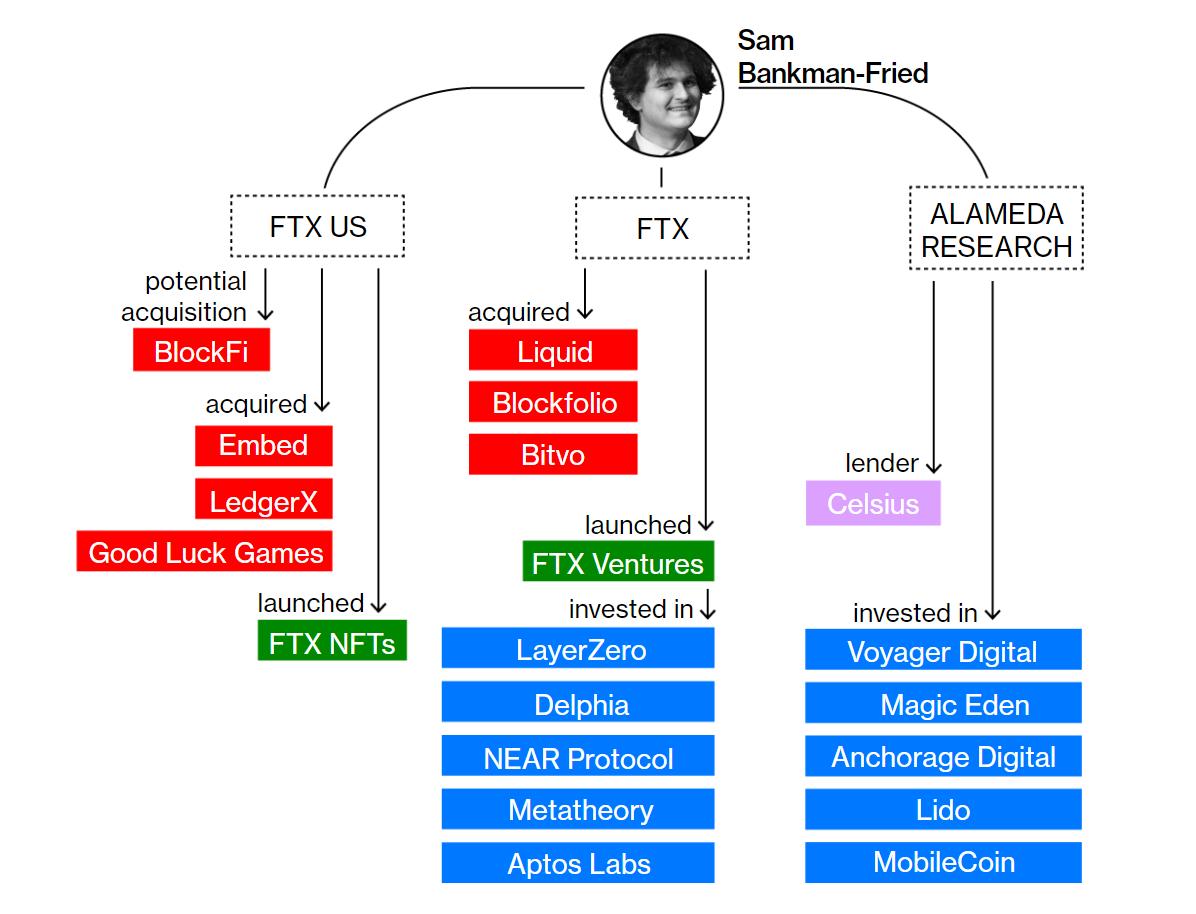
Sam Bankman-Fried's Crypto Empire
Bankman-Fried stated that the industry would face greater risks if no action is taken. “What we least want to see is a crisis spreading. What we least want to see is customer assets not being protected. As for whether we have good investments to make in return, that is to some extent a secondary matter.”
Nevertheless, his public comments and behind-the-scenes tactics suggest that it is almost certain that there will be more and larger trades. Bloomberg reported that FTX is exploring the possibility of acquiring Robinhood Markets Inc., a commission-free stock and cryptocurrency trading app that was valued at nearly $60 billion before a recent sharp drop in value. Bankman-Fried later said there were no active talks. He even floated the idea last year of one day acquiring Goldman Sachs. It's unclear if he was joking.
McCann said he wants to “win everything, and then some.”
Bankman-Fried entered the cryptocurrency space relatively late. A physics graduate from MIT, he didn't fully engage until 2017 when he left the quantitative trading firm Jane Street and launched his own venture, Alameda Research. Being able to focus full-time on cryptocurrency, he quickly made a name for himself as Alameda surged on an online leaderboard that ranked traders by performance.
Two years later, when he decided to launch FTX in Hong Kong, his rapidly growing influence came in handy. His followers were drawn by low fees and attractive products and flocked to the platform, making it quickly one of the largest in cryptocurrency derivatives trading. He is estimated to own over 50% of FTX, over 70% of FTX US (launched in 2020), and almost all of Alameda. FTX, now headquartered in the Bahamas, raised $4 billion at a $32 billion valuation in January and FTX US is valued at around $8 billion.
Cryptocurrency investment strategist Lyn Alden stated that Bankman-Fried has skillfully managed his company's capital, leaning more towards profitability rather than a growth-at-all-costs approach, a method that is now coming back to haunt many of his competitors. "He kept the employee base very tight," she said, "raising funds when they didn't need funds." This allowed him to cheaply absorb elsewhere in the crypto world when others were in distress.
In June, he acquired the Canadian cryptocurrency exchange Bitvo Inc. and the broker service company Embed Financial Technologies Inc. Amid the collapse of the TerraUSD stablecoin and internal meltdowns at Celsius and Three Arrows, intensifying cryptocurrency selloffs, Bankman-Fried took his two biggest steps yet, providing a $485 million loan to the besieged cryptocurrency brokerage Voyager Digital and extending a $400 million revolving credit to rescue digital asset lending player BlockFi, with an option to acquire the company directly.
Voyager sought Chapter 11 protection a few days after announcing its financial lifeline (before it could make full use of the loan). "We didn't have months or even weeks for due diligence. We had two days," Bankman-Fried said, adding that the move was about safeguarding client assets rather than supporting Voyager's business.
In contrast, the BlockFi deal has been hailed as a win for Bankman-Fried, even by his rivals. Industry observers say he likely acquired the company, once valued at $30 billion, at an extremely low price. "This is a good outcome for BlockFi customers, FTX, and the industry as a whole," said Mauricio Di Bartolomeo, co-founder of Ledn, a company that had proposed injecting new funds into the distressed company but was rebuffed, with BlockFi opting to back FTX US's deal instead.
Dan Matuszewski, co-founder of CMS Holdings, an investor in BlockFi and FTX, stated that the rescue of BlockFi was also a strategic decision to help FTX US build its brand and attract more potential clients. The eventual acquisition will also help Bankman-Fried further expand into the crypto lending space. "This may mean that FTX will offer a wider range of retail products," he said.
Bankman-Fried said his team had looked into about 10 transactions—including deals involving Celsius and Terra, both of which he walked away from. He said he had supported a few companies, but his involvement has not been public. He said his team has been reaching out to firms rumored to be in distress, analyzing their balance sheets to figure out what measures might be needed to save them.
He is also considering raising new funds to finance more deals, though he noted the number of bad deals his team is scrutinizing has dropped significantly in recent weeks. "I don't know of any other large companies about to go bust," he said. "I can't guarantee there aren't any. Hopefully, we've gotten through the worst of it."
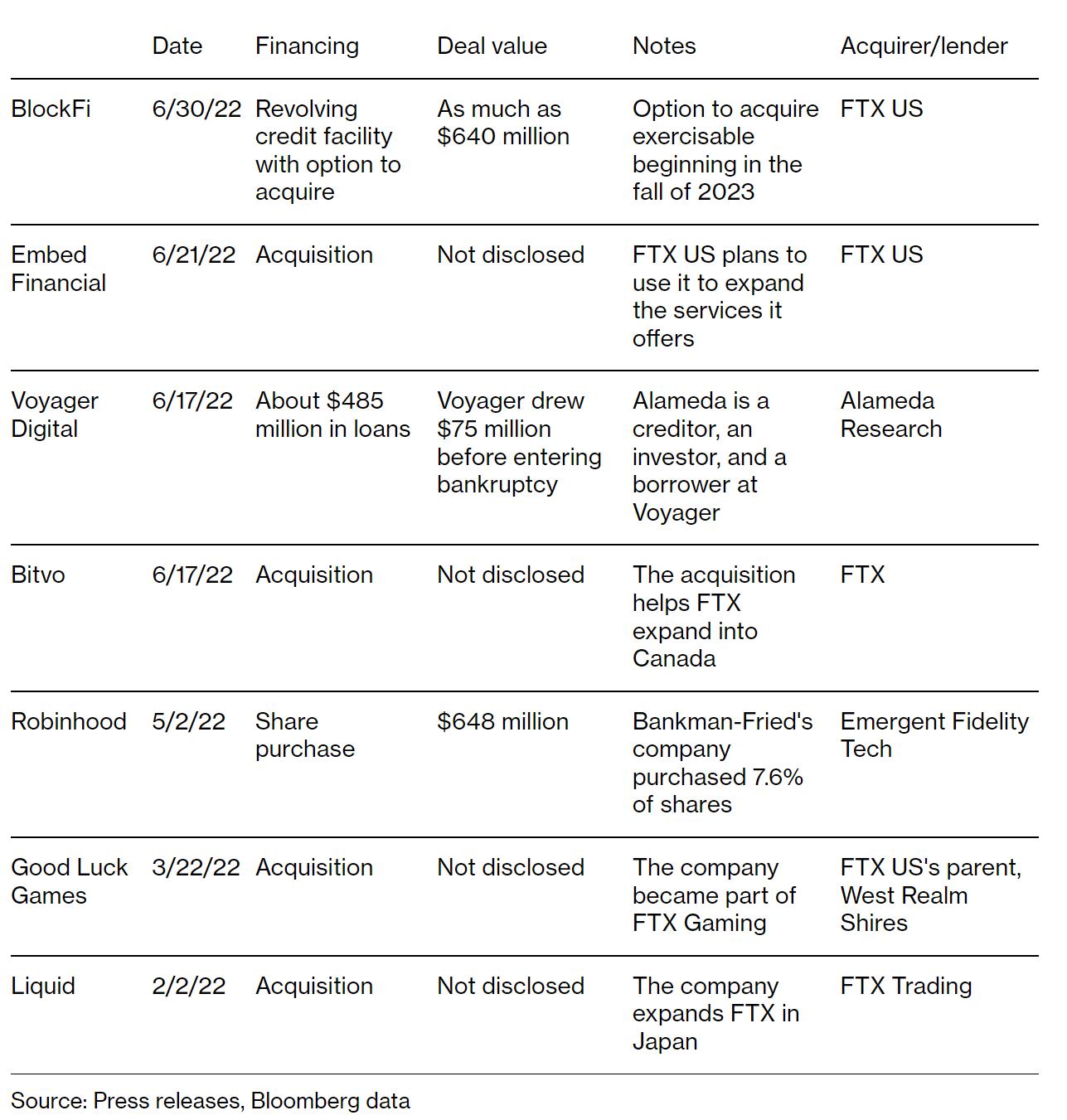
Bankman-Fried's Acquisition Deals This Year
When it comes to how much power Bankman-Fried has amassed, some in the crypto industry have already sounded alarms, particularly considering Alameda Research, which, despite sounding more like a Silicon Valley robotics lab, has grown into an influential trading and venture capital firm. According to Architect Partners, Alameda and FTX are expected to be the largest distressed financing providers in the industry by the second half of 2022.
Given the breadth and reach of his business interests, many insiders believe conflicts of interest could loom in the future. Bankman-Fried's involvement in the bankruptcies of Voyager and Celsius underscored his wide-ranging influence in the industry. Voyager's disclosures revealed a web of interconnected investments, lending, and borrowing between the company and Alameda, while Celsius listed the trading firm as one of its creditors. Toby Lewis, CEO of analysis firm Novum Insights, said, "FTX and Alameda have the ability to make or break projects."
According to Chun of Architect Partners, Bankman-Fried's growing market sway could broadly diminish market competition. "One can imagine a scenario where if FTX continues to hold at these levels, who else is around?", he said.
Nevertheless, for many, Bankman-Fried, with his Einsteinian shock of hair and pledge to eventually give away nearly all his wealth, represents a cultural figure that crypto enthusiasts can get behind. He is active on Twitter and unafraid to pose existential questions about the industry and its future. "Decentralization still needs role models, it still needs leaders, it still needs people to pave the way," said Matthew Roszak, co-founder of blockchain technology company Bloq Inc.
This doesn't mean Bankman-Fried can't play hardball when his rival is in dire straits. "He's not a kind, gentle savior," said Race Capital's McCann, "I wouldn't be fooled for a minute."
Original Article Link
Welcome to join the official BlockBeats community:
Telegram Subscription Group: https://t.me/theblockbeats
Telegram Discussion Group: https://t.me/BlockBeats_App
Official Twitter Account: https://twitter.com/BlockBeatsAsia