How can Web3 enterprises use Token to motivate employees?
Original title: "How Web3 Enterprises Use Tokens to Motivate Employees?" "
Original author: Zackary Skelly, Medium
Original compilation: RR
This article comes from WeChat public account: Old Yuppie
Designing token-based salary is a Difficult problem, especially given the liquidity of tokens and the volatility of the cryptocurrency market. So far, the topic has been fraught with vague tax/legal implications, fragmented data, and no clearly defined rules of the game. Plus, many founders and hiring managers use cumbersome spreadsheets and half-baked software for the process that doesn't quite solve the tough problems.
This article will explain how to benchmark, calculate, and manipulate individual employee token-based offers once the company's token is live.
Benefits of Token Compensation
Tokens are usually provided as part of an employee's total compensation. Overall, a job offer might include salary, tokens for a product/protocol, equity in a company, and/or some type of bonus.
If a company only offers some of these elements, this may depend heavily on the relationship between equity and token, and the risk profile in its offer .
Tokens used as remuneration have many unique benefits, they can:
- Coordinate the company Incentive mechanism for , community, product users and employees
- Allow employees to participate in the network or protocol as users
- Allow employees to utilize other DeFi protocols and primitives to generate additional revenue and Returns (e.g., lending, borrowing, providing liquidity, staking, etc.).

How to set token salary
< p>It is worth noting that not every company should provide tokens as compensation. If your company does this, depending on your company's unique circumstances, different types of documents will be used to facilitate the operation. Some commonly used structures include restricted token rewards, token options, or restricted token units.
Regulations regarding token compensation are constantly changing, so we recommend consulting your own legal counsel for the latest information to help guide your decisions.
In addition to these preparations, you also need:
A token agreement, which stipulates Amount of tokens and terms and conditions of the grant
Company wallet (typically a multisig like Gnosis Safe) to store funds and get token allocations< /p>
Employee wallet address, using a wallet client that can interact with web3 applications and sign transactions (you can use Metamask, but we highly recommend it for your company and employees hardware wallet, make sure you back it up safely in a safe location, and take other appropriate precautions)
One that tracks grant activity and ensures timely and accurate The system that delivers tokens to recipients. This can be done manually using a spreadsheet, or using a solution such as LiquiFi to automatically allocate tokens.
Additionally, you need to consider:
- Payroll Taxes and Withholding< /p>
- Bookkeeping and tracking of token-based rewards
- Legal documents and processes to ensure compliance with tax and securities laws
How much should you pay?
With the legal and operational structures in place, and a robust general token recruitment plan in place, you can now start thinking about how to compensate individual employees.
First of all, it is necessary to conduct a preliminary market survey on the overall salary range. You'll want to know what a reliable total compensation figure is for each position (say, salary + dollar value of equity). Understanding salary data is critical, web2 equity range data can also be used with some tweaks for your token reward calculations, depending on the method you choose to use.
Compensation is a complex subject area with many nuances. We recommend working with a compensation expert who understands the cryptocurrency market to determine an initial rule-of-thumb range. The people function within your VC portfolio support team should be able to help you navigate the complexities.
Some resources and strategies you may consider utilizing include:
Such as Option Impact or Radford and other large industry salary surveys. This is a solid starting point. Venture capital firms typically rely on the talent function within their portfolio support teams for this data. You can also access these tools by providing your team's compensation data, which will be anonymized and included in the aggregated dataset. (They tend to require a lot of data, so when you have a smaller team, it's usually easier to come by and less time-consuming to apply.)
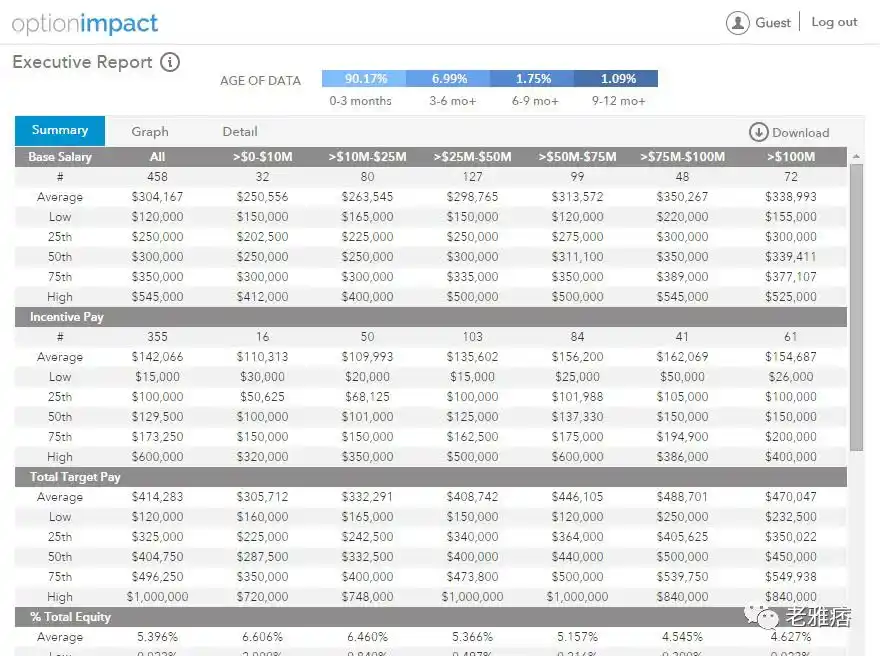
These surveys are comprehensive, with data covering a wide range of roles, experience levels, geographic locations, and more. You can segment by the number of employees the company has, the amount of funding it has raised, its stage of financing, and more.
However, keep in mind that this data is not specific to cryptocurrencies, and as a highly competitive industry, the crypto industry generally requires a little more than most other fields Pay premium. To accommodate this, you might consider using data from the most expensive/competitive geographic job market (such as San Francisco), and even if you are in an area where the cost of employment is lower, look at one higher than the candidate's usual level level of data for a specific skill/experience level and benchmark against the higher percentage of data provided.
Also note that highly specialized positions, such as protocol/blockchain engineers, may command higher salaries. For example, research by Aishvar Radhakrishnan found that MakerDAO paid protocol engineers a base salary of 280,000 DAI (a popular stablecoin whose value is pegged to the U.S. dollar, so basically $280,000), plus a four-year period 0.1% of MKRtoken obtained. That's a total of roughly $1.3 million as of this writing in June 2021, and the market has generally become more competitive since then.
AngelList is also a good resource for sanity checking the findings of salary surveys. Search for the job you're looking for, then filter by location, industry, company stage, and more. In order for your job to appear in their search results, AngelList requires you to list a salary/equity range or a fee per position. Many companies have chosen the former.
Levels.fyi can give you a good idea of salaries at big tech companies, but also be aware that startup salaries can vary A big difference. People typically don't join startups because they expect to earn the same salary as Google or Meta on day one; they join because they see things unfold and want a piece of significant growth.
H1BData.info's salary data is very reliable.
Track the competitive offers you see in the market and ask other founders/investors what they see. Employees also sometimes provide compensation data on forums like Blind, or you might find one-off surveys floating around. (These sources may not be as reliable as those above.)
Sign up for LiquiFi and keep an eye on the benchmark data to compare your token percentage ranges against other token-based offers Compare.
Other considerations when planning common levels include: Are you planning to make cost of living adjustments for geographically remote employees (more and more companies are canceling These adjustments, we believe over time, taking these factors into account will become a competitive disadvantage), what your hierarchy system looks like, and your company's overall philosophy about willingness to negotiate.
Method of calculating token Offer
With a clear scope and target total salary figure, Now you can better calculate your personal token offer.
It is important to note that while tokens are liquid, they are more volatile than traditional public stocks. This makes structuring tokenOffers in an attractive, fair and predictable way especially challenging.
Here are the most common approaches we see:
- Based on Market Value< /p>
- Annual token allowance
- Token percentage
Method 1: Based on market value
This is the easiest method and the easiest way to calculate the tokenOffer as a percentage of the total amount you wish to offer to candidates. This is also the approach we see most teams using today.
In practice, you decide the total salary based on the total salary interval you define, taking cash salary into account, and then according to the token when it is awarded or calculated Fair Market Value (FMV) calculates the number of tokens needed to meet the total number.
A major disadvantage of this approach is that the timing of when people join the team, fluctuations in the crypto market and changes in the initial offer can lead to pay inequality/discrepancies and HR debt. Employees with similar levels of experience and job responsibilities may end up with very different totals over time.
For example, if an engineer joins in January when your token's FMV is $1.00, and another engineer joins in March, you The token is $1.70 (this transition can happen in a day in cryptocurrency), and the first engineer will eventually get more tokens.
This approach may make more sense for mature startups with established positive token sentiment, but we believe the crypto market is still too volatile at the moment , cannot safely use FMV as a stable baseline.
Example
 < /p>
Example: You decide to give your employees $450,000 worth of token perks. If your token price is $1.25 at the time of award or calculation, then you will give them 360,000 tokens.
Advantages
Easiest calculation method , requiring minimal upfront research.
Disadvantages
Time and market conditions Total compensation has a significant impact and may lead to differences in compensation
Method 2: Annual Token Allowance
This method is similar to Method 1, but has a different share vesting plan. It has the potential to reduce price volatility risk, minimize dilution, and better align performance and compensation. However, this is not without significant risks for job seekers, especially for companies with great potential.
In this method, the token allowance is calculated using FMV and based on a pre-determined annual salary target (similar to method 1), but the key is to do it every year Reassess and issue. These allowances are usually paid on a monthly or quarterly basis.
In conclusion, the company does not commit to any compensation package beyond one year. While we expect to maintain the same reward amount each year, this is not guaranteed. This provides companies with greater control over individual employee token allocations, target total compensation figures, and the broader employee token pool.
This also means that employees are faced with the task of making each annual calculation based on any variables the company deems appropriate (e.g., performance, market timing, remaining in the employee pool). token, etc.) the risk of getting lower salary. Some candidates may be hesitant due to the lack of predictability and guaranteed long-term perks.
Perhaps more importantly, this approach removes the asymmetric upside/OTM option nature of the reward. If the company believes that total compensation has become too high given the skyrocketing token price, candidates will be affected by the company's slashed rewards, rather than being able to reap the potential benefits that usually attract employees to start-ups.
However, from the company's perspective, reducing rewards in this situation may affect employee retention, and we believe that the potential benefits should not be taken lightly Take away from employees. Furthermore, if the value of the perks increases, it can be argued that the incentive to stay in the company and earn the remainder is stronger.
In the end, this approach allows companies to protect themselves from overly generous token packages to those who end up underperforming.
Example
 < /p>
Example: You want to provide employees with a Token allowance equivalent to their first year FMV of $125,000. If your token price is $1.00 at the time of award or calculation, you will award them 125,000 tokens in the first year.
For the next year, you decide to give your employees an annual stipend of $150,000 per year, given their outstanding performance and current market conditions. If your token price is $1.50 when issued or calculated, you will issue them 100,000 tokens in the next year.
Advantages
Compared to method 1 , provides greater protection from market volatility, and has a greater ability to steer candidates toward the company's desired total rewards package
Companies adjust compensation numbers over time
Volatility still affects offers, but to a lesser extent Smaller than precomputing the whole scheme
Disadvantages
requires candidates People trust the impartiality of the company without contractual guarantees
Annual recalculation of all employee allowances creates additional operational overhead
Method 3: Token Percentage
This method attempts to mimic the way traditional startups calculate their return on equity. The web3 recruiting community has discussed this, and some teams have rolled out some version of this strategy, but perhaps not in the depth we wish to explore here.
Although this approach requires the most preparation, it is also, in the author's opinion, the only one that takes market volatility into account and mitigates employee pay inequality, A way to minimize unnecessary token dilution while preserving the asymmetric advantages of employees.
Again, cryptocurrencies can be very volatile. Just two months before this article was published, we saw the market drop by 47% in one month:

To use this approach, in general, you would use the same intervals as for equity, and adjust them to account for token-specific nuances -- i.e. Lack of dilution with a fixed token supply, and a potential premium for immediate liquidity. As your product matures, you can reduce the investment range over time, as equity startups do with new funding rounds.
Given that you are not calculating token rewards based on a constantly changing FMV - instead you are giving out a fixed number of tokens within a defined range based on the overall supply — This approach minimizes inequality in pay.
Please note that the descriptions below do not take inflation into account. If you don't have a fixed supply of tokens, you can still use this approach, but you might consider providing additional tokens periodically and/or based on performance.
Deciding how to apply equity ranges to your token pool
First, you should decide whether you want to apply these ranges to the overall token pool, or to a smaller pool of specific employee allocations. Your choice depends on how much flexibility you want.
Applying these ranges to your total token supply guarantees a fixed amount of tokens without natural dilution (again assuming your total token supply is stable). Alternatively, apply them to employee allocations (which may change before tokens are issued), enabling companies to adjust employee token allocations themselves.
Adjust traditional equity and token dilution
Since a fixed supply of tokens does not naturally create dilution and has other benefits (such as early liquidity) compared to equity that may secure a premium, you may consider adjusting your scope accordingly.
The chart below shows the typical equity dilution that a startup can experience over time, showing that when a company reaches a Series C, employees may end up with only Half of original ownership:
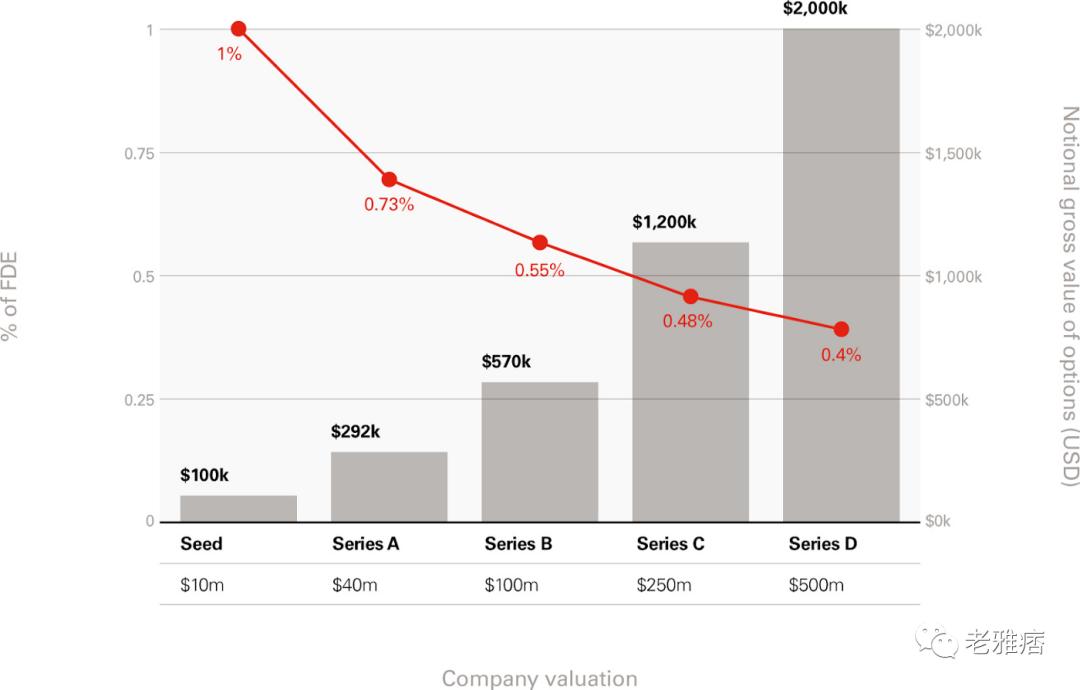
In principle, we recommend that you consider if you want to conduct three rounds of traditional financing , and reduce your equity range accordingly, so what's the expected dilution.
Three rounds of funding typically equate to ~50% equity dilution, according to the data. If you apply this amount of dilution up front, any "hypothetical diluted net worth" generated by employees after a similar, hypothetical third round effectively becomes a freebie, and they still get the aforementioned liquidity benefits.
However, narrowing the compensation range by 50% may give your offer a total dollar value, and given the current FMV, that value immediately decline. It's important to remember that this approach seeks to remove market volatility as a factor in your calculations and requires a long-term perspective. You might consider narrowing your equity range with fewer percentages.
Develop Your Zone Over Time
Like a traditional equity-based startup, you should also develop your range over time as the company matures and the protocol/project is in a more stable state
Traditional start-up company equity scope usually shrinks with new funding rounds (when dilution occurs and the risk of joining the company decreases). Token-based companies can recalculate their intervals at meaningful milestones that roughly resemble new funding rounds — such as major product, team size, and/or revenue milestones. This prevents you from over-rewarding employees. If the milestones are hard to predict, you might consider revisiting the min/max values of your range every year.
Example
 < /p>
Example: Through research, you can determine that at the stage your company is in, the traditional equity range for engineers is 0.5-1% and then narrow that range 50%, and the remaining token range is 0.25-0.5%.
Based on the candidates' seniority, interview performance, etc., you will reward them with tokens representing appropriate shares in the employee token pool. In the example above, you would be awarding a token supply of 25 basis points, which equates to 500,000 tokens.
Benefits
Considering market volatility Sex
Minimize the inequality/difference in remuneration
Retain employees Symmetrical opportunities for advancement
Increased equity in employee compensation may boost team morale and allow employees to reach their full potential
< /p>
Disadvantages
When the market price falls, the total market value of the token at the time of the offer Candidates may appear less competitive
Significant preliminary research required
Other calculation methods
The above methods are not the only ones, but they are the most common.
We've seen some teams start experimenting with a strictly milestone-based approach, whereby tokens endow specific pre-defined product or business achievements. While this incentivizes employee performance, it also creates unpredictability as to whether/when tokens will actually grant and requires a high level of confidence in what you've built. Roadmaps for early-stage startups change frequently.
Some teams are also experimenting with token rewards using a market cap based approach, but using Time Weighted Average Price (TWAP) over a 7 day or 30 day window or Volume Weighted Average Price (VWAP) for calculation. The goal here is to provide offers that are less affected by volatility and market timing.
We are even seeing some teams start exploring giving candidates the option to receive a portion of their overall token compensation based on the dollar value calculated by TWAP/VWAP, or Is another part based on a fixed number of tokens.
It seems easier to simply give cash if you tie token compensation to a fixed dollar amount and then award whatever number of tokens are needed to get to that amount. However, those employees who truly believe in your product/protocol may be inclined to hold and benefit from the upside, while they may not actively spend cash on your token. Paying by token also allows founders to avoid selling pressure on their token pool and avoid depleting their cash reserves early on.
That said, giving employees full control over what percentage of their offers are token-based will undoubtedly create a large pay variance in your tokencap table. This begs a philosophical question: If you tell all employees up front to decide what percentage of their compensation will be affected by market fluctuations, is this inevitable gap fair?
Market trials of these more advanced methods are still in their early stages. Be aware that complex offer structures can confuse candidates. Many people are new to token compensation, and even if they wanted to join your company when they received the offer, they may not feel comfortable making such a decision. Decision fatigue is a problem.
These approaches can also make the overall token distribution more difficult to manage and introduce significant logistical overhead.
We generally recommend striving for a balance between pay equity, transparency, and ease of implementation and offering.
Broad Considerations
No matter which method you choose, sticking to one method can Helping you better manage pay equity and candidate transparency. Be aware that each method has its pros and cons that may affect the candidates you attract to your company.
In addition, we must always pay attention to the psychological impact of fluctuations on employees. Although the equity value of start-ups generally does not shrink by 80%, this often happens in tokens. When someone’s initial plan is worth 400,000 US dollars when the offer is provided, it suddenly becomes 100,000 US dollars as the market fluctuates. Dollars, this might come as a bit of a shock.
To some extent, this can be mitigated by offering candidates multiple options based on a floating scale - for example, allowing them to Choose between higher stability (more cash, fewer tokens) or higher divergence (less cash, more tokens). You might consider defining a tradeoff ratio, which may have a min/max value, at your discretion. This is not the same as giving employees complete control over what constitutes an offer; instead, the choices you offer are within your control.
When making an offer, you can also create a calculator for candidates that allows them to enter a hypothetical token price point and predict their total compensation as What the passage of time might look like. (Note that if you don't have a fixed supply of tokens, you may need to factor in inflation.) This goes a long way in painting a picture of success.
Depending on your business model, you may also consider offering tokens and equity for a more risk-adjusted offer. Alternatively, you could consider offering a token-based variable bonus that might be tied to performance alongside the equity, but many candidates might not be happy if you were to use variable bonuses entirely in lieu of guaranteed recurring token grants.
Another way to mitigate the psychological effects of volatility is to make sure you hire employees who share your values. You might consider screening and optimizing your interviews for your ability to have a faithful macro view of the market and weather a recession. (Even if your staff truly believes the market will bounce back, that still won't offset the decline in liquidity in a bear market.)
Finally, the benchmarking and offer phase The calculation of is not the only tool you should employ to provide an effective token offer. The questions you ask, your narrative, and how you manage expectations are all critical. This starts with the first point of contact with the candidate. Working with skilled people who understand cryptocurrency and understanding how to best position your company, compensation philosophy, and offers at every stage of the hiring process can be as helpful as the calculations you employ.
Original link
Welcome to join the official BlockBeats community:
Telegram Subscription Group: https://t.me/theblockbeats
Telegram Discussion Group: https://t.me/BlockBeats_App
Official Twitter Account: https://twitter.com/BlockBeatsAsia
 Related Articles