NFT financialization, challenges and opportunities

Original title: "Financialized NFTs: evolving opportunities in an early space"
Original author: lingchenjaneliu @Fundamental Labs
Original compilation: Peter Pan@BlockBeats
TL;DR
- Financialization converts illiquid assets into tradable securities, which helps direct cash flow to borrowers and provides Funding for major economic developments;
- NFT financialization verticals include: NFT marketplaces and aggregators, liquidity pools, liquidity providers, fragmentation, NFT lending and valuation;
< p>- The greater potential of NFTs can be unlocked if two key limitations: low liquidity and insufficient price discovery are resolved;- NFTs are not free due to their unique characteristics: low accessibility and lack of utility
- NFTs suffer from high slippage, capital inefficiency, and poor price discovery and valuation when they are illiquid;
- NFT The market structure of financialization is still in its infancy, and the solution is still inevitably trapped in problems such as low loan-to-value ratio, high interest rate, lack of scalability and insufficient liquidity;
- In the NFT lending agreement, there are three There are several mechanisms that can promote NFT as collateral lending: peer-to-peer lending, peer-to-pool lending, and over-the-counter (OTC) lending;
- The NFT rental market is still very early, and there are very few assets listed on the platform, but the in-game Assets are great for rental markets, but popular crypto games often have their own in-game NFT marketplaces;
- NFT pricing mechanisms can be broken down into two categories: oracle-based and proof-of-stake pricing, with the former relying on the use of oracles The latter relies on the consensus of human evaluators;
- NFT financialization has yet to be further explored: Divide NFTs into different categories with different risk and return configurations, construct Borrower risk profile, and scaling NFT utility layer.
NFT current market and its bottleneck
The technology behind NFT has released an untapped part of the digital economy and realized the ownership of digital assets. Today, NFTs are popular in and out of circles mainly as personal profile pictures (PFPs), but they are also classified as works of art and collectibles. So far, the potential of the PFP category, although limited, is very useful for socializing and connecting communities. And as NFTs become more widely used, the technology will also be applied to different industries beyond PFP, whether in the physical world or the virtual world, the possibilities will be endless.

NFT category Market value; source NFTGO, data as of June 2022
The importance of NFT financialization
In theory, any financial asset can be securitized. Securitization is the process by which an issuer designs a valuable financial instrument by combining, or pooling, various financial assets into a portfolio, and then the issuer sells this repackaged asset to investors.
In addition, securitization can also be considered as less efficient traditional debt markets and more efficient A form of arbitrage between high and high capital markets, where financial firms disguise old securities as new asset-backed securities for profit. Thus, slices of cash flow and credit risk from the underlying asset pool become securitized products with different risk-reward characteristics and maturity horizons.
By converting illiquid assets into tradable securities, securitization helps move cash Channeling flows to borrowers and funding major economic developments not only facilitates market liquidity but also helps issuers and investors diversify across asset classes and across the globe.
NFT Credit Market
Let’s take a look at the NFT credit market again. Take NFTfi as an example of the loans it has issued. The loan amount in 2021 has exceeded 40 million US dollars, and the cumulative loan amount from January to May 2022 has reached 155 million US dollars.
The NFT transaction volume in May 2022 is about 3 billion US dollars, as shown in the figure below, the same month NFTfi With $36 million in loans issued, the penetration rate of the NFT credit market has only reached 1.2%.

NFT transaction volume; source Dune Analytics @hildobby, data as of June 2022
If placed in a more In complex credit markets, especially in the mortgage and real estate industries, the penetration rate of credit markets in assets worth about 40 trillion US dollars may exceed 50%.
On the other hand, in the traditional art credit market, banks usually lend 2% to 5% depending on the client's other assets and business, art loan companies and auction houses typically charge 6% to 9% Borrowers can usually borrow up to half the appraised value of a work of art.
In contrast, NFT's loan-to-value (LTV: loan-to-value ratio) It is only between 10% -30%, but the annual interest rate has reached 50%. The annual interest rate is the borrowing fee that the user needs to pay every year, and it is also a broader measure of the borrowing cost of the user. It can be seen from these that the capital of the existing NFT credit market is still highly inefficient.
So what is its key bottleneck?
After delving into the NFT financialization market, we realized that if we could solve two key limitations : With low liquidity and insufficient price discovery of NFT assets, the actual potential of NFT can be released, otherwise low liquidity will further lead to difficulties in price discovery.
Why is the liquidity of NFT low?
-Consumers need to spend more time understanding NFT assets before making a purchase decision;< /p>
- Most mainstream NFT collections have high prices and low accessibility, resulting in a small user base;
- Lack of utility:
So far, around Most experiments with NFTs have focused on the art and collectible categories. Due to the limited scope, we haven't seen unique and innovative applications outside of PFP emerge. In order to generate higher liquidity, the product or asset itself needs to have sufficient utility to create strong demand. Assets are easier to sell and turn into liquid assets, such as cash, when there is strong demand.
Problems caused by insufficient liquidity of NFT
- High Slippage: Low trading liquidity means that users cannot easily swap one asset for another and create Higher slippage, resulting in severe price deviations;
- Inefficient capital: NFT holders have very low asset utilization, long liquidation cycles, and inflexible credit terms;
p>- Poor price discovery and valuation: Low trading volume and exchange demand for illiquid assets lead to pricing and market information asymmetry, opaque information leads to low market activity and difficulty in asset valuation.
The current market structure of NFT financialization
Despite observing the illiquidity of NFT and the inability of the market to effectively evaluate NFT, we can still see the financialization space of NFT and the rapid development . According to Dove Metrics, even as the market enters a bear market, financing in the NFT space is still showing an upward trend.

NFT financing The trend is constantly listed
However, the current market structure of NFT financialization is still in its infancy, and the solution Still inevitably stuck with low loan-to-value ratios, high interest rates, lack of scalability, and illiquidity. In addition, the lack of a scalable, low-risk, and credible price assessment mechanism has also limited the NFT credit market, causing demand for NFT-backed loans to exceed the supply of lending capital, and resulting in a large amount of unmet NFT borrowing demand.
But as we see more and more builders and developers exploring and experimenting with NFT use cases, and building the infrastructure to increase the liquidity of NFTs, we are excited to embark on a journey with builders to expand the financialization of NFTs.
At present, the NFT financial market structure can be roughly divided into the following vertical areas:
p>

Among them, protocols such as NFT marketplaces and aggregators facilitate NFT transactions. Protocols exploring NFT lending and leasing markets focus on improving capital efficiency and exploring the possibility of NFT yield generation. In addition, many protocols can be seen to build the foundation for providing and enhancing liquidity and the valuation of NFT financialization. The fragmentation, liquidity provider and liquidity pool part of the agreement tries to solve the problem of low liquidity of NFT. Finally, those agreements on the reasonable valuation of NFTs are committed to making fair and objective judgments about the value of NFTs.
After digging through most of the above protocols, I chose a subset of them, These subsets reflect some of the most popular and mature protocols, as well as some younger but innovative protocols. In what follows, we will introduce the mechanisms these protocols use to financialize NFTs, including valuation, evaluation, and lending mechanisms, while exploring their limitations.
NFTX
NFTX was built by The DAO to produce ERC20 tokens backed by NFT collectibles. NFTX allows users to deposit their NFTs into the NFTX vault and mint a fungible ERC20 token (vToken) that represents a 1:1 claim on random assets within the vault, and the vTokens can also be used to withdraw Redeem specific or random NFTs in the library.
As shown below: Users can go to an automatic market maker (AMM) like Sushiswap to buy PUNK such a vToken, and use that token to get a random CryptoPunk from the PUNK Vault.

NFTX PUNK Vault
Assistance in Price Discovery
< /p>
Through the mechanism established by NFTX, NFTX considers NFTs within the same vault as fungible. Therefore, only NFTs with the same characteristics or rarity will be stored in the same vault, and this mechanism is also more suitable for floor items in the same collection.
Users who have minted vTokens in an Automated Market Maker (AMM), can create a liquid Marketplace for other users to trade. Traders can deposit and sell vTokens based on their views on NFTs, and the arbitrage process facilitates price discovery. With the establishment of liquidity and trading volume, the vToken supported by NFT will enter the price discovery stage, and the fair value will gradually be established.

NFTX Yes How does it work?
Participants in the NFTX system
1) NFT Holders
NFT holders who deposit and mint vTokens can start extracting more value from their NFTs:
p>
- Earn agreement fees;
- Earn transaction fees as a liquidity provider of AMM.
2) NFT project/content creator
Through the NFTX agreement Launched on , NFT projects can earn protocol fees while providing stable prices and instant liquidity to their communities:
- Earn protocol fees;
- Distribute NFTs as vTokens via AMM;
- Create an instant liquid market for new collections of NFTs.
In addition, NFTX This article also explains how liquidity pools work on NFTX, emphasizing the importance of having a deep pool for price stability. Having a deep liquidity pool can not only maintain a stable token price, but also create a smooth trading experience, allowing traders to buy and sell assets instantly, increasing market adoption. Therefore, it is important to have protocols that focus on creating liquidity.
FloorDAO
FloorDAO is built on NFTX and is a decentralized NFT A market-making protocol that provides deep liquidity for all collections of NFTs included in the FloorDAO library. FloorDAO uses the bond and rebase mechanism pioneered by OlympusDAO to accumulate liquidity for NFTs, which are then deployed in NFTX vaults to generate yield.

FloorDAO is How does it work?
Participants in the FloorDAO system
1) Stakers
Stakers can use the FloorDAO protocol to pledge $FLOOR to get rebase rewards $sFLOOR from the protocol, each rebase will Automatically accumulate rewards.
- Stake $FLOOR to get $sFLOOR at a ratio of 1:1;
- Get rebase in $sFLOOR from protocol emissions Reward;
- Participate in governance using $gFLOOR wrapped in $sFLOOR.

FloorDAO pledge Interface
2) Bonder
Bonding is the main mechanism for FloorDAO to obtain liquidity, and it is the process in which users sell their NFT to the agreement to obtain $FLOOR at a discounted price. The protocol quotes the amount of $FLOOR and token vesting period for Bonder, while the proceeds come from the discounted $FLOOR that bondholders receive by depositing NFTs into FloorDAO.
The choice of Bonding assets is determined by the community. The currently selected assets are blue-chip NFTs. The agreement uses Reserves in FloorDAO treasury to sweep NFT collections to create deep liquidity.

FloorDAO Bonding
3) Treasury
FloorDAO treasury generates income by providing liquidity for NFT. In addition, FloorDAO provides pledged positions (NFT) to NFTX and earns vault fees from NFTX, the liquidity provided to Sushiswap generates transaction fees, and both vault fees and transaction fees flow back to the FloorDAO treasury.
Fractional.art
Fractional.art works similar to liquidity pools such as NFTX or NFT20. Users deposit NFT and receive an alternative ERC-20 generation coins in return. Similar to NFTX/NFT20 in that when a user deposits an NFT into a vault they create, the depositor will receive an ERC-20 token representing partial or full ownership of the vault's NFT, and the depositor can set the NFT application The amount divided.
Once a liquidity pool is created on Sushiswap or Uniswap, etc., these fractional shares can be traded in the market on sale. The difference between Fractional.art and NFTX/NFT20 is that once the NFT is deposited into the Fractional.art vault, the NFT will be auctioned without any revenue generation mechanism, while the NFT deposited on NFTX/NFT20 will be locked In the revenue generating pool.

Fractional. How does art work?
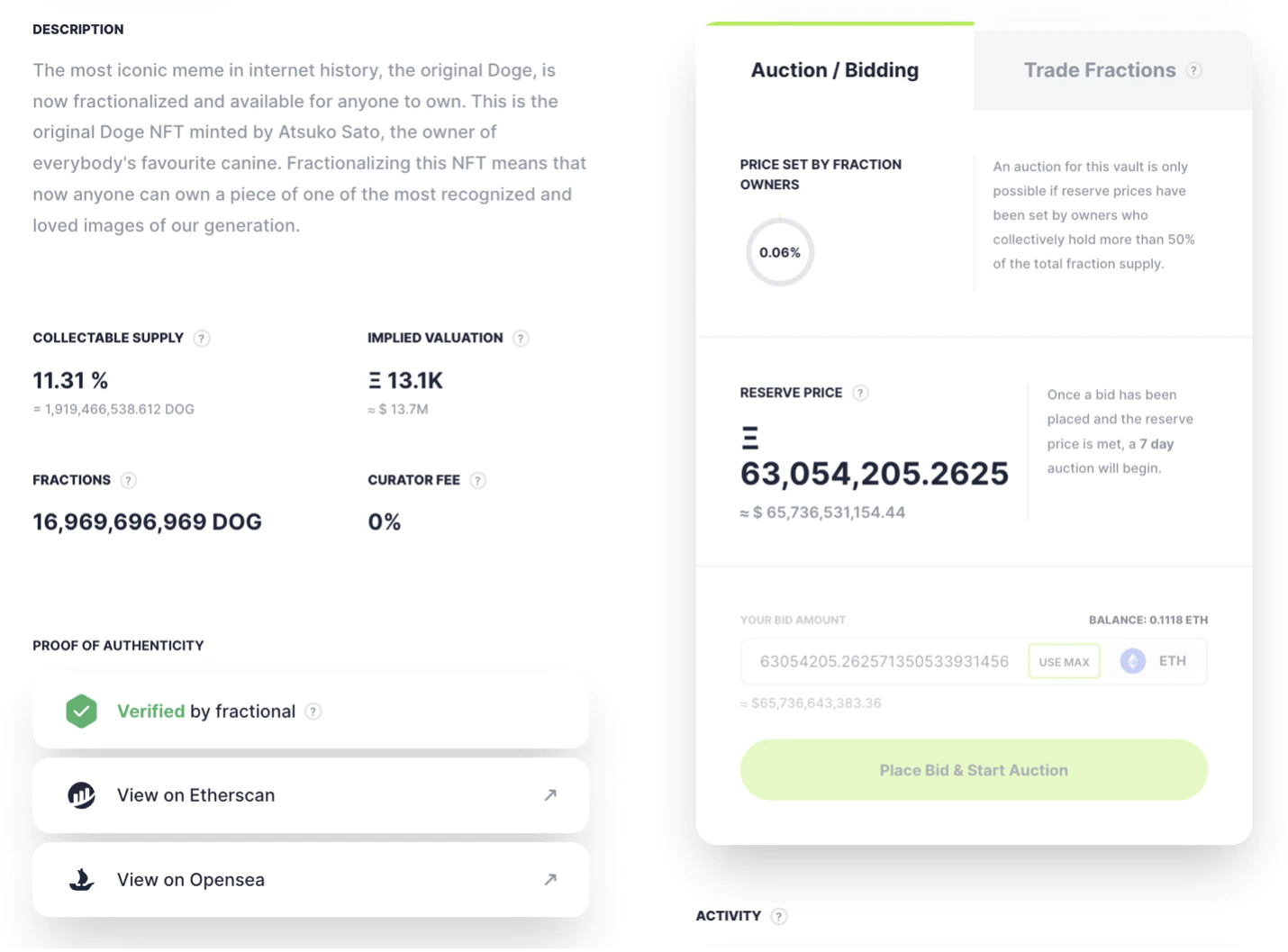
Fraction Vaults on al.art are available for buyouts or fractions trading
Lack of utility leads to low liquidity and collective ownership makes governance difficult
Fragmentation of NFT and the availability of alternative tokens does not actually solve the liquidity problem, the solution just shifts the existing liquidity problem from NFT to fragmented NFT.
In addition, multiple people jointly owning an NFT will bring difficulties to the governance of assets, because they There may be a majority that can decide the fate of NFTs. In the absence of real utility and benefits, investors or traders have relatively little incentive to own a small fraction of NFTs. But when NFT technology is widely adopted in the physical world and applied to yielding assets, such as yield-generating bonds, the adoption of fractional NFTs will increase.

based on NFT Vault ownership distribution for fractional ownership percentage
NFT Lending agreement
In the NFT lending agreement, there are three mechanisms that can facilitate NFT as collateral lending: peer-to-peer Lending, peer-to-pool lending, and over-the-counter (OTC) lending. Due to the very low liquidity of NFTs in their current form, NFT holders are looking for solutions to improve capital efficiency, and NFT lending protocols have become a popular solution to this problem and have recently gained traction.
Before looking at the different lending relationships to guide subsequent reading.
- Debtor (Borrower): Obtain funds by pledging NFT, and pay principal and interest to creditor;
- Creditor (Lender ): Provide funds to borrowers to earn yield. If the borrower defaults and fails to repay the funds when due, the lender can obtain the ownership of the NFT (peer-to-peer mechanism), or obtain a certain percentage of funds from the liquidated NFT (peer-to-peer mechanism).
In fact, NFT mortgage lending services operate in the same way as traditional finance, where creditors provide debtors Liquidity, and the difference lies in the collateral assets. Traditional finance uses assets such as real estate, stocks, equipment, and land as collateral, while NFT lending agreements use NFT as collateral, and the value of NFT is used to determine the loan amount, interest rate, and loan term. In what follows, several protocols utilizing peer-to-peer and peer-to-pool mechanisms will be introduced.
NFTfiNFTfi
In the peer-to-peer category, the longest and largest NFT lending protocol is NFTfi .
NFTfi launched a public beta version in June 2020, which will be issued in 2020 to 2022 Loans of $300,000, $40 million and $166 million. The loan period is 30 to 180 days, the annual interest rate is 30%-100%, and the loan is paid off in one lump sum. With a typical loan-to-value ratio of around 50%, NFTfi charges lenders 5% of the interest earned on loans that do not default.

NFTfi monthly Loan amount; source Dune Analytics @rchen8, data as of June 2022
NFT owners can List their NFTs on the platform and fill in their preferred terms, including loan amount, term, APR, and tokens, and liquidity providers can browse the loan terms of each NFT on the platform and make an offer.

On NFTfi
The lending process is similar to a lending market where NFT owners borrow from multiple Select offers from liquidity providers. Before the loan term expires, the borrower needs to pay the principal and interest in order to transfer the NFT back to the borrower, otherwise the NFT will be transferred from the smart contract to the lender. Since the loan process is straightforward and the loan terms are customized, we can see that NFTfi has the most collectibles listed on its website requesting a loan.

NFTfi is How does it work?
In the peer-to-peer model, NFT owners can pledge their NFT to a liquidity pool Get funds immediately after, similar to the process with AAVE or Compound.
On the other hand, lenders can provide liquidity through stablecoins or ETH to obtain passive, With a variable rate of return, the amount of interest paid by NFT owners depends on the amount of borrowed funds and the remaining funds in the pool. If the NFT owner is unable to repay or the price of the NFT falls to the liquidation line, the NFT will be auctioned on an open market such as Opensea, and the funds will be returned to the lender.
Currently, the market structure of NFT lending agreements using the peer-to-pool mechanism is very crowded, such as BendDAO Protocols such as XCarnival, Drops, XCarnival, Pine, Gradient Finance, JPEG'd, Pilgrim, etc. all fall into this category. However, one of the biggest limitations of these protocols is that only a very small number of NFT series can be accepted as collateral assets.
Peer-to-pool lending projects are often only for a strong price consensus between traders and investors The blue-chip NFT projects of 2019 offer lending pools, and these blue-chip NFTs tend to have sufficient liquidity compared to long-tail NFT collections. Take BendDAO as an example: BendDAO only accepts blue-chip NFTs like Azukis, Bored Apes, CryptoPunks, CloneX, Doodles, and Mutant Apes as its collateral type.
JPEG'd
JPEG'd uses a peer-to-pool mechanism that gives borrowers immediate access to loan. Users can deposit NFTs like CryptoPunk to borrow JPEG’s $PUSd stablecoin. JPEG uses a custom Chainlink oracle to obtain and maintain real-time on-chain pricing for its NFT collateral.
What makes JPEG'd unique compared to other point-to-pool projects is its Insurance mechanism, when borrowers deposit NFT as collateral, they can choose to purchase insurance for their loans. The insurance fee is 5% of the borrowed amount, and if the borrower purchases optional insurance and their NFT is liquidated, they can repay their outstanding debt and a 25% fee, which is based on the borrower’s outstanding debt (this Gold plus accrued interest) to buy back their NFTs. Otherwise, JPEG's DAO will own the NFT, and the liquidated NFT will be auctioned off.

JPEG' How does d work?
Pilgrim Protocol< /a>
Pilgrim Protocol is a combination of Uniswap automatic market maker and Fractional.art protocol.
Participants in the Pilgrim System
1) NFT Lister (liquidity guide pool owner)
Once the NFT list Once the issuer locks his NFT in the Pilgrim pool, the protocol creates a new PilgrimPair with two separate interfaces: Rounds and MetaNFTs.
MetaNFT represents ownership of an NFT pool in Pilgrim, Rounds represent fractional ownership of a location in the pool (Rounds are not ERC-20 codes made by splitting NFTs into small parts coins, but instead reflect the protocol's internal measures for splitting NFTs).
MetaNFT holders can obtain income through the NFT locked by Pilgrim, and the income is through $PIL Protocol rewards and transaction fees incurred once a round trader initiates a transaction in the pool.
2) Round Trader
When a trader buys Round for a specific NFT (equivalent to providing liquidity to PilgrimPair), the Round is newly minted, and when the trader sells the Round back to its base token (the current base token When the coins are WETH, USDC and PIL), Round will be burned.
Round can only be traded at the price determined by AMM, which makes Round Trader and holders Facing financial gain or loss. One thing worth noting is that since Round is not an ERC-20 token, it cannot be transferred to another account.
3) Buyout Bidder
Anyone can bid to pay the current spot price of the locked NFT, once the bid is approved by the MetaNFT owner, the NFT will be unlocked and PilgrimPair will be delisted. However, MetaNFT owners do not have the right to choose from the buyout offer, and the buyout bid will affect the round price and vice versa. Thus circulation and speculation help to discover the price of NFT.

Pilgrim Yes How does it work?
Comparison of NFT lending mechanisms
< p>The diagram below summarizes various NFT lending mechanisms and compares them along key dimensions, including target lenders and borrowers, NFT collection applicability and each limitations of the mechanism.

NFT lending Mechanism Comparison
NFT Leasing Market
The NFT rental market is still very early, and there are very few assets listed on the platform. According to Dune Analytics, the number of NFTs leased on reNFT is still far below 100 NFTs per month. Because NFTs in the art and collectibles categories generally lack utility, demand for renting such assets is generally low.
And in-game assets are very suitable for the rental market. However, popular crypto games often have their own in-game NFT marketplaces, but technically adding rental services to their own marketplaces is not difficult. Additionally, gaming guilds such as Yield Guild Games and Merit Circle offer in-game asset rentals (as part of game-earned scholarships) to crypto gamers. As gaming guilds become closer to the crypto gamer community, it is inevitable that guilds will become the largest lenders of gaming assets.
However, once NFT expands to more vertical fields, such as tickets, members, music, movies and real estate, expect a surge in rental demand.
Currently, NFT leasing agreements such as reNFT, IQ Protocol, and Rentable are aimed at general-purpose NFT series , while protocols like Double and Landworks target game assets and virtual land, respectively.
reNFT
reNFT supports the income generating ability of NFT, and NFT holders can rent out their NFT at a fixed price, lease period and collateral amount. Additionally, users can temporarily access NFTs, which they do not have access to when they do not have ownership of the NFT.

reNFT is How does it work?
NFT Valuation
Valuation and evaluation are an integral part of the infrastructure of any trading market and can be used for many NFT financialization use cases, such as lending, lending, Leases and pledges. In these applications, having a safe and objective valuation is of great importance for the service provided. However, high market volatility, extreme trading volume fluctuations, and the diverse characteristics and characteristics of NFTs make valuation very challenging and complex. While liquidity is the fundamental solution to price discovery, there are multiple protocols experimenting with NFT valuation and evaluation mechanisms.
In general, pricing mechanisms can be divided into two categories: oracle-based and optimistic equity Pricing proofs, the former rely on the use of oracles to retrieve on-chain data, while the latter rely on the consensus of human evaluators.
AbacusAbacus a>
Abacus uses Proof of Stake Pricing to create a liquidity-backed valuation system that trades Validators act as validators by committing funds to different valuation pools. The attribution valuation of NFT is the liquidity locked in the pool at any point in time (traders must lock their $ETH in the pool), and the value of NFT is equal to the total value locked in the pool.

Abacus Spot How does it work?
The valuation mechanism of Abacus seems to have never appeared in the traditional financial market, and its pricing mechanism effectiveness remains to be proven. In what follows, different valuation mechanisms will be compared and their limitations and advantages described.
In addition, several protocols are trying to use machine learning techniques to predict NFT prices, such as Upshot , NFTBank and Banksea.
Upshot
Oracle machine learning based valuation protocols work in a very similar way, the difference in the datasets and the machine learning models they use. Due to the uniqueness of NFT, NFT metadata is one of the most important data to consider when building a machine learning price model, and an important step for the protocol to build an accurate pricing model is by processing and classifying NFT features.
Here is how the protocol handles NFT metadata:
- Breakdown characteristics of NFT items;
- regroup NFT items by characteristics;
- calculate price statistics for each group;
- reconstruct NFT using calculated statistics The value of the item;

How does Upshot work?
NFT valuation mechanism comparison
NFT valuation and evaluation is a fascinating new field waiting for builders to explore and experiment. Through in-depth research on different NFT valuation protocols, the valuation mechanism can Divided into the following types:
1) Oracle-based pricing
-simple price oracle;
-price oracle + NFT attribute;
-based Prices for Oracle Machine Learning;
2) Proof of Stake Pricing .
Since the pricing data set used in the pricing oracle model mainly relies on the latest transactions of the NFT collection Price or reserve price, so the biggest trade-off of this mechanism is that it is difficult for the valuation to capture the value of the project when there is a significant difference.
In addition, when the roadmap of the NFT project is updated and the market updates its fair value accordingly, Price oracle models do not reflect potential upside. For an oracle-machine learning based model, the benefit of this model is that it can potentially enable time-series pricing and could become a key component of price oracles, or even the cornerstone of NFT financialization.
However, the difficulty comes from the construction of the model and the weighting of different parameters. The following three figures provide a detailed analysis of the limitations and advantages of different valuation models.

NFT estimate Value mechanism comparison_01

NFT valuation mechanism comparison_02

NFT valuation mechanism comparison_03
Current challenges and future Direction
NFT financialization Development and experimentation have only just begun, and while progress has been made in various verticals, the field still faces many challenges in terms of financialization.
1) The foundation to be established
Issues such as reliable and agreed valuation models and instant liquidity have yet to be resolved, which is the foundational layer of any financial product.
2) The practical layer is limited
Currently, NFTs are highly concentrated on avatars (PFPs) and game assets, and the lack of utility hinders mass adoption, thus dampening demand for NFTs. Envisioning a world where, through the adoption of NFT and blockchain technology, NFT becomes ubiquitous and unprecedented as a product or commodity, is considered a new asset class, this vision is still a long way from being realized.
The following may be some opportunities to realize this vision.
1) Divide NFT into different categories with different risk and return characteristics
- All asset classes in traditional finance have their own risk and out risk rating. However, the risk ratings given by third-party rating agencies are not completely reliable, because the financial instruments issued by these centralized intermediaries often have layers of wrapped assets, and the opaque process makes it difficult to correctly assess risks. Blockchain technology promotes the transparency of financial instruments. Therefore, for institutions or investors, the adoption of blockchain technology can improve the health of financial markets and optimize the risk-return profile.
- Part of the difficulty in evaluating NFTs comes from treating all NFTs equally, with different economic verticals NFT should be subdivided into different categories, such as some tradable assets and some non-tradable assets.
Also, I don't think Ethereum ENS domains should be traded because its fragmentation goes against The nature of NFT assets is to provide an identity for the address and does not generate income. In contrast, mortgage contracts that generate stable cash flows are tradable and have specialized valuation models.
2) Establish the risk profile of the borrower
< /p>
Credit assessment in the crypto space is still in its early stages and is expected to mature when we have clearer user profiles. At that time, the user's on-chain data can be bundled with the user's identity to assess the creditworthiness of the borrower and recommend assets that match their risk profile.
3) Extended Utility Layer
- Expect to see more economic verticals utilizing blockchain and NFT technology, especially for products or commodities with distinctive features such as medical records, conversations, insurance contracts, etc. With blockchain technology, immunity from intermediaries can increase efficiency, and its composability can create new business models. When blockchain technology is applied in these different fields, new use cases will emerge, and we will also see new ecosystems built on these foundations.
< p>- And as NFT expands to the wider economy and gets more With multiple applications, it is also easier to determine the value of an asset through the value of the application.
Original link
Welcome to join the official BlockBeats community:
Telegram Subscription Group: https://t.me/theblockbeats
Telegram Discussion Group: https://t.me/BlockBeats_App
Official Twitter Account: https://twitter.com/BlockBeatsAsia
Abacus a>
Abacus uses Proof of Stake Pricing to create a liquidity-backed valuation system that trades Validators act as validators by committing funds to different valuation pools. The attribution valuation of NFT is the liquidity locked in the pool at any point in time (traders must lock their $ETH in the pool), and the value of NFT is equal to the total value locked in the pool.
Abacus Spot How does it work?
The valuation mechanism of Abacus seems to have never appeared in the traditional financial market, and its pricing mechanism effectiveness remains to be proven. In what follows, different valuation mechanisms will be compared and their limitations and advantages described.
In addition, several protocols are trying to use machine learning techniques to predict NFT prices, such as Upshot , NFTBank and Banksea.
Upshot
Oracle machine learning based valuation protocols work in a very similar way, the difference in the datasets and the machine learning models they use. Due to the uniqueness of NFT, NFT metadata is one of the most important data to consider when building a machine learning price model, and an important step for the protocol to build an accurate pricing model is by processing and classifying NFT features.
Here is how the protocol handles NFT metadata:
- Breakdown characteristics of NFT items;
- regroup NFT items by characteristics;
- calculate price statistics for each group;
- reconstruct NFT using calculated statistics The value of the item;
How does Upshot work?
NFT valuation mechanism comparison
NFT valuation and evaluation is a fascinating new field waiting for builders to explore and experiment. Through in-depth research on different NFT valuation protocols, the valuation mechanism can Divided into the following types:
1) Oracle-based pricing
-simple price oracle;
-price oracle + NFT attribute;
-based Prices for Oracle Machine Learning;
2) Proof of Stake Pricing .
Since the pricing data set used in the pricing oracle model mainly relies on the latest transactions of the NFT collection Price or reserve price, so the biggest trade-off of this mechanism is that it is difficult for the valuation to capture the value of the project when there is a significant difference.
In addition, when the roadmap of the NFT project is updated and the market updates its fair value accordingly, Price oracle models do not reflect potential upside. For an oracle-machine learning based model, the benefit of this model is that it can potentially enable time-series pricing and could become a key component of price oracles, or even the cornerstone of NFT financialization.
However, the difficulty comes from the construction of the model and the weighting of different parameters. The following three figures provide a detailed analysis of the limitations and advantages of different valuation models.
NFT estimate Value mechanism comparison_01
NFT valuation mechanism comparison_02
NFT valuation mechanism comparison_03
Current challenges and future Direction
NFT financialization Development and experimentation have only just begun, and while progress has been made in various verticals, the field still faces many challenges in terms of financialization.
1) The foundation to be established
Issues such as reliable and agreed valuation models and instant liquidity have yet to be resolved, which is the foundational layer of any financial product.
2) The practical layer is limited
Currently, NFTs are highly concentrated on avatars (PFPs) and game assets, and the lack of utility hinders mass adoption, thus dampening demand for NFTs. Envisioning a world where, through the adoption of NFT and blockchain technology, NFT becomes ubiquitous and unprecedented as a product or commodity, is considered a new asset class, this vision is still a long way from being realized.
The following may be some opportunities to realize this vision.
1) Divide NFT into different categories with different risk and return characteristics
- All asset classes in traditional finance have their own risk and out risk rating. However, the risk ratings given by third-party rating agencies are not completely reliable, because the financial instruments issued by these centralized intermediaries often have layers of wrapped assets, and the opaque process makes it difficult to correctly assess risks. Blockchain technology promotes the transparency of financial instruments. Therefore, for institutions or investors, the adoption of blockchain technology can improve the health of financial markets and optimize the risk-return profile.
- Part of the difficulty in evaluating NFTs comes from treating all NFTs equally, with different economic verticals NFT should be subdivided into different categories, such as some tradable assets and some non-tradable assets.
Also, I don't think Ethereum ENS domains should be traded because its fragmentation goes against The nature of NFT assets is to provide an identity for the address and does not generate income. In contrast, mortgage contracts that generate stable cash flows are tradable and have specialized valuation models.
2) Establish the risk profile of the borrower
< /p>
Credit assessment in the crypto space is still in its early stages and is expected to mature when we have clearer user profiles. At that time, the user's on-chain data can be bundled with the user's identity to assess the creditworthiness of the borrower and recommend assets that match their risk profile.
3) Extended Utility Layer
- Expect to see more economic verticals utilizing blockchain and NFT technology, especially for products or commodities with distinctive features such as medical records, conversations, insurance contracts, etc. With blockchain technology, immunity from intermediaries can increase efficiency, and its composability can create new business models. When blockchain technology is applied in these different fields, new use cases will emerge, and we will also see new ecosystems built on these foundations.
- And as NFT expands to the wider economy and gets more With multiple applications, it is also easier to determine the value of an asset through the value of the application.
Original link
Welcome to join the official BlockBeats community:
Telegram Subscription Group: https://t.me/theblockbeats
Telegram Discussion Group: https://t.me/BlockBeats_App
Official Twitter Account: https://twitter.com/BlockBeatsAsia

 Related Articles