Game governance in Web3 part 1: what is game governance and its pros and cons

A Series on Different Models of Game Governance
Author: Taetaehoho. eth @ 1KX Network
Peter Pan @Blockbeats
This is a series of analyses of the different governance models used in games. Before discussing the different models, I want to talk about:
1) What is game governance?
2) The need for governance processes in Web3 games, and the pros and cons
3) possible future game governance systems in Web3
What is game governance?
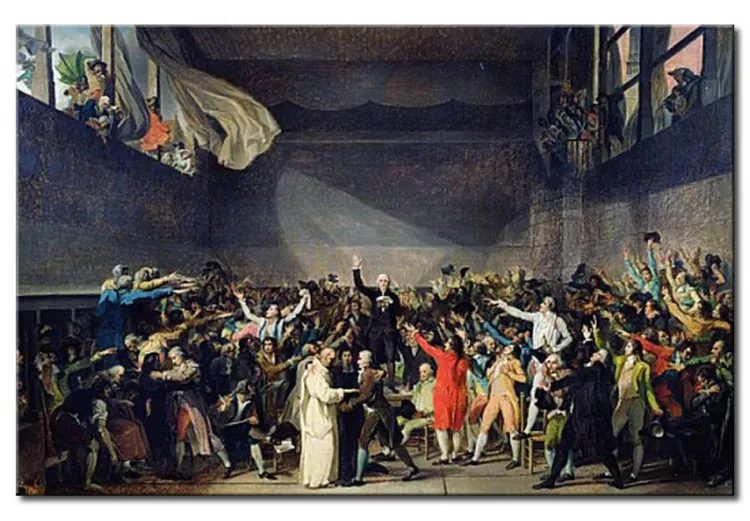
Game governance is a process in which the stakeholders of a game participate in its evolution.
It can take an indirect form like organic feedback through a public forum, and then be iterated by the development studio; You can also use a direct approach like voting on content proposals that result from community discussion. However, both methods are currently in use.
Original video link
In addition, it can be as subtle as voting for individual content updates, or as abstracted from the content itself as controlling parameters in the ecosystem, such as BPS transaction fees on the native DEX, P2E mechanisms, etc.
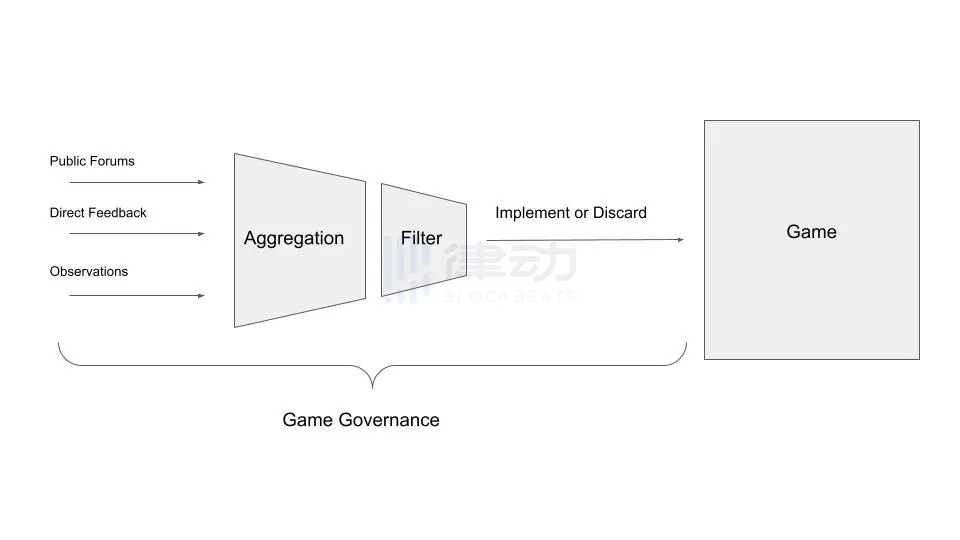
Game governance process visualization
The structure of this process is different across multiple games, and in Aggregation Games it can:
- Collecting feedback on all stages of the game via organic sources such as public forums;
- Create a committee to represent the interests of players and gather player feedback for them;
- Require players to create their own proposals.
In Filtering Games, you can choose from:
- All filtering takes place in the studio without player input;
- Additional weight may be given to proposals based on their source;
- All proposals that pass the ballot will have to be implemented.
Game governance in Web3
retained
Game governance improves retention.
With the popularity of GaaS (Game as a Service), it is important that games continue to provide experiences that meet consumer needs. As a result, this has led to an increase in methods and manpower dedicated to gathering and aggregating player feedback, and as we'll see, many game governance mechanisms have emerged as a remedy for players leaving a game after an update they don't like.
For Web3 games that want to monetize by controlling critical in-game infrastructure (NFT market, AMM, etc.), the key to revenue is the rate of player growth and willingness to invest in the long term. Therefore, player retention is important.
Build trust with the community
It is also important to increase investment by making players feel safe and building trust with the community.
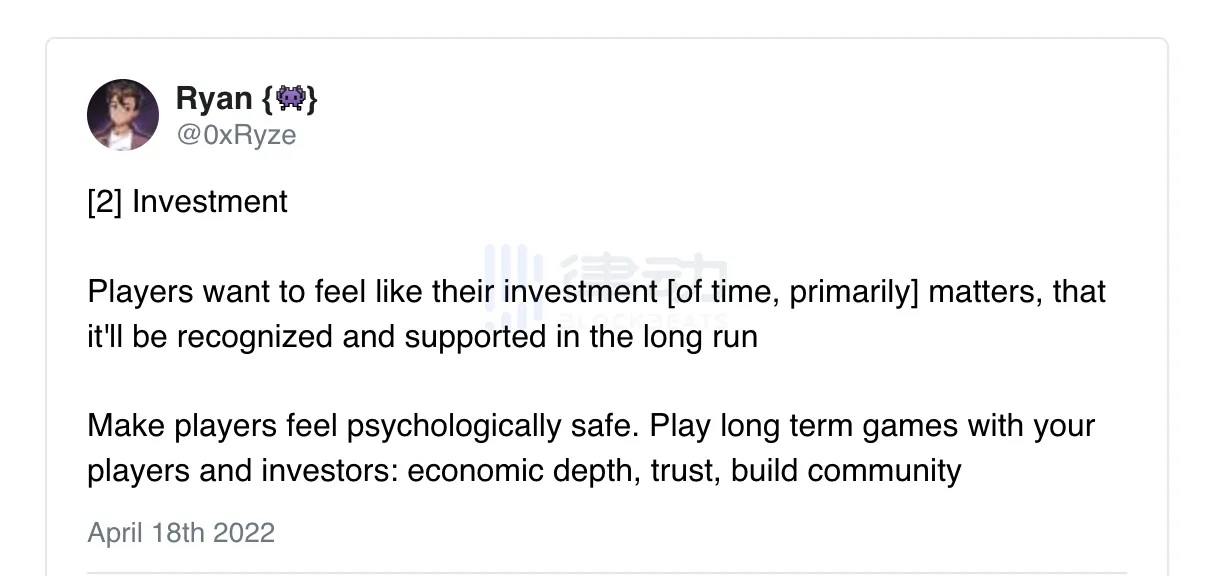
However, game designers have an incentive to boost player assets in the short term, which can damage the health of the game in the long term. As a result, game governance must think very carefully about the timing of decentralization, who can vote, what to vote on, and other financial policies to align the long-term growth of the game with its investor-class player base.
In addition, well-designed governance also ensures that players' voices are heard, and many great games have died due to unapproved updates from the community.
Pros and cons
Governance is content, in keeping with the spirit of Web3 decentralization, but with the added complexity of game design.
Edward Castronova writes in Virtual Economies: Design and Analysis that economic and market design is an extra for players to enjoy, and THAT I personally have always preferred to make markets, trade and invest rather than play actual game types like Mmos.
Therefore, I think the ultimate goal of game governance is to integrate it into the content and organize other players, especially those who are constantly making suggestions during the development of the game, who are the most common players in MMO-style games. In a sense, game governance is the perfect combination of the two.
Web3 game governance system
Weighted voting
- Certain heavy participants, demographics can increase voting power in direct ballots or council votes, which may be the UGC creators who have reached milestones in the game.
- The key difficulty is designing the best demographic map system to manage an area without managing capture over time.
Can divaricating
- Given enough time, all favorite games will open source their codebase, so private servers and modding forks will proliferate.
- If a base tier game provides assets and monetization by controlling liquidity or critical infrastructure (Dex, creator tools, wager rewards, etc.), then open source allows players to "easily opt out" of game updates they disagree with while still monetizing contributions already made.
- Private server players will still be incentivized to use the core infrastructure and assets, similar to private servers in World of Warcraft. Therefore, there is a case for open source as a means of governance for Web3 games, thanks to the monetisation and excitement of Web3 games.
- As long as the game state is not open source, the developer tends to be the primary controller of the game, deciding what and how to implement changes to the game state.
Original video link
However, sometimes a lot of player feedback is "noise" from a few special interest groups, which ultimately hurts the core player base, so mishandling aggregation and filtering, and making improvements that satisfy marginal groups, can lead to game death.
Therefore, the following solutions can be tried:
- Listen to the entire potential user base or target group;
Listen to existing users, but focus too much on the type of users the developers are trying to attract;
- Use the designer's intuition, which largely depends on how attuned they are to their target group;
- Test new policy decisions in simulation instances and collect qualitative (e.g., satisfaction) and quantitative (retention, interaction increments, etc.) user data.
The original link
Welcome to join the official BlockBeats community:
Telegram Subscription Group: https://t.me/theblockbeats
Telegram Discussion Group: https://t.me/BlockBeats_App
Official Twitter Account: https://twitter.com/BlockBeatsAsia

 Related Articles