Thinking and discussion: are games in the traditional sense really suitable to enter the field of encryption?
原文标题:《IOSG Weekly Brief | Crypto-gaming, 我们不需要更快的马车 #103 》
原文来源:IOSG Ventures
Part.1 Insight
Crypto-gaming, we don't need a faster carriage
Why do traditional games prohibit players from trading?
We've spoken to a number of game teams recently, and the general consensus is that token economy design in games is generally tricky. In traditional games, "nurture" is one of the cornerstones that keeps the game alive. What is "nurture"? The idea is to go from zero to one, from nothing. The concept of nurturance runs through almost every successful game, from World of Warcraft to the Immortal Simulator. But getting a game designer to recreate the "nurturing" experience in a chain game is like getting a track athlete to run through water.
It's important to understand how traditional game companies are industrially producing quality "nurturance" experiences. If I had to say it in one sentence, it would be "to create an infinite number of closed parallel universes and let each player get high in his own universe".
For example, in Diablo, the main character is born penniless and in rags. When the protagonist fights for the town residents and destroys the bandits, the residents give the protagonist a sword, which makes the protagonist feel the positive feedback of growth. A complete flow cycle is complete.
Behind this behavior, there are two indispensable elements. The first is A parallel universe: if player A helps the residents, the residents no longer need player B's help, the game is broken. The second is closure. If player A gets A sword and sells it directly to player B, then player B will lose the motivation to fight off bandits, and their "cultivation" and "flow" experience will be severely weakened.
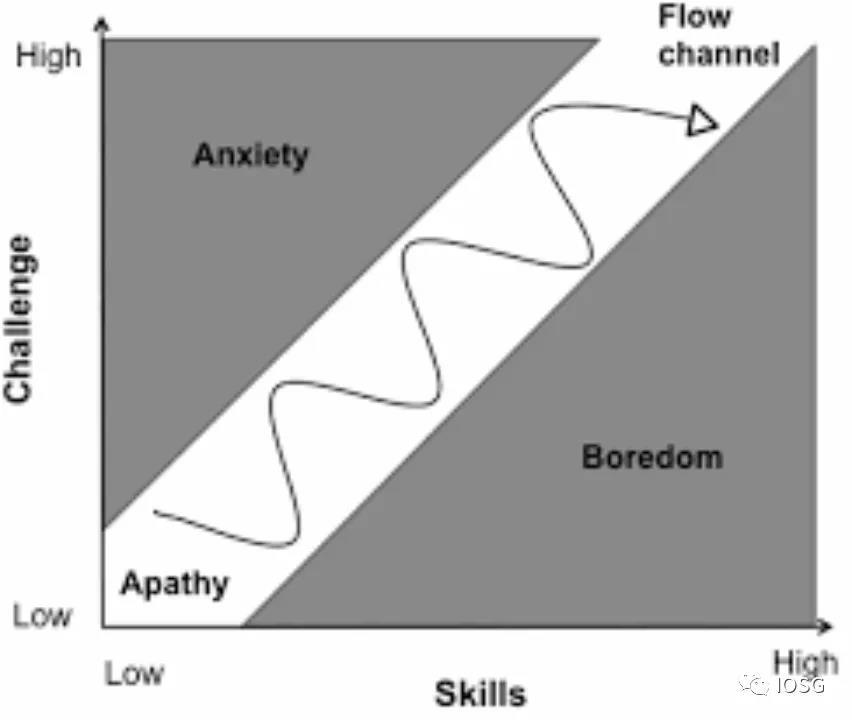
Thus, in the vast majority of games, game design follows the principles of "parallel universes" and "closed worlds". Heavy use of bitplane technology and prohibition of player trading. The first is to better capture the cash flow, and the second is to ensure the player's nurturing experience.
However, these two cornerstones of game design are at odds with the metasverse and Blockchain.
In fact, in Diablo iii, the development team tried to open an auction house where players could directly trade equipment for dollars. Soon, this feature became a disaster. Instead of a dozen hours of solid nurturing experience, the purchase of a few dollars, the player lost the goal of beating monsters and leveling up. On the other hand, the players who sold the game gear saw their hundreds of hours of hard work equated with a price tag of tens of dollars and left quickly.
The auction house feature was hastily pulled from the shelves amid flare-up and never mentioned again.
In fact, even in the design of The dragon head Axie, we can see the tension between game design and chain.In Axie, each Sprite has its own level, which grows with the player's efforts. However, this level is not logged on the chain, but is stored on a centralized server. When a player sells a Sprite to a third party, the level is cleared. When the player buys the Sprite again, the level is restored. Such a design led not only to counter-intuitive but also to a series of exploits that took advantage of the reset level feature. Behind such inelegant design, we see the incompatibility between traditional games and blockchain at the core.
This led me to my first thought.Are traditional games really suitable for entering the crypto realm? Will chain games still exist in the form we know of as games? Perhaps this "game" is not that "game"?
My first thought was that maybe all numerical nurturing experiences don't survive well in chain games. What will last, then, is the experience of growing the player's skills and abilities. To put it simply, PVP and esports games tend not to rely on the growth of numbers, and they are more likely to have chemistry with the open economy on the chain. But to predict the growth of chain games, we need a deeper understanding of the nature of games. Due to space limitation, this article does not expand.
With all the challenges, why crypto-gaming?
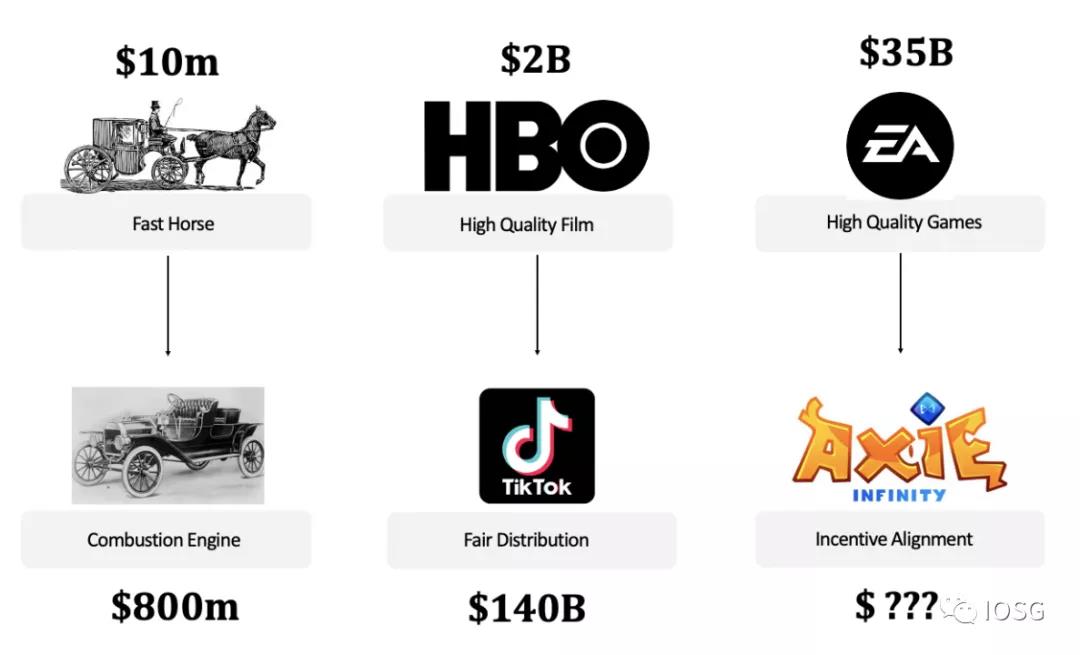
This year, the explosion of Axie has attracted many traditional game industry entrepreneurs to the track. Many people began by criticizing Axie Infinity's playability and confidently promising to make a game better than Axie Infinity. It sounds ridiculous. For example, when cars based on internal combustion engines were just invented, although the speed was not fast, it also caused widespread attention in the market. Then the men from the wagon company jumped out and promised that they would make cars, too. How do you design it? Use a faster horse to lead the car.
I think it's going to be a whole new thing, it's a discontinuous mutation. Chain games may look like games, but at present, chain games are only the stitching of the initial game between the game gene and the blockchain gene. I don't think web 2.0-native game teams can really understand and influence this evolution any more than a wagon company can really push innovation in the internal combustion engine. If "faster horse" is "better game," what exactly is "internal combustion engine"?It's a decentralized production relationship.
It may sound abstract, but fortunately, in the traditional Internet, we have been able to observe the enormous potential energy unleashed by decentralized production relationships. (Web3.0 must be decentralized, but decentralization doesn't have to be Web3.0). In my opinion, the most decentralized product in the web2.0 era is douyin. Although Douyin does not have a direct token system or token economy, it has fully activated the economy of short video creators through fair content distribution and friendly creation tools.
Tiktok is challenging centralized content producers like HBO or IQiyi. Tik Tok escaped the conundrum of content production and struck from a higher dimension. Tiktok has revitalized individuals who once lacked the capacity to produce and distribute, and built a monster creator economy around them.
On the other hand, why can Axie get such great community support? I think there is a very important factor that many people ignore: all of the revenue generated during Axie's operation goes to the Treasury, and the Treasury rewards all of the builders (players, Kols, guilds, teams, liquidity infectors). While Douyin revolutionized decentralized production relationships with fair distribution and easy-to-use production tools, Axie won over people with token economy and DAO governance blueprint. "Shu" is completely different, but "Tao" happens to coincide.
How to land the new production relations?
There is no doubt that incentive alignment in blockchain gaming will unleash a whole new level of gaming productivity. But what to make of it? DAO games where everyone works together to design gameplay and code together?
I don't think so. I've developed games myself, and I think of games as a form of art. Just as literature needs writers and movies need directors, so does the soul behind games need a voice to drive their production. We've all played the party game of "one person writes a novel," and it's clear that high-quality artistic content is hard to push through in such a decentralized way.
It may be depressing to think about this, but don't worry. If we look closely at the financial statements of a traditional game company, we will find that the largest part of the costs of a game company is not development, but publishing. Simply put, it is propaganda, promotion, marketing. And all this work, perfect fit for the natural love of game players. In fact, in the web2.0 era, there are plenty of hosts, up hosts, esports players, strategy makers, guild activists... They're all generating electricity for love, for free, for the game. If you can use the token system to recruit them, turn them into the master of the game, the potential energy is immeasurable.
On the other hand, as the composable, spliceable components of the meta-universe mature, maybe we'll see more people have the opportunity to become more meaningful content producers. Paid third party skins, maps, mods, tournaments, walkthroughs...
P2E, as Axie advocates, is in essence a way of channeling the investment of new users -- the profits of game companies and platforms -- back to gamers. However, such P2E is still in its infancy as a paradigm shift, and there are still plenty of technical problems. (Once and for all mining hinders positive cash flow formation, repetitive PVE pointless drain on player energy and spawn scripts/studios, how to successfully complete DAO transformation in 2023... , etc...).
My ideal Web3 game ecosystem
Let's imagine a person in the future, and in reference to Web3, we'll call him wang SAN.
Wang SAN is a large Internet factory code farmers. After work, Wang SAN is a very hardcore game player. His favorite game is Dark Souls. Wang SAN tried to start a game business in 2022. He made a roguelike+ chicken eating game with several friends. After burning more than one million yuan of savings, he found that the customer acquisition cost of more than 200 yuan was far higher than the LTV of this game.
In 2026, Wang SAN wants to try again.
Wang SAN has not forgotten his game, after the precipitation of time, he also more than a point of confidence. He relaunched the project and called it the Pigeon Battle Royale. He wrote the design concept of the game as Whitepaper and posted it to a Web3 game community.
Soon, the pigeon Massacre white paper sparked discussion in the community. Community members Zhang Si and Li Wu were excited about this new gameplay design, and they began to interact with Wang SAN. Several people had a long conversation in Discord3 about what was new about the gameplay and how to iterate. According to zhang Si and Li Wu's Galaxy Badge NFT, they were involved in the early construction of Axie Infinity and Illuvium, respectively. Zhang Si is one of the most popular skin creators on Axie, while Li Wu is known as an Illuvium eservation player and promotional ambassador.
The three met very soon. A week later, they decided to set up a Pigeon Battle Royale DAO on a DAO Aggregator together. Soon, more game enthusiasts joined the organization, some helping to write code, some helping to draw original art, and some helping to design the economy.
About a month later, the Demo was finished, and they jointly decided to upload it to a Web3 social platform, which gained a lot of NFT likes overnight. By this point, the team had more than a dozen part-time founders. They were so excited about the Battle Royale that several of them wanted to quit their jobs and focus on game development full time. After wang consulted with the team, they decided to crowdfund a sum of money to solve the livelihood problems of several core contributors first.
They publicly sold 10% tokens for the Pigeon Battle Royale on a Web3 Kickstarter platform. To show their resolve, they used smart contracts to lock up their tokens in the Treasury controlled by the DAO. This is a public address, and any transaction within the address needs to comply with the DAO's rules, which are smart contracts written by all coin holders based on power weight voting decisions. As the game develops, the rules will be revised irregularly by voting. In addition, for compliance, all manual transactions of non-smart contracts in the Treasury need to be announced eight hours in advance to prevent managers from maliciously mishandling the market.
Because the design of the game was so innovative and token's model was robust enough, many game enthusiasts responded with contributions ranging from hundreds to tens of thousands of yuan each. Several unions, led by YGG, also stepped in, and together they bought a 5% stake.
After the development funds are received, most of them are locked in a decentralized development platform like Gitcoin, except for a small part that is directly unlocked to the team to support the family expenses. As the team expands, more and more of the development costs will be paid directly to the engineers and designers through Gitcoin, with all invoices and corresponding source code deposited as NFT, supervised by a Web3 audit DAO. Of course, some of the anti-cheating algorithms were developed confidentially through ZK's technology. The community can see where the money is going and what is being done, but the specific code is encapsulated.
After a year of development, the game went live. At this point, the DAO had several hundred contributors (those who invested early but didn't contribute had been voted back) and several thousand deep beta players. Everyone was trying to promote the game on their Web3 friends, and the attention went up and up. After three months, the game had sold tens of millions of NFT, and the secondary market was generating millions in fees per month. 100% of these revenues are transferred from the smart contract to the Treasury, with a portion locked up to maintain the Token price and a portion continuously distributed to contributors according to THE DAO's rules.
A year later, 10 million gaming days were played, and the Pepsi Cup Pigeon World Championship was successfully concluded.
Written in the end
I now ask the founders of each project what they think is the most important thing about Crypto Gaming. Ownership, a lot of people would say.
In my opinion, ownership is only the appearance, not the essence. For example, when I hold a wad of Zimbabwean notes, do I own the money? Obviously, these notes are more NFT than NFT, they're unique, traceable, even tangible. I took ownership of the money, but the value behind the money kept escaping from me with inflation. These legal coins with strong property rights are even less valuable than the Q coins of Web2, which are criticized.Without decentralized empowerment, there can be no decentralized property rights. Those NFTS that are not decentralized will eventually be bound by the fate of the Zimbabwe dollar.
We want to see more entrepreneurs step up and build a truly decentralized creator economy.
Part.2 Investment and financing progress
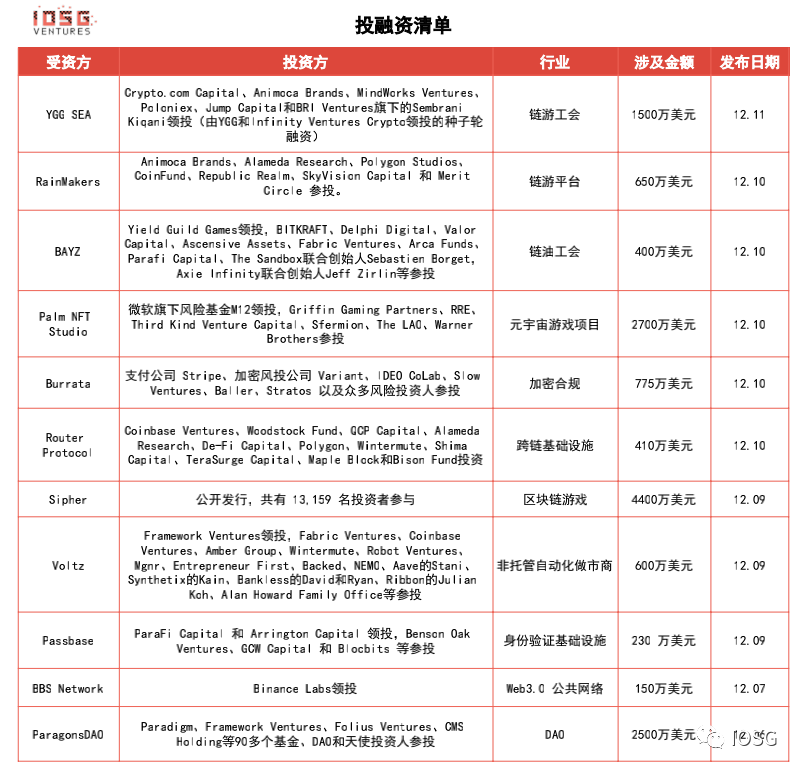
ParagonsDAO completed $25 million financing, Paradigm and others participated in the investment
* Chain game community
ParagonsDAO announced that it has closed a $25 million funding round with more than 90 funds, DAOs and angel investors, including Paradigm, Framework Ventures, Folius Ventures, CMS Holding, etc. The new money will be used to support ecological development. "You can soon contribute to the future of ParagonsDAO and be rewarded by owning our governance token, $PDT," the announcement reads.
Binance Labs led BBS Network's $1.5 million seed round
*Web3
Binance Labs led a $1.5 million seed round for Bulletin Board System (BBS) Network, a decentralized Web3.0 public Network consisting of user-run online message boards. BBS Network is a SocialFi project that allows users to share original content, while creatives, curators and other interested parties receive revenue in the form of native tokens.
Eyal Hertzog, FOUNDER and CEO of BBS, said: "BBS Network's mission is to return control of social media content and revenue to the users themselves. SocialFi will be the next big thing in blockchain, and by partnering with Binance Labs, we will be able to further decentralize SocialFi. After this round of funding, we will focus on developing more new features, including native apps, search engines, cross-BBS verification and more."
Passbase raised $13.5 million, led by Costanoa Ventures
* Authentication
Passbase on Wednesday announced A $13.5 million round, including $10 million in Series A and $3.5 million in SeED-2. The round was led by Costanoa Ventures, followed by Lakestar, Eniac Ventures and Cowboy Ventures.
Passbase is designed to help companies automate the authentication process to meet anti-money Laundering (AML), Know Your Customer (KYC) and age restrictions around the world. Its products and services cover more than 6,000 ids in 190 countries and 15 languages, and its annual revenue grew eightfold last year. The startup will use the new funding to expand its product suite and streamline policy administration for cryptocurrencies, fintech and other businesses using Passbase for authentication services to meet fast-changing global compliance requirements and break into new markets faster.
Voltz raised $6 million in seed funding, led by Framework Ventures
* Unmanaged automated market makers
Voltz announced a $6 million seed round led by Framework Ventures, Fabric Ventures, Coinbase Ventures, Amber Group, Wintermute, Robot Ventures, Mgnr, Entrepreneur First, Backed, NEMO, Aave Stani, Kain at Synthetix, David and Ryan at Bankless, Julian Koh at Ribbon, Alan Howard Family Office, and others contributed.
Burrata, a startup, raised $7.75 million from payments company Stripe
* Encryption compliance
Burrata has raised $7.75 million in funding from payments firm Stripe, crypto venture capital firm Variant, IDEO CoLab, Slow Ventures, Baller, Stratos, and a host of venture capitalists.
Burrata aims to address the personally identifiable information (PII) pain point in encryption by creating the tools and infrastructure necessary to check all compliance without building a PII server. The startup plans to create a compliance toolkit to make Know Your Customer (KYC) a more seamless developer experience. The Burrata team also said that coin-issuing may hinder the development of the project, that users can access its services without paying, so coin-issuing is not entirely needed and that there will be gradual decentralization in the future.
Router Protocol has completed $4.1 million in funding and plans to launch its main network in the coming weeks
* Cross-chain infrastructure
Router Protocol received $4.1 million in funding, Coinbase Ventures, Woodstock Fund, QCP Capital, Alameda Research, De-Fi Capital, Polygon, Wintermute, Shima Capital, TeraSurge Capital, Maple Block and Bison Fund. Router Protocol also announced partnerships with multiple protocols, including Polygon, Avalanche, Terra, Algorand, and plans to launch the mainnet in the coming weeks.
Brazilian online game Guild BAYZ has raised $4 million, led by Yield Guild Games
* Link game Unions & NBSP;
BAYZ announces closing of $4 million funding round led by Yield Guild Games, Co-founder of BITKRAFT, Delphi Digital, Valor Capital, Ascensive Assets, Fabric Ventures, Arca Funds, Parafi Capital and The Sandbox Sebastien Borget, Axie Infinity co-founder Jeff Zirlin and other contributors. The new funds will be used to partner with blockchain game developers, develop their content and creator networks, and recruit talent.
Palm NFT Studio raised $27 million, led by Microsoft's M12
*NFT
Palm NFT Studio announced the closing of a $27 million Series B funding round led by Microsoft's M12 venture fund, Griffin Gaming Partners, RRE, Third Kind Venture Capital, Sfermion, The LAO, and Warner Brothers contributed. The new financing will mainly be used to expand the company's operations and hire lots of new employees. Palm Network is an Ethereum side chain focused on NFT. Palm works with companies and brands to help them create NFT projects that use Ethereum on the back end. This is exactly the type of blockchain service that Microsoft and its M12 venture fund believe has potential at the enterprise level. So far, Palm has worked with some big names, including the "Space Jam 2" NFT series and the NFT project with comic book company DC at the DC Fandome 2021 event.
Rainmaker Games has raised $6.5 million in seed funding from Animoca Brands
* Chain game platform
Berlin-based venture capital firm Greenfield One has raised a $160 million (142 million euros) cryptocurrency fund to invest in cryptocurrency projects, with Galaxy Digital, German media giant Bertelsmann, telecom giant Swisscom and others taking part. Greenfield One, which has invested in voting rights lending agreement Paladin, bitcoin open source development non-profit Brink, and Darkblock, an economic platform for Web3.0 creators, focuses on European Web3.0 projects and was an early investor in Celo.
Sipher raised $44 million through a coin offering
* to swim
Sipher, a blockchain game based in Ho Chi Minh City, Vietnam, has announced the completion of its token public offering. According to official data, the public offering raised us $44 million (9,950 ETH) for the project, with 13,159 investors participating, and the estimated Token price was 0.00024ETH (about US $1.1).
Part.3 IOSG project progress
IoTeX has officially released the Machine Finance MachineFi Vision Book and IoTeX 2.0 Roadmap, ushering in a new era of machine finance with billions of dollars.
* Infrastructure
IoTeX has partnered with Swash, a blockchain service ecosystem, to bring verifiable data collected by IoTeX hardware into the data economy Swash has built for over 200,000 users. We also worked with Block chain leading solution provider Covalent to expand available data sources for MachineFi. In the vision book, IoTeX introduces the future of web3 machine economy era to the world for the first time, and elaborates the concept of machine finance #MachineFi; Introducing the innovations brought about by IoTeX 2.0: transforming the traditional Internet of Things and machine verticals into MachineFi DApp; A trillion-dollar opportunity to unleash in the Metaverse and Web3 worlds: use cases about to be empowered by MachineFi; And ultimately enable millions of users to participate in the machine economy with billions of smart devices.
On November 20th at 1am Beijing time, IoTeX team will conduct MachineFi live, IoTeX co-founder Raullen will give a machine financial MachineFi starring speech; At the same time, more than ten IoTeX team members will meet with the community for a variety of thematic discussions.
MachineFi vision book: https://docsend.com/view/dujzx48ihkg2mirr
MachineFi website: https://machinefi.com
Live links: https://www.youtube.com/watch?v=BXCHhGe9lio& t=0s
NEAR Foundation and WOO Network enter into a $5 million token swap
* infrastructure
The NEAR Foundation and WOO Network have announced a $5 million token swap collaboration that will see WOO Network become one of the key builders of NEAR Ecology, accelerating the construction of NEAR's financial infrastructure. NEAR tokens are pledged to generate revenue by the newly formed WOO DAO, which is used to manage a Treasury of 300 million WOO tokens. NEAR is a blockchain-based open web infrastructure that is a development platform for releasing the next generation of decentralized social, financial, gaming and more applications. NEAR recently announced an $800 million eco-incentive program. The WOO Network is a liquidity ecosystem that connects traders, exchanges, institutions and DeFi platforms with liquidity, trade execution and yield-generating strategies.
Part.4 Industry pulse
XDai and Gnosis have proposed through a merger that the STAKE token will be replaced with a GNO token
* Capacity expansion solution
XDai announced that the proposal to merge with Gnosis has been approved, and that the replacement of STAKE tokens to GNO tokens will begin in earnest, with xDai Chain changing its name to Gnosis Chain.
Polygon acquired ZK-Rollups startup Mir Protocol for $400 million
* Capacity expansion solution
Polygon announced the acquisition of ZK-Rollups startup Mir Protocol for $400 million. Polygon and Mir reached a deal on November 26, The consideration for the acquisition is 190 million MATIC tokens and $100 million USDC staboins. Polygon co-founder Sandeep Nailwal said the deal has a vestment period of three years, meaning the Mir team will be able to withdraw funds based on deliverables within three years. As part of the deal, Mir will build a new project, Polygon Zero, based on its ZK-proof technology.
Zk-proof can be used to create a ZK rollup, which can process transactions but does not require all transaction data to be published to Ethereum, which helps expand Ethereum and reduce gas costs. Mir's system generates recursive zero-knowledge proofs, allowing "many Ethereum transactions to be verified with a small proof," which would make Mir one of the fastest and most efficient tier 2 technologies, the report said.
DeFi Flamingo completes major upgrade to enable Neo N3 mainnet migration
* Full-stack DeFi protocol cluster
Flamingo has announced the completion of a major upgrade to its Neo N3 main network. Meanwhile, asset migration from Neo Legacy to Neo N3 has also started. During the migration, the generated FLM excitation will be migrated from Neo Legacy to Neo N3 within 30 days at an increasing rate. You need to migrate assets as soon as possible.
According to FLM's incentive migration plan, 25% of all incentives will be generated on THE Neo N3 and 75% of all incentives will be generated on the Neo Legacy from December 3 to December 13, 2021 (day 0-10 of incentives); From December 14 to December 23, 2021 (11-20 days from the start of motivation), 50% of all motivation will be generated on Neo N3 and 50% of all motivation will be generated on Neo Legacy; From December 24, 2021 to January 2, 2022 (21-30 days of excitation), 75% of all excitation will be generated on Neo N3 and 25% of all excitation will be generated on Neo Legacy; Full excitation will be generated on Neo N3 on January 2, 2022 (30 days after excitation starts).
Animoca Brands has entered into a joint venture with horse ranch Aquis Farm to develop horsemanship related NFT and metauniverse products
*metaverseAnimoca
Brands announced an exclusive global joint venture with Aquis Farm, a horse ranch. The new venture will develop meta-universe products, games and NFT directly related to real-world equestrian activities. Aquis Farm will be responsible for providing real-world equestrian intellectual property, business opportunities, and concept development for equestrian NFT ecosystems and meta-universes. Animoca Brands will be responsible for the development, marketing and sales of NFT and metauniverse games that combine horsemanship with blockchain.
Axie Infinity triples the SLP cost of breeding Axie and reduces the AXS cost to 0.5
*GameFi
Axie Infinity has announced that it will adjust the economics of breeding Axie in the game, increasing the cost of SLP to three times the current cost and reducing the cost of AXS to 0.5 units. Axie Infinity says much of the recent imbalance is due to the high AXS portion of breeding fees. We believe this adjustment will better balance SLP burning, Axie supply growth and incentives for breeders and players. This update is designed to manage in-game resource inflation to improve stability and ensure breeding opportunities make sense to drive Axie supply expansion and make Axies available to current and future players at a reasonable price.
Adrian Cheng, a Hong Kong property tycoon, invested in Sandbox to build virtual worlds
*Metaverse
Hong Kong real estate magnate Adrian Cheng, CEO of New World Development Group, announced that he will invest in Sandbox, a virtual land game, and acquire one of the largest digital plots in the Sandbox. Mr. Cheng's investment in Sandbox is about $5 million, according to people familiar with the matter. The 10 companies in the virtual world include diagnostic and genetic testing developer Prenetics, logistics unicorn Lalamove and tech accessories brand Casetify, all of which have ties or partnerships with New World Development and Zheng's venture capital firm. In addition, Cheng said his virtual world will include an "innovation center" to showcase the commercial success of greater Bay Area startups.
Gaming giant Ubisoft is testing in-game NFT based on the Tezos blockchain
*NFT
Ubisoft announced the launch of Ubisoft Quartz, a platform that allows players to earn and buy in-game items marked NFT on the Tezos blockchain, Quartz will be launched first in the PC version of "Tom Clancy's Ghost Recon Breakpoint," the latest tactical shooter developed by Ubisoft Paris and published by Ubisoft. Ubisoft Quartz will launch the beta on December 9 in the US, Canada, France, Germany, Spain, Italy, Belgium, Brazil and Australia. Ghost Recon Breakpoint players who have reached XP Level 5 in the game will be able to access NFT. Players must be at least 18 years old to create a Tezos wallet for the game. Ubisoft also plans to release free NFT for early adopters on December 9, 12, and 15, with more NFT planned for 2022.
"Ubisoft Quartz is the first component of our vision to develop a true meta-universe," said Nicolas Pouard, vp of Ubisoft's Strategic Innovation Lab. "It couldn't happen without overcoming the early limitations of blockchain on games, including scalability and energy consumption."
KRAFTON, a Korean game developer, is exploring the NFT business by entering the meta-universe
*NFT
In July, KRAFTON invested 5 billion won (4.2 million U.S. dollars) in Naver Z, a subsidiary of Internet giant Naver. Naver Z's Zepeto metaverse platform has more than 240 million users and recently raised $189 million in Series B funding. SoftBank Group, Mirae Asset, Naver Webtoon, JYP Entertainment, YG Entertainment and HYBE contributed. Bae Dong-geun, KRAFTON's chief financial officer, revealed that the company is also exploring the NFT business with the aim of further expanding the gaming experience. KRAFTON, formerly known as Bluehole, a well-known Game development company in South Korea, owns many popular online and mobile games such as PUBG, TERA and ELYON.
Messari Launches New Platform to track DAO governance "Messari Governor"
*DAO
Crypto research firm Messari has announced the launch of "Messari Governor", a platform to track the governance of major DAOs in the crypto space so that users can quickly grasp key DAO information. Members of the Messari research team will regularly add new proposals to the Messari Governor, rank them according to their importance and type, and measure community acceptance of the proposals, as well as include links to the related DAO voting portal and governance forum, which is currently free to the public. The platform also enables users to vote on DAO proposals on their platforms by connecting to Metamask, Coinbase Wallet, or WalletConnect, the cryptowallet platform. "Sites like CoinMarketCap allow you to see token bets," said Ben O'Neill, director of strategy and growth at Messari. "We wanted to build a platform where you could easily see community governance bets."
Former Google CEO Eric Schmidt has joined Chainlink Labs as a strategic advisor
*Oracle
Chainlink Labs announced On Tuesday that former Google CEO Eric Schmidt has signed on as a strategic advisor to the company. Schmidt will evaluate Chainlink's performance, research and provide guidance to identify possible strengths, weaknesses and opportunities in Chainlink's operations. Schmidt, a business leader and software engineer, served as CEO and chairman of Google from 2001 to 2011 and as a technology adviser to Alphabet from 2018 to 2020. Chainlink co-founder Sergey Nazarov: "Blockchain networks and Chainlink predictors are at a critical inflection point in growth and adoption, and Schmidt's experience and insights in building a global software platform for the next generation of innovation will be invaluable as we help developers and institutions usher in a new era of economic fairness and transparency."
The original link
Welcome to join the official BlockBeats community:
Telegram Subscription Group: https://t.me/theblockbeats
Telegram Discussion Group: https://t.me/BlockBeats_App
Official Twitter Account: https://twitter.com/BlockBeatsAsia

 Related Articles