Review the history of game development and interpret the past, present and future of GameFi

Original title: "Why GameFi?| h3>
I have always had a doubt:
< p>
“Why does the “Market Research” section in the white papers of so many blockchain games always list the number of players? What about the number of players citing traditional games?"
Blockchain games are still a relatively small minority Since the fourth quarter of last year, the number of users has remained close to 1 million, which is completely incomparable with the billions of players in traditional games. For this reason, if GameFi is considered as a whole, "the conversion process of traditional game players to blockchain game players" must be one of the most important issues.
Then the next question is, Why GameFi? What needs to be explained is that I define GameFi here as a game built on the blockchain, and the core is not financial .Based on this context, my question becomes very important, because at least at present and in the foreseeable future, there is a clear dividing line between blockchain games and traditional games. The specific differences will be discussed below. More introduction.
In order to answer this question, I hope to find blockchain games and traditional games The main advantages and disadvantages of GameFi. In the following, I will combine my own understanding and experience, through the analysis of specific cases, to sort out, analyze and summarize the past and current situation of GameFi, and look forward to its future, so as to find problems in the dimension of time
Second, GameFi 1.0 - Internet The era of moving bricks
Blockchain games in the GameFi 1.0 era are mostly game skins Financial tool + construction site.
Financial tool refers to many GameFi The games of the era, whether it is u-based, currency-based or otherwise, are essentially Ponzi schemes that tear down the east to pay for the west. By setting a high entry threshold to absorb blood from new users, the rewards are distributed to old users - high The fragile balance under the rate of return is very vulnerable to factors such as the sell-off of the local currency, the fading popularity, and the reduction of new users. Only a few top projects such as Axie Infinity can live longer.
The construction site refers to these games. Compared with non-blockchain games, most of them do not have enough operability , strategic and interesting, in short, they are all boring and boring games, the only purpose of playing games is to move bricks.
In my opinion, the main advantage of blockchain games in the GameFi 1.0 era is that they are more Low cashing costs.
Followed by a notorious Take the comparison of the value circulation process of the blockchain game BNB Hero and DNF Dungeon and Warriors (perspective of moving bricks) as an example to illustrate this advantage.
< /p>
a) Lower cashing costs
< /p>
DNF brick-moving players have two cashing options after converting all the income obtained from moving bricks into gold coins: through the auction house (in-game exchange) to sell gold coins to other players at a low exchange rate in C2C Exchange points for coupons, and then conduct coupon-RMB transactions with other players through unofficial channels; or conduct gold-RMB transactions directly through unofficial channels such as studios and third-party trading platforms.
Compared to BNB Hero players, DNF players are in the process of cashing out Or you need to endure extremely high asset depreciation (the price of gold coins in auction houses is generally more than 20% lower than the price of gold coins-RMB), or it takes time to communicate and find sellers and conduct high-risk transactions (self-operated C2C or to studios), or face high transaction thresholds (third-party platforms).
But I have to say that the advantages of games in the GameFi 1.0 era are also That's it. Other possible advantages are not reliable
1) to The "players really own the game" and "will not be blocked at will" brought about by centralization: at least at present, there is no implementation, which will be explained in detail at the end;
< /p>
2) NFT has a better value preservation: In the 1.0 era, few have long-term vitality, and value preservation is out of the question;
< p>3) Higher profitability: It is difficult for ordinary players to pick a good game that can really make money, and quit early before the profit efficiency decreases or even returns to zero.
Furthermore, the profitability of most GameFi 1.0 models in the early It's pretty obvious, but it starts to go downhill when the player count gets bigger. Taking BHB Hero as an example, its profitability was indeed very strong at the beginning of its launch, but it gradually turned into 10 days, 2 weeks, and 3 weeks to pay back its capital, and then directly lost all money. Take Axie Infinity again as an example. According to a report on bitcoin.com on November 15th, due to the drop in the price of $SLP, the income of ordinary players has fallen below the minimum income in the Philippines, and the current $SLP is 1% on November 15th. /6.
In addition, there are a lot of disadvantages in the 1.0 era: Zero risk and the risk of extinction brought about by future scripts and even AI bricks.
b) Zero risk
< p>The risk of zeroing is mainly divided into two categories: the project party running away and Token/NFT price fluctuations.
Compared with traditional games that need to go through multiple release reviews, block The release of blockchain games is much simpler. At least DNF will not run away suddenly, but BNB Hero will, and Chinese players cannot be held accountable through legal means.
In addition, the Token price of blockchain games is related to the macroeconomic The correlation between the game currency price and the macro economy is greater than that of traditional games. Fluctuations in Token prices will not only lead to a longer investment return cycle, but may also bring about factors that have a great negative impact on currency prices and return rates, such as reduced demand due to fewer newcomers entering the market, shrinking prize pools, etc.
c) Brought by scripts and even AI bricks Kill all risks
This is an interesting argument. I don’t know if you have heard of a project called AI Arena. Its core gameplay is to let your boxer become a mature automated AI boxer through imitation, learning or algorithm programming.
Picture: AI Arena
This kind of gameplay is a very interesting way to add value to NFT, but it Is it the so-called "plug-in" in the traditional game world? Or the so-called "automated brick-moving script"?
I think that all mechanical, easy-to-capture, and time-based moves rather than operations or extremely complex strategies Brick games will eventually be reduced to a paradise for studios and scripts. What followed was a large amount of materials and currency produced, and the inflation rate that ordinary brick-moving players could not catch up.
Third, GameFi 2.0 - more economical off-chain games
< p>I believe that friends who follow GameFi must have more or less experience with Bomb Crypto, also known as Bomberman. The number of users of this blockchain version of BNB has almost always been ranked in the top ten in GameFi since its launch.
I classify Bomberman into GameFi 2.0 because it combines both playability and profitability. The playability of GameFi 1.0 is completely negligible compared to the profitability, and GameFi 2.0 from my understanding should be a batch of games that are equally important for playability and profitability - or preservation of value.
a) The playability gap has been narrowed
In addition, GameFi game production in the 2.0 era is not much different from off-chain games. In [Playability] already comparable.
Here are the Titan Hunters and a A simple comparison with the domestic mobile game "Vitality Knight".
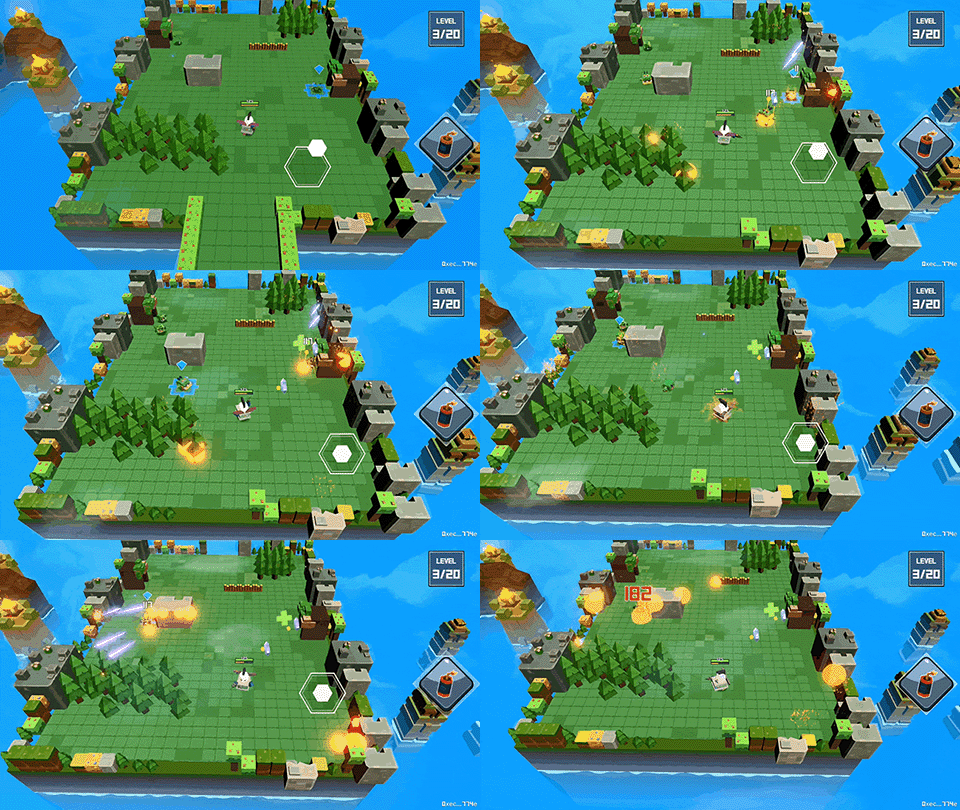
Titan Hunters moving Picture
You can see that in terms of battle screen and painting style , the two are almost the same (although Titan Hunters is on the PC side), and after my experience, the operability and fluency of the two in battle are also similar.
But TH needs more krypton gold investment, otherwise the process of slowly building equipment is still very exhausting; It is very easy to use, and novices can also get a very pleasant brushing experience.
The era of GameFi 1.0 and X.0 I defined has distinct characteristics of blockchain games In this era, the former is a purely decentralized financial tool, while the latter is a metaverse interaction scene with endless imagination. But GameFi 2.0 should be the era of blockchain games with the most traditional game characteristics. It should be the era when a large number of off-chain games are transferred to games on the blockchain. Games are drawn into the era of GameFi.
Thanks to NFT, GameFi games in the 2.0 era have the biggest advantage over off-chain games That's - preservation of value.
b) Give time and effort, gain pleasure and money
Preservation has two meanings. The first is that the time players spend in the game can be quantified. Due to the NFT of everything in the game, the rewards for all the time spent can be quantified, such as higher-level colors, better props, etc. In the GameFi world, what you spend your time getting is not only the thrill of playing games, but also economic benefits.
For example, an NFT-based game character means a character whose liver has finally reached its full level after a few weeks, all aspects of attributes are superb, and it can be immediately put into the highest-level copy It can be sold separately, instead of selling dozens of characters in the entire account through a third-party platform like an off-chain game.
Another example, NFTized game characters mean aesthetic is a valuable skill. Pinching a good-looking face, choosing a perfect outfit for the character, and even applying one's "unique aesthetic" to the character can all be reflected in the character's worth.
c) Krypton gold is not only for becoming stronger, but also an investment behavior
< /p>
The second meaning of preservation of value is that players’ krypton gold faces less depreciation pressure. Since everything is an NFT, as long as there is enough liquidity (which requires enough players and demand), players can easily sell their krypton gold to escort the early development of the trumpet.
As far as Titan Hunters are concerned, Krypton passed the Open blind boxes or in-game market transactions to configure efficient map-making equipment, which improves the efficiency of map-picking and mints higher-level equipment. Afterwards, you can mint the old equipment into higher-grade equipment or sell it directly in the secondary market, and enjoy profits/accept losses according to market price fluctuations.
d) One wallet unlocks all game accounts
The blockchain game wallet allows players to no longer need to register an account and write down a lot of account passwords , No longer suffer from different places and account exceptions. It means:
1) Unique identity. A wallet means an identity, and network residents who hold this identity can use the wallet to log in to all blockchain games without registration.
2) Repository. Through authorization, the virtual currency in the wallet can be directly consumed in the game, and NFT can be used in the game.
e) The barrier to entry is the biggest disadvantage
< /p>
However, GameFi games in the 2.0 era still have higher barriers to entry than off-chain games. These barriers are not only the main reason why blockchain games cannot be tried and accepted by most gamers, but also the biggest disadvantage of blockchain games in the GameFi 2.0 era compared to off-chain games.
1. Learning Threshold
The learning threshold is actually relatively easy to cross. Currency Conversion", "How to Install Wallet" and "How To". However, due to the firewall and most of the blockchain world application scenarios and learning materials in English, many domestic users have great obstacles in learning and using blockchain-related basic applications and operations.
Scientific Internet access, basic English skills and proper Internet knowledge For example, Chrome's translation plug-in has become a hidden threshold beyond the learning threshold.
2. Cognition Threshold
2. b>
The cognitive threshold of GameFi is not only that people actually "don't know GameFi ", "I don't know what GameFi is fun and economically profitable", but also because some people have a one-sided understanding of encryption, an unknown thing, or even never heard of it.
With the adoption of NFT avatars on Twitter and other highly influential social platforms, Chinese who have a deep understanding of foreign media and investment frontiers have gradually "know "GameFi" (of course, most of them are young people or overseas students).
But the problem is that GameFi can’t break the circle of blockchain , into the circle of the majority of gamers. Although major overseas companies such as Ubisoft have begun to test NFT games, the majority of domestic game circles are exposed to overseas games. In addition, the public opinion environment we are in is also very unfriendly to cryptocurrencies and GameFi, which constitutes a high cognitive threshold.
3. Investment Threshold
Although there are already many free blockchain games in the GameFi 2.0 era , such as the Titan Hunters mentioned above, but they are still very unfriendly to zero krypton and light gamers.
If new players don’t invest tens or hundreds of dollars Start-up capital requires a lot of time and energy to bridge the gap with krypton gold players, resulting in a double disadvantage of game experience and economic benefits.
f) Summary
Blockchain games in the GameFi 2.0 era, which will emerge in large numbers in 2022, will be the first year for overseas off-chain gamers to enter the GameFi world. When the playability is improved, and the value preservation and economic benefits far exceed those of off-chain games, overseas players and some domestic players who can cross the entry threshold have enough motivation to get in touch with GameFi.
Fourth, GameFi X.0 - work, crowd economy and decentralization
In the future, GameFi is expected to combine IOJ's outbreak of UGC economy-led play earning opportunities, blockchain game spectator economy and IP derivatives in the short to medium term (within 1-3 years) The outbreak; and the long-term problem that needs to be solved is to explore the real decentralization issue under the condition that the technical infrastructure has matured.
Why didn't I mention the so-called 3A masterpiece here? Because it is not friendly to ordinary players, it does not constitute a reason for "Why GameFi". GameFi's 3A masterpiece is like a giant whale's battlefield, with extremely high entry barriers (for example, the entry threshold for Sidus NFT Heros is at least one hero, the current floor price is 0.25ETH, and it needs at least $1,500 including handling fees) and high in-game content. The price of NFT (Star Atlas) is enough to dissuade most players who test the water.
In addition, due to the expected landing time of the Metaverse is too far away , The landing method is highly uncertain, so I won’t discuss it here
a) IOJ, UGC and the crowd economy of blockchain games
UGC's image, audio, video, map, gameplay and other elements revolve around the game, supplemented by IOJ and WorkFi platforms as the C-end Users and players provide monetization means, and through decentralized streaming media platform announcements and guessing (gambling) gameplay support, it will attract a large number of B-side IP and C-side investors, players and netizens, which will become a new trend of GameFi in the next few years.
The entire process can be roughly summarized as "taking the game as the core interactive scene, combining traditional IP, and UGC creates an onlooker economy for major content formats.” It is completed by users who are motivated to make UGC through IOJ platforms/tools, GameFi games, NFT production platforms/tools, and decentralized streaming platforms/publishing tools.
The game is the core part of the process, whether it is a game , NFT or streaming media, all need avatars as the main body of activities in the online world, especially the IP part. Compared with Internet content forms such as novels, comics, and videos, games emphasize interaction, emphasizing "participation" rather than "watching".
Why must GameFi be better involved in this process instead of off-chain games? Because of the blockchain's ability to confirm rights, traceability and peer-to-peer capabilities.
In the ecosystem under the chain, station B is already a mature example.
The whole process is very mature, but there are still two Question:
1) If the video is watched by a certain voice The author steals, the cost of rights protection is very high, and there will even be outrageous arguments about "who is the original";
2) There is no separate income distribution/confirmation platform, and the economic income distributed based on a single video on the streaming platform is very small, and it is still the monetization logic of accumulating fans-bringing goods and receiving advertisements.
What about on the blockchain?
First, players
1) Mint the big-headed snowman on Opensea into 10 NFTs and sell them to 9 players;
2 ) Post a job post on Chrone.tech, hire an engineer to make a map of DNF West Coast elements in the first-person shooter game MetaStrike;
3) Import the big-headed snowman NFT MetaStrike plays a shooting game in the image of a big-headed snowman, and spectators bet on the game;
4) Record this video of the game and mint it into an NFT and put it on the blockchain streaming media Platform;
According to the above process, players can play in
1) Earn the price difference between NFT sale and Mint handling fee;
2) Earn listing The difference between the map/other players' income from using the map and the commission paid by chrone.tech;
3) If you win, you will earn money in the prize pool;
4) to earn streaming media NFT sales and other streaming media platform revenue;
In addition, the blockchain version of IP value circulation Compared with the off-chain process, the UGC ecosystem generated by the UGC vitality blessing is expected to attract the entry of traditional big IPs, so that the IP side and the UGC side will form a positive growth cycle of two-way promotion.
As for what is the IOJ mentioned in the title, it is simply a new form of work brought about by Web3-a real two-way choice between employers and employees.
For details, please refer to these two articles by Su Yuan Yuxin Article:
https://mp.weixin.qq.com/s/ovswqQ40Wu-PpGldhcT8Ng
https:// mp.weixin.qq.com/s/RljBE57SSniHHBomMyARtQ
b) The Right and Difficult Long-term Road - Decentralized Games and DAO
Decentralized games mean that the project party only acts as a "game developer" and "bug fixer" Appeared, and profited by selling Token and NFT and occupying a certain share. And more power is delegated to the players, and the decision-making power to choose the rhythm of the game update, the direction of the update, the future props and roles, and the method of benefit distribution is returned to the players, and governance is carried out in the form of DAO.
(https://mp.weixin.qq.com/s/aaGBfSaIJNHLIR0BRxdWYw, what is DAO is introduced here)
A while ago, there was a piece of news about the long gone FPS game CF that topped the hot search list, probably because a CF official was in charge of sealing the title The staff member "Aka" was cheated in the high-scoring game rankings, shot the body with a rifle and got 80 blood, and after being reported by the player, he responded, "Cook B looks like everyone is dead."
For all games now, including the decentralized games promoted by GameFi on the chain, the game publisher has the absolute right to speak when facing all matters in the game , Embarrassing incidents emerge in endlessly, such as endless tricks, game bugs that are never optimized, even secret changes to the explosion rate, and "one size fits all" anti-cheat titles. "Because I accidentally discovered a BUG and it was cool once, I was banned and there was no way to appeal", "The new equipment made after 3 months of liver was cool for a week, and it became a storage item because of the version update" and other things, I I believe that no one wants to let them happen to them.
The real decentralization of "the cultivator owns the land" is that blockchain games can be distinguished from traditional games , and even surpass the ultimate way of traditional off-chain games, which can be realized in the form of DAO.
The specific form is still in a very early stage, but please allow Let me make a wild guess:
1) Govern the primary circulation of Token Only issued in the form of bounty. 10% of the governance tokens belong to the project party, and 90% of the governance tokens are obtained by users/players by completing various tasks;
2) Establish a dedicated management team, and set up operations, development, marketing, compliance and other divisions (Sub-DAO). Users who complete various bounty tasks and obtain governance v can choose to join a certain branch or management team, and each branch designs its own governance model, but the governance token must be used as the core right certificate;
< br>
3) All remuneration is settled by the project system, and the governance token is paid. The technical layer is designed by the project party The code is maintained and open-sourced, and external users can be recruited to maintain it together. Operation and publicity are carried out through voting players through v incentives, and game strategy and update direction are carried out through Token incentives through voting to recruit consultants;
< /p>Why is the blockchain game that promotes "players really own the game" not decentralized in my opinion? Because the right to speak is still owned by the project party, players can make comments and threaten to sell Tokens ( But not everyone is a giant whale), but the project party can completely ignore it.
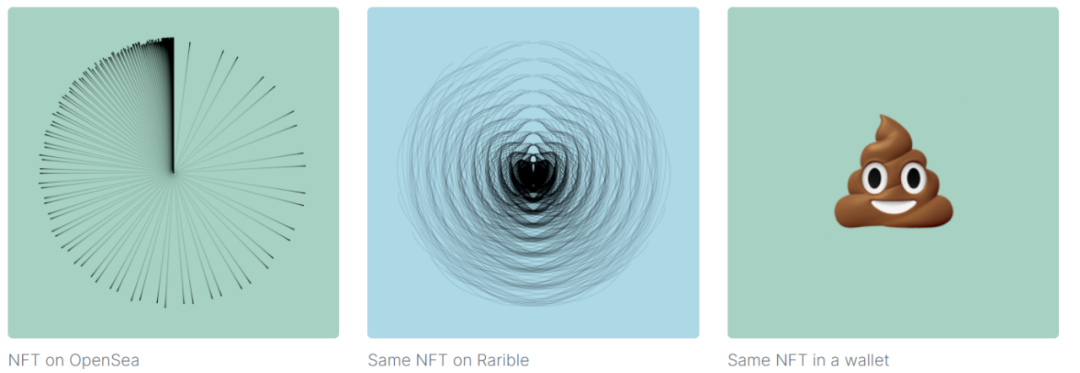
In addition , NFT does not mean absolute insurance. Owning NFT does not mean that the player has the function it represents in the game, because this function is given to the player by the project side. By the way popular science is a fun thing - there is no Opensea and Infru API interface The NFT is actually just a JPEG, and the same NFT can appear in different forms in different places.
< p>
The picture comes from "My first impressions of web3" by Moxie marlinspike,
Based on my one-sided understanding of this article, I guess that as long as the game project party does not want to admit that your NFT can be used in the game, they have ten thousand ways to make it Become a reality - I can't confirm what it is, so I won't talk nonsense.
Five, Dictionary
< p>GameFi 1.0: Generally refers to the blockchain game whose playability is worse than 4399, but it is possible to earn huge economic profits by playing games and selling reward tokens obtained. It also refers to the time period when most of the blockchain games on the market are such games.
GameFi 2.0: generally refers to the playability that can be compared with general off-chain page games/online games, and can obtain economic benefits by playing games (not necessarily selling Token ) blockchain games. It also refers to the time period when most of the blockchain games on the market are such games.
NFT: Non-Fungible Token, a unique Token that can be bound one-to-one with a certain physical asset, and is a proof of ownership.
Gas fee: the fee to be paid to operate on the blockchain
Mint: minting, Refers to the act of paying Gas fees to design and obtain NFT.
Giant Whale: A user with a large number of certain Tokens.
Launchpad: translated as launch pad, mainly refers to IDO launch pad. It is gamefi.org, redkite, seedify, etc. Pledge platform tokens to have the opportunity to purchase game/project tokens at a very low price, but the purchase tokens will be distributed in batches.
DAO: https://mp.weixin.qq.com/s/aaGBfSaIJNHLIR0BRxdWYw
IOJ: https://mp.weixin.qq.com/s/ovswqQ40Wu-PpGldhcT8Ng
https://mp.weixin.qq.com/s/RljBE57SSniHHBomMyARtQ
Original link
Welcome to join the official BlockBeats community:
Telegram Subscription Group: https://t.me/theblockbeats
Telegram Discussion Group: https://t.me/BlockBeats_App
Official Twitter Account: https://twitter.com/BlockBeatsAsia



 Related Articles