Babel Finance: A comparative study on the performance of the stock market and Bitcoin before and after the Fed raised interest rates
Original author: Yuanming Qiu (Research Analyst at Babel Finance) 、 Robbie Liu (Head of Research at Babel Finance)
During the epidemic, we have witnessed the incredible growth of the encryption market, and we have also observed a strong relationship between cryptocurrencies and traditional risk assets. Correlation. Since May 2020, the correlation between Bitcoin’s movements and the S&P 500’s volatility has been high at the 120-day and 240-day levels. And on a shorter scale, Bitcoin's 30-day correlation with the S&P 500 reached nearly 0.8 on May 6, 2022, the highest level since July 2017.
U.S. inflation hit 8.6% in May, a record high of 40 due to the coronavirus lockdown, rising energy prices and broader price pressures The Fed expressed its strong intention to tighten monetary policy in its recent press conference. Fed Chair Jerome Powell's most hawkish yet in May 2022 In the speech said: "What we need to see is inflation falling in a clear and convincing way, we Will keep pushing until we see that."
Uncertainty over monetary policy, along with fears of a recession, continue to Investors are reminded of the old adage "sell in May and run for the ride". In such a predicament, the debate among investors on whether Bitcoin still retains the property of storing value, or whether it is completely reduced to a high-risk investment, is rapidly heating up.

BTC Price and S&P 500 Index Historical Chart

Multi-time-period tracking correlation between S&P 500 index and Bitcoin price
We analyze the reactions of the U.S. stock market (as measured by the S&P 500 Index) and two of the most representative cryptocurrencies (Bitcoin and Ethereum) to recent U.S. monetary policy tightening events. In order to observe and quantify the response of each asset to various monetary policy regulation events, we adopt the most classic event research model: constant mean model (constant mean model), the estimation window (estimation window) is set to 250 days, and the event window ( event window) is set to 21 days (10 days before and after the event).
Regarding the selection of monetary policy regulation events, we base our selection on two criteria: whether key monetary policy decisions are made on that day, And whether investor attention, as measured by the Google Search Index, peaked on that day. Based on this, a total of three events have been selected for this research, namely:
May 4, 2022 - The Federal Reserve raises interest rates by 50 basis points, keywords Google search index for "rate hike" peaked;
March 16, 2022 - Federal Reserve raises interest rates by 25 basis points, Google for keyword "rate hike" The search index peaked;
January 26, 2022 - the first FOMC meeting this year, the Google search index for the keyword "Federal Reserve" peaked.
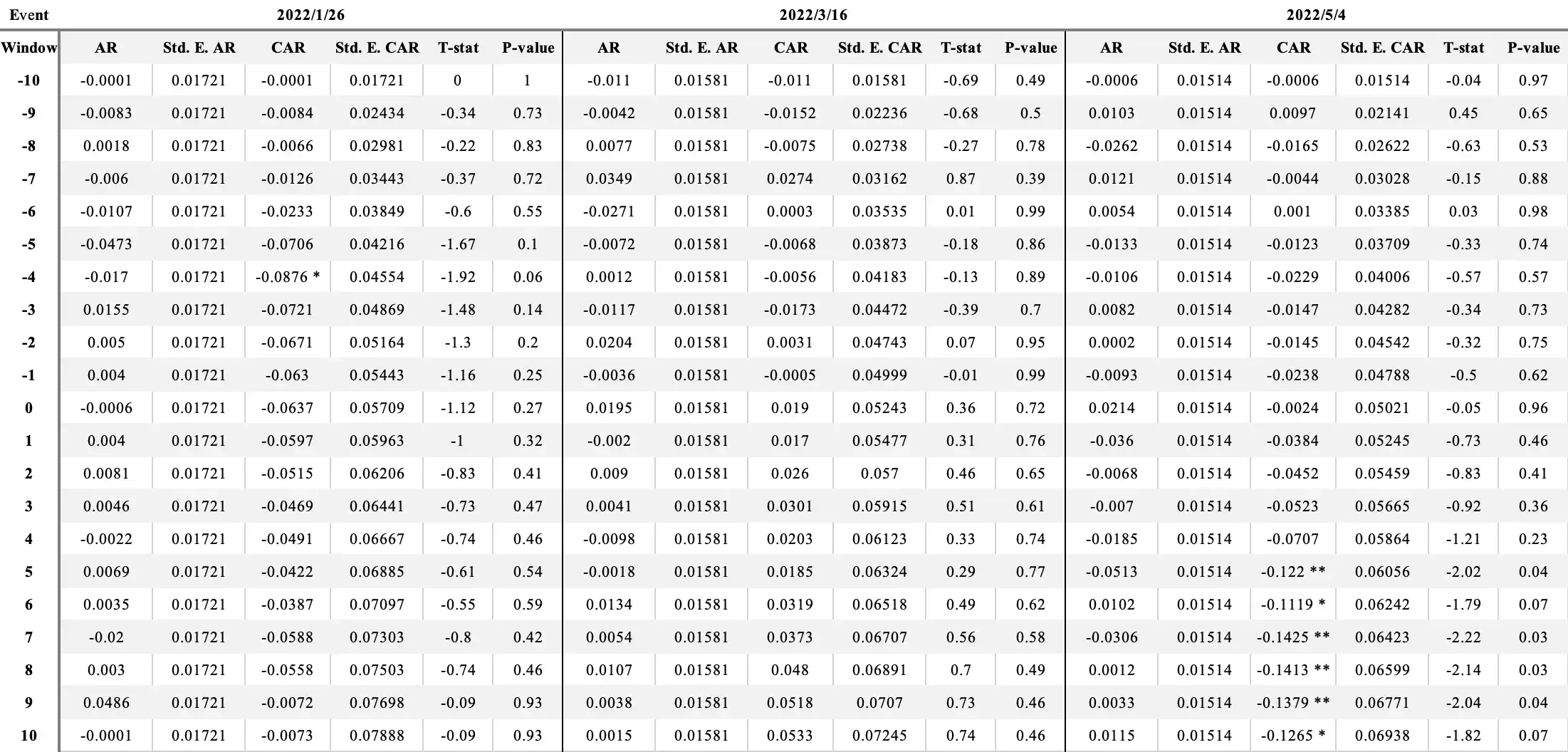
According to our model, both the S&P 500 and the two cryptocurrencies were affected by the Fed’s announcement on May 4. interest rate impact of 50 basis points. Notably, the S&P 500 saw a statistically significant sell-off pattern in the ten days leading up to May 4, 2022, continuing until the end of the rate hike event window. However, Bitcoin and Ethereum did not follow the same sell-off pattern. The two cryptocurrencies only came under a lot of selling pressure after the exact date of the rate hike.
Only the S&P 500 for a 25 basis point hike on March 16, 2022 Witness a statistically significant loss of profit prior to the event. Neither Bitcoin nor Ethereum has seen a statistically significant profit loss.
For the first FOMC meeting of the year on January 26, 2022, the S&P 500 and Ethereum traded at (-5 , 1) Both event windows experienced statistically significant loss of profit, while Bitcoin showed considerable recovery ability before the event (recovering ability) – We use the term “resilience” here given that this event is a scheduled FOMC meeting.

Three assets are aligned three times Price response to monetary policy regulation events
(the horizontal axis represents the number of days before and after each event; the blue line represents the cumulative abnormal return of each asset; the blue column represents the abnormal return of the asset in each event; The shaded area represents the 95% confidence interval for the t-test calculation)
In general, Bitcoin is The historical performance of the news event window shows that the largest cryptocurrency Bitcoin is better able to moderate the impact of monetary policy regulation events than the S & P 500 index and Ethereum. A reasonable explanation is that a considerable number of investors have always had confidence in Bitcoin's value storage properties and the narrative of hedging inflation. Even if the prices of other risky assets plummet, they will choose to hold Bitcoin for a long time.
Bitcoin’s on-chain statistics cross-validate this conclusion. Since the price dropped to the $25,000 to $32,000 range, it was marked as The "Little Shrimp" (<1 BTC) and "Big Whale" (>10,000 BTC, excluding exchanges and miners) addresses have been actively accumulating Bitcoin. According to Glassnode's data, in the past two months, Bitcoin This accumulation happens all the time when coins are running at low prices.
What can we expect from now on? As U.S. inflation continues to accelerate, the Fed will step up its efforts to cool the economy, regardless of whether Powell announces a 50 or 75 basis point hike after Wednesday's meeting. Some analysts are looking for signs that Bitcoin has bottomed out. Our analysis does not answer whether "buy the current dip" is a good bet, although the 30-day level correlation between Bitcoin and the S&P 500 has shown signs of declining, it is not sure whether the correlation between the two is will recover and how. In fact, our research shows that Bitcoin's store-of-value properties remain despite experiencing massive market capitalization growth and exhibiting contemporaneous volatility with other risky assets. Fidelity Digital Assets in the latest research article "In the event of a hard landing, we think Bitcoin will respond positively," he said. As always, Bitcoin's long-term narrative won't be easily derailed by another price crash. Bitcoin "true believers" will still stick to their original intentions.
Appendix: Based on constant mean Cumulative abnormal returns calculated by the model and the daily Bitcoin price data before and after the three monetary policy regulation events of 2022/5/4, 2022/3/16 and 2022/1/26
Welcome to join the official BlockBeats community:
Telegram Subscription Group: https://t.me/theblockbeats
Telegram Discussion Group: https://t.me/BlockBeats_App
Official Twitter Account: https://twitter.com/BlockBeatsAsia

 Related Articles