Why is China cutting interest rates while the rest of the world is raising them?
Original author: @0xUnicorn
The US dollar is the de facto international settlement currency and has a very special status.
Every time in history when the US dollar raised interest rates, it led to varying degrees of economic shock: in 1993, the US dollar raised interest rates and Mexico experienced a debt crisis; in 1995, the US dollar raised interest rates and Southeast Asia experienced a financial crisis; in 2001, the US dollar raised interest rates and Argentina experienced a debt crisis; in 2005-2006, the US dollar raised interest rates and the US experienced a subprime mortgage crisis; at the end of 2015, the US dollar raised interest rates and an emerging market crisis erupted.
The impact of US interest rate hikes is understandable for the US itself. Why do crises erupt in other countries every time the US dollar raises interest rates? Why do other countries follow suit when the US raises interest rates? And why is China lowering interest rates in a generally rising interest rate environment?
01 Arbitrage on Interest Rate Differential
In order to understand the impact of the US dollar interest rate hike, we first need to talk about a concept called "interest rate arbitrage". What is interest rate arbitrage? Let's take an example.
If you are a billionaire with $1 billion in liquid funds that need to be stored in a bank, and in early 2020, the deposit interest rates in the UK and the US were both 1% per year, then it doesn't matter whether you store your money in the UK or the US, as the interest earned in one year is $10 million. Upholding the principles of fairness and justice, you would deposit $500 million in the US and $500 million in the UK (corresponding to pounds).
One day, the Federal Reserve suddenly announced a rate hike, causing the deposit interest rate of American banks to increase to 3%. You realized that this was not good, as the interest on 500 million US dollars deposited in the UK for a year was only 5 million, while the interest in the US was 15 million, resulting in a profit difference of 10 million. You immediately called your secretary and instructed them to notify the UK bank that you wanted to withdraw all your money and convert it to US dollars to transfer to the American bank.
Not only have you discovered this arbitrage opportunity, but many large investment institutions have also discovered it. As a result, these institutions have obtained low-interest loans from British banks and deposited them in American banks to earn interest rate differentials. This process is called "interest rate arbitrage".
How will the interest rate arbitrage affect the economy? To understand this question, we need to introduce what the foreign exchange market is.
02 Foreign Exchange Market and Currency Depreciation
You are a leader of a large investment institution. You have discovered a huge "interest rate arbitrage" space in the financial markets of the United Kingdom and the United States. Therefore, you have borrowed 1 billion pounds of low-interest loans from a British bank and are ready to deposit them in the United States to take advantage of the interest rate difference.
However, you have British pounds in your hand. If you deposit them in a US bank, you cannot enjoy the interest in US dollars because the bank's interest is tied to the currency. In other words, before depositing British pounds in the US, you need to exchange them for US dollars. Therefore, you need to purchase US dollars with British pounds in the foreign exchange market. This process is the process of foreign exchange trading.
More and more people are borrowing British pounds at low interest rates from British banks and buying US dollars in the foreign exchange market. The US dollar is becoming increasingly popular and in demand. Previously, 100 pounds could buy 120 US dollars, but now 100 pounds can only buy 110 US dollars. As the US dollar becomes more "expensive", the British pound becomes increasingly cheaper. In economics, this phenomenon is called currency depreciation.
In fact, since the US raised interest rates, major currencies in various countries have started to depreciate.
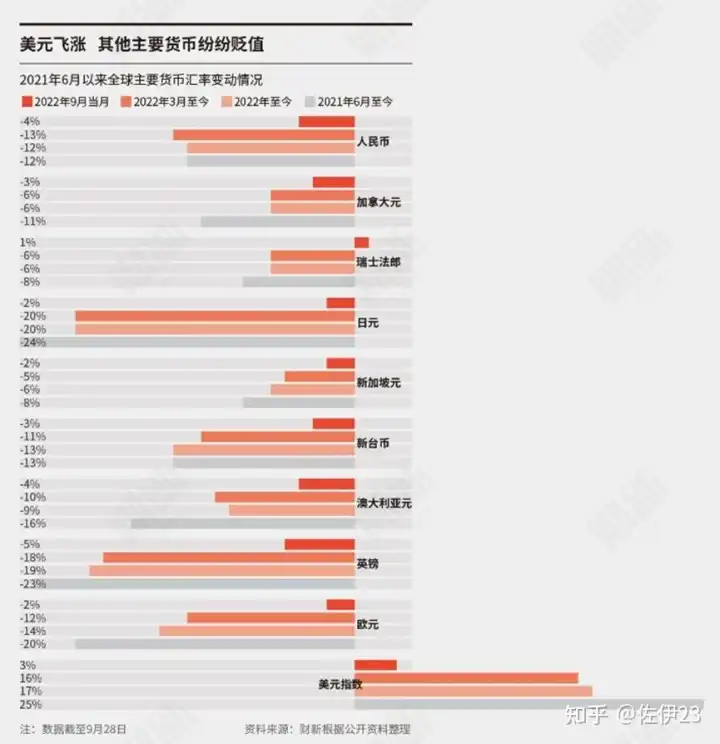
Some people say, "I don't trade foreign exchange, so currency depreciation doesn't affect me." This is incorrect. Currency depreciation affects each and every one of us. To understand this issue, we need to talk about input-type inflation.
03 Inflation
The first consequence of currency depreciation is that you may choose not to trade foreign exchange, but a country cannot avoid importing goods. As long as you import, you will need to use US dollars, because most imported goods are priced in US dollars.
For example, in the international market, a pair of Nike shoes is priced at $10. When the pound depreciates, importing a pair of shoes requires $10, totaling 9 pounds. Now that the pound has depreciated, although a pair of shoes still costs $10, it totals 11 pounds. In the eyes of British consumers, the product is undoubtedly more expensive.
Nike shoes are just an example. In fact, for many countries, the inflation of imported products is primarily reflected in energy and other commodities. Industrialized countries must consume energy to produce, and many countries cannot be self-sufficient in energy and must rely on imports. For example, oil is priced in US dollars, so even if international oil prices do not rise, if the local currency depreciates, the same amount of imported oil will consume more of the local currency. When raw material prices rise, it will be reflected in the final product, and domestic consumers will generally feel inflation. Taking Japan as an example, research has shown that "90% of the total price increase in Japan over the past 10 years comes from imported food and energy products".
Here, the impact of the US interest rate hike on the economy gradually enters the real economy of other countries through the foreign exchange market, through the means of interest rate arbitrage in the financial sector. As a result, important manufacturing countries such as Japan, Germany, South Korea, Italy, and France have experienced a decline in international trade income and even a trade deficit in 2022 (due to the sharp rise in import prices). Inflation in Europe also remains high under these conditions, struggling to sustain.
If you think that the impact of the US interest rate hike is over, then you are completely wrong. The impact of the US interest rate hike on the economy has just begun.
04 Financial Turmoil: The Second Consequence of Currency Depreciation
We often hear a term called "capital outflow". So, what is capital outflow? Why does capital need to flow out? Let's have an immersive experience to find out.
You are an international investor from the United States, and your funds are allocated in major stock markets around the world. Assuming that at the beginning of 2022, the exchange rate between the pound and the dollar is 1:1. After researching, you found that the UK stock market may experience a wave of growth, so you spent $1 million to exchange for 1 million pounds, and then used the 1 million pounds to purchase stocks in the UK stock market. Your vision is excellent, and the stocks you bought have performed well, rising to 1.2 million pounds after a few months, making you very happy.
However, unexpected events can happen. One day, you suddenly see the news that the US has raised interest rates. You realize that this could be bad news. Sure enough, those speculators who rely on interest rate differentials start to take action. They borrow large amounts of low-interest British pounds and buy US dollars. The value of the US dollar keeps rising while the British pound keeps depreciating. You suddenly realize that the money you earned from stocks was all virtual. After carefully calculating your accounts, you find that since the beginning of 2022, the British pound has depreciated by 15% against the US dollar. Your investment of 1.2 million pounds can now only be exchanged for 1.02 million US dollars, which is close to your cost.
What's even more frightening is that the Federal Reserve is continuing to raise interest rates, which means that the trend of the depreciation of the pound may continue. If this continues, your stocks will lose value if exchanged for dollars. What should you do? You tell yourself to cut your losses and sell your stocks on a large scale for cash, and then buy dollars with that cash as a "safe haven".
More and more people are discovering this problem, and they are also selling their stocks. The stock market began to reverse, and negative news came one after another. When most people are selling, the stock market experiences turbulence. It's not just the stock market that's shaking, but also the bond market, stock market, and real estate market. Each one is likely to experience turbulence, and the reasons are similar.
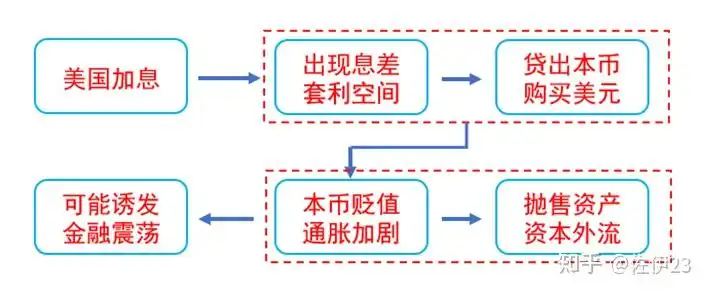
This is the transmission path of the so-called dollar cycle that we often talk about. The US interest rate hike leads to the emergence of carry trade space, which in turn leads to the appreciation of the US dollar and the depreciation of the local currency. This further causes investors to sell financial assets, which may ultimately trigger financial shocks.
Since it is the interest rate differential space that triggers capital outflows and then causes financial shocks, a natural idea arises: if we raise interest rates, can't we reverse the interest rate differential space?
Yes, this idea is very intuitive and has its own reasoning. This is also an important reason why the US interest rate hike has triggered a global interest rate hike. When the US raises interest rates, many countries also follow suit to prevent capital outflows and avoid interest rate differentials. However, raising interest rates can suppress capital outflows but also harm the domestic economy, which will first harm the country's real economy.
05 Using Interest Rate Hikes to Combat Interest Rate Hikes
1) Damage to the Real Economy
Using interest rate hikes to counter interest rate hikes, why does it harm the real economy of our country?
Assuming you run a factory and your partner introduces a project to you that requires an investment of 10 million yuan with a return of 10% after one year, but you only have 5 million yuan on hand. What should you do? Get a loan from the bank! You go to the bank and find that the cost of the loan is not high, with an annual interest rate of only 5%. Without hesitation, you sign the loan contract. "Using the bank's money to make money for me is the kind of thinking that a boss should have." After one year, you pay back the loan with interest and earn a net profit of 750,000 yuan.
One day, the United States raised interest rates. In order to prevent capital outflow, your country was forced to follow suit and raise interest rates as well. As a result, borrowing interest rates increased from 5% per year to 15%. Your partner introduced another project to you, which requires an investment of 10 million and will yield a return of 10% after one year. However, you only have 5 million in hand. Would you still seek a bank loan? If you borrow 5 million, you will need to pay the bank 750,000 after one year, leaving you with a net profit of only 250,000. You looked at your 5 million in savings and sighed, "Forget it, why bother running a factory? I'll just close it down and put the money in the bank to earn interest."
More and more people share the same idea as you, so the investment of enterprises begins to decline, and fewer and fewer new projects are launched. The demand for workers in enterprises is also decreasing. More and more workers are becoming unemployed, and the wages of those who are still employed are not increasing. As a result, domestic demand will gradually shrink, ultimately leading to damage to the real economy.
本币加息,除了可能损害实体经济外,还可能加剧金融市场震荡。
The interest rate hike in the domestic currency may not only harm the real economy, but also exacerbate the volatility of the financial market.2) Intensify Financial Market Turbulence
The simplest model for financial asset pricing is that the price of a financial asset is proportional to the cash flow provided by the asset and inversely proportional to the market interest rate. For example, in a mature market, the value of a commercial property that can provide an annual rent of 10 million yuan and a market interest rate of 5% per year is 200 million yuan.
Why is this the case? Let's do a thought experiment. In a mature market, there is a commercial storefront that can provide a rent of 100,000 yuan per year. The market interest rate is 5%. How much would you be willing to pay for this storefront? If the owner asks for 300,000 yuan, would you buy it? You would certainly be willing to, because if you put 300,000 yuan in the bank, you would only get 15,000 yuan in interest after a year, while buying the storefront would give you 100,000 yuan in rent. If the owner asks for 1 million yuan, would you buy it? You would still be willing to, because if you put 1 million yuan in the bank, you would only get 50,000 yuan in interest after a year, while buying the storefront would give you 100,000 yuan in rent. If the owner asks for 3 million yuan, would you buy it? You would be less willing to, because if you put 3 million yuan in the bank, you would get 150,000 yuan in interest after a year, while buying the storefront would only give you 100,000 yuan in rent. Therefore, the final price equilibrium point falls around 2 million yuan, where the return on your money in the bank and the return on buying the storefront are the same.
Therefore, the price of the store equals the annual rent divided by the market interest rate. In other words, the selling price of the store is directly proportional to the amount of annual rent and inversely proportional to the level of the market interest rate. A store that can provide an annual rent of 100,000 yuan is worth 2 million yuan when the bank interest rate is 5%. Assuming the bank interest rate increases to 10%, the store is only worth 1 million yuan.
Of course, this is a very simplified model, excluding various factors such as differences in risk and expectations of price increases. However, through this model, we can illustrate one issue, that is, raising interest rates will lead to a decline in financial asset prices (especially bond prices).
Preventing capital outflow through raising interest rates is a "fighting fire with fire" approach, with significant side effects. On one hand, it may partially curb capital outflow, but on the other hand, it may also accelerate domestic financial turbulence and lead to other uncontrollable consequences.
Not only that, but developed countries following the United States in raising interest rates may not only impact their own real economies, but also lead to a more serious consequence - triggering a global debt crisis.
3) Debt Crisis
You are a poor person, when do you most hope to borrow money? It's simple, when you encounter difficulties. So, when are you most likely to borrow money? Also simple, when wealthy people are willing to lend you money. If the interest rate is still low at this time, you will definitely borrow the money without hesitation. This principle is universal, it applies to you, and it also applies to borrowing entities in the international market (countries, large enterprises, etc.).
Who are the "poor" in the international market? Most developing countries are poor. Who are the "rich"? Those old developed countries are the rich. Since 2020, developing countries have been hit hard by the epidemic and their economies have plummeted, forcing them to seek help in the international lending market. At the same time, developed countries have implemented extremely loose monetary policies to stimulate market demand and have maintained extremely low interest rates (even zero interest rates) for a long time. In such a loose market environment, developing countries have borrowed a large amount of foreign debt, and the level of foreign debt has generally experienced a round of increase.
During the period of generally low interest rates in developed countries, developing countries, although burdened with huge debts, have relatively low annual interest payments, so the pressure to repay debts is not great. Borrowing has become an important means for developing countries to get through economic downturns.
However, starting from 2022, under the high inflation of high-income countries, the Federal Reserve, Bank of England, European Central Bank, Bank of Canada, Reserve Bank of Australia, Reserve Bank of India, and others have all implemented interest rate hikes, which has unprecedentedly increased the debt repayment pressure of developing countries. For a certain developing country, it may have only needed to spend 10 billion US dollars from its foreign exchange reserves to pay interest each year before. However, due to the increase in interest rates, it now has to overdraw more foreign exchange reserves each year. As a result, more and more countries and companies are defaulting on their debts.
Not only developing countries may face debt crises, but some European countries may also face crises. Currently, many European countries have high debt levels and need to pay a large amount of interest each year. If interest rates continue to rise, the amount of interest paid each year will also increase, which may cause even larger deficits. These deficits will require further financing, which will further increase the debt-to-GDP ratio.
The following two charts show the global weighted debt level and debt default situation. The current global debt level has approached the level of the Latin American debt crisis in the 1980s, making it the second highest in history. The debt problem in developing countries around the world is becoming increasingly severe.
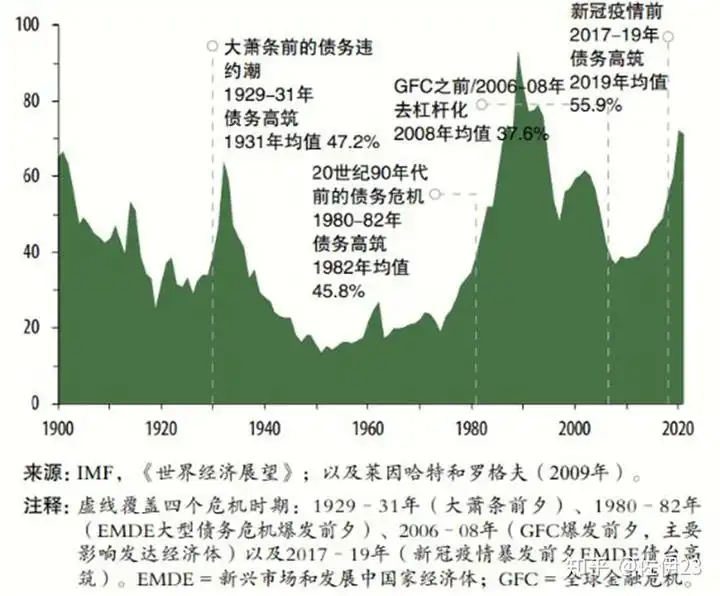
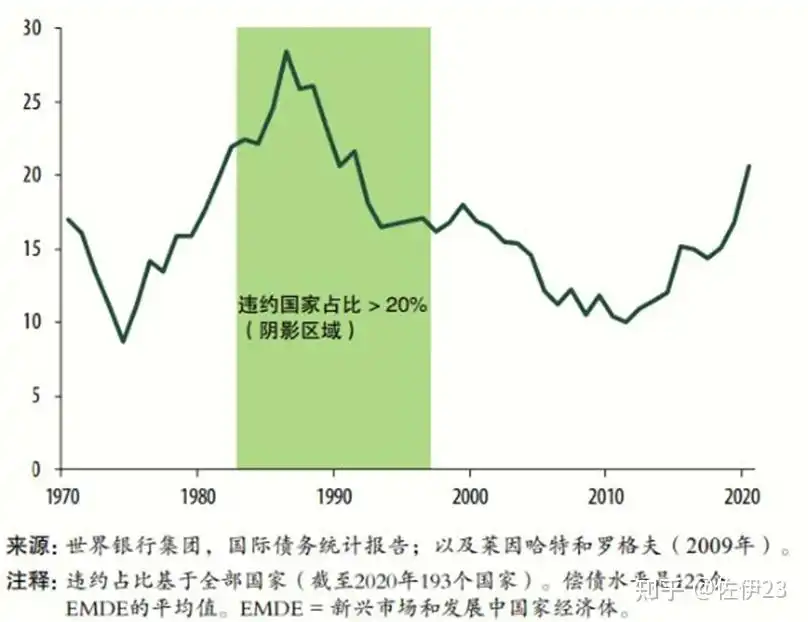
The probability of debt crises occurring in some countries and the deterioration of debt in most countries has greatly increased. The dark clouds of recession are looming over the global economy, and developing countries will undoubtedly suffer the most in this crisis. So, is the United States, the initiator of interest rate hikes, really "better off than the rest"?
06 Is the scenery better on this side of the United States?
There is a saying that the US interest rate hike is harvesting the world, which is not entirely accurate. This saying has an implicit premise, as if the US can ignore the objective laws of the economy and raise interest rates solely based on subjective will. In fact, the US interest rate hike this time is a helpless move under high inflation, and the impact of the US interest rate hike on its own economy cannot be underestimated.
Recently, several banks in the United States have had problems, which are closely related to interest rate hikes. Take Silicon Valley Bank, which was the first to have problems, as an example. Interest rate hikes accelerated the bankruptcy of Silicon Valley Bank from several aspects. Note that I am saying accelerated, not directly caused.
Among the clients of Silicon Valley Bank, many are technology companies that have been developing well in the past few years and have accumulated a large amount of funds in the bank. Since the US interest rate hike in 2022, these companies have been more or less affected. Firstly, the financing cost of the companies will increase, which means that a larger portion of the profits earned by the companies will be eroded by financial capital. Secondly, the decline in company profits will affect the stock prices of the companies, which in turn will reduce their ability to raise funds in the stock market. As a result, technology companies have entered a downward spiral trend, which is directly reflected in the accelerated pace of layoffs. In the 24 months from May 2020 to April 2022, the US information industry had a total of 731,000 layoffs, with an average of 30,500 people per month. Since the interest rate hike in May 2022, the pace of layoffs has accelerated significantly. As of February 2023, there were a total of 431,000 layoffs in the past 10 months, with an average of 43,100 layoffs per month.
In this situation, technology companies are experiencing decreasing revenue and are withdrawing their deposits from banks to survive the difficult times. More and more technology companies are withdrawing cash from Silicon Valley Bank, causing the bank to have insufficient funds to pay, and thus forcing it to sell its assets. Most of the assets held by Silicon Valley Bank are US Treasury bonds and mortgage-backed securities, which have a characteristic that can be simply understood as "the price of the asset is inversely proportional to the market interest rate" (this is a basic principle of many financial assets prices). In other words, as the US raises interest rates, the assets held by Silicon Valley Bank continue to depreciate.
Silicon Valley Bank has started selling assets that are already depreciating, and this kind of selling undoubtedly exacerbates the decline in asset prices. As a result, Silicon Valley Bank has fallen into a vicious cycle, with technology companies withdrawing large amounts of cash, causing a shortage of cash. In order to cope with the crisis of redemption, assets are being sold, and the further decline in asset prices has led to a further decline in the company's risk resistance.
As more and more people discovered that Silicon Valley Bank was caught in a death spiral, a run on the bank occurred. People rushed into the bank, hoping to withdraw their cash before the bank went bankrupt. In this frenzy of a run on the bank, Silicon Valley Bank inevitably went bankrupt.
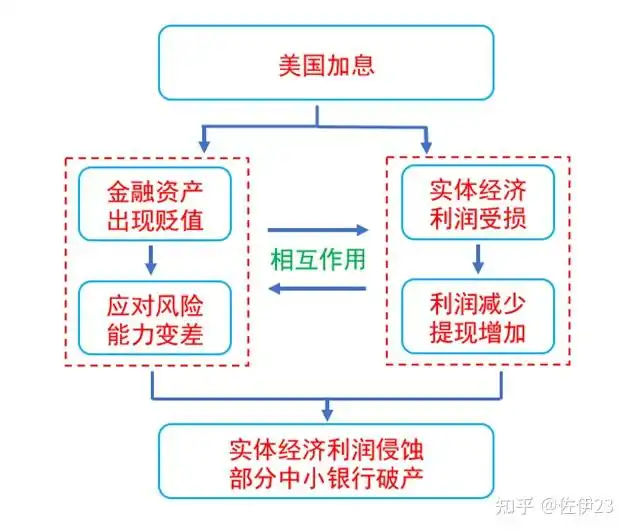
Here we can see that on one hand, the interest rate hike has led to the accelerated decline of US technology companies, resulting in large-scale withdrawals. On the other hand, the interest rate hike has caused the devaluation of bond assets held by banks, thereby reducing their ability to cope with risks. When these two aspects collide, bank runs and bankruptcies occur.
Above, we roughly introduced the impact of US interest rate hikes on domestic and foreign economies. Next, we will do a comprehensive review to form a more comprehensive concept.
07 Reviewing the impact of US interest rate hikes on the economy
The impact of the US interest rate hike is complex and far-reaching. In this article, we have simplified the analysis to help readers understand the basics. From our analysis, we can draw the following conclusions:
(1) Raising interest rates in the United States will create a space for interest rate arbitrage between the US dollar and other currencies. Speculative capital will borrow low-interest loans from their own countries, purchase US dollars, and deposit them in banks to take advantage of the interest rate differential.
(2) A large number of speculators buying US dollars will cause the US dollar to appreciate and the domestic currency to depreciate.
(3) There are two direct consequences of currency depreciation. Firstly, it will cause imported goods to become more expensive, leading to input-type inflation. Secondly, currency depreciation will cause financial market turbulence and accelerate capital outflows.
(4) In order to alleviate the inflation and capital outflow caused by the depreciation of their own currency, other countries may follow the United States in raising interest rates, which will bring three problems.
(5) First of all, raising interest rates in our country will directly harm the real economy. Raising interest rates leads to an increase in financing costs, which lowers business investment expectations and reduces the scale of expanding reproduction. As a result, it also lowers the overall wages of workers and may ultimately harm the real economy from both investment and consumption perspectives.
(6) Secondly, raising interest rates in our country may exacerbate financial market turbulence. If our country significantly raises interest rates, it may lower the prices of financial assets and intensify turbulence in major financial markets such as the bond market and real estate market.
(7) Third, following the interest rate hikes by developed countries may lead to a debt crisis. It is possible that not only developing countries, but also some heavily indebted European countries such as Italy may face a debt crisis. Once interest rates continue to rise, the interest payments made by these countries will increase significantly, greatly increasing the risk of debt default.
(8) The US interest rate hike cannot simply be understood as "harvesting the world". The US interest rate hike has an impact on foreign countries, as well as on domestic ones. On the one hand, the interest rate hike leads to erosion of profits in the real economy, which strengthens the impulse to withdraw funds; on the other hand, the interest rate hike leads to a drop in the prices of assets such as government bonds, and banks hold a large amount of government bonds, which reduces the ability of small and medium-sized banks to cope with risks. Currently, three banks in the US have already gone bankrupt, and according to a report from "USA Today" on May 4th, nearly 190 banks in the US are facing the risk of bankruptcy. The impact of the US interest rate hike on itself is not limited to this. Here, we have only briefly analyzed some of the current hot events.
(9) All of the above is not isolated, but rather interacts and influences each other. One ultimate result of their interaction is the global economic weakness.

08 Monty Hall Impossible Triangle: Why China Can Choose Not to Raise Interest Rates
Against the backdrop of interest rate hikes in the United States, why is China able to avoid raising interest rates? To understand this issue, we need to briefly review the impossible trinity (Mundell's trilemma): for an open economy, independent monetary policy, exchange rate stability, and complete freedom of capital flow cannot all be achieved at the same time.
We review the example above. The interest rate hike in the United States caused an interest rate arbitrage opportunity in a certain country, leading to speculative institutions in that country borrowing low-interest loans to purchase US dollars, which in turn caused the depreciation of the country's currency. Currency depreciation may also trigger capital outflows, further accelerating depreciation. In order to prevent currency depreciation, the country implements a tight monetary policy, which in turn leads to higher interest rates and reduces capital outflows.
In this example, a certain country has chosen complete freedom of capital flow (allowing large inflows and outflows of capital), which means that it cannot maintain both independent monetary policy and a fixed exchange rate. To stabilize the exchange rate, it must give up its independent monetary policy and be forced to follow the United States in raising interest rates; to implement an independent monetary policy and not follow the United States in raising interest rates, it must bear the impact of exchange rate fluctuations.
However, if a country abandons the complete free flow of capital and implements some form of control over capital, it can to some extent ensure the implementation of independent and autonomous monetary policies and obtain relatively stable exchange rates. And China is just such a country.
The IMF uses the "Capital Account Openness Index" to determine whether a country is in a state of complete capital free flow. If a country's index value is less than 0.25, it is in a state of capital control. In 2020, China's index value was 0.16, indicating a relatively strict capital control system. In other words, China has given up complete capital free flow in exchange for an independent monetary policy and a relatively stable exchange rate policy (China's current exchange rate policy is a "managed floating exchange rate system").
Therefore, under the backdrop of the possibility of global interest rate hikes triggered by the United States, China may choose not to raise interest rates. In January 2023, Debon Securities released a research report titled "If interest rates are lowered, which one will be lowered? What is the impact on the bond market?", which pointed out that if the central bank lowers interest rates, it may exacerbate the impulse of capital outflows. However, under the mode of capital control in China, the country has sufficient foreign exchange reserves to cope with capital outflows. Therefore, Debon Securities concluded that "we believe that China's foreign exchange reserves are relatively sufficient, and the pressure of capital outflows is controllable, which constitutes the basic conditions for lowering interest rates."
However, having the conditions for a rate cut does not necessarily mean that a rate cut is necessary. To understand why China chose to cut interest rates at this time, it is necessary to review the current economic situation in the country.
09 Current Economic Situation in China
Why China chooses to cut interest rates? After a commodity is produced, it can only go in three directions:
(1) Purchased by consumers (such as food, clothing, mobile phones, etc.), used for eating, drinking, playing, clothing, housing, and transportation, that is, consumed by consumers, which is consumption.
(2) Bought by enterprises (such as machines, raw materials, etc.) to produce other goods, which means that they are consumed by enterprises, and this is investment.
(3) If domestic consumers (including the government) do not buy, and enterprises do not buy, then the only option is to sell to foreign consumers or enterprises, which is known as export.
Due to the fact that China still purchases foreign products, imports are subtracted from the calculation to form net exports. Consumption + investment + net exports, when measured in currency, constitute GDP. (Many friends who have studied macroeconomics may ask, what about government procurement? Here, government procurement is included in consumption or investment. For example, if we open Wind and enter government consumption, we can see that it belongs to a category under final consumption).
One commodity, if consumers don't buy it, businesses don't buy it, and foreign consumers and businesses don't buy it, the commodity won't sell. If a large number of commodities cannot be sold, or a large number of devices are idle and cannot be put into production (because there are no orders), a crisis will form. Therefore, economic crises are also called crises of relative overproduction, where production exceeds consumption capacity.
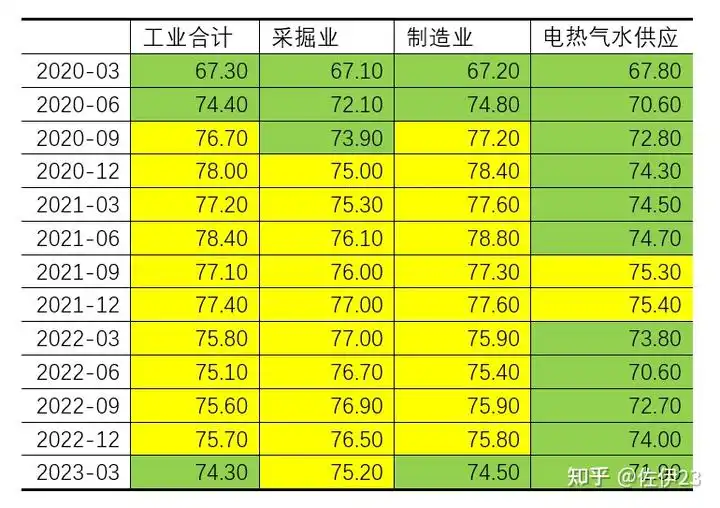
Therefore, to determine whether the economy of an industrialized country is recovering or deteriorating, it is more accurate to start with capacity utilization rate. The peer indicators of capacity utilization rate are roughly as follows:
(1) Less than 80% is considered overcapacity.
(2) Below 75% is considered severe overcapacity.
(3) More than 90% is considered insufficient production capacity and requires investment in expansion.
In the past three years, the basic situation of China's industrial sector is shown in the following figure. The green part is less than 75%, and the yellow part is less than 80%. In the first half of 2020, the capacity utilization rate was the lowest, and it gradually increased as the epidemic improved. In 2021, thanks to a large number of foreign trade orders returning, China's capacity utilization rate reached the best level in the past three years. Since 2022, the capacity utilization rate has declined again, and by the first quarter of 2023, the capacity utilization rate has almost returned to the situation in the first half of 2020.
Original Link
Welcome to join the official BlockBeats community:
Telegram Subscription Group: https://t.me/theblockbeats
Telegram Discussion Group: https://t.me/BlockBeats_App
Official Twitter Account: https://twitter.com/BlockBeatsAsia

 Related Articles