An Alternative Perspective for Understanding DAO: A Novelty Search Engine
Original title: "DAOs as novelty search engines"
Original author: olly.eth
Original compilation: 0x123, H.Forest_Ventures
This article describes the special ability of DAO due to its organizational structure, as a new search tool to help organizations better develop. It also expounds the advantages and disadvantages of the company's hierarchical system, and compares it with the DAO organization to more vividly show the advantages and particularities of the DAO.
As a collaborative network, DAO is likely to show its unique role in the future. To determine its role, you need to think outside the box. Like a toddler taking his first steps, today's DAOs are immature, unstable, and likely to stumble.
While tempting to skim over, especially in "serious" innovation areas, their structure does give them a unique ability to serve as a vehicle for discovery New things. We will briefly introduce its structure and complete the following points:
DAO as a new search engine enables many cooperative teams to collect and Integrate fundamental information to more efficiently explore the search space.
Searching for novelty—another paradigm of discovery
Imagine yourself in a lake Side, you try to reach the other shore, and must do so by jumping over stepping stones on the ground. However, the fog is so thick that you can only see the nearest stepping stones at your feet. The coast fades away behind you as you move forward over the stepping stones.
On the way forward, a fork appears in front of your eyes, and you will make a decision. Which way is the best? Although the fog makes it impossible to see where either path leads, you must make a choice.
< br>

Stanley and Lehman (2015) compare the above case to search discovery. The lake represents an abstract space of possibilities, while the stepping stones represent navigational strategies. Your journey is one of constant exploration in this space of possibilities. The question is how do you move forward when you don't know the road ahead.
We can redefine this by considering the space of all possibilities as a room. Now imagine yourself as a painter and try to create the next Monet in your room. As a search space, our rare diamond is already there. Your purpose is to go around numerous pointless dead ends and find it.
When you create, you search the room. Every time you visit a room, your artwork will be partially influenced by those rooms. If you spend time studying Modernism, chances are you've been influenced by it. Without going to a watercolor corner, it's unlikely you'd invent them. The lake problem is here again. How to become Monet? Where will the stepping stones lead us?
We can think about all complex fields in this way. We know there will be new discoveries once we get to the other side. Unfortunately, we can only see the stepping stones under our feet, but we cannot see anything else.
Vacuum tubes, for example, no one knew they would enable the first computers. It was only after the discovery of the vacuum tube and the associated computing that the possibility emerged that a computer could be enabled using a vacuum tube so that someone could tie it together. If you had started building computers in the 1800s (as Charles Babbage did), you were unlikely to have gained this insight.
We tend to think of intermediate steps as small goals to reach the end, and treat these small goals as stepping stones to the end. However, when we don't understand where we are, these small goals can easily get us into trouble.
;
It is entirely possible that moving closer to the goal does not actually increase the value of the objective function, even though the move brings us closer to the goal.
"Why Greatness Can't Be Planned"—Stanley & Lehman (2015)
Another example of education, we base To measure educational progress, assume that higher test scores mean we are getting smarter. "Improved math grades! That's great, right?" Wrong. Optimizing math performance through evaluation forces us to focus on things that improve performance in the short term, but prevents us from exploring a larger search space.
So are there other options? Of course, a novelty search is a non-objective form of search. Instead of stepping toward seemingly stepping stones to the end, simply collect stepping stones that lead in interesting directions. Focus on the new, wherever it takes you.
Because ultimately you have to acquire some kind of new knowledge to continue innovating, which means novelty search is a kind of accumulator of information about the world in which it occurs. The longer the search goes on, the more information about the world you end up accumulating.
Why Greatness Cannot Be Planned - Stanley & Lehman (2015)
Every stepping stone you collect leads to new possible. New ideas often come from combining existing ideas: combining different stepping stones. Every now and then, a certain combination will take you into a whole new situation.
The more stepping stones you collect, the more interesting combinations you can create. You can't predict where they'll lead you, but what is predictable is that if you stick with it, you'll end up somewhere interesting.
;
Focusing and expanding
Neither the company nor the DAO can be easily described. However, their core structures have different organizational characteristics, allowing them to play different roles in future innovations.
Companies are convergent vehicles for a single vision
Great ideas often come from collecting And synthesized a series of independent ideas of unusual stepping stones.
The company is hierarchical, with one person leading and ultimately responsible for decision-making. Companies are ideal structures for ideas that require the power of many people to realize, because leaders have the power to optimize resources to pursue their vision.
It's a feature, not a bug, that makes a company strong, but it can also make it weak. A strong leader with a vision can lead a company to incredible success; a weak leader with a short-sighted vision can't accomplish much and can actually be harmful to the company.
In any case, the focus of the company is to unite everyone to achieve specific goals, making everyone work towards a common goal. This is "powerful alliance", that is, everyone works together to achieve a convergent result.
Leaders distill their vision into something understandable and call it a goal, while the rest of the team does their part work together towards this goal. In the absence of such a purpose, a strong vision can be diluted into a mosaic.
< br>
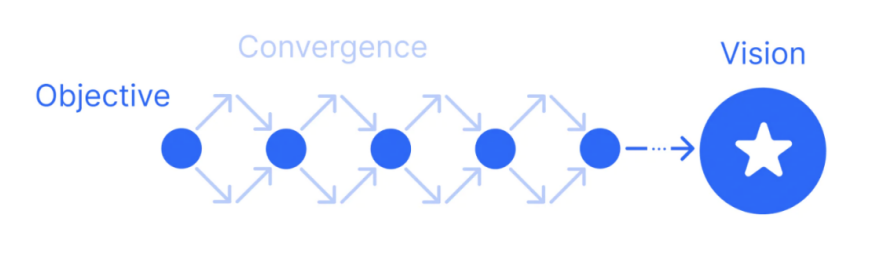
The company uses the target to pursue the result of convergence
The advantage of the hierarchy is that it allows the collective Pursue a single vision articulated by the leader and coordinate individual efforts to achieve a common goal. To do this, companies must carefully define the problems they want to solve and stay focused by breaking down goals to measure overall progress.
However, a company doesn't try to step up to stepping stones that don't align with its goals, thus reducing a lot of possibilities. This further makes the company lose the possibility of combination.
DAO is an extension tool for exploring domains
DAO is defined by nodes and links A network of , corresponding to people and relationships.
The network has a flexible topology, which can be flexibly changed according to changes, and the shape adopted will evolve and update over time. Leadership is assigned on a case-by-case basis, with individuals empowered to make meaningful decisions that change organizational structures without permission or consensus. We can call this ability self-organizing ability.
Imagine deploying large networks like democracies. A nation is made up of many individuals and organizations that contribute to its growth and improvement. Yet the complexity of a country is such that no single entity, not even the president, can appreciate it as a whole.
Instead, each entity engages in its own context, such as a local community, business or social circle, and understands the country in its own way, thereby doing Make decisions that affect your environment. As they make decisions, such as starting a business, voting on a government, or forming new relationships, the structure of the network changes meaningfully.
Similarly, in a full-fledged DAO, individuals can understand parts of the network, but they cannot understand it as a whole. Individuals will understand DAO in their own way, and can explore directions that can affect their own environment without considering the overall environment. - As they make decisions, the structure of the network will self-organize accordingly.
The network has an information advantage due to this mechanism. Everyone knows themselves better than anyone else and decides for themselves how they can best contribute.
It is clear that all aspects of individual effort—talent, motivation, workload, and focus—are varied by small Fluctuations, let alone months, make it impossible to regulate and price them.
Organizations that adopt a hierarchy are a medium that gets lost. All information that could possibly be relevant to the decision of each factor of production, but was not introduced in a form or at a location that empowers it to be "credited" in the agent's decision...is lost.
Coase’s Penguins—Yochai Benkler (2002)
For any given set of programs, even without changing resources and collaborators, different People's productivity will also vary and fluctuate wildly.
Peer production has an advantage over corporations and markets because it allows a larger group of individuals to scour a larger resource for materials, projects, collaborations and combinations .
Coase's Penguin—Yochai Benkler (2002)
The network can also distribute members more efficiently, because anyone can be any role, and the network benefits from the best combination.
At the same time, tokens create a "weak alignment" mechanism where everyone in the network has an incentive to increase network value. However, the means by which this value will be realized is unclear.
Therefore, DAOs are not suitable for pursuing a single vision. They are optimized for exploring many different visions simultaneously, and individuals can make different decisions based on their own circumstances. This is a feature (not a bug) that will be the powerhouse of the future web.
Some people can't adapt to this kind of thinking. "No one to lead!". "There is no roadmap!". Instead, that's exactly the point. Members are autonomous. Autonomy comes not only from smart contract logic, but also from the continuous process of distributed self-organization.
;
DAO is a container for many weakly aligned teams
DAOs and companies have different organizational characteristics due to their different core structures. However, this does not mean that they are mutually exclusive, quite the contrary, a DAO can be seen as a container for many weakly aligned hierarchies.
Great ideas often come from individual minds, and leadership is a necessary condition for effective human collaboration. Hierarchies are optimized to enable strong leaders to achieve great results. DAOs cannot get around this fact. Hierarchy works because it enables leaders to combine contributions from their teams.
Leaders with different ideas will naturally appear in the crowd, and people will also be natural to follow leaders and causes they believe in. Rather than replacing hierarchies, DAOs create a mechanism by which a single organization can allow teams of multiple hierarchies to simultaneously explore different directions.
< br>
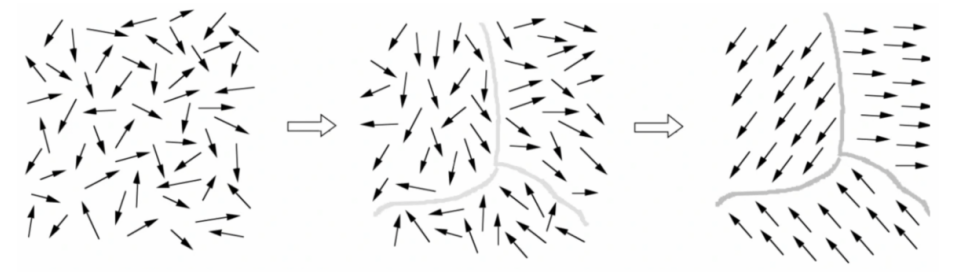
Local alignment of actions, from global heterogeneity to local homogeneous. We can observe this pattern everywhere, from magnetism to human society.
The following problems tend to arise in hierarchies due to groupthink: gradual inability to Consider other perspectives.
Homogeneous groups are good at what they are good at, but they gradually lose the ability to research alternatives.
The Wisdom of the Crowd - James Surowiecki
In a network arrangement, each team understands its own direction on its own terms and contributes what they think Something that adds to its value without being limited to a single vision or narrative. No consensus or compromise is required, as each group has the right to self-organize.
The best collective decisions are the product of disagreement and competition, not consensus or compromise.
The Wisdom of Crowds - James Surowiecki
In this way, a single DAO can be viewed as a multi-organization network. In the past, these structures have struggled to exist due to a lack of technology required for coordination. Now, the weak consensus of programmable tokens provides an incentive for every team to cooperate and share information, and open blockchains make information sharing easier and easier.
The key principle is heterogeneity (or, to use another term , "panarchic") collaboration. Network design has historically existed, but multiorganizational design structures are now able to gain strength and mature as new communication technologies allow small, dispersed, autonomous Consultation, coordination and joint action in problem areas.
Tribes, Institutions, Markets and Networks—David Ronfeldt (1996)
The future DAO will Benefit from the best of both worlds at the same time. Strong, unified hierarchies that achieve convergent results at local scales while exploring many different directions that collaborate to improve the state of the whole.
< br>
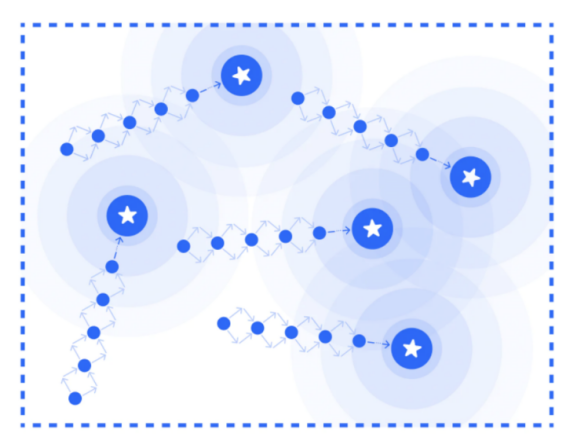
DAO enables many weakly aligned teams to explore the search space through cooperation
Exploring tools
Let's go back to the process of finding Monet. We know it's somewhere, we just have to find it.
< br>
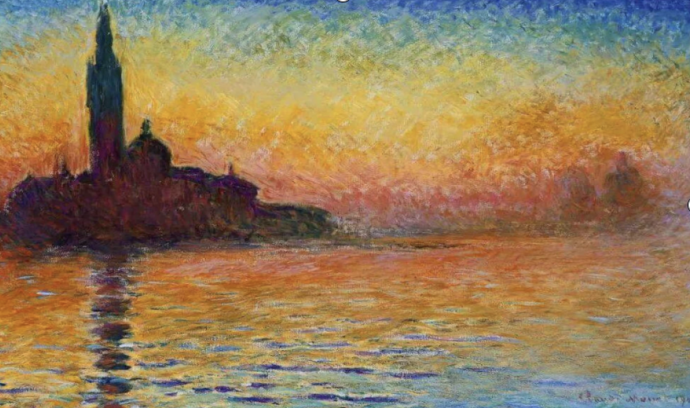
San Giorgio Maggiore at dusk, Claude Monet, 1908
As we've established, goals aren't very useful when we don't understand our circumstances. Instead, we should collect stepping stones that lead in interesting directions when we don't know where we'll stop.
Companies help us jump between single stepping stones by using hierarchies to pursue a single vision. However, it is difficult for companies to get beyond that vision because the same mechanisms prevent exploration of broader search spaces.
The magic of DAO is that it enables many cooperative teams to collect different stepping stones to embrace complexity. These stepping stones can be shared, reused and combined in new contexts to lead the organization in new directions.
DAO is a system of exploration and discovery, made of people and information.
A build system...is a package of parts with rules about how those parts go together. Almost every "monolithic system" is generated by a "generating system". If we want to make things that work as "wholes", we have to invent generative systems to create them.
System Generation Systems—Christopher Alexander (1968)
The DAO is thus an open evolutionary mechanism. In other words, evolution is open: not only can it generate solutions to current directions, but it can gradually open up new directions.
Instead of seeing openness as an existing condition or property of an evolutionary system, we see them as a consequence of evolution itself.
Openness to evolution, not evolution to openness - Pattee & Sayama (2019)
So, the core of the argument is: DAOs are novelty search engines that explore a search space more efficiently by letting many collaborating teams collect and integrate stepping stones.
This capability suggests that there is a unique and interesting role to play in future innovation. What we end up with is unpredictable, but predictable, and the results are interesting.
;
Translator's Note:
DAO is currently in its infancy, still immature, and poorly understood, but at its core The structure and mode of operation are full of infinite possibilities. The autonomous attribute of DAO allows members to explore in different directions according to their interests. Multiple individuals and organizations with different visions can create more paths for the organization. Therefore, DAO is inherently embracing complexity. The more complex , the more combinations that can be created, and thus the higher the probability of an innovation. Organizations within a DAO that are made up of like-minded hobbies and interests create good leaders who can lead and unite members toward a common vision, so DAOs can benefit from the best of both worlds . DAO motivates members through the token economy, so as to bring members together to form a "weak alliance" organization, and hobbies and incentives will jointly strengthen the structure and relationship of the organization, and everyone can make the most effective according to their own situation. Contributions of value, making contributions from the bottom up can avoid negative slowdown and perfunctory situations, so the contributions made will be more valuable.
< /p>
Original link
Welcome to join the official BlockBeats community:
Telegram Subscription Group: https://t.me/theblockbeats
Telegram Discussion Group: https://t.me/BlockBeats_App
Official Twitter Account: https://twitter.com/BlockBeatsAsia
 Related Articles