Panorama of DAO
Original Title: "DAOs Mapping|0xResearch"
Original Author: Crystal, 0xRank
Chapter 1 The Development of DAOs< /h3>
1. The origin of the DAO concept: a new way of social collaboration
In 2006, the science fiction writer Daniel Suarez published a book called Daemon, which is regarded by the industry as the original text on DAO.
In 2013, Daniel Larimer, CEO of Invictus Innovations, first proposed the concept of "DAC" (Decentralized Autonomous Corporation), believing that DAC is to provide useful goods and services for society An effective metaphor for decentralized systems that will play an efficient role in news aggregation, AdWords, domain names, patents, copyrights and next-generation intellectual property rights, insurance, courts, escrow and arbitration, authorized anonymous voting, prediction markets and next-generation search engines . The core of DAC is "have its own blockchain to exchange DAC shares (note: Token)", and must not rely on "any individual, company or organization to own value", "cannot have private keys", "cannot rely on any legal contract".
Later, Vitalik Buterin proposed DAO, distinguishing DAO from DAC, thinking that DAC is only one of the subcategories of DAO, and because DAC introduces the concept of shares, it is a A for-profit entity, while he emphasized that a DAO should be a non-profit entity, even though it can earn money by participating in its ecosystem. In 2014, Vitalik published the article "DAOs, DACs, DAs, and More: An Incomplete Terminology Guide", which introduced the potential of this blockchain-based organizational governance in detail. The definition of DO and DA has also become a topic of DAOs research in recent years. field focus.
Second, what is DAO: an important part of Web3 infrastructure
In the simple version In the DAO picture of the company, we can see that all the systems, regulations, norms, salaries, and bonuses in the company are written into smart contracts and stored on the blockchain. All decisions and governance of the company will be pre-written through smart The rules of the contract are complete.
The full English of DAO is Decentralized Autonomous Organization. From the dismantling of the concept, it can be seen that it contains two important features, namely decentralization and autonomy. Some DAOs currently rely on the blockchain to realize a decentralized operation and decision-making system, and the advantages of distributed systems have also ensured the openness of the network. Autonomy, that is, automatic operation that does not require human intervention, can be further understood as the specific operational activities within the organization are generated by pre-written codes. After the organizational activities trigger a certain condition, the smart contract will automatically start execution, and the organization will govern itself. However, almost all DAOs have not yet realized the concept of Autonomous. Only the Token distribution relies on the implementation of the blockchain algorithm, which is still dominated by the rule of man. This is also more in line with Vitalik's definition of DAO's three dimensions: self-government, rule of man, and internal capital.
DAO is an open and transparent organization based on smart contracts, controlled by all stakeholders, not affected by centralized institutions, DAO's financial transaction records and procedures The rules are stored in the blockchain, and the organization realizes self-operation, self-governance, and self-evolution through the public management rules and the incentives of the Token economic model, and then realizes the organizational form of the organization's maximum effectiveness and value transfer. DAO originated from the decentralized financial DeFi, which has higher requirements for decentralized autonomy. Through this form of autonomy, smart contracts, on-chain transactions, and fair project and platform management can be realized. At present, the vast majority of DeFi projects in the world use DAO. To manage its funds and issue Token.
3. Benchmarking the modern corporate system: why do we need DAO?
In the past For centuries, the large-scale production of machines brought about by the industrial revolution has greatly improved the productivity of the human world and concentrated the means of production in the hands of a few capitalists. The rich gap, in this context web3.0 was born, and DAO has become an indispensable link in the web3.0 ecology.
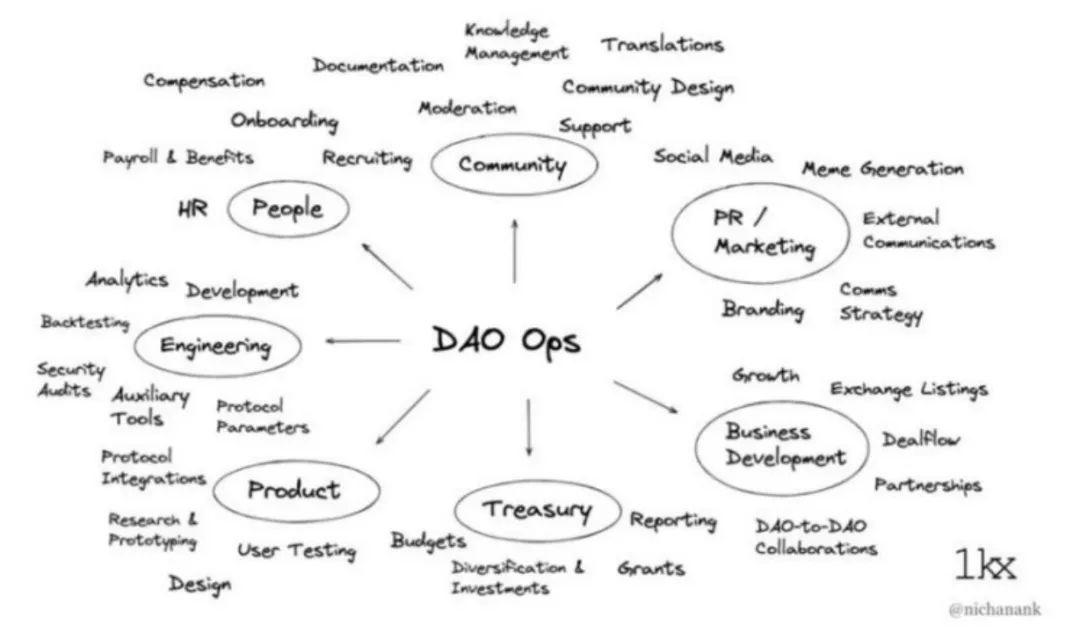
Source: "From the Perspective of Organizational Design to DAO "Organization Lego" Tool Ecology"
@lastofours co-founder Nichanan Kesonpat
DAO as a native digital organization, Because it also has similar characteristics of the existing organizational model, it is not a complete subversion of the organizational model, but we can observe through the benchmarking company system that the organizational characteristics of DAO, which is a human-machine symbiosis, are largely In fact, it has indeed realized the improvement of the existing organizational model and the problems of the original organizational ills.
Modern companies can use huge levers such as labor, capital, technology and publicity to magnify their own advantages under low investment conditions and make greater leverage production. And this also makes modern companies face three main problems: 1. The advantage of investors widens the capital gap between owners and workers;
Compared with modern companies, the DAO model can theoretically avoid this series of problems. First of all, members of DAO become interested participants in company activities through the Token they hold, and the appreciation of Token will also get due returns, which to a certain extent realizes the state of co-governance and sharing of owners and workers; the establishment of DAO is more like In an ideal state of a fully market-oriented market economy, the elimination of monopoly and barriers is conducive to full competition among DAOs; the primary purpose of DAOs is to solve problems and create value, and profits become by-products of value creation, and profits are accompanied by problem solving and value Produced by creation, it belongs to mission-driven organization.
In the era of web3.0, project developers and users pursue "ownership economy", the right to speak determines the ownership of their assets, and the distributed right to speak determines the economic model From a centralized system to a crowdfunding and crowd-sharing system, this is also a major reason why various DeFi projects continue to attract traditional investment fund organizations.
Chapter 2 DAOs landscape
1. Ecology of DAO
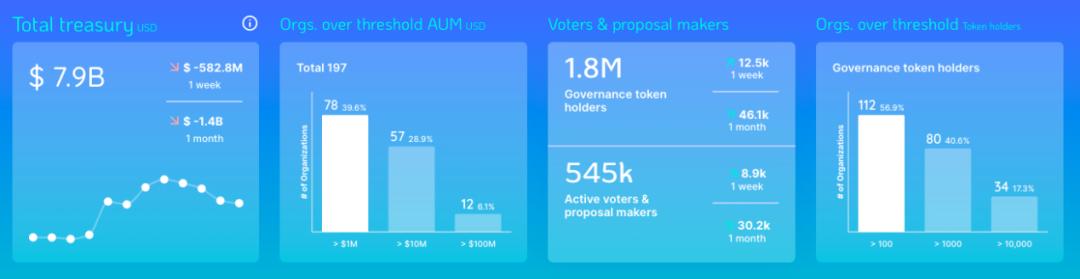
Messari wrote in the annual report: "2020 belongs to DeFi, 2021 belongs to NFT, and 2022 will be the year of DAO". DAO is considered by many people to be one of the most potential directions in the future social organization structure. Therefore, at the beginning of 2022, many investors set their sights on DAO when looking forward to this year's market opportunities. According to the data on March 12, 2022 on DeepDAO, the total assets managed by the DAO ecosystem are 7.9 billion US dollars, and the number of DAOs with more than 1 million US dollars in assets under management has reached 78, accounting for about 40% of the total, with more than 100 members There are 112 DAOs in China, accounting for 56.9% of the total. This data was still 44 in September 21.
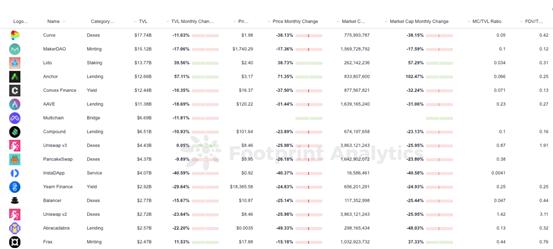
TVL$2.00B Dapps
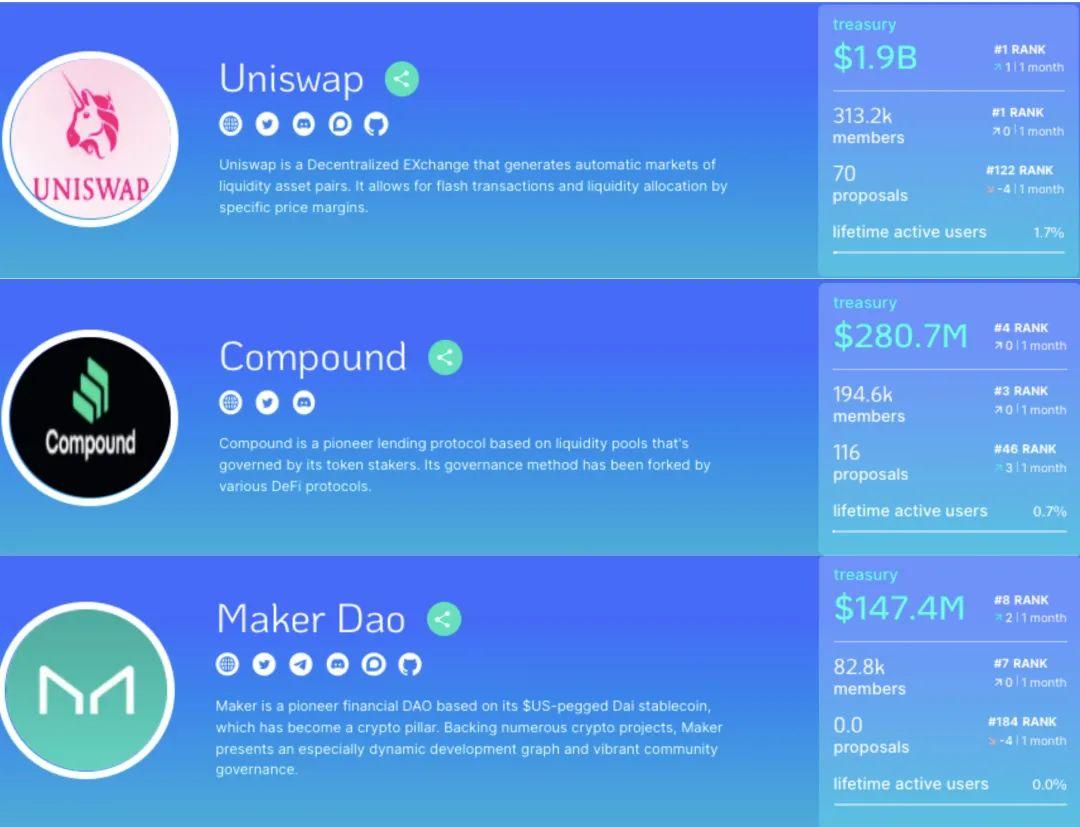
Reject the allocation of some stable coins or agreements with more liquid assets such as Bitcoin and Ethereum, facing larger risks such as sharp decline in currency prices, contracts Vulnerabilities, flash loan attacks and other currency price fluctuation risks. According to DeepDAO data, most of the top ten DAOs by assets are closely related to DeFi projects, such as Uniswap, Compound, etc., and all use native Token, stable currency or Bitcoin and Ethereum as their reserve assets. The diversification of capital pools promotes the healthy development of sustainable financing.

Top 10 Dapps by Asset
(source: DeepDAO until 2022.3.12)
From the perspective of Token holdings, the top ten are UNI, BIT, ETH, LDO, stETH, USDC , COMP, B-stETH-STABLE, RAD and AAVE, among which the holdings of UNI have reached the order of two billion US dollars, and the circulation of other native Tokens including Bitcoin and Ethereum have also exceeded two million US dollars.

Top ten Tokens by Token holdings
( Source: DeepDAO as of 2022.3.12)
Second, DAO's operating system and DAO tools
The operating system project of DAO provides different templates, frameworks and tools for the community to gather resources and establish DAO. They usually provide smart contracts and interfaces to promote actions on the chain of decentralized communities. The DAO operating system uses Anyone can easily start a DAO with limited technical ability. At present, the main types of DAO tools include DAO starters, rewards & benefits, salary management, governance & voting, information transmission & interaction, content, NFT, fund management, identity authentication, and security. The most numerous project categories in DAO Tools are DAO Launcher, Rewards & Earnings, Governance & Voting, Fund Management.
1. The functions of the DAO launcher include creating DAO, running DAO, voting, etc., among which the more popular ones include Aragon, Moloch, DAOhaus, and OpenLaw.
2. There are many social Token issuance platforms and Token reward platforms in reward & income tools. Typical social token issuance platforms are Coinvise and Roll, and typical token reward platforms are RabbitHole and Layer3.
3. Governance & Voting tools cover governance history query, governance voting, governance Dashboard, etc. Snapshot and SafeSnap are commonly used for voting. Other tools include Tally, DeepDAO.
4. Among the fund management tools, Gnosis Safe and Parcel are mentioned more, and the project with more potential is Utopia.

3. Types of DAO
The DAO ecology was not formed overnight in the past two years. Since 2019, DAOs with different functions have gradually emerged, including infrastructure, agreement, funding, investment, and service DAOs such as categories, collections, social and media, and now DAOs are constantly exploring the utility and value of DAOs in the realization of diversified purposes, multi-scenario applications and ecology. According to different voting methods, it can be divided into DAO based on Token voting and DAO based on share voting. According to the DAO code execution environment, it can be divided into on-chain governance and off-chain governance.

The Evolution of DAO (Source: @coopahtroopa.mirror.xyz)
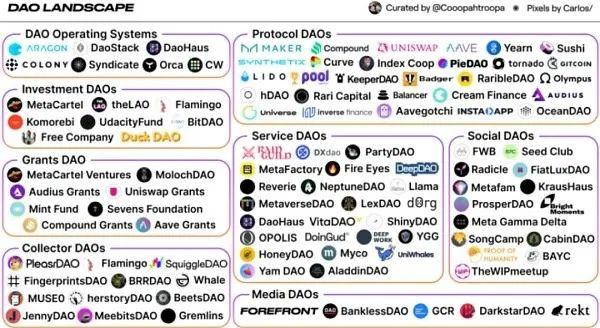
DAO Ecological Basic Framework
(source: @coopahtroopa.mirror.xyz)
1. Protocol DAO (Protocol DAOs)
Protocol DAO gives every user the right to vote on network decisions, instead of making every key decision It's all left to a small development team to decide. Usually, the protocol DAO will directly issue governance tokens to users based on past usage and contributions to pass on voting rights. Any user can propose ways to improve the project, and Token holders can vote to decide whether developers should advance the proposal and have more Multiple Tokens are equivalent to having more voting rights. For example, Uniswap Token holders are currently voting on which second-layer network the decentralized exchange protocol should be deployed on, and Token holders are also making proposals ranging from marketing plans to how to manage Uniswap's $2 billion-plus treasury.
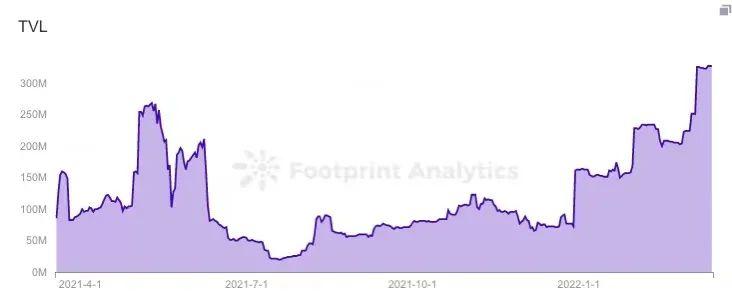
B.Protocol Dashboard
(last360 days TVL data Source: Footprint Analytics)
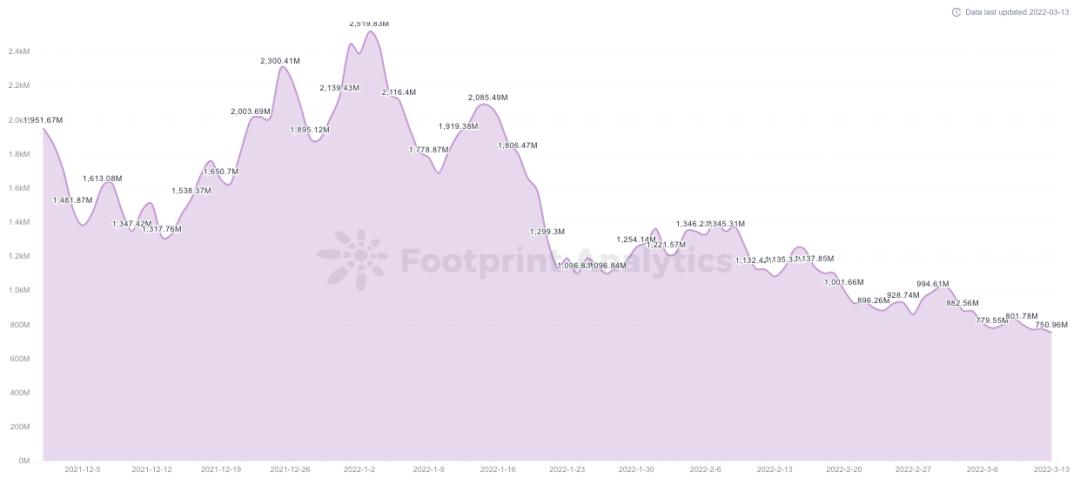
Curve Market Cap & Ranking(Source: Footprint Analytics)
2. Grands DAO
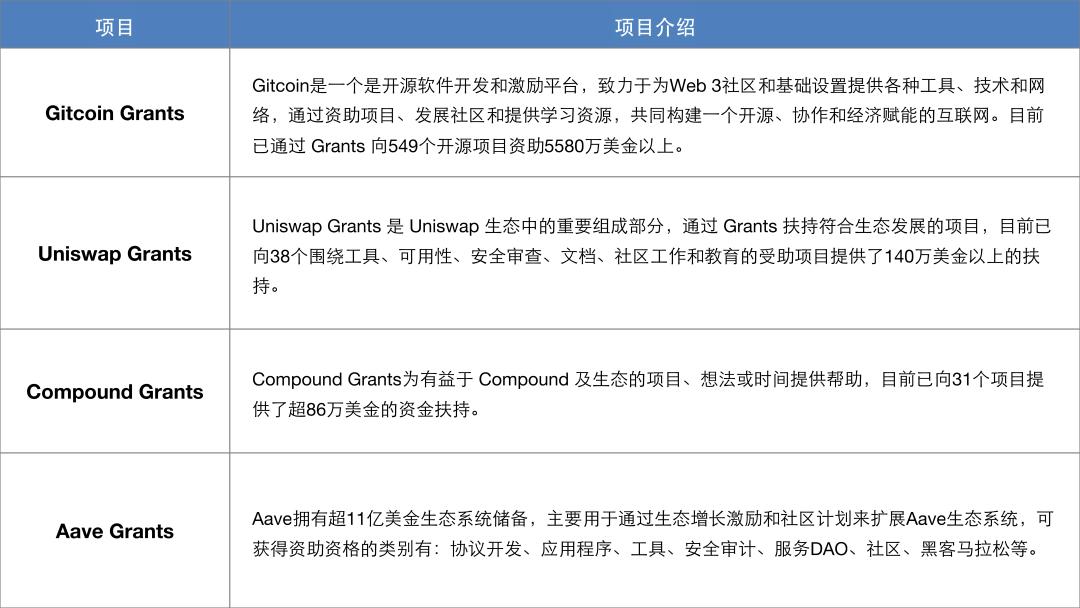
Funding DAO can also be called Grants DAO, which aims to fund organizations or individuals who build decentralized projects on the blockchain. Similar to investing in a DAO. Gitcoin is a pioneer of this model, funding critical open source infrastructure that might otherwise be difficult to fund. Likewise, large protocol projects like Uniswap, Compound, and Aave all have specific Grants DAOs that allow communities to vote on how to deploy their funds to support builders and developers for their own development.
< p>
3. Investment DAO (Investment DAO)
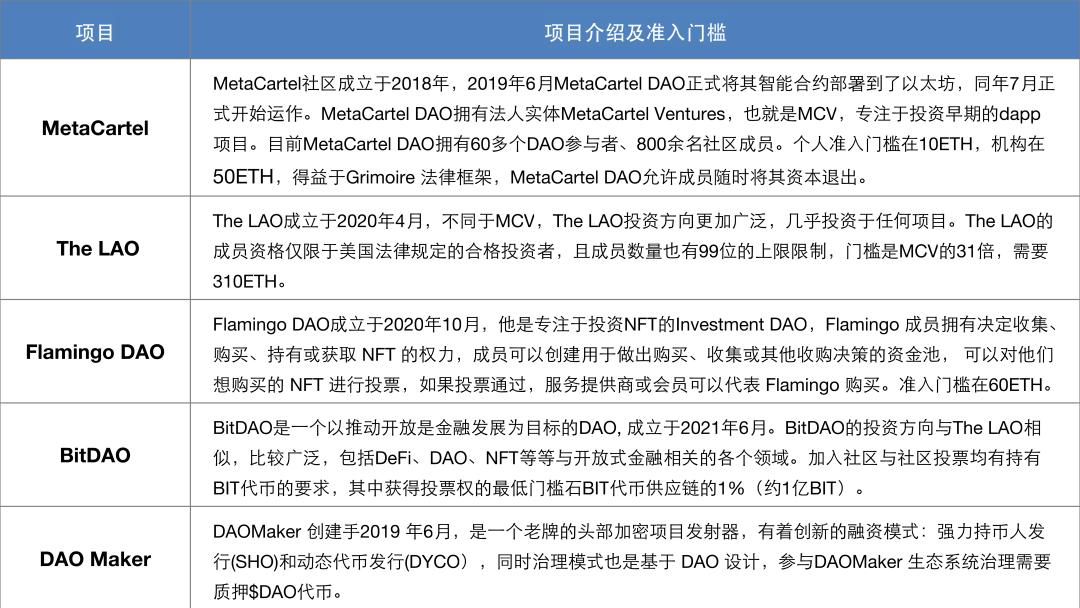
Most of the past The nature of DAO is basically non-profit. After a long period of non-profit DAO, the investment club started to make members get rewarded. Investment DAOs Compared with traditional financial investment institutions, investment DAOs have more intellectual investment fields, and at the same time enjoy the social capital and relationship network of a large number of community members, further forming a new way of cooperation and investment. The purpose of the profitable DAO created by MetaCartel is to invest in decentralized applications (DApps). The community orientation stimulates collective wisdom and promotes the ability of DAO organizations to make decentralized investment decisions that may be better than a single decision maker.
< p>
4. Service DAOs (Service DAOs)
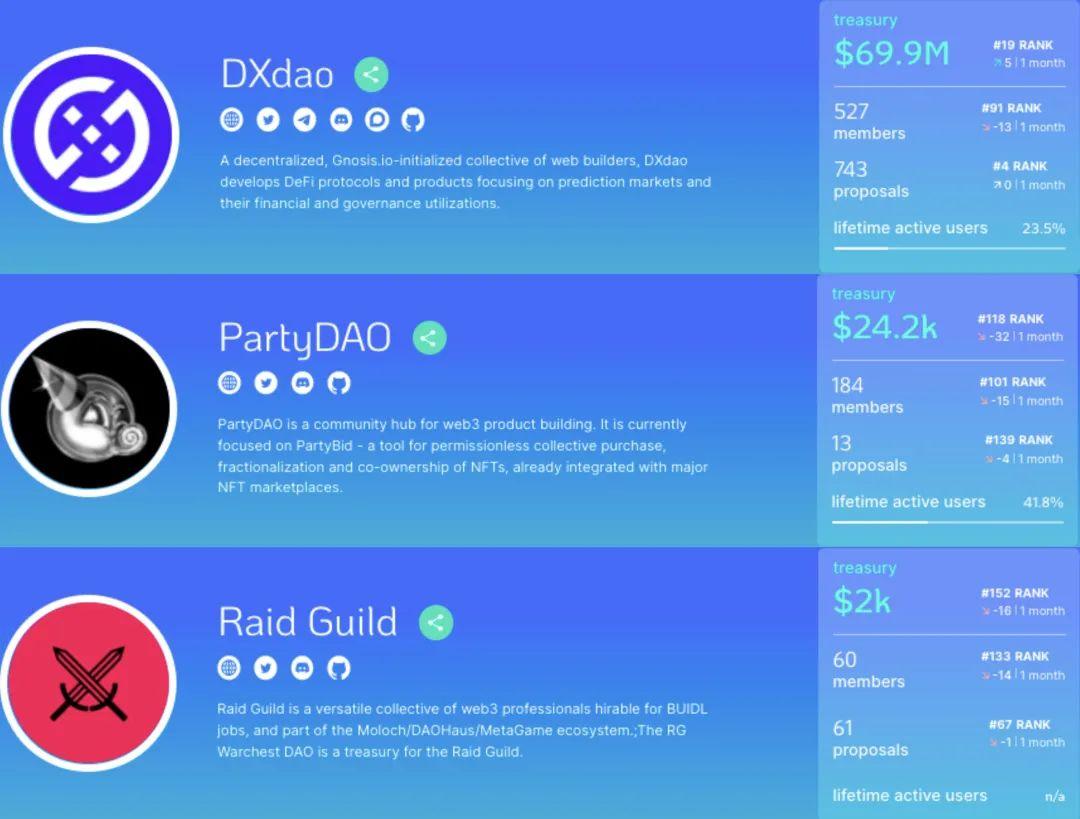
Service DAOs are in progress Try to reinvent the way people work, where people assign work on their own time and take ownership in the networks they care about. While early service DAOs were crypto-focused, it is conceivable that traditional organizations could also be replaced in the future. Service DAOs are similar to online talent agencies, bringing together strangers from all over the world to build products and services. Most early service DAOs, such as DxDAO and Raid Guild, focused on bringing together talents to build an encrypted ecosystem. For example, all contributors to DXdao can participate in proposals and get paid through on-chain, transparent governance.
< blockquote style="text-align: center;">Key Service DAOs Project Introduction (Source: DeepDAO)
5. Collector DAO (Collector DAOs)
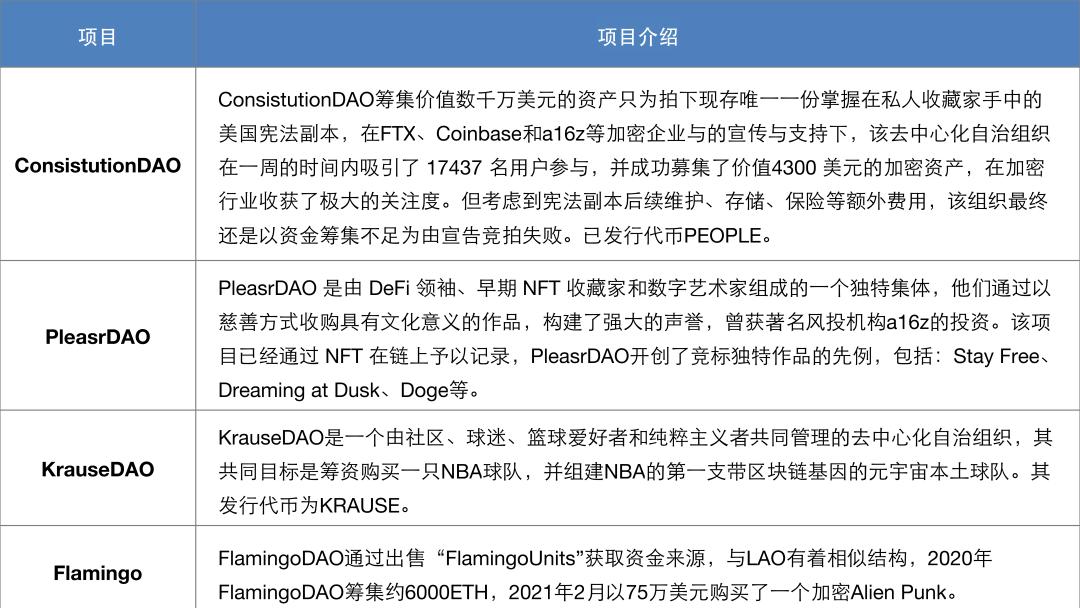
Favorite DAO provides a fast and efficient way of capital formation, and is more transparent and fair, allowing all members to directly audit the chain on the deal. By injecting funds, you can gain voting rights to decide to invest in specific assets, such as purchasing rare historical collectibles or professional sports franchises, and participate in co-creating investment portfolios that meet their mission and investment goals. Specific projects include ConsistutionDAO, PleasrDAO, KrauseDAO, Flamingo, etc.
6. Social DAO (Social DAO)
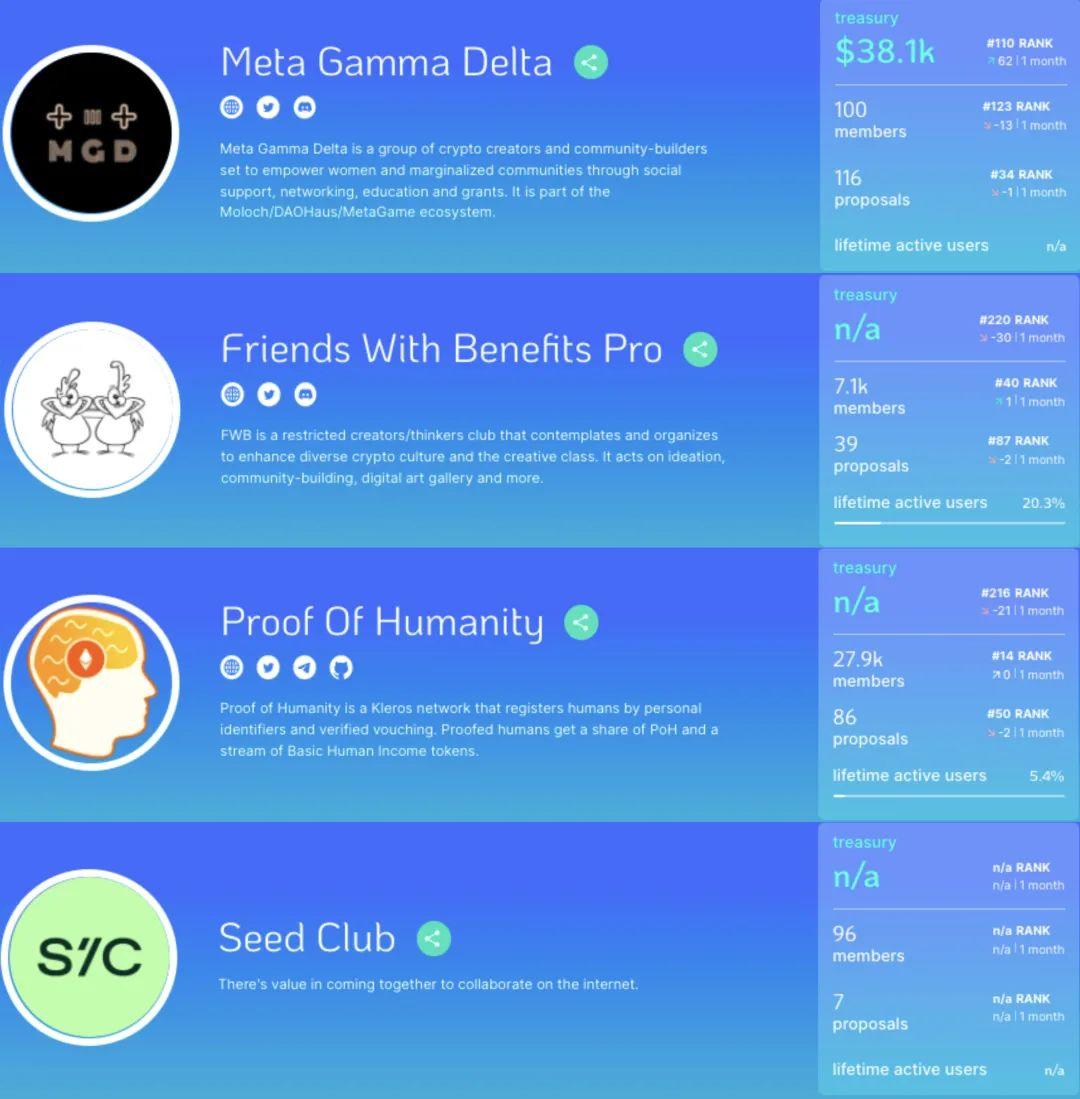
Social DAO more Focusing on social capital rather than financial capital, like-minded people gather in online communities, coordinate and organize participation around tokens, and together create a valuable community - sharing insights, throwing meetups or great parties, and unlocking the power of the wider community access rights etc. Social DAO is still in its infancy, and it will take time to understand and verify the effectiveness of each model. The rapid rise of Social DAO also shows that it represents a powerful new form of social organization. Leading examples are Friends With Benefits, Meta Gamma Delta, Minty, Proof of Humanity, Seed Club, etc.
Among them, key projects such as Friends with Benefits are a new type of DAO with strict entry review. Joining FWB requires a written application, which is reviewed and approved by the community itself Voting, and a minimum of FWBToken to represent ownership in the DAO. Since launching as a social experiment in September 2020, FWB has grown to nearly 2,000 members, launching a "token-gated events" app, NFT gallery, Web3-focused editorial in addition to a series of parties around the world Businesses, virtual music studios, etc., the next launch of "FWB Cities" will aim to expand the footprint of DAO in real life, and cooperate with specific spaces, communities, etc. in the city to bring real-world benefits to FWB members.
7. Media DAO (Media DAOs )
Media DAO aims to reshape the way content producers and consumers interact with media, the biggest difference between it and traditional media Here it is: Redefine the rights of producers and consumers by incentivizing contributions. BanklessDAO is a typical example. Users earn income by producing content, researching, designing, translating, marketing services, and voting on key decisions that guide the DAO. Media DAOs offer a compelling alternative to realign interests between readers and producers.
The more active MediaDAO includes BanklessDAO, which aims to promote the adoption and awareness of the bankless currency system, Rekt, an anonymous media public platform, and the Asian blockchain market and Global Coin Research, an investment research company for technology, Decrypt, which covers encryption and decentralized networks, etc.
Chapter 3 Governance of DAO
1. Current status of governance
The core strength of DAO lies in its diverse governance models and synergy. It is not only a form on the blockchain, but also an extension of the traditional OB and OG (Organizational Behavior and Organization Governance) theories. DAO is mainly divided into two types: Share-Based and Governance Based. The difference between the former and the latter is that the former has its own fund pool to facilitate the exchange of Token holders, while the latter’s Token can only be used as a governance token.
As the scale of DAOs applicable to various scenarios and functions grows, the management of decentralized protocols becomes the focus of emerging DAOs and high-quality DAOs. Continuously adjusting its own governance methods, through collective decision-making with a high participation rate and collaboration to optimize the organization's capital operation and internal operations. Compared with traditional centralized organizations, the way smart contracts run decentralized decision-making itself greatly reduces the cost of governance coordination. More DAOs link different roles together through encryption protocols, contributing to consistent motivation and common interests. Decision intelligence.
Just as God V defines DAO from three dimensions, DAO still contains a large part of "rule of man" at present. The pursuit is still a long way to go. In the "rule of man" of DAO, it is necessary to create a decision-making framework to ensure the effective operation of the DAO process. In order to grow and develop these web3.0 communities, attract more network participants and motivate stakeholders to participate in the degree of co-governance, which promotes The development of a set of economic incentives to effectively govern DAOs. There are three common ways:
1. Growth incentives: protocol users control the protocol (and the cash flow of the protocol);
p>
2. Revenue farming: Create various incentives on the protocol, distribute governance tokens to protocol users, not just to investors and development teams;
3. Retroactive Airdrop: Deliver Tokens to current or former users' wallets to spread awareness, build (protocol) ownership or retroactively reward early users ;
Second, common governance risks
DAO is increasingly becoming the organizational primitive of Web3 , to reshape the ways of governance, investment, work, creation and donation. With the continuous development and improvement of the metaverse ecology, the category, quantity and quality of DAO are in a process of explosive growth. Of course, there are also several constraints. Governance ills of sustainable development.
1. Legal/Regulatory Issues
DAOs don't exist anywhere, nor like Companies operate the same, so at the moment they cannot be fully integrated into the existing regulatory framework. It remains to be seen how different jurisdictions will build their regulatory frameworks around these new types of organisations. For example, the U.S. Securities and Exchange Commission shut down the U.S. CryptoFed DAO, which planned to create an encrypted payment system, just four months after its launch, saying the firm had "grossly misled" the public through conflicting documents that failed to disclose key information about its audited financials. information such as reports.
2. Lack of an effective coordination mechanism
The ideal characteristics of DAO (decentralization, Non-tamperable, trustless) have obvious performance and security flaws in essence. It is exciting for some potential organizations to grow rapidly as DAOs, but they also bring many risks that do not exist in traditional organizations, such as low voting rates, inefficient operations, and chaotic decision-making processes. The results may not be as good as Traditional enterprises are efficient, centralized and efficient operation or open participation is still a contradiction that is constantly discussed.
3. Lack of developed infrastructure
Clear structure and efficient decision-making process of traditional organizations Both benefit from a highly developed operating infrastructure, and the current stage of DAO is to build an infrastructure similar to traditional organizations from scratch for governance, compensation, fund management, communication, etc. At present, the infrastructure ecology of DAO has just begun. As the application scenarios of DAO are continuously developed, the requirements for its infrastructure will become more and more complex.
4. Smart contracts, fragmentation and sustainability risks
“Smart contracts exist Security breaches, attackers stealing digital assets” news or incidents have been heard all the time. The emergence of Ethereum’s The DAO and smart contract security breaches in other projects have gradually aroused ordinary users and investors’ doubts about the security of smart contracts. . The largest encrypted networks also have a history of fragmentation caused by internal divisions in the community, such as the fork events of Bitcoin and Ethereum, which is also a major risk that DAOs need to consider in their future development.
Chapter Four Summary
DAO is not a new term, but its development The process is extremely complex and will become more diverse in the future. Today's DAO has become an important part of the infrastructure of the web3.0 ecology. DAOs play an important role in the decentralized operation and governance of various projects such as DeFi, cryptocurrency, NFT, and GameFi around the world.
Compared with the past organizational model, DAO uses blockchain for asset management and automatic execution of some decisions, realizing a larger scale of decision-making power decentralization as a whole , which is in line with the open spirit of the blockchain. Although DAO still faces problems such as unclear legal status, the value of efficiency, flexibility, and transparency possessed by DAO will inevitably give it a broad space for evolution. The governance issues DAO is currently facing are not purely at the level of capital operation with technical support, but how extensive social collaboration can find a home in the web3.0 ecology.
Original link
Welcome to join the official BlockBeats community:
Telegram Subscription Group: https://t.me/theblockbeats
Telegram Discussion Group: https://t.me/BlockBeats_App
Official Twitter Account: https://twitter.com/BlockBeatsAsia
 Related Articles