In-depth analysis of Web3 network effects from five mental models
原文标题:《 Web3 Network Effects: Five Mental Models 》
Original author: Sangeet Paul Choudary
原文编译:hahaho@DAOrayaki.org, DAOrayaki
Network effects drove the rise and dominance of the Web2 platform, which has attracted many builders and investors over the past decade. Some people think that Web3 will be more powerful, others think that Web3 will kill network effects.
There is so much hype around Web3 that we need to reframe our mental models of network effects to find out. Lessons learned in the Web2 world (covered in my book platform revolution) may not apply to the Web3 world. To understand network effects in a Web3 world, you need to use first principles to rethink network effects and understand what happens when you migrate from Web2 to Web3. This article is part of DAOrayaki's series on Web3 network effects.
We'll take a closer look at five mental models and what they mean.
Four key differences between Web2 and Web3 network effects
Before understanding network effects in Web3 ecology, it is necessary to first determine the differences between Web2 and Web3 ecology and further understand how these differences affect network effects.
First, in the Web2 ecosystem, the market infrastructure is created by the platform provider. In the Web3 ecosystem, the market infrastructure needs to be built by the ecosystem itself, either through resource commitments (such as storage capacity commitments) or infrastructure development activities. Therefore, creating and amplifying network effects presents unique challenges to the Web3 ecosystem, requiring not only coordinated market activities (as web2 platforms do), but also coordinated market infrastructure development.
其次, Token 价值为网络效应的创造和扩大提供了额外的价值杠杆。市场活动通过 Token 进行管理,贡献者会被激励尽早向平台提供内容,以换取具有增值潜力的 Token 。同样,负责构建市场基础设施的开发人员会被激励参与建设核心基础设施组件以获得 Token 。 Token 提供了一种新的激励机制,这在 Web2 生态中并不常见。
Third, the portability of data and reputation, coupled with the interoperability of technologies, makes network effects particularly popular in Web3. But even if the Web3 ecosystem quickly builds network effects, they can't extract residual value from user data as effectively (and now infamously) as Web2 can.
Finally, the Web2 ecosystem is mainly composed of market participants, while the Web3 ecosystem needs to consider not only market participants, but also infrastructure, financing and governance participants. While Web 2 marketplaces like Etsy are open to third-party sellers, they primarily build the core market infrastructure in-house and centralize the management of funding and governance. By contrast, Web3 commercial protocols, such as Boson Protocol, need to do this
At the infrastructure level, market infrastructure construction is organized around agreements
在资金层管理 Token 流动性,以推动资金以及 Token 价值升值(反过来激励所有参与者)
Extend governance at the governance layer to ecosystem participants, not just the original team

Let's take the next step in our discussion around the various mental models of Web3 network effects and deepen our understanding of them.
Model 1: The nature of value
Web2 主要依赖于两个价值来源:独立价值(产品价值)和网络价值。但 Web3 提供了一个额外的价值杠杆: Token 价值。
Independent value:Value that exists on a platform when no one else is using it (only from the underlying product) is called stand-alone value. This is the value that users experience on the platform independently of other users using the platform. The first user to use the platform can benefit from this independent value, which will remain constant as more and more users join. Independent value often comes in the form of providing value through platform technologies.
Network value:The value that exists on the platform due to the use of other users on the platform is called network value. This is the value created on the platform through the activities and usage of other users. When a platform has no users to begin with, it has no network value. The first user to join the platform will not benefit from the network value. However, as other users increase their use of the platform, the value of the network grows on the platform.
On Web2, the community is made up of platform users (producers and consumers). On The Web3 platform, the value of the web is further enhanced because almost all of the value in the Web3 ecosystem is created by the user community.
There are many examples to illustrate the differences. Instagram started as a standalone app and has since generated online value through the social network behind it. Square started as an app that turned phones into credit card terminals, then built the network with the Square Cash app and other components of the Square Ecosystem.
Token The value of:在 Web3 平台上,从协议相关的原生 Token 中产生的价值称为 Token 价值。
如我们(原作者)之前提到的:区块链协议提供了一种关于生态参与者(贡献者)的新的组织和治理机制。与平台不同,协议不提供端到端市场基础设施,也不内化交易监管和验证,因此他们通过发行 Token 来试图激励生态参与者。随着生态系统中市场活动价值的增加,与协议相关的 Token 价值也会增加。例如,Boson Protocol 利用 Token 确保买卖双方交易的可靠性,从而使交易确定性的验证外部化。
随着协议用例的增加,与协议相关的 Token 的价值也在增长。早期用户(用 Token 激励)可以从 Token 的升值中受益。因此, Token 价值为网络效应的推广提供了额外的价值杠杆。
然而, Token 并不是一个包罗万象的解决方案。 Token 模型仍需要经过精心设计,以确保它们能有效激发网络效应。
Model 2: Market activity management and market infrastructure construction
Another difference with Web3 networks is the components. A Web2 network consists primarily of market participants involved in value creation and exchange: producers and consumers. While developers can further extend the Web2 platform, the core market infrastructure is provided by the platform owner. Ecological actors in Web3 also include individual contributors who build the infrastructure for a market to enable a function.
In Web3, infrastructure resources (such as computing, storage, and so on) may be committed by ecological actors (contributors) rather than centrally set up. Developers build the infrastructure around the protocol, providing functionality that enables producers and consumers to participate in the market.
As described in Unbundling the Unbundlers: In the Web2 world, market infrastructure and market governance are tied together by the platform. Amazon, Ebay, Upwork, Uber and other such marketplaces tie together market infrastructure (in Amazon's case, even physical infrastructure through FBA and Amazon Logistics) and market governance.
In the Web3 world, market infrastructure is separated from market governance. While the core components of market governance are coded into the protocol layer, the components of the market infrastructure can be built from an ecosystem around the protocol.
Because market infrastructure needs to be built externally, the construction of market infrastructure needs to be managed in parallel with the expansion of market activities.
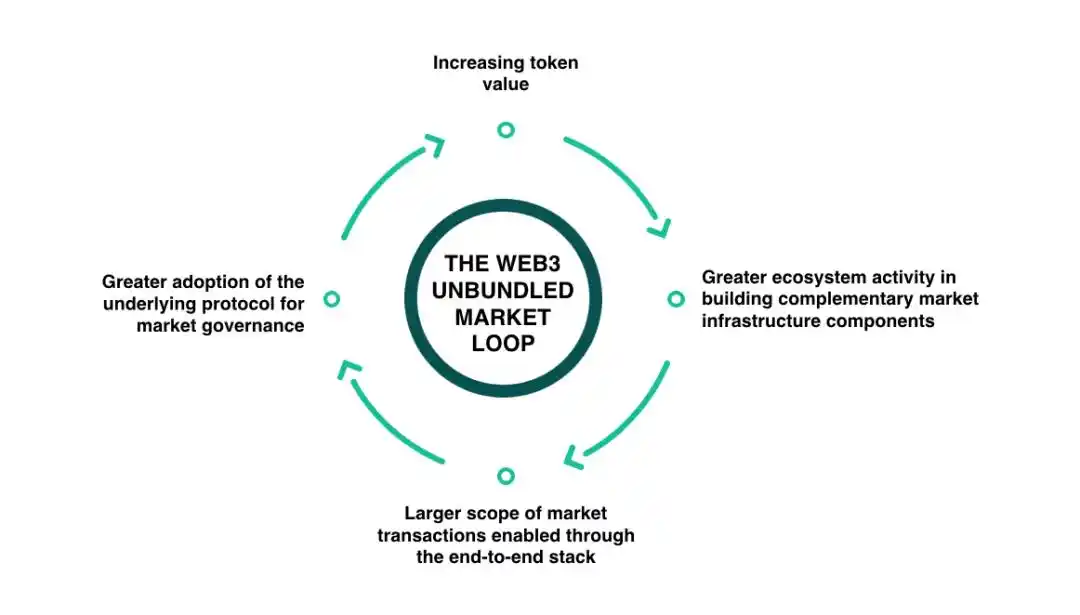
In Web2 platform, the platform manager needs to manage the correspondence between supply and demand. For example, if all the listings on early Airbnb were in Denver, but the user was searching for listings in New York City, the transaction would not take place. But Web3 requires additional coordination and incentives between the marketing infrastructure and corresponding marketing activities. For example, if users on the Web3 platform are looking for a particular type of search interface, the platform needs to provide incentives to attract developers to build the project in order to meet those needs.
In summary, managing Web3 network effects requires not only managing marketing activities, but also their coordination with market infrastructure. When Web3 ecosystems reach this equilibrium, they are in a positive feedback loop that amplifies these ecosystems further:
Model 3: Defense capability and low transfer cost
Another important difference is that Web3's network effects are less defenseless.
Web2's defensiveness is achieved through four forms of stored/accumulated value: data captured by the platform, content submitted to the platform, reputation built on the platform, and influence created on the platform.
Creative content: Users invest in creating a portfolio of creative content that is the foundation of their interactions on the platform.
- Reputation: Building a reputation on the platform requires consistently providing highly rated services and may also require meeting some minimum standards specified by the platform. Thus, once a service provider has established a reputation on the platform, it prevents her from migrating to a competing platform.
- Usage data: The more information users consume through the platform, the smarter the algorithm is at recommending relevant content to users.
- Impact: As a user's number of followers grows, so does the value of storage in the network and the incentive to stay actively engaged.
The four forms of cumulative value, which are platform-specific in web2, can also be easily transferred across platforms in web3. New markets can easily gather available NFT and attract large numbers of users, who can also move their activities and data to the new platform at low cost.
While Web3 has allowed innovation to explode, the ability of platforms to retain innovation and continue to add value is declining. So any strategy for building network effects in web3 needs to account for the lack of cumulative value and low transfer costs. Web3 needs new factors to make network effects defensive.
Model 4: Management extraction
Defensive network effects with high transfer costs enable Web2 platforms to indulge in (and benefit from) excessive extraction (of user data) and control (through seduction and conversion, locking, commoditization, etc.). This will cause network effects to work in reverse as transfer costs collapse.
The creation and management of network effects in Web3 need to solve the problem of easy switching, and therefore need to solve the problem of extraction. This is especially important because, unlike Web2, the market infrastructure and resources in Web3 are provided by ecology. To provide their resources and innovation capacity, ecological actors need to ensure that they get an appropriate return on their investment and have institutions in place to protect those returns from commodification and policy changes.
Management extraction is the key to managing Web3 ecological network effects. In the world of open source protocols, excessive extraction leads to forking and frequent migration of activity by ecological actors. Web3 also allows ecosystem participants to abandon protocols and organize around forking protocols.
Model 5: Governance degree management and risk
High transfer costs encourage Web2 platforms to lure and switch, change policies and disempower ecological players.
Since Web3 has lower transfer costs, managing participants will be key to developing network effects.
The governing body will need to build and assign governance tokens to assign degrees of governance for agency, control, and management of the platform outside of the founding team (and other internal people).
随着协议的发展,相关的治理 Token 可能会变得更有价值,从而进一步加强网络效应,因为持有 Token 的关键贡献者不仅可以从回报中受益,而且还有能力塑造未来的发展路线图并组织资源分配和相应的参与激励。
conclusion
Different network effects of Web3 bring new challenges, support new incentive mechanisms, rewrite the traditional defense and extraction rules, and reconstruct the balance between platform and ecology. As illustrated by the five mental models above, Web3 network effectiveness requires an entirely new playbook: new guidance and promotion models, new governance mechanisms, new sources of competitive advantage, and new forms of value capture.
The original link
Welcome to join the official BlockBeats community:
Telegram Subscription Group: https://t.me/theblockbeats
Telegram Discussion Group: https://t.me/BlockBeats_App
Official Twitter Account: https://twitter.com/BlockBeatsAsia
 Related Articles