Four models for coordinating charitable giving in the crypto world
原文标题:《 Coordination and Crypto Charity 》
Original author: Takens Theorem
DAOrayaki, DoraFactory
The 100,000 transactions recorded on the Ethereum main network show how blockchain charitable giving is coordinated.
Cryptocurrencies have an odd paradox. It emphasizes individual sovereignty, which some consider a central concept. But there are also seemingly opposite forces that see it as a process of coordination and consensus. The contradiction is not hard to explain. In cryptocurrencies, you can't have sovereign individuals without coordination of trust minimization. Like two sides of the same coin. While we talk more about self-banking and self-custody, people are looking at the rich forms of coordination that the cryptocurrency space brings.
An inspiring example of coordination is charitable giving. Cryptocurrencies are a natural vehicle for philanthropy. It minimizes the intermediaries, thresholds, and boundaries that can limit giving. Donations can reach fundraising goals instantly. The process can be either anonymous or published on a public ledger for all to see as "proof of donation".
Because charities sometimes use public addresses, we can mine blockchain for this pattern of coordination. Therefore, the DAOrayaki community compiled the article "How crypto Communities Coordinate Charitable Giving". For this article, a modest data set was gathered, including 100,000 inputs to about 20 public addresses on the Ethereum main network (see appendix for a complete list and important caveats). This is just a subset of the entire cryptocurrency donation, focusing on data samples using the Etherscan API. Though incomplete, the record of donations on this chain reveals the power, speed and efficiency of coordination, as well as the different forms of coordination.
In investigating this data sample, four clear coordination patterns were observed and summarized below: viral, initiative-based, automated, and spontaneous. These features are particularly important for humanitarian action at a time of global concern and a need for rapid resources. So before we summarize these patterns, we want to give a few important examples.
Pay attention to case
There are two easy cases. The first occurred in 2021, when India was hit by the biggest wave of COVID-19. Many cryptocurrency companies feel compelled to take action to drive support for humanity. The campaign started with a tweet from Polygon co-founder Sandeep Nailwal.
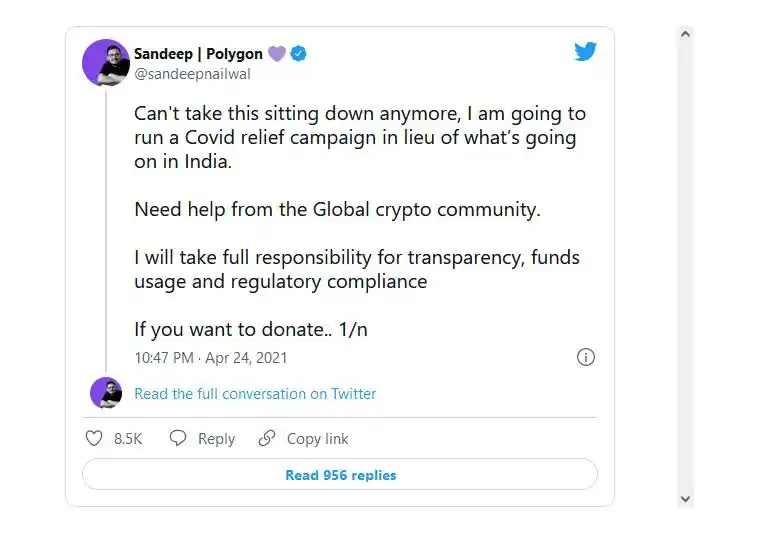
When word spread, hundreds of donations rolled in, and eventually about 1,200 people made donations. India COVID Relief's multi-signed wallet was the largest donor address in this data set, with donations totalling over $1.5 billion (in early April 2022 DOLLARS; See notes for endnotes).
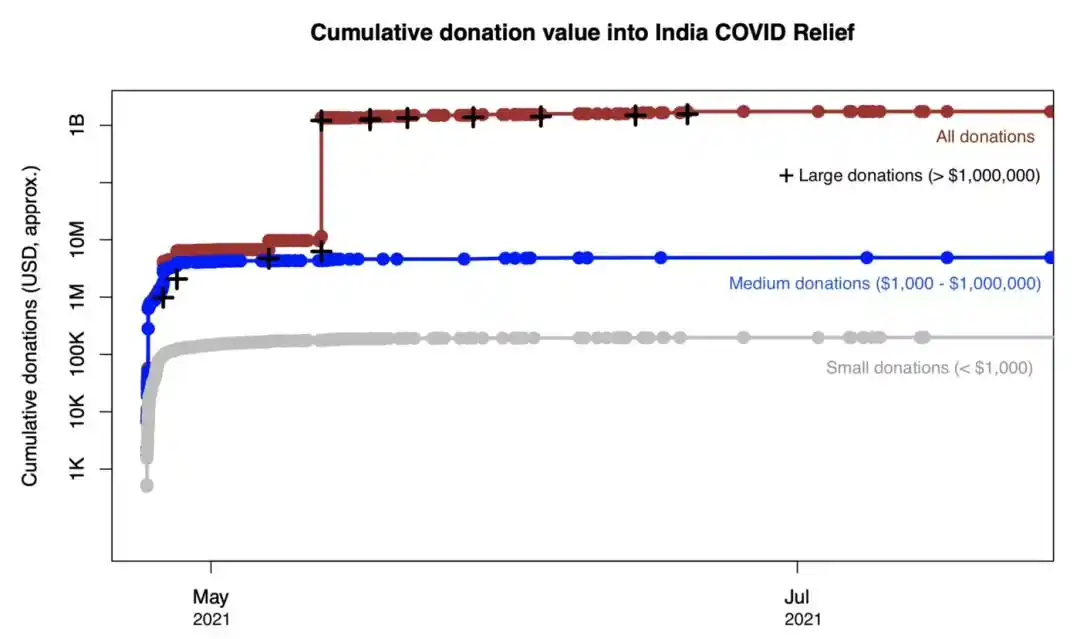
VB's large donation in May; Most of the donations were small, with the whales making up the bulk of the donations
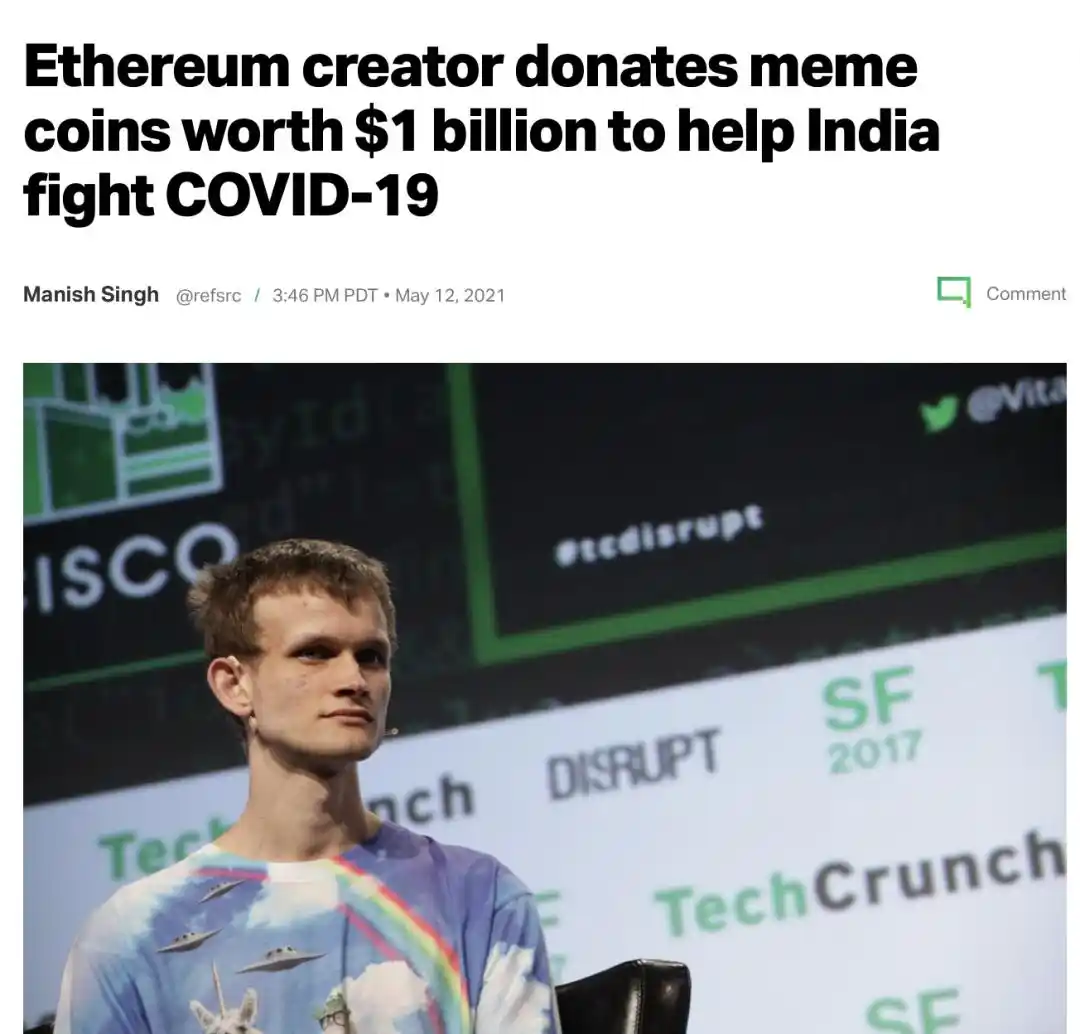
不仅如此,一笔著名捐赠使这个合约的余额增加了 10 倍。Vitalik Buterin 意外获得了一笔狗狗币空投(Shiba Inu token, 以太坊的 ERC-20 Token )。他决定捐出 50 万亿 SHIB Token,按当时的价格计算几乎达到 10 亿美元。他直接将其发送到了印度疫情纾困 的钱包地址。可以看到 Etherscan 上的交易。这可能是加密货币历史上最大的单笔慈善捐款。
Tech Crunch 2021 cover
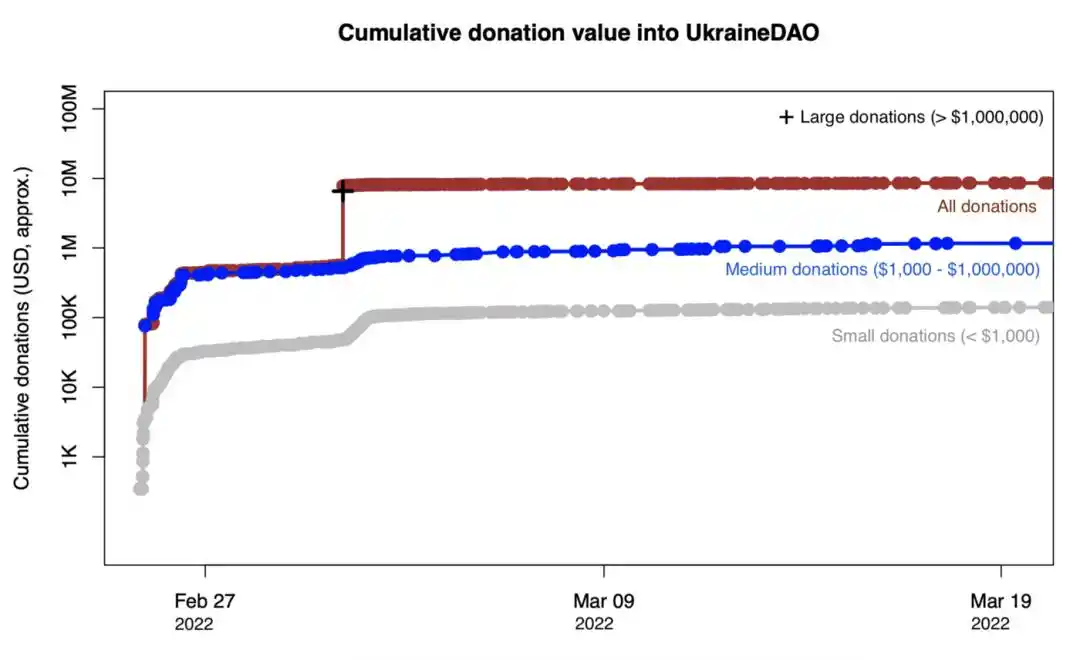
Another more recent example is charitable donations to the war in Ukraine, where millions of ukrainians have been displaced (or worse) by the invasion of their country. Some members of the Ethereum community teamed up with Pussy Riot to set up UkraineDAO. From ideas and planning to near-instant funding for humanitarian work, this is a further striking example of how flexible cryptocurrencies can be in coordination. In just a few weeks, the fund received more than $10,000,000 from more than 1,000 transactions. It's just UkraineDAO, and it only counts the Ethereum main net. Including another Ukrainian government official wallet and other public chain donations, the total to Ukraine could approach or exceed $100 million.
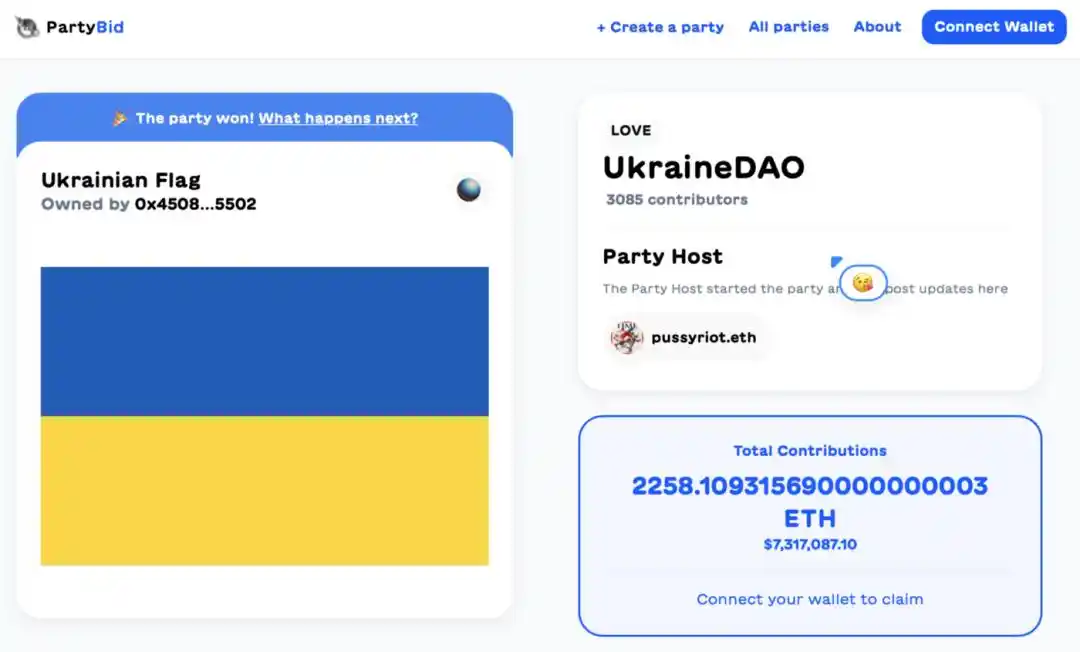
Ukraina Da was presented in a matter of weeks; Significant NFT sales were seen in early March
This donation also added a new NFT method -- 2,258 ETH was raised through the Ukrainian flag NFT. The money was raised by coordinating more than 3,000 smaller donations through PartyBid.
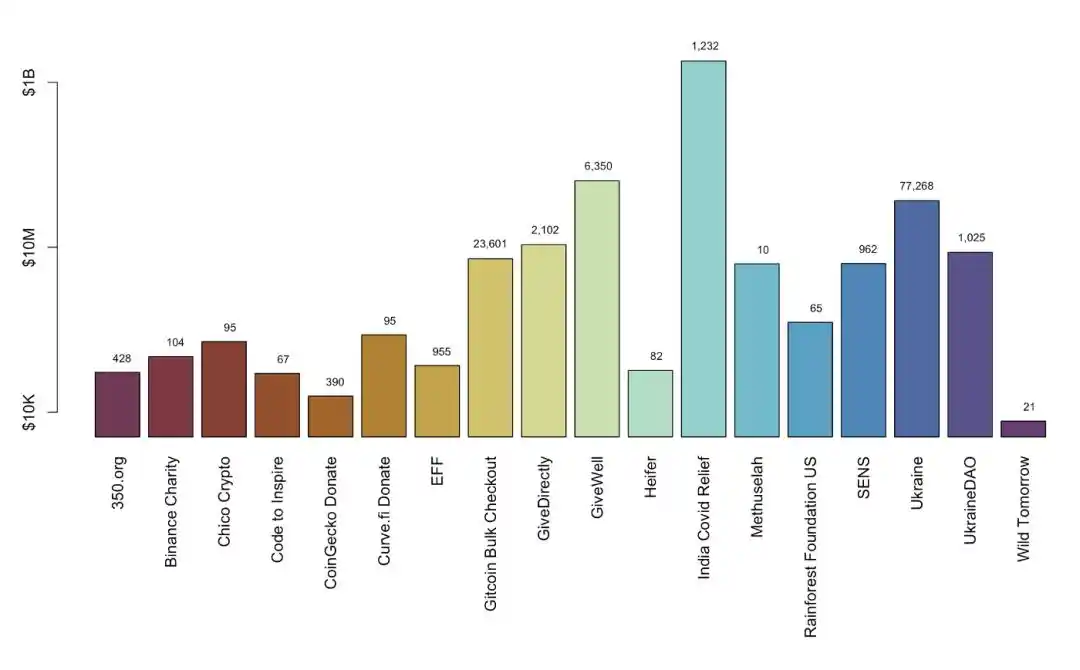
In total, donations from these 20 public addresses have been estimated at around $2,000,000,000 (in April 2022 dollars) over the past few years. And that's just ethereum, so it's only a subset of that donation. Support for these donor initiatives varies widely. Etherscan's "charity" and "Donation" tags are used in addition to the established addresses, so some of these are public wallets that support projects or creators (like Chico Crypto on YouTube). Most are charities, and one is large donations on a variety of themes, like Gitcoin.
Contributions per initiative in the sample we analyzed (US $); The bar chart shows the number of donations
Interestingly, more than 75,000 of these 100,000 donations went to the official wallet of the Ukrainian government (the numbers are shown above each bar in the bar chart above). Many initiatives have been launched to help this official wallet in Ukraine, including thousands of transactions from Uniswap and directly from exchanges (Coinbase contributed over 3,000 transactions, for example).
Patterns and Principles
When evaluating the distribution of these donations, we see a pattern that is all too familiar in cryptocurrencies: the superinfluence of Whales. About 95% of all individual donations were less than $1,000, which adds up to only about 1% of the total value of cryptocurrency donations in the dataset. But donations from the top 100 alone accounted for more than 95 percent of the money. This is mainly due to Vitalik's donation, but if we take out his donation, the top 99 alone accounts for more than 90% of the rest. This pattern is common in many systems, including socioeconomic systems. But it will be evident in some indicators of cryptocurrencies, although that has been changing in recent years.
About 90 percent of donors give several times. But several wallets had hundreds, some even thousands of donations. Further analysis of these high-frequency donors reveals some important initiatives. Here are some examples:
1. Art Blocks Make 1,508 donations to GiveDirectly and GiveWell
2. Donations made through Colorglyphs Foundry (Mint). Made 480 donations to the EFF
3. Donations made through Autoglyphs Foundry (Mint). Made 384 donations to 350.org
Cryptocurrencies facilitate programmable giving. This is very unique because it is embedded in the blockchain. Projects like Art Blocks and Colorglyphs automate the distribution of initial Mint royalties. When a sale is made, the contract is matched with the charitable recipient for a specific share. There was no one involved in the whole process. (In fact, Art Blocks has given much more, distributed among other charities, as described here).
One problem is that charitable giving is heavily distributed among a small number of senders and recipients. How can we expand the reach of giving so that more people help more people? One way is to design a grant plan that acts as a "vote" for donors to receive matching funds when they give to multiple favorite projects. Projects with more voters receive more matching funds. That's the goal of Gitcoin and Dorahacks-HackerLink's funding rounds, which distribute millions of dollars to hundreds of projects.
Note, Hackerlink is an infrastructure service provided by DoraFactory.
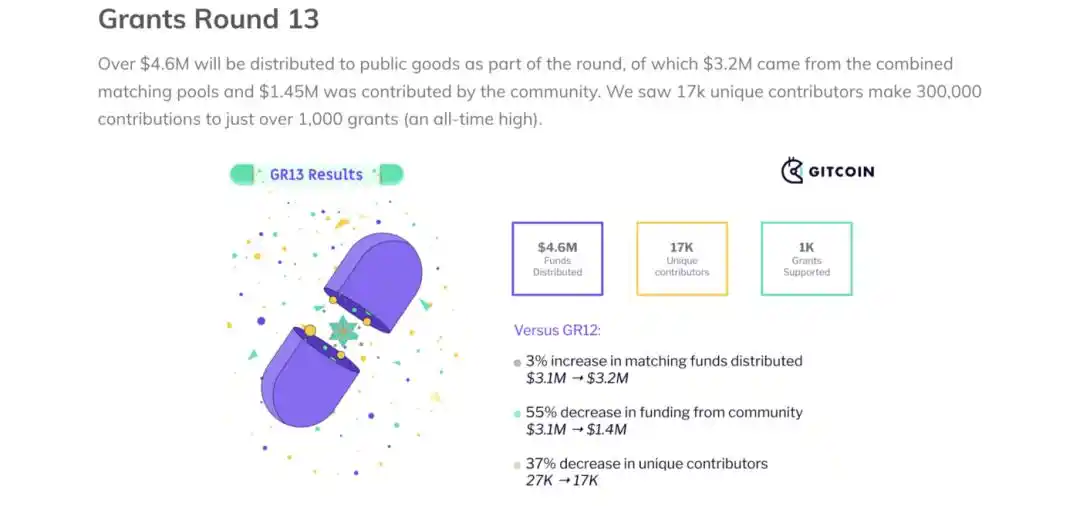
Gitcoin round 13 funding distribution, from their announcement page
Gitcoin just completed their 13th round of funding, which includes Web3-related projects, social and community initiatives, and philanthropic activities (such as several new grants for Ukraine).
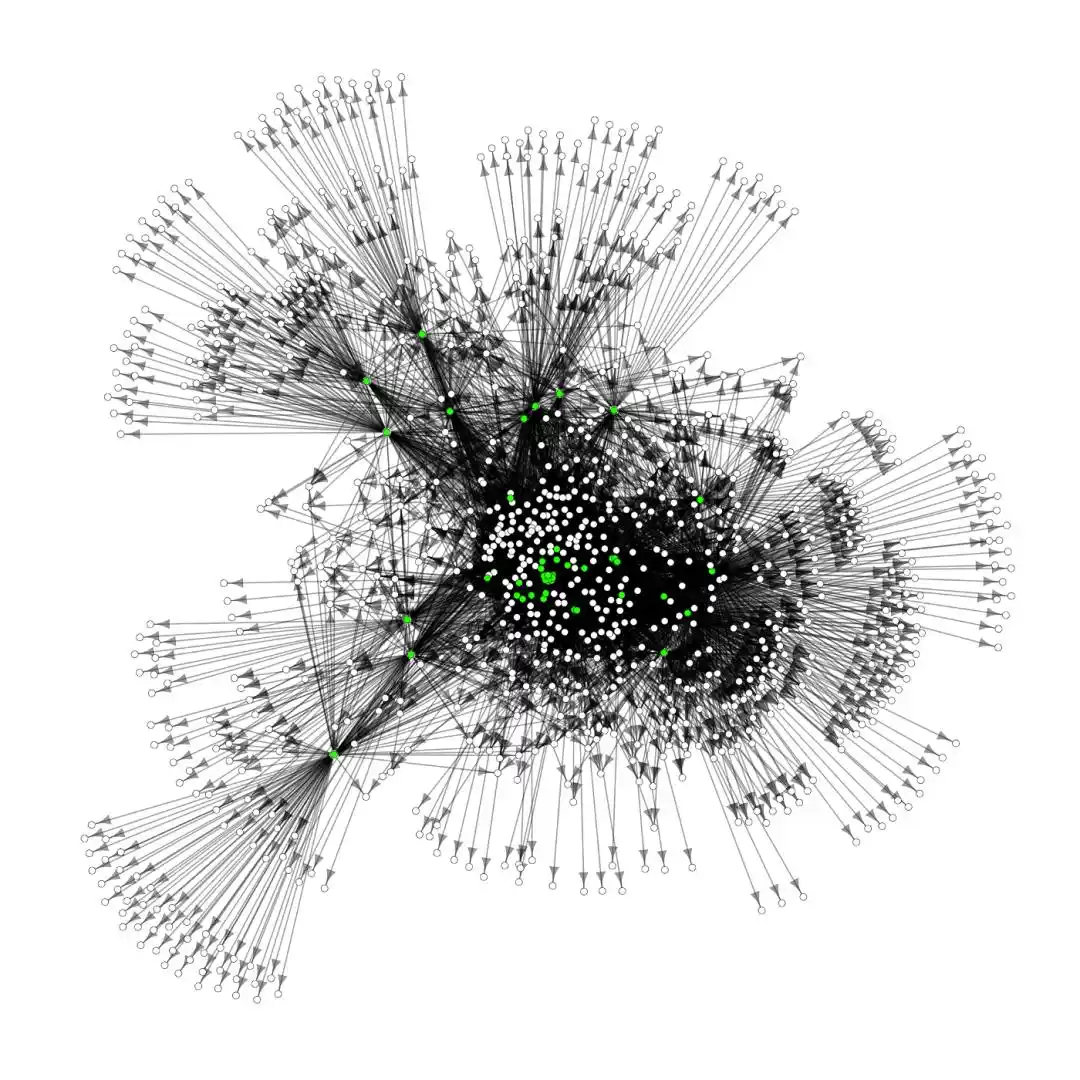
The data set here folds these donations into a single Gitcoin wallet. But we can break these entries down into their respective Gitcoin donations. We can infer which grants are funded by using the input field in Etherscan's API (account transaction endpoint). By doing so, some amazing contributions can be found. For example, one user donated 451 Gitcoin items in a single transaction, each item sharing $2.85 of DAI. Kevin Owocki, co-founder of Gitcoin, donated to more than 50 projects during the deal. To get a sense of these donations, let's plot the top 50 such donations on a network. The green dots are the donors, and the open dots are the projects they donate to.
The green node is Gitcoin donor 1 pair of multiple donations; The open node is the receiver
As previously observed, a few projects still receive the majority of grants. Some projects (such as Rotki and Ether.js and other head projects) received more donations than others. But in general, donations are more widely distributed, and many projects are seen because voting encourages support for more favored projects. There are still "winners", but because of the diffusion effect, some obscure treasure trove projects or projects that have just started are also likely to be supported.
conclusion
From the above analysis, we can see some clear patterns. Some of them are familiar to us. For example, the existence of whales. More interesting are the strategies that emerge from these patterns. We can draw four patterns of coordination for cryptocurrency donations.
Viral.These tend to be charity events with a time window, driven by some major event, like COVID or the war in Ukraine. Their coordination models are often simple, such as direct crowdsourced donations, but some projects have taken a different approach, such as using NFT to attract more attention. Cryptocurrencies can help charities mobilize by drawing attention to an important philanthropic initiative and transparently revealing who is involved. That may motivate others to help.
Based on initiative.Donations can also come from tweaks to coordination, such as Dorahacks' use of quadratic fundraising to encourage support for more projects and to balance the "rich get richer" effect by funding projects that receive donations (or "votes") from many people. This model presents perhaps the most complex coordination possibilities. As interest in daOs grows, there will be more and more experimentation with how to promote donations.
Automation.With the Public Charity Wallet, it would be possible to program contracts to give automatically. Colorglyphs and Autoglyphs have done this with Mint, and Art Blocks has done it in many more projects. In my own recent project, The Mesh, owners can interact with contracts and make small automatic donations to charity. This coordination is often simple, but it also makes giving simple: it automates it unconsciously.
Spontaneous.I leave this last category to other giving patterns that cannot be "explained" by the three categories above. Maybe it's similar to traditional philanthropy -- giving at the end of the year, a desire to give back to the community, or reading information on a charity's website. But even so, cryptocurrencies are providing a boost here. When using cryptocurrency to donate, there is little difference between you and the charity. If you don't want to be identified, you can transfer money directly from the exchange or from any address that has no connection to your other wallet. I described these features in a previous article.
I know it's a limited data set, but I can still find these different patterns. Blockchain provides a wealth of data that clearly illustrates these patterns. Another reason this data set is limited is that charitable services like Giving Block help donors remain anonymous. Giving Block creates one-off addresses for charities and donors. See here for details. Obviously, I don't have access to these donated data.
Despite the limited data set, I was also impressed by the $2 billion cryptocurrency donation. And, while whales account for the bulk of it, even the smallest donations, made by thousands of people together, can raise tens of millions of dollars to help others.
Notes, disclosure
上述总结不应视为对任何捐赠者或慈善机构的认可。这个数据挖掘只基于一个数据子集,特别是公共钱包上的直接的、内部的 Token 交易(见下文)。我使用 Etherscan 的 API 来提取这些数据。美元金额是基于 4 月的价格的近似值,它们只描绘了整个加密货币捐赠活动的一部分。
Here are 20 wallets that mined Etherscan data, totaling more than 100,000 transactions. Several of them were found on charity websites, counting a certain number of transactions on Etherscan marked "charity" or "donation." That means some are donor wallets for creators or other projects, but most are public wallets for charities.
India COVID Relief
GiveDirectly
GiveWell
Heifer
EFF
Wild Tomorrow
SENS
350.org
Rainforest Foundation US 1
Rainforest Foundation US 2
Methuselah
Ukraine
UkraineDAO
Binance Charity
Code to Inspire
Chico Crypto
Coingecko Donate
Curve.fi Donate
reference
India COVID relief: https://etherscan.io/address/0x68A99f89E475a078645f4BAC491360aFe255Dff1
Xb65bcbb85c1633b0ab4e4886c3cd8eeaeb63edbb39cacdb9223fdcf4454fd2c7 Etherscan: 0
Tech manager at: https://techcrunch.com/2021/05/12/vitalik-buterin-donates-1-billion-worth-of-meme-coins-to-india-covid-relief-fund/
Ukraine flag NFT:https://twitter.com/Ukraine_DAO/status/1498997683683348481
PartyBid: https://www.partybid.app/party/0x4508401bade71ae75fe70c97fe585d734f975502
Uniswap:https://twitter.com/FedorovMykhailo/status/1498936977474965504
Art Blocks: https://etherscan.io/address/0x47e312d99c09ce61a866c83cbbbbed5a4b9d33e7
GiveDirectly:https://www.givedirectly.org
GiveWell:https://www.givewell.org
Colorglyphs: https://opensea.io/collection/colorglyphs
EFF: https://www.eff.org/pages/other-ways-give-and-donor-support#crypto
Autoglyphs: https://www.larvalabs.com/autoglyphs
Art Blocks: https://medium.com/the-link-art-blocks/charity-on-chain-how-art-blocks-is-raising-85eth-or-300k-4c27f3742b82
https://medium.com/the-link-art-blocks/update-charity-on-chain-23-5-million-in-august-b4876db65c77
https://gitcoin.co/grants/explorer?page=2& limit=12& me=false& sort_option=& collection_id=false& network=mainnet& state=active& profile=false& sub_round_slug=false& collections_page=1& grant_regions=& grant_types=& grant_tags=& tenants=& idle=false& featured=true& round_
https://etherscan.io/tx/0x37675faa53e5b81c7706162fa7f3bed62600d4a5d5a92b47cde9ffe15a9bc23b
https://etherscan.io/address/0x00de4b13153673bcae2616b67bf822500d325fc3
The Mesh: https://the-mesh.eth.link/
https://thegivingblock.com/donate/
India COVID Relief: https://etherscan.io/address/0x68A99f89E475a078645f4BAC491360aFe255Dff1
GiveDirectly: https://etherscan.io/address/0xc7464dbca260a8faf033460622b23467df5aea42
GiveWell: https://etherscan.io/address/0x7cf2ebb5ca55a8bd671a020f8bdbaf07f60f26c1
Heifer: https://etherscan.io/address/0xd3f81260a44a1df7a7269cf66abd9c7e4f8cdcd1
Wild Tomorrow: https://etherscan.io/address/0xfa53ed45c13a2b86daa0074e7ada739280635d19
SENS: https://etherscan.io/address/0x542eff118023cff2821b24156a507a513fe93539
350. org: https://etherscan.io/address/0x50990f09d4f0cb864b8e046e7edc749de410916b
Rainforest Foundation US 1: https://etherscan.io/address/0x54334ebc8c9ef04bc28d614caa557143ed8afc87
Rainforest Foundation US 2: https://etherscan.io/address/0x338326660F32319E2B0Ad165fcF4a528c1994aCb
Methuselah: https://etherscan.io/address/0xa18E7e408859BC1c742aA566D6aCc3F8fD5e7ffD
Ukraine: https://etherscan.io/address/0x165CD37b4C644C2921454429E7F9358d18A45e14
UkraineDAO: https://etherscan.io/address/0x633b7218644b83D57d90e7299039ebAb19698e9C
Binance Charity: https://etherscan.io/address/0x8B99F3660622e21f2910ECCA7fBe51d654a1517D
Code to Inspire: https://etherscan.io/address/0xF30B6Efd7B77Ad91C2a9D12fdb4dfE38dbc506f8
Chico Crypto: https://etherscan.io/address/0xf1d402c0175a9fa80dd770e82fa0bd50fdab0ebd
Coingecko Donate: https://etherscan.io/address/0x4Cdc86fa95Ec2704f0849825f1F8b077deeD8d39
Onto the fi Donate: https://etherscan.io/address/0x28b88cfD875C883cDb61938C97B8d1baabf31c88
The original link
Welcome to join the official BlockBeats community:
Telegram Subscription Group: https://t.me/theblockbeats
Telegram Discussion Group: https://t.me/BlockBeats_App
Official Twitter Account: https://twitter.com/BlockBeatsAsia

 Related Articles