Consensus Game Among GameFi Players
Original title: "The Consensus Game Among GameFi Players"
Original author: Research DAO
Original compilation: Dinzz, H.Forest Ventures
< br>
Introduction
Behind the financial attributes of DeFi and GameFi The action consensus (that is, the action that most participants will take) is used to adjust the game strategy for the game.
Why is it not a simple decision, but a dynamic game?
Because Player A's decision affects Player B's decision, which in turn affects Player A's own decision. As a result, players will experience the complexity of the game as their decisions (or sometimes anticipated decisions) happen to all players simultaneously. The development of the game will be multidimensional and happen in real time, especially in a market with sufficient depth and liquidity.
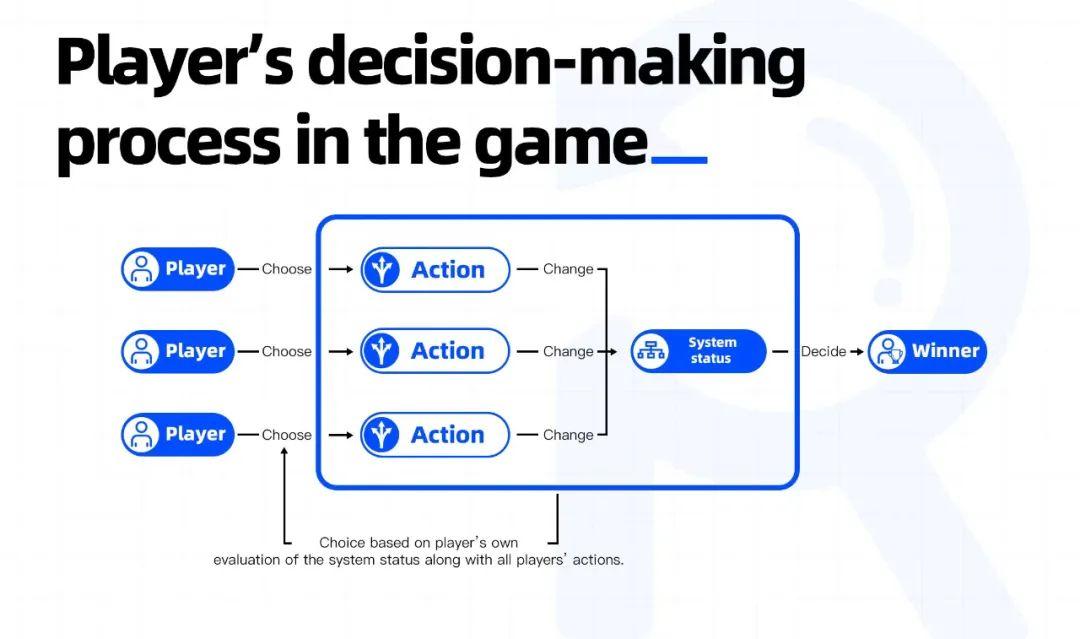
Participating in the market means participating in the game. After evaluating the average consensus of all participants in the market, an action below the average consensus must be chosen to win. If a participant behaves above the average consensus, it will fail.
This article discusses the unique capabilities of GameFi and its inherent system properties, which are used by multiple parties in a gaming system to facilitate consensus. Take GameFi's various interest groups as an example, including developers, guilds, and ordinary players. Some players in the game can see the panorama of the entire market, and they can act by anticipating the actions that other players may take, and choose a course of action with a greater chance of winning to gain an advantage in the game.
In this article, we will analyze Axie Infinity, the most typical GameFi game, and YGG, the most important guild in the GameFi field. We hope that through our efforts, we will give you an in-depth understanding of the main functions and internal logic of GameFi.
Summary
1. "Guess 2/3 of the average" game
1.1 Two players guess the "2/3 of the average" game: the minimum number of "strict advantage strategy" is "0".
1.2 Multiplayer "guess the mean" game: After evaluating the average of Offer a number 1/3 lower than the average to win.
2. DeFi+GameFi Consensus Game
2.2 GameFi: The emotional value of NFT combined with the game function of GameFi makes it easy for various interest groups to manage the consensus of players in the market. Unlike DeFi, which adopts a single Token system, the value of GameFi is not only reflected in its Token price. The complexity of player interaction patterns and consensus games are also growing.
3. AxieInfinity
3.1 Axie's Economic model: The player consensus is divided into three types of assets, and the consensus game focuses on maintaining the price of SLP.
3.2 Axie team and YGG: YGG has more ability and motivation to manage the consensus of players, but it still needs Axie to introduce adjustments to the economic model.
4. The consensus game will never stop
< br>
1. Average 2/3 Game: Evaluate Consensus and Win with Weak Dominance Strategy
In the Nobel Prize-winning economist's book "Misbehaving", Richard Thaler proposes an interesting game: guess the average of 2/ 3.
Participants are asked to choose an integer from 0 to 100. The participant whose number is closest to 2/3 of the average of all selected numbers wins the game. For example, suppose 3 participants guess 20, 30 and 40 and the average is 30. Then the person who chooses 20 is the winner.
1.1 Two-person "average 2/3" game
In this game, If there are only two players, there is a "strictly dominant strategy" (meaning that no matter what numbers the other players choose, each player will have an optimal strategy to win the game). Picking 0 has a higher chance of winning than picking any number greater than 0.
For example, if the numbers provided by two players are 0 and 100 respectively, 2/3 of the average would be (0+100)/2*( 2/3) = 33.3. The number 0 is closer to 33.3, so the player chooses 0 to win.
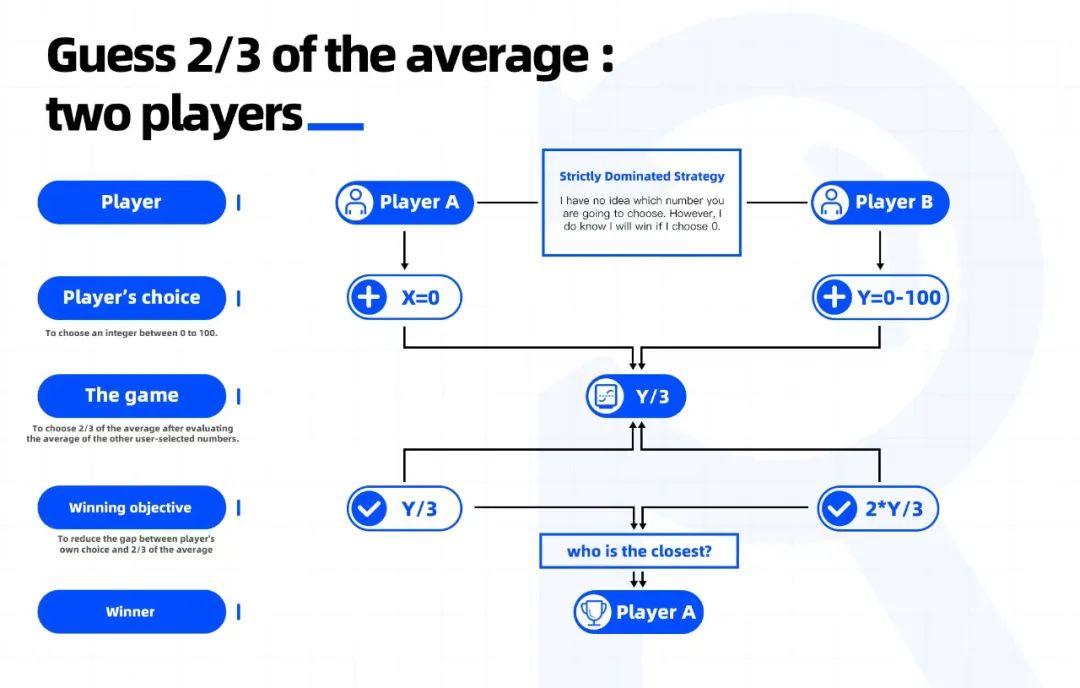
Reduced to its most essential form, a two-player game is really a "whoever picks the lower number wins" scenario. Due to the low degree of freedom of the game, players only need to choose a smaller number than other players to win the game. Therefore, the "strictly dominant strategy" is to choose 0 for all players.
1.2 Multiplayer "average 2/3" game
When the game has two When the above players, we will face a more complex situation, because the presence of new players will force all players to rethink the behavioral motivations of other players. The winning strategy changes from a "strictly dominant strategy" to a "weakly dominant strategy".
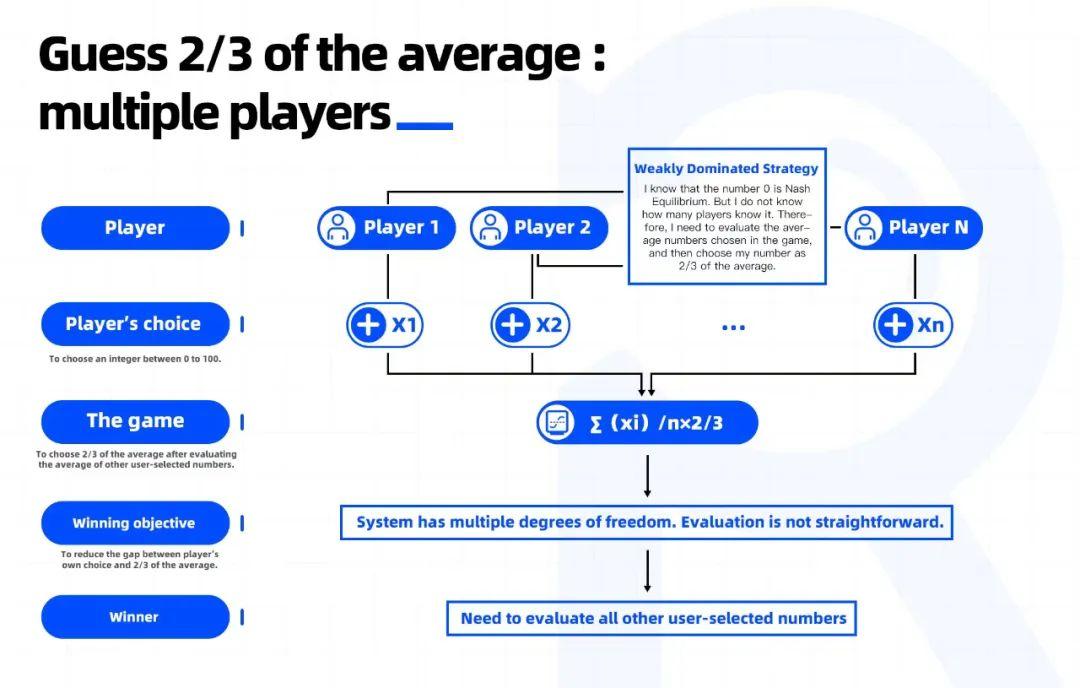
A rational game player would reason like this:
- At first, I could make a Reasonable assumptions: Assume that the player's choice of 0-100 will follow a normal distribution with mean 50. 2/3 of 50 would be 33.3. So, to win, I'll pick number 33 as my answer.
- According to the previous reasoning, I can dig a little deeper: If some players are the same as my reasoning above, they will The number 33 is provided as the answer, which means that the actual average would be slightly lower than 50. Of course, if each player made the same reasoning as above, the actual average becomes 33. To win, I put 22 as my answer (ie 33*2/3 = 22).
- After a process of elimination, the answer will gradually approach 0. Finally, the integer 0 is the final answer, and the game reaches a "Nash equilibrium".
Multiplayer games have more freedom than two-player games. Its basic mechanism is to predict the average of all players. Simply picking the smallest number 0 will not win the game.
Moreover, for multiplayer games, the point is not that the game will eventually reach a Nash equilibrium.
The point is how far the current system is from reaching a Nash equilibrium, taking into account all players in the game. The answer depends on the degree of information asymmetry within the system and the speed at which information is transmitted between all participants.
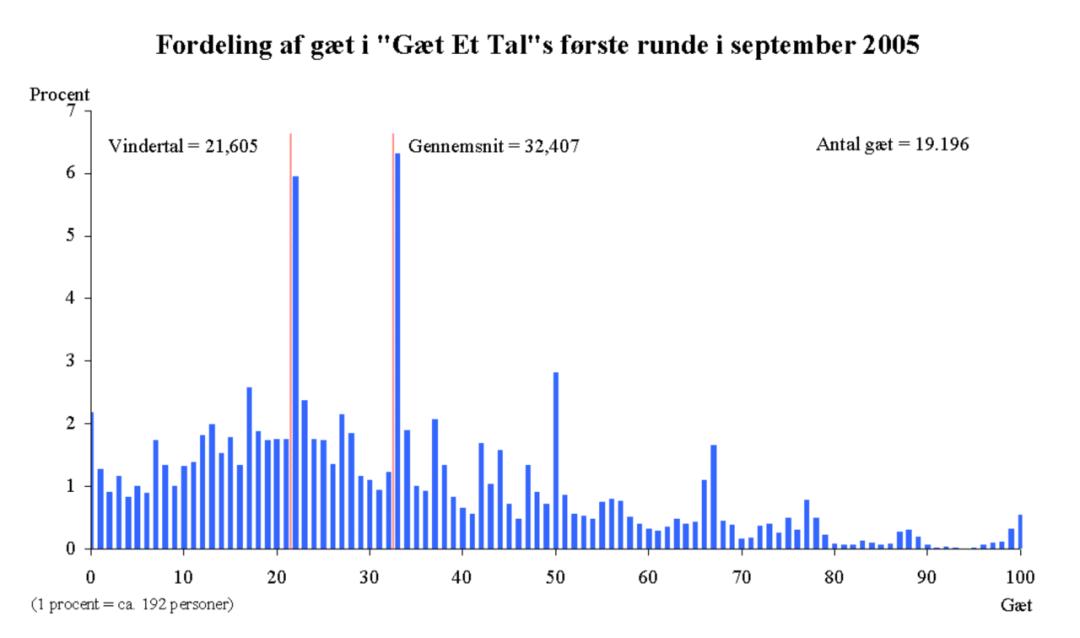
For example, players who play for the first time follow the distribution shown in the figure above: more than 6% of players choose 33, less than 6% of players choose 22, and win The number is 19. Imagine if these players played the game a second time, the winning number would be closer to 0. When all participants realize that 0 is the final answer to win, no player will be a loser. Ironically, the games would end at the same time, with no winners.
So, for players who want to win, here are a few things to consider:
- How to evaluate the consensus of all players;
- How to win by behaving below the overall consensus;
- How to interact with other players or influence the choices of the entire community.
As a classic game in the financial field, the game paradigm of "guessing 2/3 of the average" is reflected in blockchain players' cognition of project information, Token In the game of price expectations and future business operations. In the subsequent chapters of this article, we will explain in detail how ordinary users, project parties, whales, game guilds and other players play consensus games in the DeFi and GameFi fields.
02. Consensus Game in DeFi & GameFi
In the first part, we discuss A "strictly dominant strategy" that takes 2/3 of the average of the two players' guesses. But the actual dynamic game takes place in a multiplayer game. Players need to evaluate the consensus of all players, which is the average number in the market, and the final winner only needs to give a number that is lower than 1/3 of everyone's consensus. The consensus game in DeFi is also a similar form.
2.1 DeFi
DeFi participants need to assess the overall consensus on the DeFi project and the All information to be collected. Consensus can be reflected by many factors, including average market behavior or the current trend of token prices.
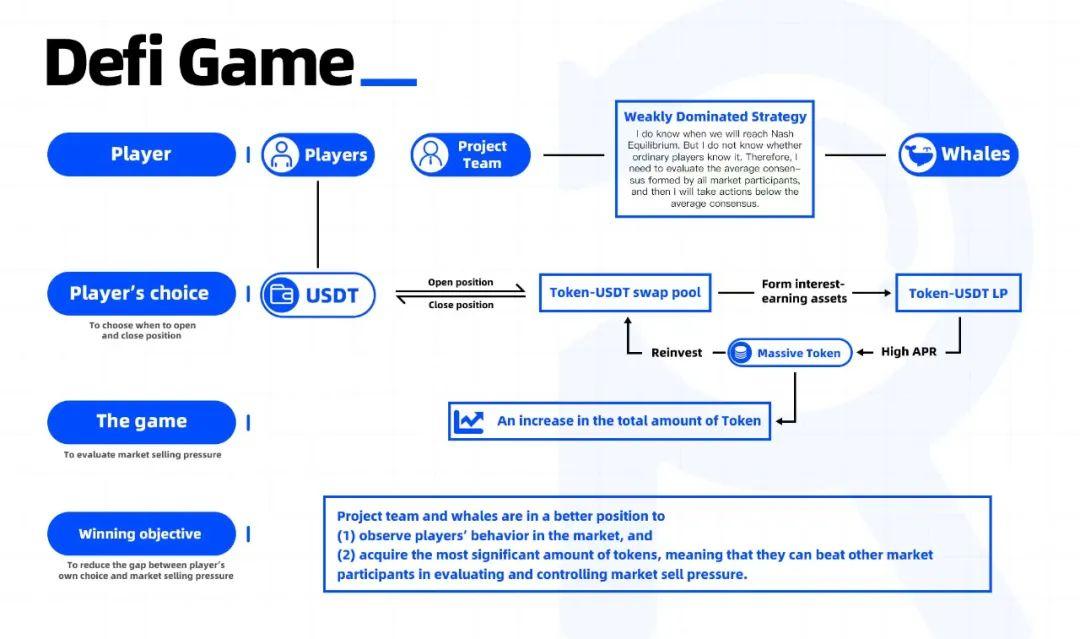
When the DeFi swap form integrating DEX and AMM appears, the market liquidity is greatly improved. Therefore, market behavior can be directly reflected by user opinions, and Token prices directly reflect the quantified market consensus.

However, Token price does not fully represent the average consensus of all participants on the project. The concepts involved in DeFi are much more complex than the game of "guess 2/3 of the average". DeFi project parties can directly participate in the design of the game system, and continuously introduce new concepts, values, cooperation forms, and financing during the operation cycle, including but not limited to:
Design a sustainable Token economic model;
Implement effective business operations;
Maintain community building;
Increase project value;
Improve the prediction of the future value of the project;
Grasp the macro market trend, etc.
The DeFi project team is good at using the unique DeFi mechanism to improve players' evaluation and expectations of the project and increase the average consensus of market participants , eventually prolonging the project lifetime (i.e. delayed Nash equilibrium).
2.2 GameFi

GameFi has similar game mechanics. However, unlike DeFi's single Token system, GameFi adds the following two key features:
-Introduction of multiple Token systems + multiple capital pools + NFT Marketplace
- As an interest-bearing asset, NFT also brings additional sentimental value (i.e. non-financial product) to players. Additionally, the rarity grading and functionality of the NFT itself introduces new ways to manage market consensus.
The ability to continuously inject value is the most significant advantage of GameFi: Players' evaluation of GameFi projects is affected by emotional factors and innate The game value of the game is greatly affected. In addition, project valuation is not necessarily directly related to its Token price.
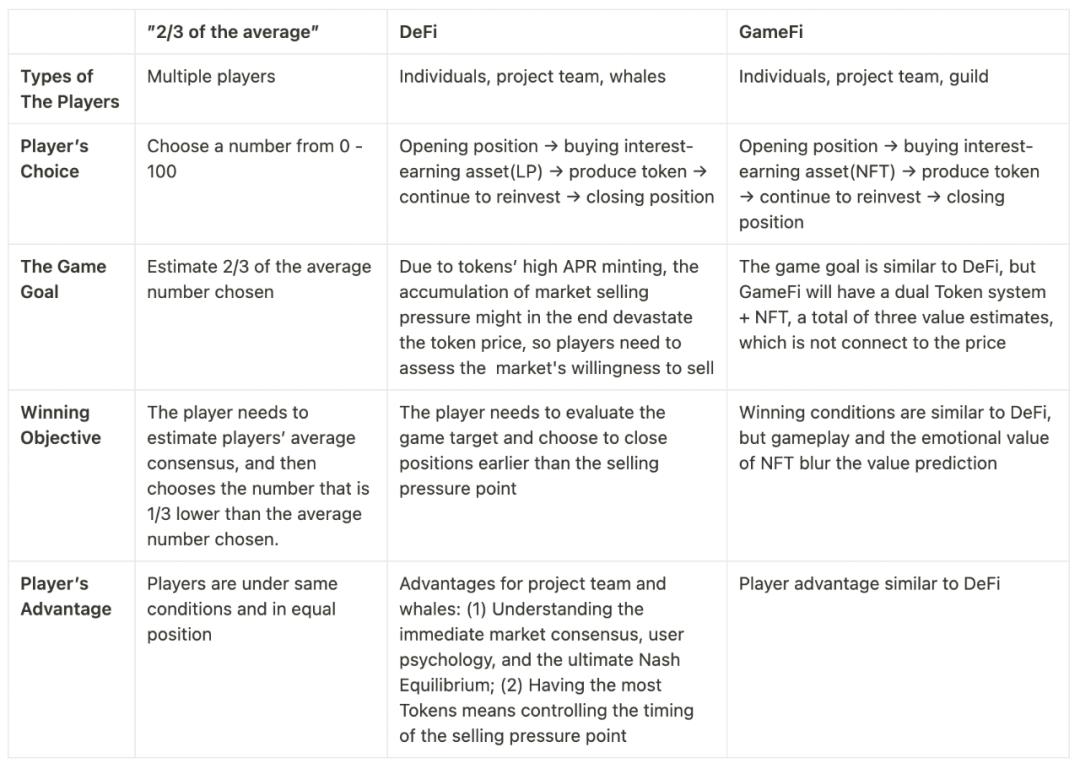
When playing DeFi and GameFi games, project parties, whales and institutions often have a clearer vision, better channels and higher risk tolerance than ordinary players abilities, which give them more initiative and exploitable advantages in the game. With rich market information and funds that can influence market behavior, these players can quickly accumulate in-game assets, influence the average expectations and consensus of all players, and ultimately determine their own winning goals.
For ordinary players, due to insufficient understanding of market information, they often cannot make optimal decisions. As far as the outcome of the game is concerned, careless decision-making is the norm, and most players fail to maximize their own interests. And sometimes, ordinary players are forced to get involved in vicious competition between project parties and whales.
03, Axie Infinity
Take Axie Infinity as an example. When the GameFi project endowed its NFT with the value of interest-bearing assets, the rise of game guilds became inevitable. The three-party consensus game between guilds, project parties and ordinary players has become more complicated. Due to Axie Infinity's own characteristic dual Token and its NFT economic model, the consensus goals of market participants are relatively scattered, which provides more operability for project teams and guilds, and injects project value into the community.
3.1 Axie Economic Model: Dual Token+NFT
By establishing a sustainable economic model With a manageable consensus system, AXS can continuously create project value and help Axie NFT expand SLP usage scenarios. Ultimately, market consensus will primarily focus on the price of SLPs.
Axie Infinity assets are divided into three categories
- AXS: Total Ecological Governance Token 2.7 100 million AXS Tokens will be in circulation in 2026.
- SLP: Consumption Token required for Axie Infinity game activities. It has no supply cap and is the main source of income for players. Players can obtain SLP through character daily tasks, battles, PVE-adventure mode, PVP-arena mode, daily rewards, etc.
- Axie NFT: Main method for game content. Inside Axie Infinity, it is an interest-bearing asset that can generate SLP, and it is also a way to burn AXS and SLPToken.
As a card battle game, the gameplay of Axie Infinity requires players to combine three Axie NFTs through the PVP/PVE battle mode team to obtain SLP. SLP can be used for upgrading and breeding of NFT. Excess SLPs can be sold on the secondary market, which is the source of income for most players in the secondary market.
In the Axie Infinity economic model, AXS and Axie NFTs are more valuable than infinite supply SLPs (in the long run).
- AXS: A lot of AXS is controlled by the Axie team.
- Axie NFT: YYG holds a large number of NFTs. NFT is similar to production materials. YGG rents Axie NFT to ordinary players who use NFT to make gold. In return, YGG will draw a certain percentage of the obtained Token.
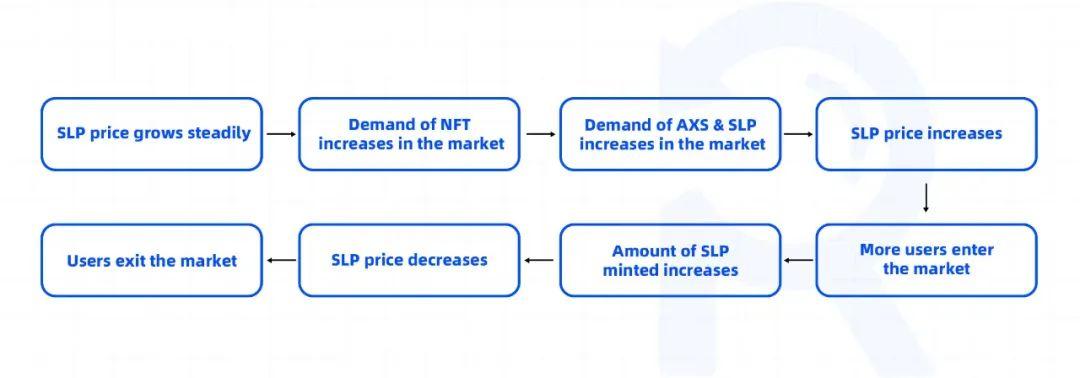
Until the output of AXS and SLP fails to meet the consumption, the prices of the two Tokens will continue to rise. In effect, players burn AXS and SLPs to generate Axie NFTs, which are then used to generate SLPs. However, SLPs don't have much in the way of reducing inflation, leading to SLPs taking all of the selling pressure on all three assets.
Given SLP's high inflation economic model, it is inevitable that SLP will continue to decline. When the number of new players joining starts to decrease, so will the demand for Axie NFTs. If there are no more ways to spend, SLP prices will drop, which will further reduce NFT production rates. The growth rate of Axie NFT will become 0.
Although SLP prices continued to rise in the DeFi summer of 2021, it only lasted for 4 months. After peaking in July, the SLP has never returned to its peak.
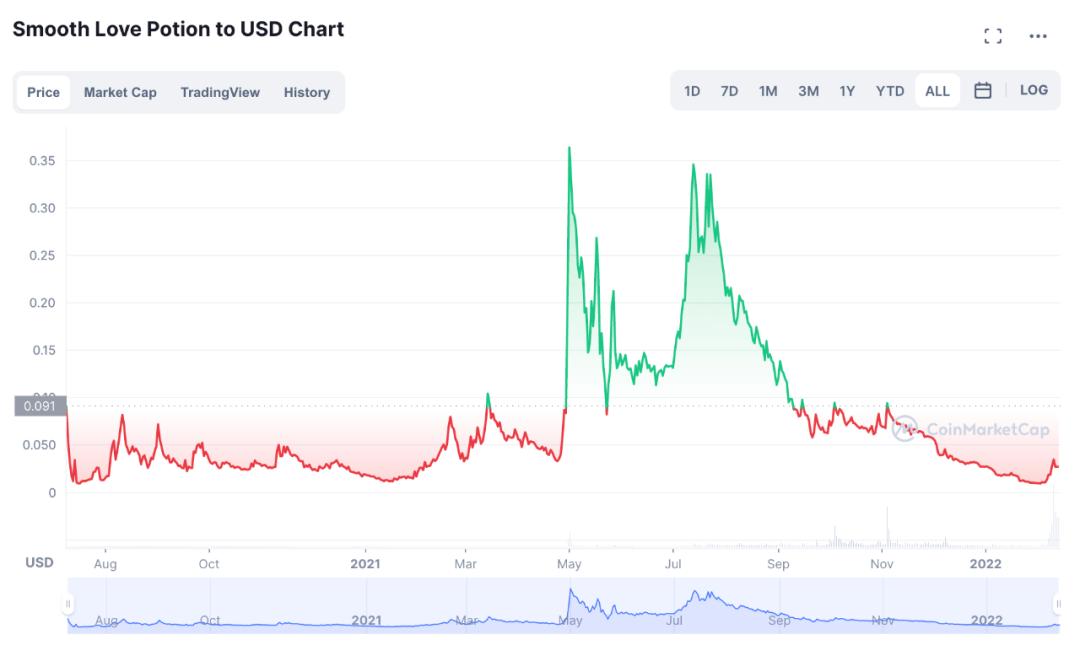
In fact, the decline of SLP prices is an inevitable trend. But as mentioned earlier, the Nash equilibrium is not the most important problem for us. As a direct participant in the market, we are more concerned about the following issues:
- How to evaluate the consensus of all players.
- How to win by taking actions below average consensus;
- How to influence other players Even the project consensus of the entire community.
Due to the limited space of this article, we will only discuss YGG for the time being. We will discuss other related topics in subsequent articles.
3.2 Axie team and YGG
Axie Infinity exploded, and the role of YGG cannot be ignored. YGG is responsible for operating the community, introducing and educating new players, cultivating player needs, and tapping the potential of NFT games. When YGG holds a large number of Axie NFTs and SLPs, the main responsibility for operating user consensus is transferred from the Axie team to the YGG Guild.
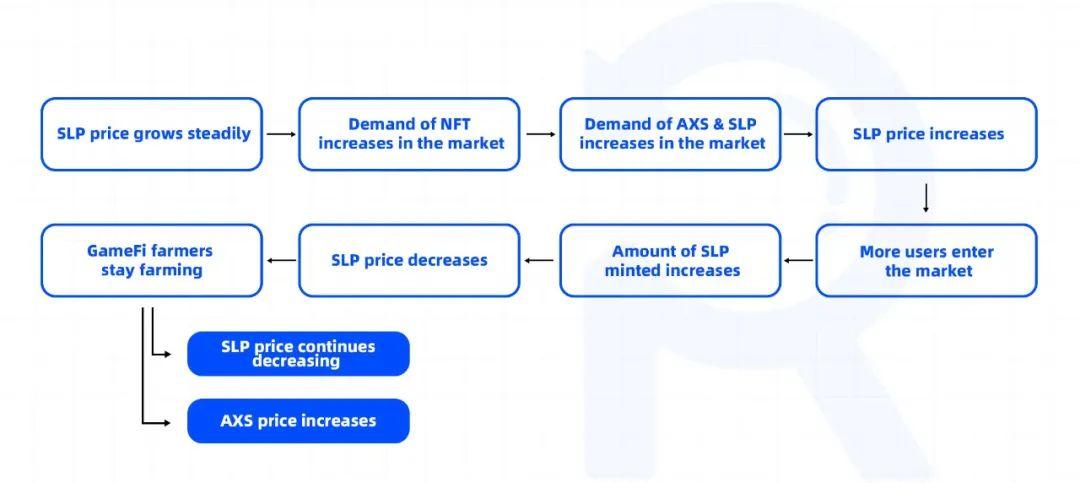
From the perspective of risk management, the Axie team holds a large amount of AXSToken. Compared with SLPToken, the economic model and distribution method of AXS make it unlikely that the price will drop significantly. Having said that, in order to prolong the life cycle of the project, the Axie team does not want the SLP to drop. For YGG, however, the need is more pressing as it owns even more Axie NFTs and SLPTokens.
From the perspective of consensus management, maintaining the SLP price is also one of the important tasks of YGG in community governance. YGG members are mainly low- and middle-income people in Southeast Asian countries. The close personal relationship in the Asian cultural circle makes it possible to optimize consensus management. Through the offline development and governance of the community, the guild can effectively manage the expectations of gold users, and gradually transform gold users from SLP producers to final NFT users and recipients.
YGG holds high-quality NFTs on the market. Axie NFT is not only an interest-bearing asset, but also represents its gaming experience. YGG improves the average consensus of players to a certain extent by controlling the NFT market, and provides additional usage scenarios for Axie NFT and SLPToken.
YGG's control over SLP gradually weakened as the project reached a stalemate. Until recently, the Axie team released SLP adjustments as follows:
-Adjusted Axie NFT breeding formula: SLP cost increased by 3 times, AXS cost reduced by 50%.
- Removed SLP rewards from daily quests for players after rank 800.
- Removed SLP rewards from Adventure mode; reduced SLP rewards in PvP mode; higher MMR, higher SLP rewards.
- Add more SLP usage scenarios.
- Gradual reduction or even removal of SLP rewards in daily quests and PvE modes.
Although the above method increases the amount of SLP destroyed, it reduces the market circulation and leads to an increase in the price of SLP.
However, reducing the output of SLG to increase its token price will not last long and will be counterproductive. Ordinary players know it, Team Axie knows it, and YGG knows it. When token demand and price can only rise through production cuts, the average consensus among players for a project will drop.
We know that dips only lead to more dips, just as players know they are in a "guess 2/3 of the average" game and have to be in It is the same as finding a way out when it is less than 1/3 of the market consensus.
04. The consensus game will never stop
In the words of Richard Taylor, the participants give numbers under the condition of information asymmetry and limited information transmission speed, and the final winning condition depends on Depends on the extent to which participants obtain information and make judgments based on the information obtained.
With each round of elimination, the information will diffuse further in the system. Until the end, when all participants "know it all", when all participants realize that the integer "0" is the final answer, the game ends. Until a new game restarts, new players come in.
For the Axie development team and other participants with more complex identities in the community, when they play games with ordinary participants, they have a better understanding of the direction and final results of the project Good understanding and estimation. At the same time, they have a panoramic view of the consensus of all participants, enabling optimized consensus management. They can continue to bring in external funding, create new ways to play, turn speculators into value investors, and find new applications for tokens and in-game assets.
In addition, Axie Infinity is actively exploring a new identity. The launch of the Ronin sidechain and its native infrastructure, along with the development of several new projects, has transformed Sky Mavis (parent company of Axie Infinity) from an application developer to an infrastructure provider. In other words, players of the current "game" can seamlessly participate in the next round of the new consensus game.
Every consensus game will always have an ending, but at the same time, new consensus games will continue to emerge.
It can all end, but the lessons learned along the way are valuable. Whether it is DeFi or GameFi, short-lived projects will inevitably appear during the development process.
But the consensus game is always there. As game participants, we will stick to it and hope that the new round of Dapp can break through.
Please continue to pay attention to our follow-up reports. GameFi projects will become increasingly complex and diverse, but we are committed to describing game behavior in a simple, quantifiable way.
Translator's Notes:
In the game There is the most classic case "Prisoner's Dilemma" in the discussion, which is also the origin of the DeFi2.0 concept Olympus (3,3) theory. The Prisoner's Dilemma roughly talks about such a case. A and B were arrested together for committing a crime and were taken to the interrogation room for interrogation. A and B are told: ①If both of you plead guilty, both will be sentenced to 3 years; ②If one pleads guilty and the other does not plead guilty, the one who pleads guilty will be sentenced to 1 year, and the one who pleads not will be sentenced to 10 years; ③If both of you plead guilty, you will be released without guilt.

At this time, A will analyze: If I plead guilty, my result is 1 year or 3 years. If I deny it, the result is acquittal or 10 years. Judging from the results, there is a high probability that A will choose to plead guilty. Similarly, B will do the same analysis, so there is a high probability that both A and B will choose to plead guilty. Although the result of neither pleading guilty is the best for the community of the two, but pleading guilty is the best choice for oneself while protecting one's own interests.
So in this market, in the game of interests between individuals, the best result of an individual does not represent the best result of the whole, and sometimes even conflicts. We can use this kind of thinking to look at the words and deeds of others to choose our own course of action.
Original link< /a>
Welcome to join the official BlockBeats community:
Telegram Subscription Group: https://t.me/theblockbeats
Telegram Discussion Group: https://t.me/BlockBeats_App
Official Twitter Account: https://twitter.com/BlockBeatsAsia

 Related Articles