Are blockchain art and finance really decentralized?
Original title: Are Blockchain art and Finance Really Decentralized?
Author: Hex6c
Block unicorn
What is decentralization?
According to the Oxford English Dictionary, decentralization is "(1) the removal of administrative power centralized in one center, (2) the distribution of administrative power centralized in one center, etc." Blockchain is the transfer of control and decision-making from centralized entities to distributed networks. However, devolution -- as a way of protecting our privacy -- was also a milestone in the cypherpunk movement. This is clear from the following excerpt from Eric Hughes's 1993 Cypherponk Manifesto:
Privacy is necessary for an open society in the electronic age. [.] Privacy is the power to selectively present oneself to the world. [.] We cypherpunks are dedicated to building anonymous systems. We are using cryptography, anonymous email forwarding systems, digital signatures and electronic money to protect our privacy. [.] Cypherpunks write code, and we know that someone has to write software to protect privacy, and since we can't get privacy unless we all do it, so we're going to write it. [.] We know that software cannot be destroyed, that a widely dispersed system cannot be shut down.
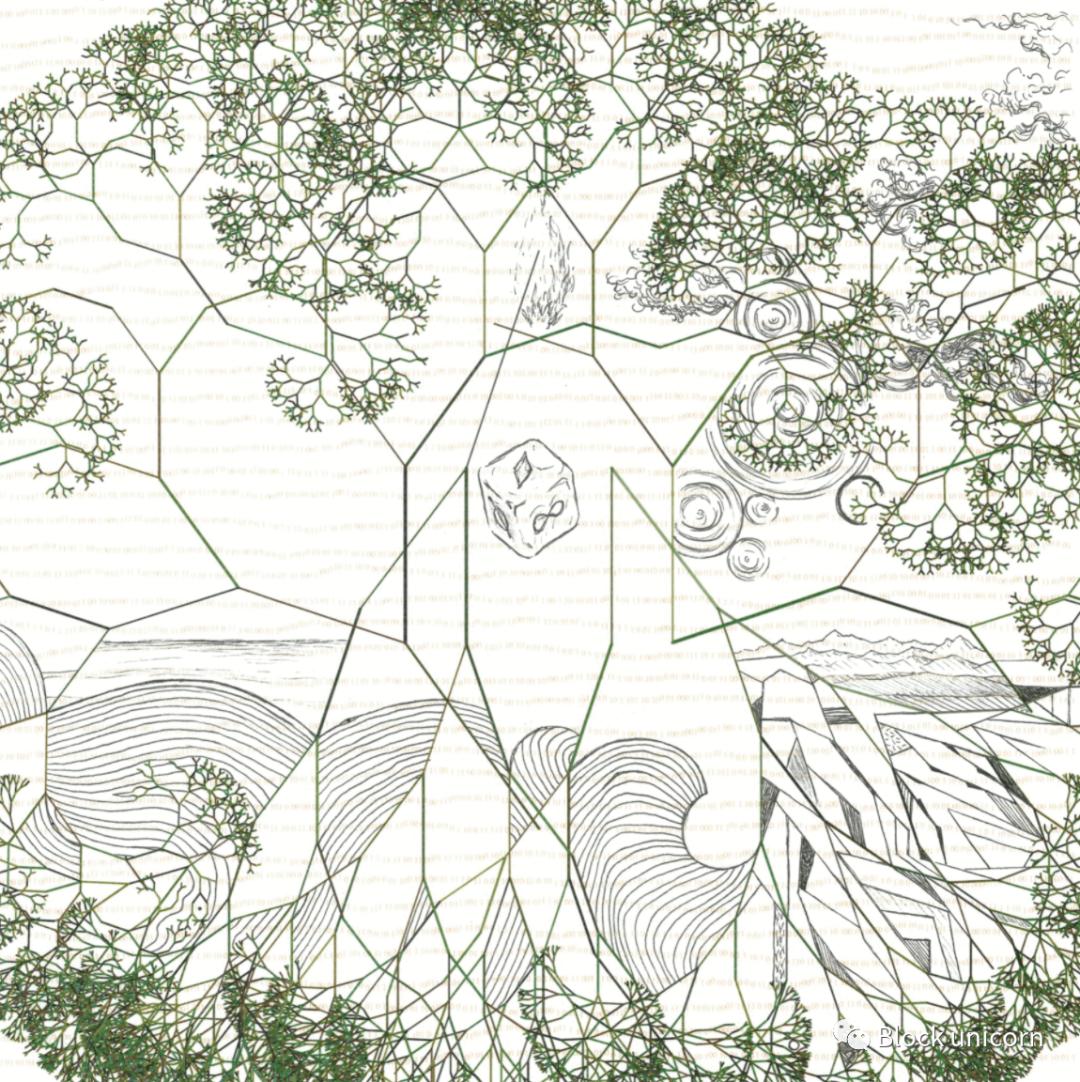
In information science, centralized organizations are usually represented by tree data structures. Trees are hierarchies, usually associated with the following principles:
1. Centralism. A tree structure has a single root node from which all other nodes descend. This means that power and authority are concentrated in the central role of the system.
2. Finalism. It describes the one-way, linear process of a tree: any point in the tree can be reached from the root through a unique, linear, top-down path to the intermediate node. Thus, trees represent an organization without multiple linear or feedback loops.
On the other hand, decentralized organizations are often associated with network data structures. A network is a root structure defined by the following principles:
1. Decentralization. Networks are webs without spiders: there is no central authority or root to regulate their growth, but they develop in self-organizing ways.
2. Multilinearity. The network allows for feedback loops. This means that participants in the system can be reached through multiple paths.
The root (network) structure offers a new model for knowledge and society that recognizes decentralization, autonomy, flexibility, creativity, diversity, collaboration, altruism, and ultimately democracy.
Networks match and sustain the proliferation of typical information in postmodern conditions -- the coexistence of multiple heterogeneous discourses -- rather than the simple, central discourses that unify all forms of knowledge:
Those who miss the meta-narrative of unity -- the central dream of Western metaphysical history -- experience the postmodern state as fragmented, full of anarchy, and therefore ultimately meaningless. It makes them dizzy. On the other hand, those who embrace postmodernism find it challenging, exciting and full of unknown Spaces. This fills them with a sense of adventure.
An important example of the modern shift in perspective from trees (centralization) to networks (decentralization) is knowledge. Denis Diderot and Jean Le Rond d'Alembert, in their encyclopaedia published between 1751 and 1772, described the genealogical structure of knowledge as a tree with three prominent branches: memory and history; Reason and philosophy; And imagination and poetry, only a small number of scholars can participate as contributors.
Modern encyclopedias, by contrast, are embodied by Wikipedia's woven web, to which everyone can contribute an article. As another example of this shift, enterprises are evolving a more fluid and dynamic decentralized autonomous Organization (DAO) model from the typical single hierarchical structure characterized by business in the past.
My aim was to investigate whether and how the decentralisation promised by the cypherpunk movement could emerge in blockchain art and finance -- arguably the two main applications of digital ledger technology.
Decentralization of blockchain finance
The 2008 financial crisis led to the collapse of Lehman Brothers and other big banks, forcing many states to bail out other banks with public money. The crisis triggered a recession that has yet to be fully absorbed. On a psychological level, 2008 undermined the trust built into the relationship between citizens and banks and between citizens and the state.
On Halloween that fateful year, something else happened. A mysterious figure hiding behind the pseudonym Satoshi Nakamoto circulated an article titled "Bitcoin: A peer-to-peer electronic cash system," preceded by a statement that left no doubt about their motives:
I've been working on a completely peer-to-peer electronic cash system, with no trusted third parties.
On January 3, 2009, Nakamoto's idea was realized and the first block of the Bitcoin chain was laid. In fact, they included an indelible message in the first block, citing an article in The Times on the same day that said a second public bailout was imminent.
Since then, blockchain finance has become a reality. However, while the original motivation was to operate completely peer-to-peer without a trusted third party, much of blockchain finance today is actually centralized finance (CeFi), not decentralized finance (DeFi). The CeFi platform uses blockchain technology but is owned by a private company. Users must trust third parties to monitor transactions and secure assets. Such services also require a person to submit personal information for verification to operate, claiming to be the Know Your Customer (KYC) process.
The three pillars of blockchain finance are stablecoins, exchanges and lending services. The most popular stablecoins, such as USDT and USDC, are centralised and backed by the US dollar, which, like all fiat currencies, is centralised. USDT is owned by Tether, while USDC is owned by Center, which in turn was founded by Circle and Coinbase.
DAI, by contrast, is the first decentralized staboin maintained and overseen by MakerDAO, a decentralized autonomous organization made up of owners of its governance token MKR, who can vote on changes to certain parameters in their smart contracts, To ensure the stability of DAI, which is pegged to the DOLLAR. DAI is backed by Ether and other cryptocurrencies, including some centralised staboins, rather than fiat currencies.
Terra USD (UST) is a fully decentralized algorithmic stablecoin. Algorithmic staboins have no collateral associated with them, but open source smart contract management helps maintain their stability, and contract rules can only be changed using social consensus or through governance token voting.
The most important cryptocurrency exchanges by volume, such as Binance, Coinbase, FTX, and Kraken, are all concentrated under private corporate identities, known as centralized exchanges (CEX). This effectively means that when clients move money on these exchanges, it goes into the exchange's wallet and the client no longer owns it. Customers are forced to trust third parties, just as they would with a traditional bank. All transactions require a fee paid directly to the exchange. The same goes for centralised lending services such as BlockFi, Celsius, Ledn and Nexo. In these cases, a person is rewarded for saving as a percentage, or a person borrows money to deposit as collateral in a cryptocurrency.
However, on a decentralized exchange (DEX) like Uniswap, customers rely on smart contracts to operate: exchanging coins or depositing liquidity. Smart contracts are public, audited by third parties, and stored on a blockchain. As a result, they always do what they are supposed to do (including execution errors) and cannot be changed unless new contracts are deployed in accordance with the wishes of the token-holder community.
Market recipients (who exchange coins) pay a fee to compensate market makers (providers of liquidity). Notably, when users exchange coins, the funds exchanged are deposited directly into their wallets. Similarly, when they interact with decentralized lending services such as Compound and Aave, all transactions are mediated by public smart contracts. In using these decentralized applications, users are not forced to trust private companies, but rather public code (smart contracts) and the developers behind it.
So it is wrong to say that decentralization is distrust. In fact, a person's trust target has changed from human to human-written code.
Decentralization of blockchain art
In his first article on crypto art, Jason Bailey identified some common elements of this artistic trend, including democratization, which encourages everyone to participate, regardless of education, skill, age, class, gender, race, or creed; And decentralization, where tools and guides are designed to reduce the power of gatekeepers and middlemen and increase the autonomy of artists. As an early crypto artist, I can attest that these were the original premises. But does crypto live up to its promise?
Despite its initial efforts to decentralize and distribute resources equally, the crypto art market is now highly concentrated around a small number of artists and collectors. At SuperRare, I calculate that 80% of sales (April 2018 to January 2022) are made up of 14% of top artists (gini = 0.83) and 8% of top collectors (Gini = 0.89). By comparison, in the United States, the Gini index for household income was 0.48 from 2014 to 2018. In other markets, such as Foundation, the picture is similar or worse. In other words, if crypto art were a country and sales reflected the income of the population, wealth would be as concentrated as it is in the broader economy.
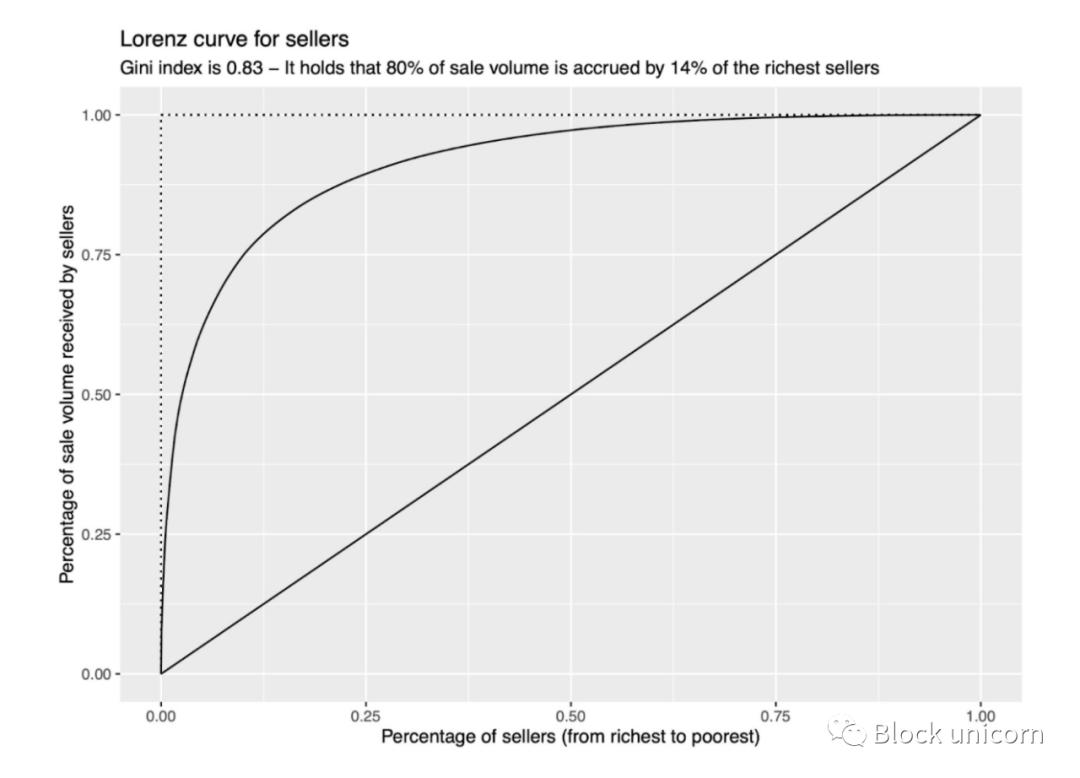
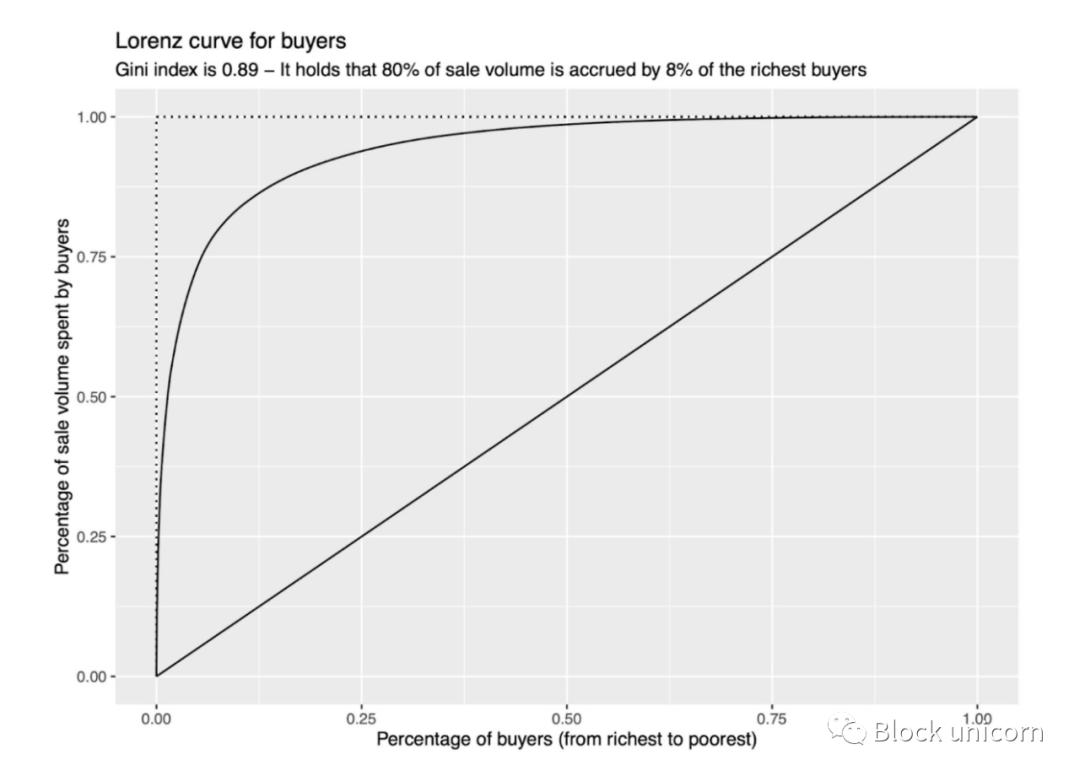
Statistically, the crypto art market follows a long tail distribution, in which an important few dominate at the expense of a paltry majority. Selling follows a process of cumulative advantage (or preferential attachment) : "For every man shall have more, and he shall have plenty: but whatever he hath not, even that which he hath shall be taken away from him" (Matthew 25:14-30). Therefore, the democratic principles of crypto art do not hold in practice.
Another point of concentration involves markets. In principle, artists could write and deploy their own smart contracts on the blockchain, and use it in a purely peer-to-peer manner to interact with collectors and sell their art. In practice, few artists have these technical skills and prefer to use smart contracts developed by markets such as SuperRare, Art Blocks and OpenSea. In all cases, only NFT is stored on the blockchain, while the artwork's metadata and the media containing the actual digital Art are typically stored on central servers, such as Amazon Web Services (AWS), like Art Blocks, or on intergalactic file systems (IPFS). Links between NFT's transaction records (but not validation) tokens and metadata and artwork files are forged on the blockchain.
Indeed, IPFS is a decentralized point-to-point network. However, nodes on IPFS still have no incentive to share and download files from other nodes, so art files are usually stored only on the artist's node (if they can run servers with IPFS nodes) or more likely on the market. NFT can be cast using custom smart contracts, artwork can be fixed to IPFS using free services such as Pinata, and files can then be immediately removed from the Pinata node. It is likely that no other IPFS node gets the file in the meantime, and the cast NFT may not be linked to anything.
That is, the Web3 marketplace is fundamentally different from centralized Web2 applications. Neither NFT nor art files are stored on a central server. The only centralized element is the front end of the market site. The case of Hic et Nunc illustrates this point. When its creator Rafael Lima decided to shut down a very successful NFT market -- not to mention an incremental ecosystem based on the Tezos blockchain -- many users felt cheated, with some even claiming it was a scam. However, only the front end of the site disappears, while all the smart contracts and NFT remain immoralized on the blockchain and are visible through other NFT aggregators such as Objkt.com.
Power of centralization
Moxie Marlinspike, founder and CEO of messaging app Signal, recently talked about effective decentralization of Web3. In his view, the Web3 architecture follows the client-server model, but almost all clients who want to access it do so by trusting the output of servers run by Etherscan, Infura, OpenSea and a few others. However, this inevitably leads to some form of centralization because:
1. People, even the "nerds" Marlinspike describes, don't want to run their own servers and never will.
2. Building software is a huge burden. At this point, software projects require a lot of manpower.
3. Protocols like blockchain move much more slowly than platforms like OpenSea. If something is truly decentralized, it becomes very difficult to change and tends to stand still in time.
If, as Marlinspike points out, enough money has been made and enough taps are available to keep the NFT system running at this point, it's worth thinking about how to avoid Web3 becoming Web2, but with less privacy and efficiency:
Once a distributed ecosystem is centralized around a platform for convenience, it becomes the best of both worlds: centralized control, but still scattered enough to get bogged down in time.
After Marlinspike posted his criticism, Ethereum founder Vitalik Buterin offered a partial rebuttal on Reddit: "Moxie's criticism in the second half of the post makes me feel like there's a valid critique of the current state of the ecosystem...... [sic] but they're missing where the blockchain ecosystem is going," adding that Web3 has yet to realize its ideals due to "limited technical resources and funding."
Centralization means delegation, while decentralization means responsibility
Owning a cryptocurrency is symbolic, and buying a bitcoin offers two ways to store it. Anyone can deposit money on a centralized exchange like Binance, or keep it ina physical wallet like Ledger. The first involves delegating all issues related to the custody and security of cryptocurrencies to Binance. For example, if a user forgets their password for a Binance application, they will receive a new password as soon as Binance proves their identity. However, as the recent seizure of encrypted wallets linked to The Canadian Motorcade demonstrates, delegation responsibility is not the same as ownership.
The second approach involves buying a Ledger wallet, understanding how it works, and carefully protecting the password phrases associated with the wallet. The user is still the sole owner of his Bitcoin, but has an additional responsibility to protect it: If someone steals my password, or I just forget about it, I may find that one morning my Bitcoin is no longer mine.
As Marlinspike hinted in his post, not everyone has the will, skills and time to adapt to a complex interdisciplinary field like blockchain. Thus, even in the most decentralized system, some degree of delegation and centralization is inevitable. That's not a bad thing, as long as we know what's going on behind the scenes.
The original link
Welcome to join the official BlockBeats community:
Telegram Subscription Group: https://t.me/theblockbeats
Telegram Discussion Group: https://t.me/BlockBeats_App
Official Twitter Account: https://twitter.com/BlockBeatsAsia

 Related Articles