NFT PFP: A Guide to Psychoanalysis, Gaze, and Future Markets
NFT PFP: A Guide to Psychoanalysis, Gaze, and The Future Market & NBSP;
原文作者: Mingzin
原文编辑: 王涵宇
At the beginning of this article, I struggled with a thorny question: Does being male naturally bias my writing about women in some way? This is probably a problem that all authors who try to talk about identity face. As I later discovered, the author's position does not really matter, because writing is an inquiry, an undecided judgment. Therefore, before starting my topic, I hope that the readers of this article will be able to experience this outsider's concern with critical thinking, and that they will always be alert to male identity and broaden their perspectives to explore the ambiguity of things when pondering this controversial topic.
First, it may be important to point out the fact that women in the socially subordinate position, both in the traditional tech industry and the emerging field of cryptography, still lack visible representation. Business journalist Sohini Bagchi has pointed out that research by BitMEX found that women make up only about 5% of crypto investors globally, compared to about 24% of traditional stock investors. Despite the fact that cryptocurrencies like Bitcoin were invented to encourage financial fairness, 75% of cryptocurrency holders to date are men, according to the 2021 STATE of U.S. Cryptocurrencies Report. In terms of the data proportion, the "absence" of some female discourse undoubtedly exposes the current situation of the industry dominated by male leadership. Needless to say, this gender injustice and the suppression of women's voice can be found in many other industries with a little inspection. And in the NFT market, the hot crypto space these days, we seem to be seeing the possibility of some sort of women using art to reclaim representation.
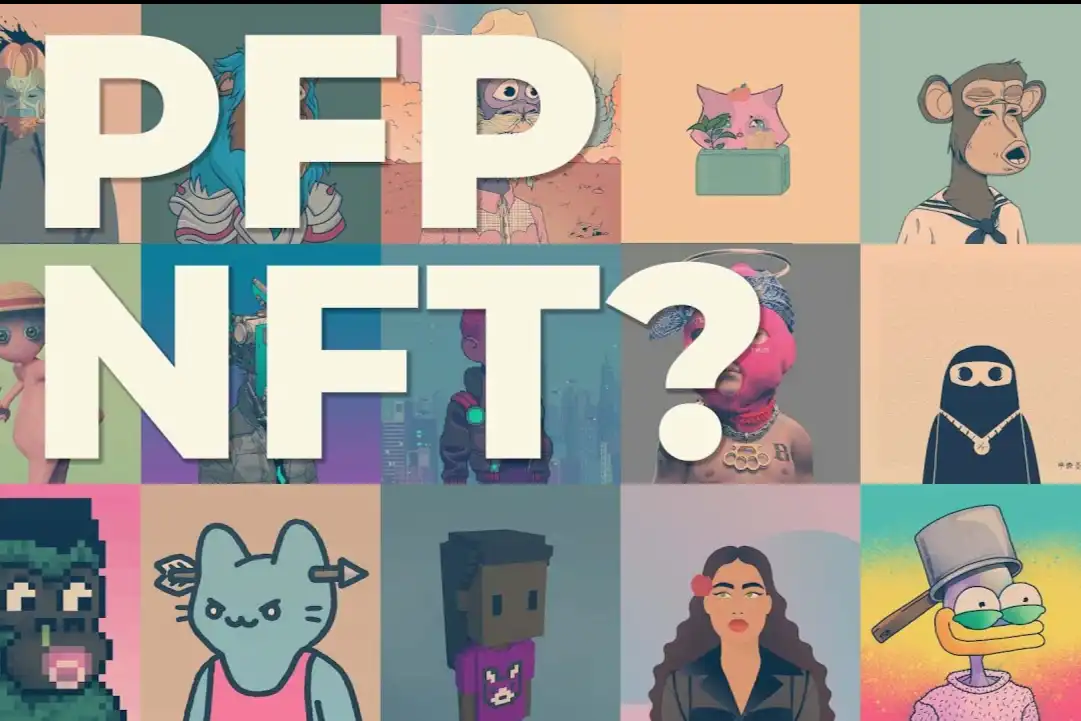
In 2021, the popular NFT PFP cultures around the world inspire an exciting and cohesive visual effect, and their digital virtuality and unique personal ownership value have the potential to redefine the discourse status of power centers, And women in the field of encryption "aphasia" encounter but for the NFT market to establish female theme encryption art to provide a realistic context. Therefore, a number of female investors, project parties and a large number of artists have entered the encryption world, and jointly build a fertile ground for female theme encryption art. This wave makes the encryption field into the author of different identities, a time of discourse everywhere, for the grand view.
In terms of standpoint and value, the current female NFT PFP can be divided into two categories: one is feminist NFT PFP, and the other is female NFT PFP in the real sense. The reason for this seemingly contradictory category is that feminist NFT PFP is approaching the mainstream of the current NFT market, which makes its value impact questionable by groups on the opposite side of the political spectrum. The accompanying effect of political symbols on feminism often does more harm than good, and I insist that only through de-symbolization practice can it be possible to explore the real path of centralization in the context of Web3.0 and reach the female NFT PFP in the real sense. Therefore, the essence of this paper is to elaborate some hidden dangers of feminist NFT project from the perspective of psychoanalytic film theory, female gaze and market aesthetic trend, in order to answer what kind of female NFT project we need in the era of Web3.0.
If the Azuki series constructed a post-national imagination of Japanese animation culture, and Mfers spoke of a global postmodern zeitgeist syndrome, then the emergence of the current traceable (from the real world) feminist NFT series is a self-projection of female figures. Inspired by narratives such as "Women" s Empowerment "and a plethora of cultural ICONS, this self-projection has led the feminist NFT PFP to weave a seemingly revolutionary fantasy. If the psychoanalytic theory of Cinematic apparatus is introduced, the basic conditions for establishing the relationship between the text and the audience are met.
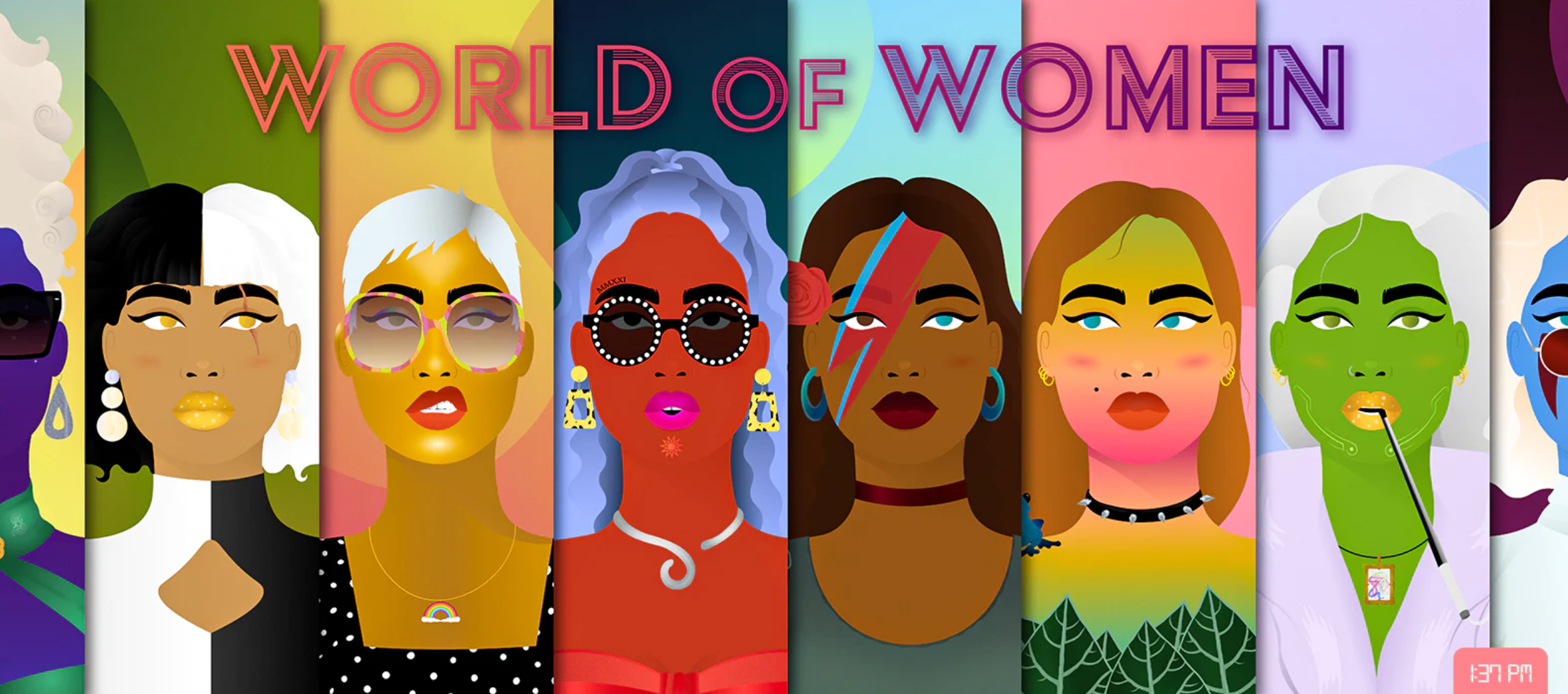
For example, The female character models and corresponding narratives of "WoW", "The Crypto Chick" and "Boss Beauties" are all full of cliches. The loss of freshness is nothing more than submission to political correctness fundamentally. This reduces their seemingly uplifting narratives to laughable "wealth codes". The deadly symbols full of capital charm everywhere turn these feminist NFT PFP works into beautiful commodities decorated with the sense of consumption, and even use consumption to exploit the disadvantaged women's right to speak. The vision of social change offered by the so-called feminist narrative is more like a castle in the air than anything else.
Professor Yan jingjuan points out that in a consumer society, men are as likely to be stared at as women. Obviously, when a market shift occurs that must satisfy the needs of women who dominate consumption, men must become the object of gaze. When male gaze occurs in the past, an idealized female image is often simulated, and men project their own desires on the female in sight, so the commercialized attribute of female serves the male gaze. But the occurrence of female gaze is the same, behind all is the capital secretly manipulation. The fundamental purpose of capital is to stimulate female consumption, "turning men into things produced in the consumer society and symbolic goods catering to female consumption aesthetics".
In today's NFT market, what the feminist NFT PFP practices is such a female gaze in the context of consumerism, packaging itself with eye-catching female representation and declaration calling for value identification, while the core is nothing more than to replace the male gaze with female naked. The self-declaration of feminist NFT PFP perfectly fits the subconscious desire of those who want to change the fate of women. In their imagination, women in a subordinate position and in need of rescue are the protagonists to be developed, and the feminist NFT PFP shows them a dazzling possibility of giving ideal status.
In psychoanalytic theory, film theorist Jean-Louis Baudry holds that there are three ways for film machine to construct the audience subject: 1. Regression mechanism; 2. Primary identification; The concealment of those "marks of enunciation" that stamp the film with authorship.
The regression mechanism means that the movie, as a dream making machine, stimulates an overall watching situation, which allows the audience to experience a kind of uterus-like effect. The degeneration of the mental level makes their unconscious desires fully activated. The film attempts to bring the audience back to the early stage of spiritual development before the formation of ego. When female investors do not find NFT PFP that can indicate their Web3.0 identity, it can be said that their cyber "self" has not been formed, so this chaotic state of subject is just like a baby who has not gone through the mirror stage, unable to define the real boundary between self and the world.
French film theorist Christian Metz pointed out that psychoanalytic film theory distinguishes the audience from the human subject in the real and objective world, and the audience subject needs to be established and expressed through an unconscious operating mechanism. Psychoanalytic film theory holds that the subject position of the movie audience is constructed by the movie machine. The movie machine does not construct the subject of objective reality, but activates a subject position in the unconscious dream, which is occupied and formed by the movie audience. Therefore, in the view of psychoanalytic film theory, the audience (the subject) is not only a "productive" space, but also an "empty" space that can be occupied.
By analyzing the feminist NFT PFP culture with psychoanalytic film theory, we can find that its operating mechanism is actually isomorphic with the film machine. In the context of Web3.0, perhaps everyone needs a PFP (profile picture) to bridge the virtual world, especially the long-lost female group. The assimilation of women by feminist NFT is similar to the assimilation of audiences by films. The beautiful narratives they construct for women place women in unconscious dreams. In this way, female investors have become a kind of container with "space". In the slogan of feminist NFT PFP, there are universal "female empowerment" and "female voice" and other exquisite narratives. In terms of models, there are also various "feminist" symbols. Like the movie-goers in the darkroom, oppressed women in the real world are forced to passively accept the beautiful "myths" written by such symbolic systems and enter a belief regime in Web3.0. They had no choice but to believe that the feminist NFT PFP and its value system were real and effective.

The "primary identification" mechanism is the synchronisation and internalisation of the act of looking by moviegoers, creating the illusion that the film is happening under their conscious control. Women can only realize that they are "watching" the Boss Beauties under the control of carefully woven consumption narratives. They have not seen any NFT series that claim to represent women. This allows them to naturally assimilate with the focal point of the camera, establish "primary identity", and then develop secondary identity through a complex and direct system of narrative symbols.

Boss Beauties #5867 #3091 #7546 #3423
As can be seen, the Boss Beauties series #5867, #3091, #7546, and #3423 are all randomly generated NFT PFP to express confident and diverse female characters. From left to right, female artists, athletes, military and police officers with different skin tones and professional attire seem to offer a glimpse of a decentralized effort. Moreover, the traditional binary opposition is also broken in these PFP paintings. For example, the image of "soldier" no longer belongs only to the dignified and masculine male, but also to the female with cat-ear headdress and fan scarf. Character image is the biggest gimmick of these feminist NFT PFP, they rely on perfectly fit politically correct icon to earn the favor of the market, seems to firmly occupy the biggest winner in the FIELD of NFT.

The Crypto Chicks #653 #2585 #4566 #3419
However, the delicate illusion of these female images falls short of commercial logic. We cannot fail to notice that this kind of PFP has a prominent homogeneity and stereotypic tendency. The female facial image is bound to the deep-rooted European and American aesthetic concepts, even if only focusing on the uniform plump and sexy lips, we can feel this point. The aesthetic trend of the whole PFP project shows an increasingly centralized trend, and even establishes a kind of aesthetic bullying. Images that violate its aesthetic attributes will not be allowed and displayed. The advocation of diversity and the slogan of representing women eventually become mere appearances, because they only flatter the image expectation and aesthetic identity of those aristocratic buyers. Isn't this the biggest irony of the decentralized practice of Web3.0?

Boss Beauties #8310 #8500 #4108 #2012
It should also be pointed out that algorithm random generation is also a double-edged sword. In the algorithm generation logic, the most obvious racial skin color is taken as a benchmark, and the female character image randomly generated by the deviation generated by this benchmark actually becomes a variety of racial abnormalities, and the difference and repetition are oddly matched in the same role. For example, in the picture above, four female characters of different skin colors and ethnic identities all wear a Karaba hairstyle (a style common to African women), which makes the diversity of female identities seem strangely comical.
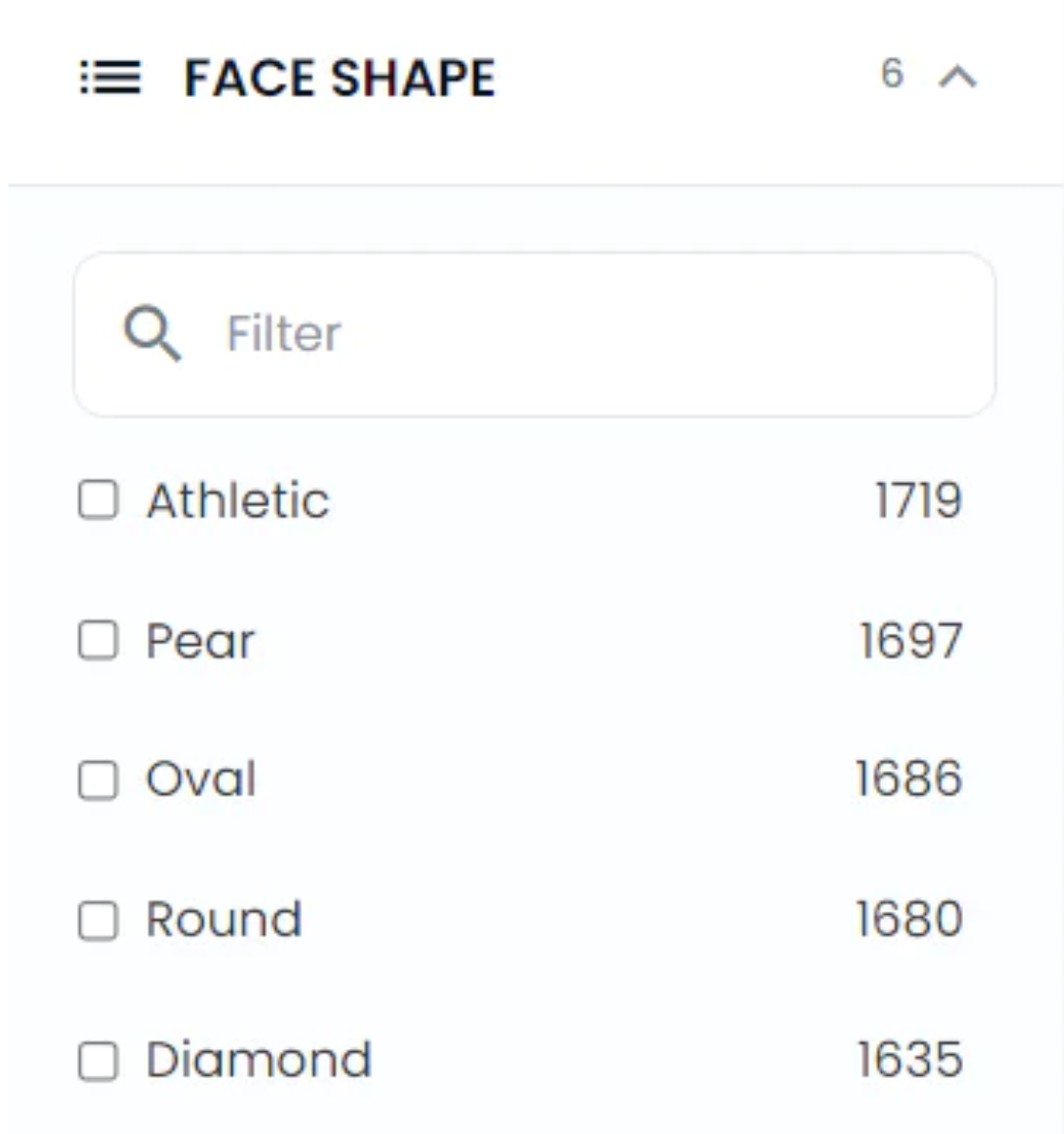
In the selection column, the project provided five designs of face shapes: active, pear, oval, round and edge. Such generalizations are too coarse, and the gaze dominates every aspect of female appearance; At the same time, the shape of women's faces has become a statistical object, not so much to create a "diverse" look as to accumulate vast amounts of statistical data. Such a simple and crude approach, which treats "concrete people" as nothing, may eventually bite back at capital itself.
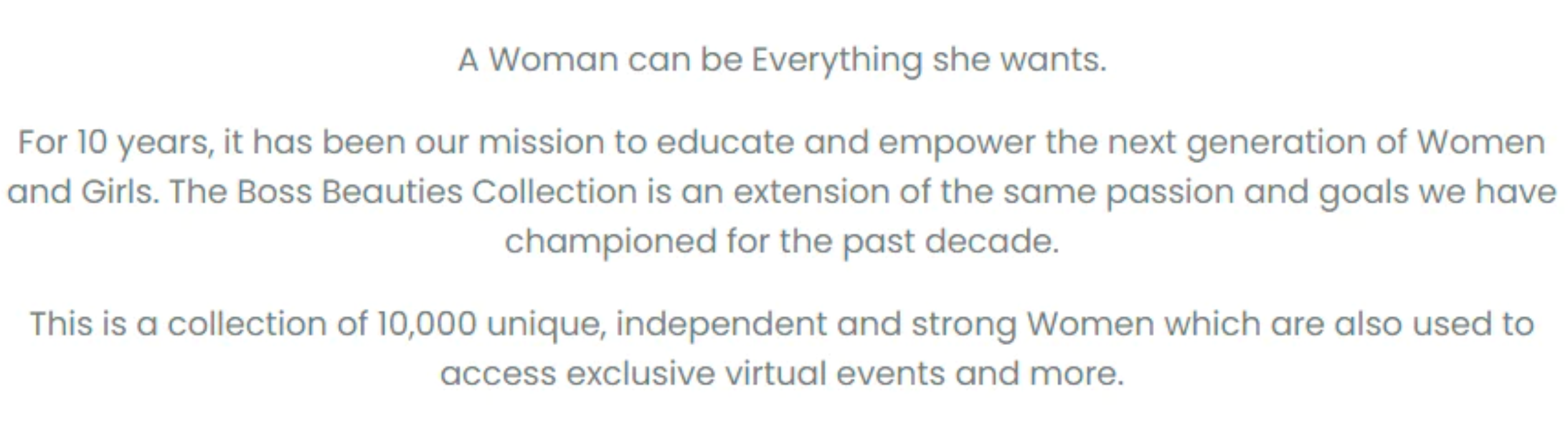
Different from the secondary identity process gradually established by the film machine, feminist NFT PFP has the possibility to establish primary identity and secondary identity simultaneously due to its cross-media presentation, which greatly speeds up the integration of female consumer identity. Ironically, the Boss Beauties' most eye-catching tagline is "A Woman can be Everything she wants."
Scholar Sandy Flitterman-Lewis has shown that under the simultaneous regression, primary and secondary identification steps, moviegoers have the impression that the images on screen are their own imagination, forgetting instead that they are false dream creations. This also achieves the purpose of the film author, making his "label" gradually disappear and letting the audience forget that this is a fantasy that does not belong to them, but the presentation of the audience's own desire.
Let's restate that the process of subject construction in movies, that is, the process of moviegoers establishing self-identity and subject identity consciousness through screen images, has been re-interpreted in the virtual world of Web3.0. "Female investors" temporarily lose themselves in the face of NFT PFP, and at the same time strengthen themselves. In other words, at the moment of their first fictional identity and establishment, these women both lost themselves and regained their imaginary "selves" in the feminist NFT PFP.
Immersed in these PFP images, often "mixed in" by the project side, women began to believe that these female characters shared their fantasies and represented their repressed desires. Hidden under the propaganda slogan of "enabling women to gain autonomy and become the image in their own hearts" is the potential transformation and rough regulations of female image aesthetics, and women do not even realize that they are not only trapped in the whirlpool of consumption, but also in the cage of discourse.

Example of secondary Identification (1)
「The Crypto Chicks 是一个为庆祝世界各地所有女性独特且多元的美而设计的 NFT 首次系列。」

Secondary Identification Examples (2)
"World of Women is a community that celebrates the uniqueness, inclusiveness and equal opportunity of all people. Made up of a collection of 10,000 pioneering works of art that showcase diverse and powerful Women."
It is necessary to introduce psychoanalytic film theory to examine feminist NFT PFP projects because it can reveal the fundamental difference between the image projection of such projects and other NFT track projects. Feminist NFT PFP projects are unique in that they have rich and specific representations of women in the real world. Moreover, as mainstream female NFT PFP tries to manipulate "feminist value" and female narrative (the two minor identification examples in the figure), they have the leading influence of film media in the audio-visual field, and can control women's identity and value identification unrestrained in the virtual world.
The reason for the "nitpicking" of such a playfulness character model is that the project managers think they need to be taken seriously. If they are not allowed to put forward these logic loopholes and thinking manipulation, the serious political demands they advocate such as "feminism" and "diversity" are invalid and hypocritical. Professor Yan Jingjuan later stated: "Once women return to the reality outside the simulative world, they will find that implicit gender discrimination still exists in the society. At the same time, women are lost and frustrated, they almost indulge in the simulative world, which weakens their feminist awareness and resistance ability."
In a word, female narration in feminist NFT PFP is very rough and one-sided compared with feminist films. Moreover, the female identity politics constructed by these PFP role images cannot produce realistic concerns about the social status and image of most women. On the other hand, the retrospective nature of these female NFT PFP roles means that they need to reflect, to some extent, the construction process of race, gender and class in the real society. Therefore, we must strongly call on these feminist NFT projects to take responsibility for the roles and feminist slogans they design. After all, the Web3.0 world can't be built entirely by a few whitewashed "better years" gimmicks.
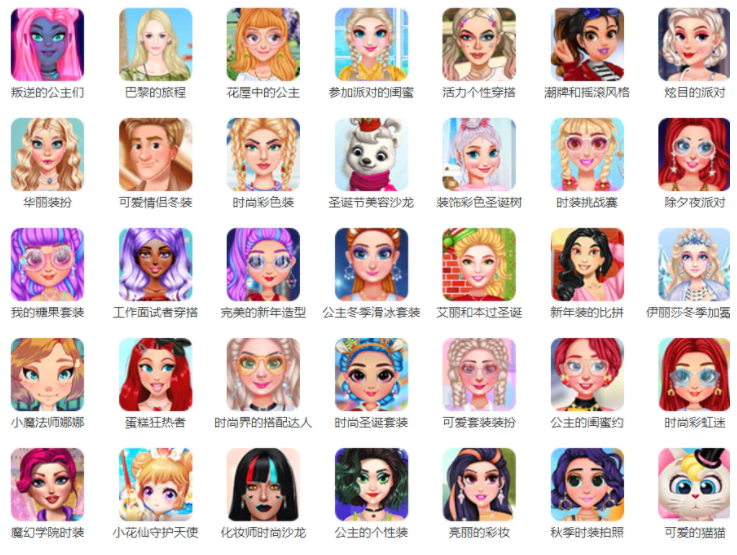
At present, the emerging NFT market is still in a period of savage growth. The value realization of many projects is dominated by the emotions of speculators, and the quality of projects has become an element that nobody cares about. It's a sad fact that the mainstream aesthetic system on the female-themed NFT PFP circuit is similar to the Flash Player makeup mini game that existed more than a decade ago. If we continue to allow this cynical approach of treating feminism as a "code for wealth" to operate, then it is time to confront and resolve real moral and aesthetic dilemmas.
In the main competition of the 2021 Cannes Film Festival and the main competition of the Venice Film Festival, we have seen three excellent films from a female perspective: Titanium, The Worst People in the World, and It's Happening. Titanium is a Cyborg fable that boldly breaks through the gender framework of binary opposition and its epistemological foundations. Set in Northern Europe, where gender equality is highest, "The Worst People in the World" explores the anxieties and worries that modern women face when it comes to universal issues like love, career and life. "The Happening" takes us back to France in the 1960s, before abortion was legal, and witnessing the heroine's plight makes viewers think about the brutal oppression of women and the need for women to compete for the "right to the womb."

Titane. Dir. Julia Ducournau The Worst Person In The World. Dir. Joachim Trier Happening. Dir. Audrey Diwan
Professor Tai Kam Wah once said: "Feminism's biggest significance not only lies in the equal rights between men and women, more not gender confrontation, but in the life experience of women as a new cultural resources provide imagination space for the world, to create a new, more reasonable of another in the future, the future is different from the modern logic, male logic, capital logic, more not to return to the patriarchal domination yesterday."
Needless to say, the aesthetic concept and overall thinking of the NFT market are far behind the traditional entertainment industry, which is undoubtedly limited by the historical development foundation. But when everyone is proposing to respect and publicize the female experience, the feminist NFT PFP is still obsessed with giving women political symbols within the framework. Such an approach is repudiated and is bound to become a "contrarian" against the ethics and future of a more decentralized and diversified market.
What I firmly believe is that in order to turn action into reality, female artists must be encouraged to make works based on rebellious practice and self-experience. They should break the male gaze, not only to remove the male centrism, but to bring back the female gaze and decentralized thinking in the real sense. The world of Web3.0 no longer needs the machinery of abstract political slogans. It is now Web3.0's mission to discard the outdated ideology of the feminist NFT project.
References:
Bagchi, S. (2022, February 18). Will crypto usher a new era of gender diversity and inclusiveness? CXOToday.com. Retrieved March 4, 2022, from https://www.cxotoday.com/blockchain/will-crypto-usher-a-new-era-of-gender-diversity-and-inclusiveness/
Baudry, Jean-Louis. (1975). The Apparatus: Metapsychological Approaches to the Impression of Reality in Cinema.
Flitterman-Lewis, Sandy. (2010). Psychoanalysis, Film, and Television. In Channels of discourse, reassembled: Television and contemporary criticism. essay, The University of North Carolina Press.
Happening. Dir. Audrey Diwan. Perf. Anamaria Vartolomei. France 3 Cinma, 2021. Film.
Metz, Christian. (2000). The imaginary signifier: Psychoanalysis and the cinema. Indiana Univ. Press.
Titane. Dir. Julia Ducournau. Perf. Agathe Rousselle, Vincent Lindon. Arte France Cinema, 2021. Film.
The Worst Person In The World. Dir. Joachim Trier. Perf. Anders Danielsen Lie, Herbert Nordrum, Renate Reinsve. MK2 Productions, 2021. Film.
Yan Jingjuan, Guo Yifan: On the Construction and Confrontation of female gender from the perspective of gaze, Journal of Daqing Normal University, January 2021.
This article is submitted and does not represent the opinion of BlockBeats
The original link
Welcome to join the official BlockBeats community:
Telegram Subscription Group: https://t.me/theblockbeats
Telegram Discussion Group: https://t.me/BlockBeats_App
Official Twitter Account: https://twitter.com/BlockBeatsAsia
 Related Articles