Tokemak Founder: How will mobility become the bandwidth for the entire future decentralized economy
Tokemak Founder: Mobility in the Age of Web 3 = Bandwidth in the Age of Internet
原文作者:Liquidity Wizard, Tokemak 创始人
The Tao of the meta-universe
The Internet is changing at a tremendous rate.
The vast data exchange network known as "the Internet" is evolving into an increasingly complex ecosystem in which direct exchange of value can take place in the form of tokens. Web3 will revolutionize the economy, the way businesses operate, the way individuals work and organize, and the way products are delivered and consumed. This decentralized economy requires grid access and network access (just like the Internet).
In addition, it requires block linking and, most importantly, liquidity.
The goal of this paper is to discuss how liquidity will become the bandwidth of the future "Internet", and indeed the entire future decentralized economy. We will then briefly discuss Tokemak's role in increasing liquidity bandwidth.
Broadband mobility has almost arrived.

To better grasp the concept of liquidity as bandwidth, you should first understand what these two terms mean. We will start with the definition of bandwidth, which is easier to define, followed by the definition of liquidity.
bandwidth
Network bandwidth is the speed at which data is moved across the network. Therefore, more bandwidth represents more data flow. In a world where users communicate with each other over the Internet, it's clear that higher bandwidth means a better Internet-based economy (think of all the hype around 5G).
Bandwidth is measured in bits of information per second (bits per second). In the genesis of the modern Internet, consumers used dial-up modems to transmit data at 56 bits per second. This made possible early Internet products such as web pages and E-mail.
When Ethernet arrived, the game changed quickly. Ethernet boosts bandwidth at speeds of up to 10 MBPS. That means Ethernet can send about 180 times more data over the Internet than dial-up modems. Broadband bandwidth and data transmission have arrived!
Since then, speeds have gotten faster and are now typically between 1-10G/ SEC (18,000-180,000 times more than dial-up data). These speeds are needed to unlock a range of Internet-based products that would be unthinkable with dial-up's low bandwidth. Streaming services like Netflix, cloud-based gaming, and always-on servers in the cloud are all made possible by the current increase in Internet bandwidth.
More importantly, however, reliable network bandwidth requires not only strength and speed, but also sustainability. Users send and parse data asynchronously over the Internet, which means reliable bandwidth needs to be acquired on demand. More on that later.
liquidity
Liquidity is a difficult role to define. In DeFi/Web3, liquidity is used to define tokens (value) that are offered or parked almost anywhere. While there is nothing inherently wrong with the general use of the term, we will try to be a little more specific here.
We define liquidity in a more targeted way, as it can be used to exchange one Token for another. In a sense, liquidity is the magic juice for trading and converting tokens. For example, if I have an ABC Token and I want to trade or "convert" it into an XYZ Token, then I need to interact with liquidity.
In trading terms, I need to interact with the liquidity of ABC/XYZ by selling ABC/XYZ. Selling ABC/XYZ means I sell my ABC in exchange for XYZ.
Let's talk about liquidity differentials, starting with differentials.
Poor liquidity is any liquidity that you lose a lot of value when you interact with it. That means thin liquidity is poor liquidity. Thin liquidity occurs when there are not enough tokens to trade. For example, suppose you want to sell ABC for XYZ, and suppose that each ABC is currently worth 1 XYZ. If there's not a lot of XYZ to work with, that means there's a premium on the XYZ available. You want to sell 10 ABCs to get the 10 XYZ you deserve (for the price of 1 XYZ).
But instead, because of illiquidity, you only get 8 XYZ in the trade. By interacting with scarce liquidity and buying XYZ for more than it's worth, you lose a lot of value (in this case, 2 XYZ) in the process.
Good liquidity, on the other hand, is any liquidity in which you retain most of the value when you interact with it. As you might guess, "deep liquidity" is good liquidity.
Let's go back to the example above. In retrospect, if you want to sell ten ABCs for XYZ, the price of one ABC is still worth one XYZ. So in the case of deep liquidity, where there's a lot of XYZ to buy, you can walk away with 9.9999 XYZ. You still get a little bit less XYZ than 10, and that's what it costs to get liquidity. But you retain almost everything you started with.
Author's note: Some exchanges can price Token liquidity better or worse for the same level, but that is beyond the scope of this article!
"Deep liquidity" means preserving value when trading between tokens, while "thin liquidity" means losing value when trading between tokens.
In other words, when there is deep liquidity, you can trade at market prices. When liquidity is thin, prices move wildly when you interact with it.
Who needs liquidity?
Having said bandwidth and liquidity, we need to understand why this is important and who really needs liquidity. In a word: all of them. Moreover, it is not broad enough. It does include everyone and everything.
The above discussion might suggest that only traders should care about liquidity. In Web3, this could not be further from the truth. All users interact with liquidity because all users need to buy and sell tokens that are required based on Token economy. Similarly, all agreements need to interact with liquidity as they buy/sell and lend/borrow between themselves and other agreements with which they interact.
Here are a few examples.
Case 1 & have spent
Let's start with an example of a user looking for yield. Suppose a user wants to get an APR from pledging ABC. Then he will most likely start with ETH or USDC (or other stablecoins), so they need to interact with the liquidity of ABC/ETH to get the original ABC to pledge.
At the same time, they are accumulating profits. Once they claim them, they may want to sell them to pay bills, shop, or make other investments. Again, they will interact with liquidity to do this.
Case 2 & have spent
Suppose a game user decides that he wants to buy real estate and an avatar in a new "P2E" game. The game only accepts the in-game currency, ING. So, the user first needs to trade with the liquidity of ING to get ING. Next, the user will use ING to purchase property NFT and avatar NFT to interact with liquidity again (this time the liquidity of ING and NFT).
Example 3 & have spent
The function of many protocols is to convert part of their TVL into something else on a particular trigger. For example, suppose that protocol A interacts with Protocol B to hedge when the price reaches A certain point.
When the trigger occurs, protocol A needs to take A certain amount of their Token AAA and exchange it for protocol B's BBB so that it can interact with protocol B. A specific case in this regard is the liquidation of the MakerDAO vault when the value of the collateral falls below the minimum collateral rate. When that happens, enough collateral is sold to cover the debt, on top of the existing liquidation penalty.
Example 4 & have spent
Suppose a DEX protocol relies on liquidity deposited by a liquidity provider (LPs) to make its entire business model work. Then, more liquidity on deposit means they can offer better pricing (less value loss to users). That, in turn, attracts users to trade here rather than elsewhere, which increases the volume of transactions through the DEX. Of course, increased transaction volume means increased fee income generated by DEX.
After looking at a few examples of how liquidity can be used in Web3, we'll move on to the issue of liquidity bandwidth.
Fluidity = bandwidth
In this new "Internet of value", liquidity is fundamentally needed to do everything. So in this world, liquidity acts as bandwidth.
To recap, as the data Internet grows, extra bandwidth is needed to do more things and move more data. Low data bandwidth means that participants cannot move more data. You can't create Netflix until you have enough data bandwidth to reliably stream movies over the network.
In the Internet of value, more mobility is necessary to do more things and move more value. Thin liquidity means that participants do not transfer more value because their value losses are too high. Imagine an economy in which value does not flow freely because it loses value every time it is exchanged or transferred. This is the current state of DeFi and Web3.
Value transfer has replaced data transfer, and mobility is the new bandwidth for Web3 networks. The problem is that current liquidity bandwidth is thin and unreliable. Look at how many tokens are currently being held up instead of being used as liquidity. The answer is most.
ALCX, for example, has less than 20% of its circulating supply available as liquidity on Sushiswap. In addition, there are additional non-tradable supplies, so the vast majority of ALCX generations are not actively used for liquidity. Note that this is not specific to ALCX, but rather is an example that applies generally to all phenomena.
The root cause of thin liquidity is that the DeFi space introduces too much friction for users to become LP. For a normal holder,They don't provide liquidity for three key reasons:
- User experience challenges
- Indefinite loss
- Capital is inefficient
User experience challenges arise because experienced users can find and provide liquidity to Uniswap, Sushiswap, or Balancer (as an example), while average users simply balk at the whole experience.
For those capable of facing ux challenges, they still need to understand impermanence losses and be willing to take that risk. In addition, they need to have the "other side" of the deal, making them very inefficient in providing liquidity with capital. For example, if they want to provide ABC liquidity, they need to own and provide both ABC and ETH in order to provide ABC/ETH liquidity.
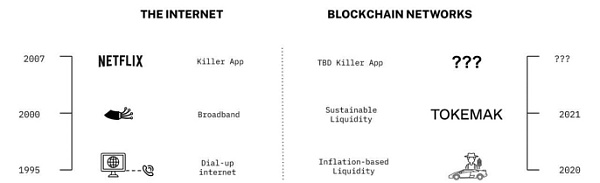
As a result, DeFi's liquidity is now in a dial-up mode. There just isn't enough liquidity to realize and encourage the transfer of low value losses.
Moreover, existing liquidity is highly unreliable. Projects usually incentivize liquidity through inflation incentives. This inflation-based liquidity is unsustainable and can be turned off in a flash. Stop the rewards? You lose liquidity. Keep the rewards? Dilute the value of your tokens.
Neither is a good outcome.
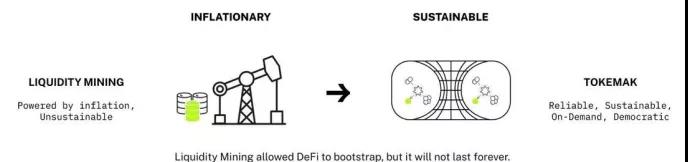
Tokemak is a solution designed to address these issues by unlocking deep, reliable and sustainable liquidity bandwidth.
How does Tokemak solve the liquidity problem
Tokemak is a tool that attempts to usher in a broadband moment of liquid bandwidth. This bandwidth will unlock coveted Web3/DeFi/GameFi applications. Tokemak's mobility engine will power all of this.
So, what is Tokemak?
Tokemak is a unified mobility layer for Web3, spanning all DEX, chains, and layers. It removes the friction of users becoming liquidity providers and improves liquidity bandwidth across the board. The figure below illustrates Tokemak's capabilities.
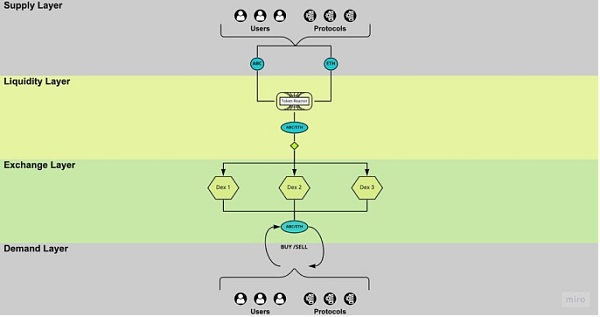
From the top of the diagram, any user or protocol can provide liquidity by simply depositing their ABC directly into Tokemak. They don't have to go through the user experience challenges of exchange level LPing, nor do they have to take on the risk of volatile losses.
They can only deposit what they own and do not need to be paired with other assets (ETH, USDC, etc.). In this way, Tokemak converts a one-sided supply of liquidity into two-sided liquidity in the market, drawing from a one-sided pool of assets.
A user called the liquidity director directs the routing of liquidity in all defis. Route the economic bandwidth provided by Tokemak, ensure liquidity, and ensure the success of DEXs, chains, L2, and stablecoins by providing liquidity across the spectrum. Users and agreements can then go to the exchange and interact with the deep liquidity provided by Tokemak (by buying and selling into it).
If you look at Tokemak's diagram again, you'll notice something very interesting. The supply layer and the demand layer are the same: both are made up of users and protocols as participants. That's because with Tokemak, everyone can now be a passive liquidity provider. When all the underlying assets of the entire network sit in the DEX as liquidity and can flow freely according to the needs of the participants, this unified liquidity layer becomes powerful for all users and the loss of value is minimal for all.
In the future
So what happens when the maximum liquidity bandwidth is provided? This is the ultimate state of liquidity bandwidth, and Tokemak will fulfill its destiny as the liquidity engine driving the entire network.
The decentralized economy will really be unleashed.
As we move towards a future with broadband mobility, it becomes challenging to imagine what that future might look like. While we knew that deep liquidity would make reliable pricing and less volatility possible, the implications are more intriguing.
Trying to imagine what would be in store for the coming deep mobile bandwidth is like trying to imagine Netflix streaming video to your phone in 1995 with dial-up Internet. Future innovations unleashed by deep liquidity bandwidth will be even more important.
Nonetheless, I'll try to speculate on a few examples of what I think are coming innovations based on broadband mobility.
First, think about how challenging it is for individuals in developing countries to get credit for something as big as buying a house.
In most cases, the financial infrastructure (i.e., banks) either does not exist or individuals do not have access to the system. In the new world of democratized finance with deep liquidity bandwidth, an individual's cash flow can be verified on a chain, and lenders around the world can offer that person a loan or mortgage on demand. Smart contracts can instantly check money flows and verify an individual's on-chain activity, and transfer money to his wallet the moment he asks for a loan.
Second, imagine an entrepreneur with a great idea for a new on-chain business, but no capital to launch it. In the future, users will post an overview on the Internet and use a Token template to pitch it to initial "idea investors". Individuals and agreements will see the material, decide if the idea has merit, and fund the new venture at the seed stage (or pre-seed stage). This compresses the entire capital-raising process so that it can happen immediately after ideas and models are formed; It's every entrepreneur's dream.
Finally, imagine the world we're heading into with GameFi and the metasverse. All people will have their own identity, their own data and the cash flow associated with that data and identity.
The Web2 giants no longer have users. Built on deep liquidity, tokens used to pay and motivate users can flow to individuals in real time on the blockchain. As users interact, buy, contribute and simply spend time in a virtual "always-on" universe, all forms of entertainment and games can flow value and payments to participants as easily as scoring high scores in today's video games.
In short, the coming deep liquidity bandwidth will allow any value stream to flow freely, without friction, middlemen or rent-seekers.
The future will be even more incredible and unimaginable than the examples outlined above. The whole economy will soon be running on liquidity bandwidth, and you heard it here first.
The original link
Welcome to join the official BlockBeats community:
Telegram Subscription Group: https://t.me/theblockbeats
Telegram Discussion Group: https://t.me/BlockBeats_App
Official Twitter Account: https://twitter.com/BlockBeatsAsia
 Related Articles