Are UST and MIM really Ponzi? Listen to Magic Ventures explain how a decentralized stablecoin can reverse its trend
The Counter-attack of decentralized staboins: UST and MIM
原文作者: Magic Ventures
Stablecoin is one of the most important and profitable pieces of infrastructure in the market, and it doesn't need to be proven, just by its market cap growth over the last few years.
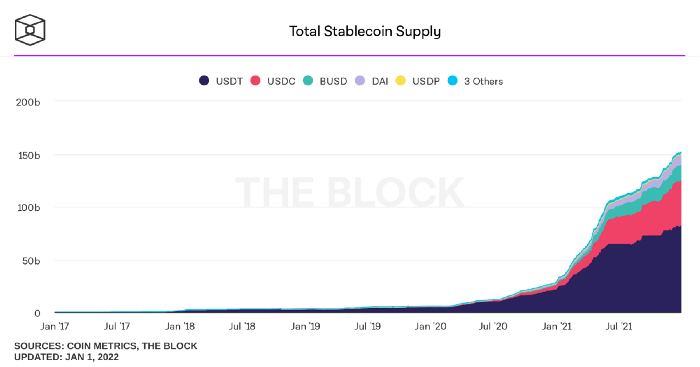
It is because of this reason that this circuit has also caused the influx of many giants and fierce competition. For the early parties, having their own Stablecoin seemed to be the norm. So we see Bitfinex/Tether's USDT, Coinbase/Circle's USDC, Binance's BUSD, and so on.
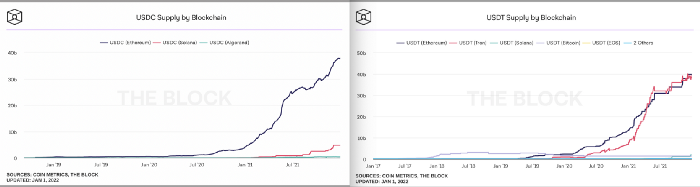
Although some Stablecoins dominate in subdivided circuits by virtue of their first-mover advantage, such as USDT in TradFi and BUSD in BSC, the continuous progress of the industry also brings many opportunities for newcomers. For example, after taking advantage of DeFi, The USDC minted almost as many coins on the Ethernet network as the USDT, and at the beginning of last year it minted only a fifth as much.
Therefore, we see up-and-comers such as sUSD alUSD UST MIM start their journey one by one. Now some of them have achieved small success, while others are stuck in difficulties. By looking back at their growth, let's also explore the main factors that influence or limit the success of a Stablecoin.
"Why would anyone use your Stablecoin?" This is a question that every Stablecoin project has to answer. And until you can't force them to use it, pay them to use it. That's the answer from Kain, Synthetix's founder and the man credited with pioneering liquidity mining.
SUSD is the medium through which other synthetic assets (Synth) are traded within Synthetix. Initially, sUSD only accepts the platform's native Token SNX through pledge, and the pledge ratio is very high.
With Synthetix Staking reward+Liquidity Mining taking effect, and WITH THE beginning of DeFi Summer, sUSD is Staking reward+Liquidity Mining, and sUSD is otherwise in great demand. This demand also has a strong positive feedback on Synthetix's price: The greater the demand for sUSD, the greater the demand for SNX used to make sUSD, and the less SNX in circulation on the market, the higher the price.
However, this process also exposed the serious shortcomings of sUSD, that is, a Stablecoin not only needs to be able to stabilize PEG after being sold in a large area in the market, but also needs to be able to buy in a large amount at a low premium. SUSD, however, cannot guarantee the latter point. Most of the time, it has a premium of 2% or more, because the high pledge rate of 8 to 1 makes sUSD's minting cost extremely high.
Another factor is the scarcity of application scenarios. SUSD lacks more application scenarios except trading within the Synthetix system for trading with other Synth and mining part of the protocol. Therefore, when the DeFi Summer boom passed, Synthetix's own ecology shrank. As well as the reduction of mining demand, sUSD and SNX coin prices also fell into a negative cycle of sUSD demand reduction and SNX coin price decline.

Terra's UST is, in a sense, the successor of sUSD. In Terra's ecology, UST also assumed the same role sUSD assumed in Synthetix, but more radically. Compared with the high pledge ratio of SNX to sUSD, Luna can synthesize UST by 1 to 1, so the capital efficiency is also higher. In addition, Terra itself is a public chain compared to Synthetix, which means it can tell a bigger story, have more room for valuation, and make more scenarios to host more UST.
As long as the ecosystem continues to expand, the greater the number of users, the higher the demand for UST will be. This is also reflected in Luna's price.
Projects in Terra ecology exist with a single and clear purpose: to create more scenarios and demands for UST, and to provide actual subsidies with their own tokens. It could also deflect some of Luna's inflationary pressure.

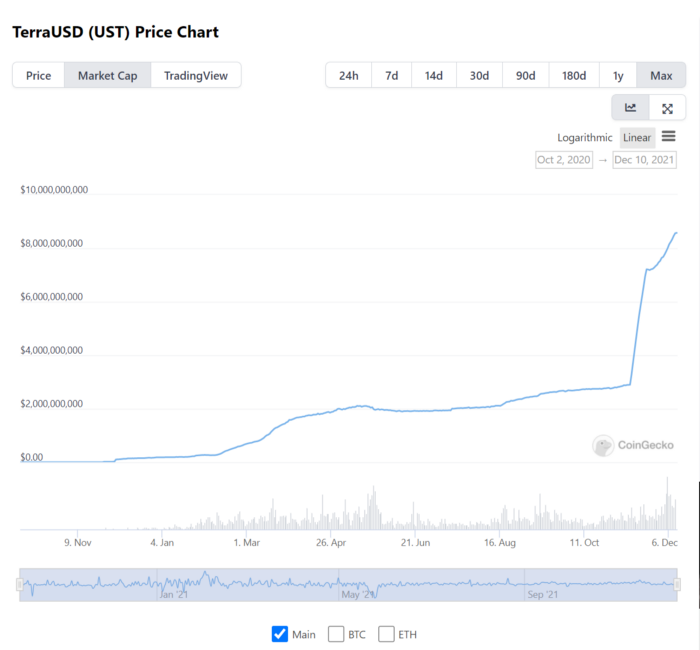
In the case of Mirror Protocol, Terra's first major ecological project asset synthesis platform, the assets used to synthesize THE U.S. equity asset mAsset, such as CDP, are mainly UST (or other Massets). With the early liquidity mining incentive of $MIR, the initial platform TVL was as high as $2 billion.
Why is the TVL of a synthetic asset platform at its peak comparable to the TVL of Synthetix's entire platform? Synthetix has the same functionality, but the price feedback is much more accurate. This is because unlike the clever design of Synthetix debt Pool matchmaking, where each Synth is priced directly by the prognostic machine, the secondary market price of mAsset on the Mirror platform is determined by the AMM. In the Synthetix ecosystem, the only people who hold synthetic ASSETS in U.S. stocks are those who need EXPOSURE, and those people tend to be the fewest. In the Mirror, there are LP's, which prop up liquidity, and arbitrageurs, who keep prices in line with the stockmarket. MIR Token's subsidy attracts the former group, while mAsset's spread with the stock market attracts the latter group.
The launch of Mirror and lending agreement Anchor greatly stimulated the demand of UST, and also drove the first wave of take-off of Luna coin price. But after that, things didn't go smoothly. The market suffered a major correction in May, a stress test in which Terra ecology performed badly. Due to network congestion, a large number of Anchor positions have been liquidated due to the inability to supplement the margin, and the panic also makes more funds choose to flee at this time. During this period, Stablecoin UST once dropped to around 0.9USD, and the price of Luna also plummeted 75% in one week.
But after that, UST didn't go down in smoke. After a brief hiatus and the launch of more ecological projects, Terra's ecology regained its vitality, and UST has continued to grow ever since. Through this campaign, the team also consciously created scenarios for UST outside of Terra's ecology to be applied to more ecologies, thus generating more needs.
Another Stablecoin project that is gaining momentum is Magic Internet Money (MIM). Compared with the 1:1 casting of UST and the redemption provided by Luna's liquidity, MIM follows the CDP route similar to MakerDAO and targets the emerging long-tail assets that MakerDAO has not been involved in.
Unlike UST, which grew up with a golden key in its hand, MIM was born of Ethereum, surrounded by strong enemies. It stands out from its competitors by cleverly seizing several key opportunities. The first thing Stablecoin does is solve the problem of supply and liquidity. The answer is not hard: motivation. But how to motivate effectively is another question.
At this time, the online of CRV and Votium, so that the liquidity of Stablecoin trading platform Curve can be rented. Any project side can post a bounty to the veCRV holder to tilt the weekly CRV emission toward their Gauge. Higher CRV incentives are bound to attract more liquidity for Gauge, which in turn means higher MIM demand and minting.
The MIM team was quick to recognize this before the market could find liquidity leasing to be as efficient as it is today, and spent heavily in the first few weeks, making CRV's gauge quickly skewed toward the MIM, at one point accounting for 30% of weekly releases. In this way, the mintage of MIM took off, and TVL quickly broke through the milestone of 1 Billion.
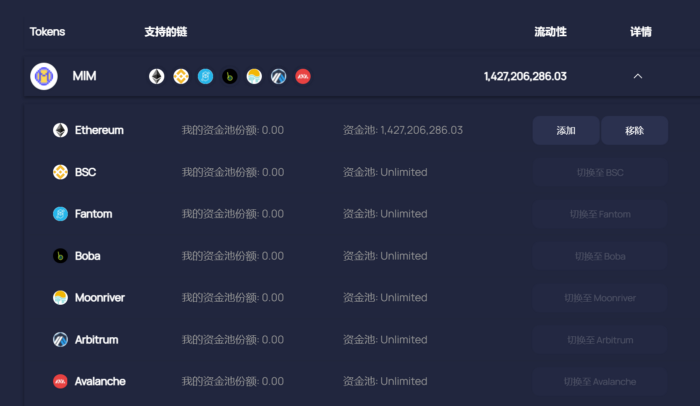
Another competitive differentiator between MIM and MakerDAO is multi-chain deployment. Unlike MakerDAO, which is only deployed on the Ethereum main chain, MIM contracts are deployed on multiple chains. In this process, MIM also worked with cross-chain protocol AnySwap to enable tokens to move from L2 bridge to L1 in real time, eliminating the 7-day wait time and greatly improving cross-chain capital efficiency.
However, motivation and strategy can only make a project top in the short term competition, application scenario domination is the most important factor for 3CRV (USDT+USDC+DAI) to succeed in the long term. (To make matters worse, half of the subsidy for MIM-3CRV gauge actually goes to 3CRVs, a problem that gets worse at a later stage, as $0.50 of every dollar of incentives is spent on boosting demand from competitors.)
Of course, the MIM team has clearly realized this, which is well proved by reducing the emission of daily spell and promoting the Mi-UST Gauge. In addition, the team also pays special attention to the expansion of application scenarios. In addition to the real-time transfer from L2 to L1 mentioned above, the team also cooperates with several DEX to launch trading pairs of MIM as Quote currency and so on.
Source:https://twitter.com/CurveFinance/status/1466733088524881921
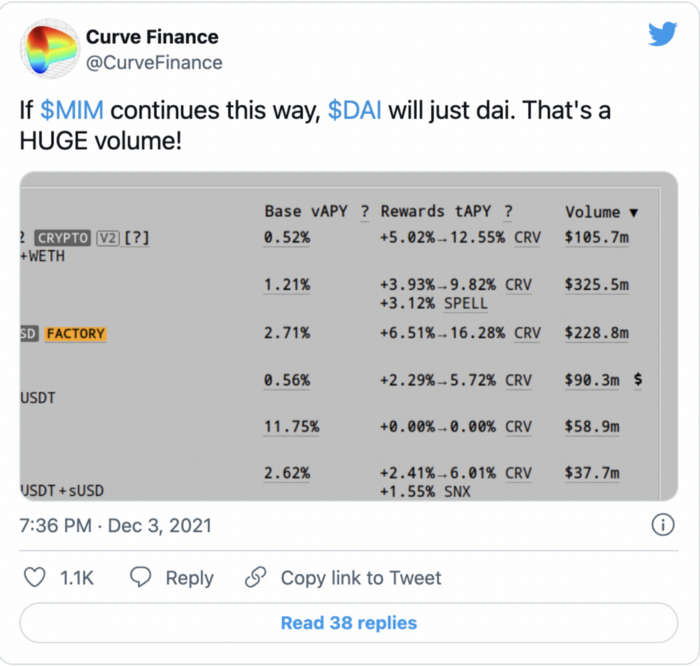
Today, on Curve. Fi, while MIM Gauge is often the top gauge in terms of volume, MIM growth has stalled. I think the reasons for this are as follows: first, MIM is experiencing pains in the process of gradually transforming from the mode of stimulating demand to the mode of stimulating demand by scene; The other is that although MIM started out benchmarking itself against MakerDAO and DAI, its real competitors were the other two decentralized Stablecoins, It is only recently that people have slowly started to demand it from MakerDAO and DAI standards - another example of fake it Till You make it?
Although UST and MIM are stablecoins with completely different routes, the reason why they can go all the way is that apart from the personal charm of the project founder, their team solved the problem of supply and part of demand well through encouragement and scene development. From there, the competition will be stiffer, and it remains to be seen how far they can go.
The original link
Welcome to join the official BlockBeats community:
Telegram Subscription Group: https://t.me/theblockbeats
Telegram Discussion Group: https://t.me/BlockBeats_App
Official Twitter Account: https://twitter.com/BlockBeatsAsia
 Related Articles