Epidemic situation, the rise of game association
Original source: ViaBTC Capital Insight
Since the outbreak of COVID-19 in 2020, the global financial, service and manufacturing sectors have been hit hard. Frequent isolation and restrictive contact measures have devastated a large part of the industry that relies on human contact for a living, with large numbers of workers losing their livelihoods, many of them family breadwinners, while governments have failed to provide adequate protection for workers, particularly in Southeast Asia.
In the Philippines, which relies on labor export and tourism as its economic pillar, a large number of unemployed people relied on P2E (play-to-earn) games to gain a particularly valuable income during the pandemic last year. However, with the popularity of games and diversified competition in the game market, players have to face the problems of high investment and low return, reduced revenue and increased difficulty in making money. In order to Axie Taking Infinity as an example, the initial player needs 3 NFT to play the game, which costs about $8,000 based on the current market price. Such an entry threshold is very high for ordinary users, and the selection of breeding and gold farming strategies is also crucial for players. This is where an organization is needed to lower the player entry fee and guide the rest of the gameplay. Blockchain game association is the unique market conditions emerged at the historic moment.
According to the statistics of the United Nations, the world population is about 7.7 billion at present, and is expected to increase by another 2 billion in 2050, and close to 10 billion by the end of this century. Half of the projected global population growth between now and 2050 will come from just nine countries: India, Nigeria, Pakistan, Democratic Republic of the Congo, Ethiopia, Tanzania, Indonesia, Egypt and the United States of America (in ascending order). Sub-saharan Africa's population is likely to double, while Europe's is likely to shrink.
According to statistics, most of the world's population growth is coming from third world countries, which are the main audience of P2E. Some of these countries have very little per capita disposable income, and the $1-2 earned by spending 2 hours a day playing video games in the world of P2E is very important in their real life. According to public data, Infinity has 2.5 million DAU, while guilds YGG, Ready Player DAO, Merit Circle and GuildFi have 5,000, 1,800, 1,500 and 1,500 players, respectively. At present, Axie Infinity's game token SLP was accepted by some merchants and renters in the Philippines. Blockchain gaming has the potential to enable 6 billion people to use cryptocurrencies, and players can also achieve unbanked access to financial infrastructure via DeFi.
Different from the traditional play for fun model, the play to earn model of chain games is naturally suitable for the development and expansion of game guilds. The guild provides NFT rentals, scholarships, automated tutorials, gold farming strategies, breeding tutorials, and cloud services to provide a simple and easy-to-use gaming experience. These services are the main source of income for the guild. As the chain game plate continues to grow, the territory of game associations will continue to expand. With a large pool of players and a financial advantage, it's easy to start a new game. The guild can directly participate in the game from the private round, and then carry out ecological construction of the game later in the game. Once the ecosystem is well established, guilds can earn another share of the coin price and NFT revenue or early mining rewards. Generally, the governance of trade unions will follow the spirit of decentralized blockchain, and THE DAO has become the only choice for them to form an open and fair funding process. Guild profits are often reinvested in NFT or tokens to seek future ecological development, realizing a positive capital cycle.
The following article will share some of the major game guild platforms in the market:
YGG (Yield Game Guild)
YGG is an interesting topic to discuss when discussing game guilds, because it is the benchmark and leader of the industry. In May 2021, YGG released a short documentary titled "Make Money while You Play: NFT Games in the Philippines", which showed the story of Filipino people improving their lives through online games during the epidemic. The project party with rich experience in the game industry seized the opportunity of filipinos to earn income by playing chain games during the epidemic, thus establishing the Gold Mining Association and gradually implementing the DAO in the later stage. YGG's vision is to get more players involved in the process of P2E. Through NFT lending, gold training, recruitment, profit sharing and other processes, YGG has solved some substantial problems for both regular and new players.
Meanwhile, YGG is Axie One of the important participants of Infinity Scholarship program, mainly responsible for the management and training of new players. Three NFT are rented to new players as a group, so that they can start the game at zero cost to earn AXIE's reward token SLP. When a player's SLP accumulates to a certain number, Revenue is redistributed through smart contracts -- 70% goes to players, 20% to managers, and 10% goes to YGG guilds. YGG will use the proceeds of the tokens to buy NFT assets again for leasing, expanding by constantly attracting new players, thus achieving a positive operational logic cycle. This model benefits players, guilds and players alike.
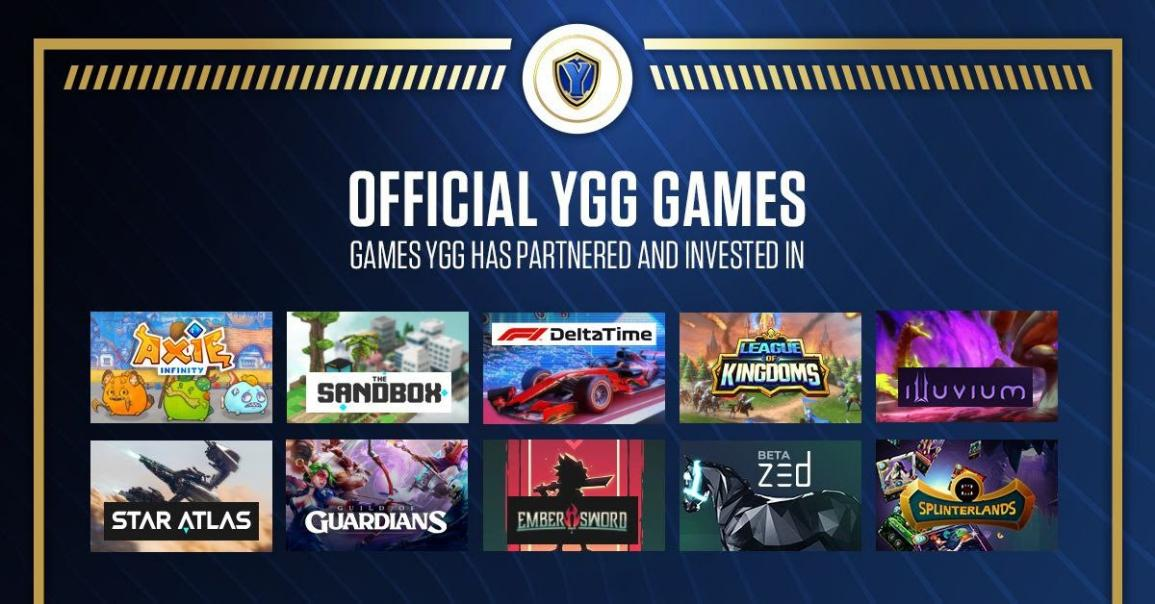
Now it's YGG. The largest guild in Infinity, which also extends to other games, It has advanced layouts in popular games like League of Kingdom, Delta F1, TheSandbox, Star Atlas, Illuvium, Thetan Arena, and Zedrun. YGG manages the sub-DAO as Guild The model of OF Guild, which is very flexible, allows sub-DAOs to self-manage and issue their own tokens, but correspondingly pay a certain rate to the YGG brand.
Merit Circle (MC)
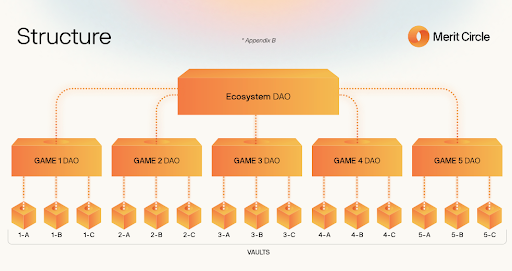
Merit Circle is very similar in functionality and operation mode to YGG, with minor differences in DAO governance, profit distribution, and token role. MC originated from Axie Infinity's 420 Scholarship program, which was originally intended to make Axie Infinity affordable in low-income countries.
In early August 2021, the project raised $200,000 from Flow Ventures and established an incubation and partnership, followed by $1.25 million for direct scholarship distribution. In September 2021, the project officially reorganized the scholarship program as Merit Circle and started to operate the guild, which received an additional investment of us $4.5 million, especially US $175,000 from YGG guild. The main reason MC attracted attention was that it successfully raised $100 million on Copper with over 4,500 participants.
Regular players can apply to Merit Circle to join guilds, where DAO managers conduct a small interview and then provide training and tutorials to get them into the game faster, while MCS provide widgets to track player activity to optimize progress. MC The DAO will issue SLP tokens every two weeks, 70% of which will go to the players and 30% to the MC Foundation. There are also many sub-DAOs for different games, including Star Atlas, Illuvium, and Nyan Heroes. MC adopts the SuperGuild architecture, that is, sub-DAOs and master DAOs share a token, which also maximizes the power of MC tokens.
AAG Ventures (AAG)
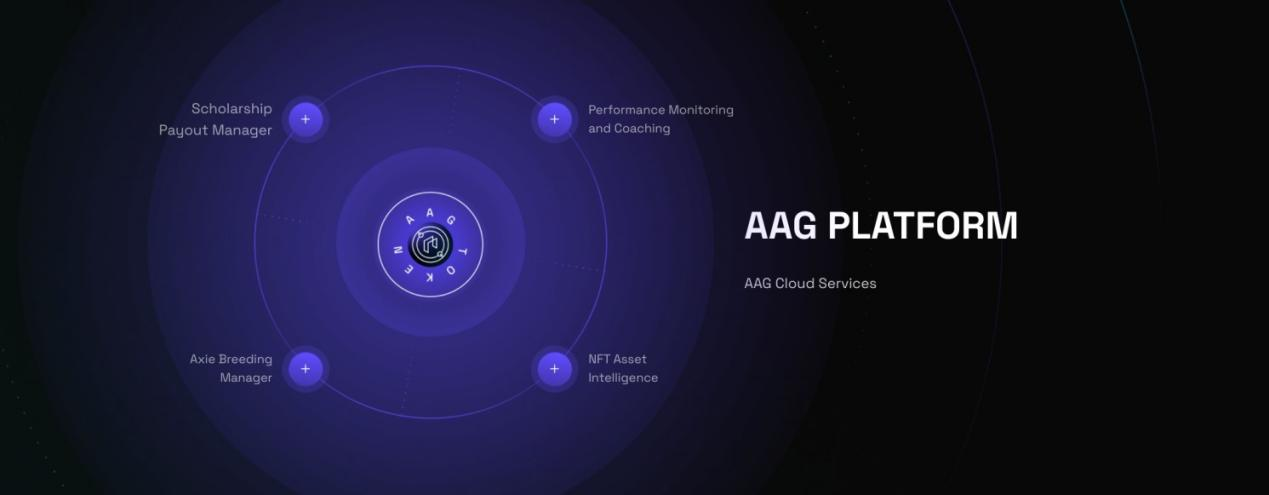
AAG is a rapidly growing game guild project with a strong background in machine learning, data analytics, basic operations and web services. To its credit, the project is in operation in just seven weeks. Infinite successfully built a guild of 1500 students. At present, the students of AAG are all over 7 countries, mainly from Southeast Asia, South America and India. The annual income of AAG is nearly 6 million DOLLARS. AAG offers paid services including manager commissions, performance reviews, AXS breeding and NFT trading strategies. AAG also has one advantage that other guild projects don't have. Its wallet integrates the conversion function, which means that any tokens earned by the player in any game can be converted into AAG tokens, and also integrates the conversion function of legal coins to achieve one-click gold payment. Although the feature is not yet available, the idea of a wallet feature is very friendly to new players who have never been to blockchain, and can complete a series of operations including playing games, gold mining and gold mining without having to specifically learn blockchain knowledge.
Avocado DAO
Avocado is an upstart in the gaming industry, attracting $18 million in early series A funding, the highest ever for P2E, and A valuation of $200 million. Brands and QCP Soteria NODE(QSN) co-led the shot. The program is expected to offer scholarships to 12,000 players by the end of 2021, and currently has more than 7,000 members, mainly from the Philippines and Malaysia. Similar to other guilds, the core of the project is the profit sharing between players and guilds. Different from other Avocado projects, Avocado focuses more on community education, including not only the knowledge of chain games and how to play, but also the basics of blockchain, DeFi applications and the development of the metaverse. Avocado has a bigger vision than being at the forefront of the game industry, and they'd rather be evangelists for blockchain.
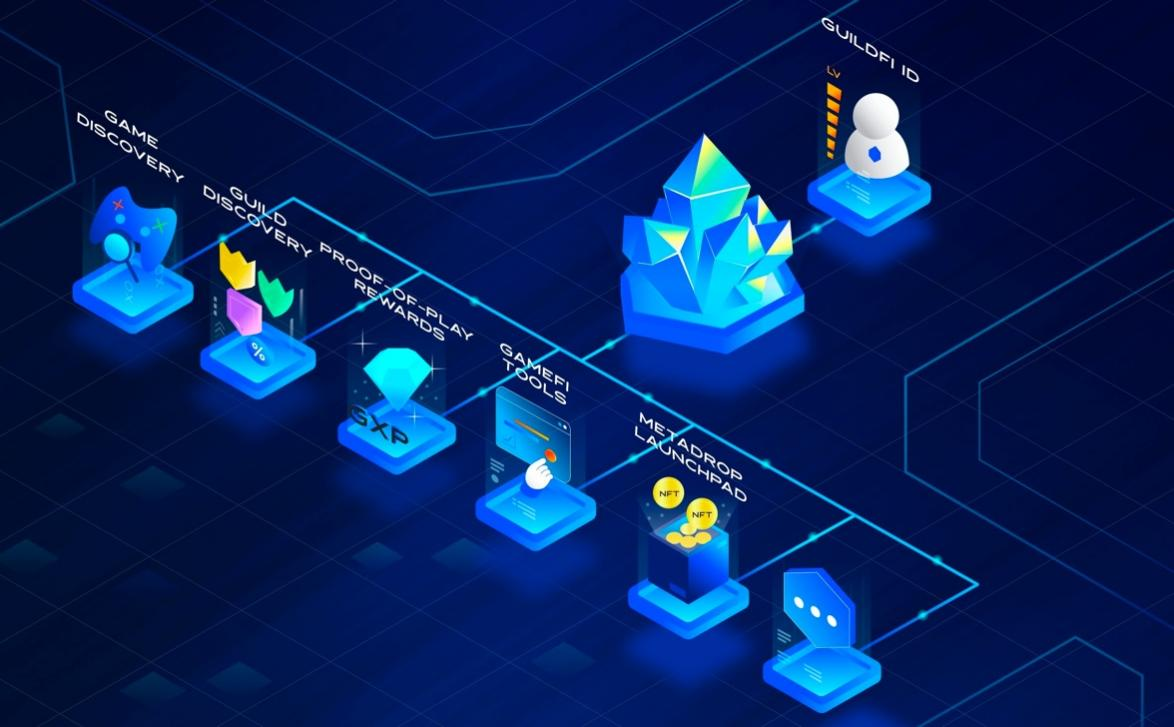
GuildFi (GF)
GuildFi is the third Alpha Launchpad project to connect games, NFT and ecosystems. The core function of the GF is to collect all achievements and rewards in the metasomes in one place. The GF can track players' activities and establish proof-of-Play rewards, which can analyze players' activities in the game to provide desired rewards. Metadrop Launchpad will distribute NFT and tokens based on the player's rank in GF. GF acts as an intermediary, connecting all players, chain games and game guilds, giving them a platform to share profits with each other and match each other. It is fundamentally different from the pure guild run projects mentioned above.
A comparison with Uber's platform might be easier to understand:
Passengers = gamers
Vehicles = Games
Car owners = union
Uber= GuildFi
What GF should do is to establish user stickiness, carry on subsidy burn money in the early stage. When passengers want to go to a certain place at a profit (gold) first want is open GF (game), to find a suitable vehicle system near the background will match and suitable for vehicles (gold efficiency and cost for the game), owners (matching gold guild) will be in accordance with the guidelines to shuttle customers, at the same time will provide follow-up service including grade evaluation, etc.
For guild projects, this paper makes a horizontal comparison of these guilds in terms of the number of students, the quantity and quality of games, the geographical division of students, the amount of financing, and the background of institutions and project parties, with a full score of 5.
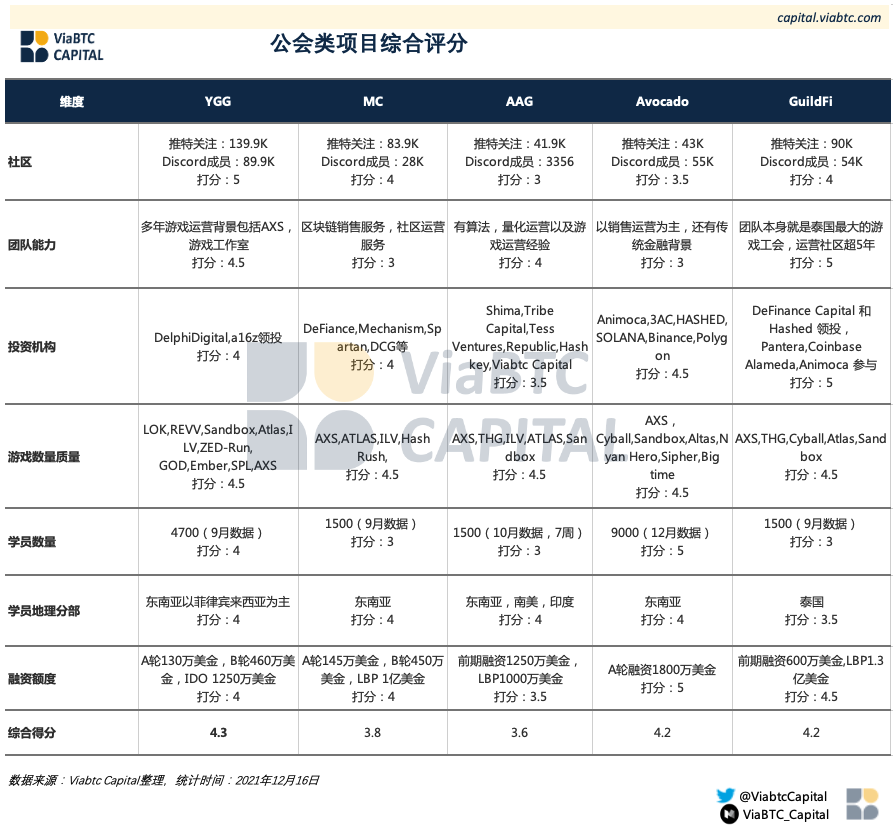
In addition to the projects mentioned above, there are many other great Guild projects that haven't been mentioned yet: UniX Gaming (UniX), Good Games Guild (GGG), BlockchainSpace(Guild),Rainmaker, and more.
The competition in guild events is very homogeneous, and the core competitiveness of getting more customers (students) at this track is still good service. The basic services offered by the various guilds, the games they play, and the target audience are all the same. The only difference is the derivative services offered behind them. Improving the operating logic of DAO organization structure, enriching the types of services behind it, radiating more areas and exploring and investing better game capabilities are important boosts for the future development and promotion of guild.
Reference links:
https://www.un.org/zh/un75/shifting-demographics
https://www.sohu.com/a/500463051_100105055
https://www.oignite.com/2021/12/1639135691.html
https://www.panewslab.com/zh/articledetails/1639567946988944.html
This article is submitted and does not represent the opinion of BlockBeats
Welcome to join the official BlockBeats community:
Telegram Subscription Group: https://t.me/theblockbeats
Telegram Discussion Group: https://t.me/BlockBeats_App
Official Twitter Account: https://twitter.com/BlockBeatsAsia