Viewpoint: How do on-chain status, off-chain status and market sentiment affect Token value?
原文标题:《 Narrative Tracking - 随便聊聊 Token 的价值问题 》
原文来源: 片面 Crypto
Today, I would like to talk briefly about the Value Capture of Token, which is the Value of coins.
First of all, this topic contains very bright content. The economic design of Token can also contain many problems, so it is almost impossible to explain this issue clearly. Because I have read some relevant content with my friends, including myself, I want to sort out some words and have a chat.
The main content includes
What exactly does Token mean?
What exactly is the Token value of a protocol?
Does a protocol require a Token?
Why are some protocols great, but coins are getting worse?
Say what else comes to mind.
What exactly does Token mean?
Actually this question says simple also simple, say difficult also quite difficult answer. I remember a few years ago, a Swiss financial regulator first issued a classification of tokens, which divided tokens into:
Security Token
Utility type Token Utility
Token Payment
Today, of course, all tokens can still be classified according to the above classification criteria, but in practice, the community may prefer to classify tokens into:
Governance type -Token for project governance vote
The utility model -As the key element of project operation, it has the rights of dividend, pledge, income and so on
Storage type - Bitcoin, for example, is slowly being used as an alternative investment asset/broad commodity
Ownership - With the popularity of DAO, more and more agreements begin to emphasize the community ownership of the agreement. One of the important symbols of decentralization is to give all the decision-making, revenue and other rights about the project to Token holders
It is not meaningful to classify and analyze tokens forcibly. In such an information-exploding industry, where information and innovation are constantly emerging, it is better to find out the common ground and capture the characteristic values of market conditions/protocol behaviors to describe the future development path. So instead of trying to come up with a so-called classification standard, I'm going to just extract some common ground/eigenvalues and share them.
今天有社区的朋友问:
「生产力和生产资料的代币化是否真的能够提高生产效率?」
「
区块链技术是否是一次人类社会激励模式的变革?」
First of all, as always, the question is too big to answer. Both "productive forces" and "means of production" are supposed to be concepts of Marxist economics, and these two concepts are somewhat abstract. I personally feel that if these concepts are to be applied, tokens should only be about distribution systems, not productivity and means of production. The improvement of productivity and means of production depends more on the improvement of science and technology, while the distribution system affects the incentive system, which further affects the use of productivity and means of production, thus indirectly but to a great extent affecting efficiency.
But blockchain technology may indeed affect the means of production, and one of the most important means of production for society today and tomorrow: data. The time frame of data retention and the acquisition of historical data are the most intuitive examples. The historical data preservation and uniqueness of blockchain ledger technology changes the nature of data as a means of production, which in turn affects the use and processing of data at the upper level.
But I have always felt that the concept of "permanent storage" should not be stressed too much. Nothing is permanent, the sun has its own life span, and even love is not permanent.
Back to Token, it changes the distribution mechanism, including the distribution of the means of production and the distribution mechanism of the returns generated after processing on the basis of the means of production. So Web3 emphasizes ownership, and this ownership includes any content that an individual produces as well as the ownership of revenue on top of that content.
You write a song, you put it in your account in the form of an NFT, and the asset itself is a certificate that establishes ownership of the song. The business on this basis is much more certain and the benefits should go to you.
So on this basis, let's look at the Token value of any agreement/project:
Does Token have a profound impact on the distribution of means of production?
Does Token have a profound impact on the distribution of income on the basis of means of production?
Source of price/value of Token
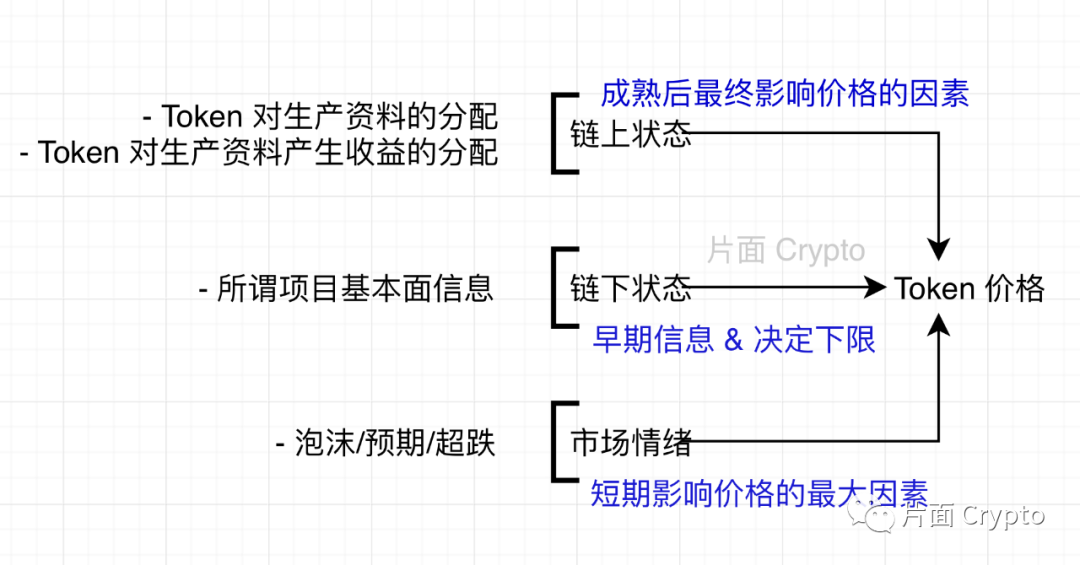
The two points I mentioned above ultimately determine the on-chain value of a project/agreement. Here I break down the Token's price performance (directly using price rather than value) into three components:
On-chain - is the economic design and incentive design of Token
Off-chain - includes information such as track, team, etc. (such as the judging status of the team is reliable)
Market sentiment - the factor that has the greatest impact on prices in the short term
Chain on the state
On-chain states include what is often called Token economics model design. We can classify a large number of voting management mechanisms such as key parameters of a decision project into the distribution logic of production data, and the share out bonus of the agreement or buyback is destroyed belong to the distribution mechanism that produces income on production data. These two points together constitute the most important part of the Token economic model, and these mechanisms ultimately form the mature fundamental data on the project chain.
Specific votes may include the following:
Control of the protocol - Determines the core parameters of the protocol
Control of the protocol - Determines the deployment direction of the protocol
Control of the Assets - The Assets are owned by the Agreement
Such as the NFT assets in the GameFi/DAO organization agreement, and the use of so-called Treasury storage assets, which are generally decided by vote, are part of an agreement's means of production allocation. For example, Uniswap has a large amount of Treasury assets in Uni, Maker has key data on settlement of loan and mortgage, Ribbon is an asset of agreement, etc.
The means of production should be the most important element, but the actual impact that means of production can have on the price of tokens in the short to medium term is limited in most cases. What's more, these means of production decisions generally have very little impact on the average user, resulting in a large number of average users not caring about these voting decisions at all. Another reason why governance votes have little impact on Token prices is that a large number of projects are at an early stage where there is essentially nothing to decide on at all. In order to make the community feel that the Token is valuable, the only way to empower the Token is to make the users feel that holding the Token can really affect the future development of the agreement and the Token is really valuable. But in fact, the future development of the agreement even the project may not figure out how to do, and how can it be handed over to the user?
In addition to empowering tokens through means of production governance, distribution of proceeds generated on the basis of means of production seems a more realistic option. Generally speaking, mature and successful agreements will have cash flow income from tokens, and if not, will say they will in the future (more cases). Fees from users engaging in friction on the basis of the agreement, or revenue from the agreement itself, are the source of these funds. The project generally adopts:
Repurchase/destruction
- Reduce the circulation of project tokens "realistically"
Share out bonus
- Hold to earn income
At present, mainstream projects will combine the two. By locking the liquidity of the Token, they can obtain the right to share out the dividends in the agreement. At the same time, the income of the agreement will also buy back the project Token. Examples of such projects include CRV, SUSHI, and ALPHA. CRV can capture the benefits of the agreement by locking in CRV, while enhancing the benefits provided by participating in Cruve liquidity. SUSHI gets xSUSHI after locking, and xSUSHI represents the claim on platform revenue. ALPHA is locked in the same way and gets xALPHA, which has the right to share the revenue from the agreement, as well as the revenue generated by other businesses: ALPHA Launchpad, etc.
This approach is very feasible and has been proven to work. But basically all projects imitate these practices, and many times direct copying does not work because:
Where is the buyback Token? If the original did not participate in circulation, that buyback is also a lonely
The income earned is often given to users in the form of Token - drink poison to quench thirst
While we're at it, let's talk a little bit more about why many of the so-called DeFi blue chip projects, notably Uniswap, are dead in the water. Uniswap doesn't actually have any buybacks, dividends, etc. The lack of such mechanisms may have more to do with regulatory risk. Because when it comes to buybacks or dividends it can be classified as securities. A big reason why these DeFi blue chips, or "classic DeFi", are failing is surely that the market heat is gone. Everyone's understanding of these projects is basically clear, if there is no particularly clear and significant holding benefits, a large number of users are not willing to continue holding, let alone holding means opportunity cost. The world is changing so fast and there are so many opportunities out there, why spend money on something that isn't sexy anymore?
That's what I'm going to talk about. The biggest influence on asset prices at the moment is market sentiment. That said, if the project makes steady money and is able to give Token a little more power, the story will come back, just in time.
Another reason is that classical DeFi projects emphasize TVL, the protocol lock-up value, or the ratio of the protocol lock-up value to market value. Lock-in is a very general concept and sometimes does not accurately represent the value of an agreement:
Lock-ups may have investors contributing a lot of assets
Lock-in has a large number of illiquid assets, such as the agreement's own tokens
And lock-up value/market value, essentially the utilization of funds. Different agreements are hard to compare side by side, so the ratio does not stand up to scrutiny. For the same amount of money, the exchange's revenue is definitely much better than the wallet/DeFi protocol. All the funds in the exchange are managed by the exchange first of all. Basically, all the behaviors of users must be transferred/traded through the services of the exchange. Any friction is the income of the exchange.
But wallets, for decentralized wallets, users use assets to interact more with other protocols rather than with the wallet itself, so the friction/flow generated by such interactions basically goes to ETH miners (transaction fees) and various protocols.
Again, the middle key of the future wallet is crucial. Moreover, the direction must be to increase the interaction between the user's assets and the wallet itself, and put the user's asset friction transaction behavior in the internal, so as to enhance the value of a single user and increase the revenue. One of the most impressive business directions is probably the recommendation business, which is popular with Web2.0. Imagine that you go to the bank APP to buy financial products. Do you go through each product or buy the product recommended by the bank?
Chain under state
This part of the value is actually the most difficult for the average user to capture. The core reason is the opacity of information. This part of information includes the project team, future development plan, team status, working mode, process, efficiency, etc.
This content is generally reflected in the early stage of investment (private placement), and more often in the form of chat communication. The average investor is very keen to grasp the news.
A good team can often determine the value floor of an agreement. When the market is bad or a project goes wrong, the difference between the team often determines the fate of the investor and the project.
Of course, in the open market, proper marketing of this basic information can also enhance the understanding and confidence of the average user in the project.
Market sentiment
It is both painful and exciting to admit that market sentiment has the biggest impact on Token prices.
The painful part is that if sentiment is the biggest driver, that means there are no fundamentals, or none at all. At best it is called market sentiment, at worst it is "bubble" + "price manipulation".
Think back to when DeFi was acquired, all the articles in the market were DeFi Lego, more efficient than traditional finance, and blue chip with unlimited potential. Then dYdX started talking about decentralized derivatives as a huge racetrack and even the future of the industry. MEME, of course, is a thing of fascination and madness. To NFT, Loot, Fragmentation, SocialFi, DAO, Web3.
And the exciting thing is, since it's still storytelling, either the industry is a total fraud industry, or it's really in its early stages. Whether the front is a cheater is really a matter of opinion, but if you look at this text, that large probability you will not feel that this is a cheater industry. The other possibility that's left is an exciting one.
One last word
A few days ago, there was an incident of two programmers in Tencent. In fact, TO some extent, I can partially understand that idea. Perhaps all of us, most of us ordinary people, have had to face the fact that we are all just ordinary, mediocre people going through life without much meaning. It's like "in the long run, we're all going to die." Is it worth it to realize that working and living is ultimately about that few rations and the material pleasures that most people now seek? Do you have anything meaningful to do?
Most young people are probably not just lying flat psychologically, but actually lying flat. What I'm actually thinking about here is the idea of "drawing big pies", and I don't think there's anything wrong with "drawing big pies".
Why a person has ideals and ambitions, we all know that should not be laughed at but respected. But a company with ideals and ambitions is a lie, is to paint a picture is to exploit employees come up with a means?
What teenager doesn't dream of changing the world if he can?
One has to believe in something. I love this industry as much as a lot of people love this industry, because it's new enough, it's open enough, and there are enough opportunities to do what you love to do. Laziness may not really be an excuse for inaction in many industries, but in Crypto, luck plays a bigger role. But laziness can most likely be an excuse for bad behavior, both for individuals and companies.
I'm going a little out of my way. The economics of tokens are really hard to articulate, and they're off the top of your head.
The original link
Welcome to join the official BlockBeats community:
Telegram Subscription Group: https://t.me/theblockbeats
Telegram Discussion Group: https://t.me/BlockBeats_App
Official Twitter Account: https://twitter.com/BlockBeatsAsia

 Related Articles